Competition Rules
| Site: | OpenLearn Create |
| Course: | Lunabotics Hub |
| Book: | Competition Rules |
| Printed by: | Guest user |
| Date: | Friday, 20 November 2026, 12:40 PM |
Table of contents
- 1. Introduction
- 2. Moon Yard Arena
- 3. Moon Yard Operational Rules
- 4. Robot Design Requirements
- 5. Permitted and Prohibited Technologies
- 6. Emergency Stop Requirements
- 7. Power Systems & Batteries
- 8. Competition Operations
- 9. Navigation Rules
- 10. Mission Control Centre (MCC)
- 11. Communication Rules
- 12. Autonomy Rules
- 13. Inspection & Compliance
- 14. Penalties, Score Reductions and Disqualification
1. Introduction
Purpose of these Rules
This book provides the operational, technical, safety, communications, and competition requirements for UK Lunabotics 2027.
All teams are expected to understand and comply with these rules throughout the competition. Failure to meet the requirements outlined in this document may result in penalties, loss of points, disqualification from a competition run, or removal from the competition.
Rules Update
The UK Lunabotics Rule Book is a living document. Teams are responsible for ensuring they are working from the latest published version and monitoring any updates issued by the organisers.
2. Moon Yard Arena
Overview
- Starting Zone
- Obstacle Zone
- Excavation Zone
- Construction Zone
- 7.9 metres long
- 4.4 metres wide
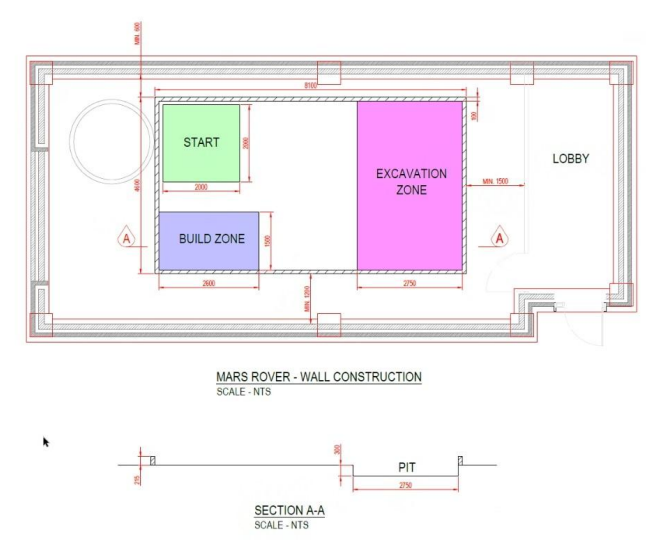
Arena Obstacles
Boulders
- Approximately 30–40 cm in diameter
- Randomly positioned before each run
Craters
- Up to approximately 40–50 cm wide
- Variable depths and shapes
3. Moon Yard Operational Rules
Restricted Access
- Follow instructions from Arena staff at all times.
- Only enter when authorised.
- Remain within designated areas.
- Comply with all safety requirements.
- Wear required PPE.
Team Access Limits
- 4 Arena Team Members to move the robot into the yard
- 1 Arena Team Member to remain in the yard once the rover is in permission
- 4 Mission Control Team Members
Electronic Device Restrictions
- Mobile phones
- Tablets
- Cameras
- Smart devices
4. Robot Design Requirements
Robot Dimensions
- Length: 150 cm
- Width: 75 cm
- Height: 75 cm
- The additional deployed height must not exceed 175 cm.
- Maximum height above the arena surface must not exceed 250 cm.
Robot Mass
Maximum permitted mass is 80 kg
This includes:
- Robot structure
- Navigation systems
- Beacons
- Communication devices mounted on the robot
Multiple robots may be used, but the combined mass must remain below 80 kg.
Lifting Requirements
Robots must include:
- Four clearly identified lifting points
- Safe handling features
A minimum of one person per 20 kg must be available when carrying the robot.
5. Permitted and Prohibited Technologies
Permitted Technologies
Examples include:
- Li-Ion batteries
- NiMH batteries
- SLA batteries
- Composite materials
- Electric motors
- Infrared sensors
- Hall Effect sensors
- IMUs
- Pneumatic systems
- Active cooling systems
provided they comply with all safety requirements.
Prohibited Technologies
The following are prohibited:
- GPS systems
- GPS-assisted navigation devices
- Ultrasonic proximity sensors
- Hydraulics
- Pneumatic road tyres
- Foam-filled tyres
- Touch sensors for obstacle avoidance
Any robot containing prohibited systems will fail inspection.
6. Emergency Stop Requirements
E-STOP Specifications
Every robot must be fitted with:
- One red commercial emergency stop button
- Minimum diameter of 40 mm
- Clearly visible mounting position
- Immediate stop functionality
Multiple robot systems must provide an emergency stop for each individual robot.
E-STOP Performance
The E-STOP must:
- Immediately stop the robot motion
- Disconnect the battery power
- Latch when activated
- Require deliberate resetting
- Do not automatically restart the operation after a reset
Failure to comply will result in safety disqualification.
7. Power Systems & Batteries
Power Requirements
Robots must:
- Be completely self-powered
- Operate without external power supplies
- Carry all power sources onboard
No facility power will be provided during competition runs.
Energy monitoring
All teams must install:
- A commercial off-the-shelf energy logger
- Visible and accessible energy monitoring hardware
Energy consumption will contribute to competition scoring.
Battery Safety Rules
Teams must:
- Supervise batteries while charging
- Store batteries safely
- Use approved transport/storage containers
- Inspect damaged batteries before use
- Disconnect chargers overnight
Battery safety violations may result in suspension of competition activities.
8. Competition Operations
Starting Conditions
At the start of a run:
- The robot must remain entirely within the designated start zone.
- The starting location will be randomly assigned.
- The starting orientation will be randomly assigned.
Excavation Rules
Robots may only obtain construction material from the Excavation Zone.
Robots must not:
- Collect from the Starting Zone
- Collect from the Obstacle Zone
- Collect from the Construction Zone
Construction material used in the berm must originate from the Excavation Zone.
Obstacle Rules
Robots:
- Must avoid obstacle field hazards
- Must not intentionally relocate obstacles
- Must not fill obstacle-zone craters
- Must not drive outside arena boundaries
Obstacle impacts will result in scoring penalties
Arena Restrictions
Robots must not:
- Leave the arena
- Ram walls
- Anchor themselves
- Use arena walls for propulsion or support
- Alter sand chemical or physical properties
- Fire projectiles or deploy ordnance
Violations may result in point deductions or disqualification.
9. Navigation Rules
Robot Orientation
Each robot must clearly indicate:
- Length axis
- Width axis
- Forward direction
A clearly marked arrow shall indicate the robot's declared forward direction for random arena placement.
Navigation Aids
Teams may use:
- Fiducial markers
- Navigation beacons
- Class I lasers
- Class II lasers
- Low-power lasers (<5mW)
All systems must be self-powered and count toward the robot mass limit.
Navigation Restrictions
Teams may not:
- Use GPS
- Use compasses
- Use arena walls for localisation
- Use touch-based obstacle avoidance systems
IMUs are permitted, provided compass functionality is disabled.
10. Mission Control Centre (MCC)
Mission Control Team
Competition Runs
Each competition run lasts 20 minutes
Teams are expected to operate professionally and follow instructions provided by Mission Control Judges (MCJs).
Communications
11. Communication Rules
Router Requirements
Teams must provide:
- Dual-band router
- 2.4 GHz support
- 5 GHz support
- WPA2/WPA3 encryption
- Assigned SSID broadcasting
Hidden networks are prohibited.
Wireless Restrictions
Teams must not:
- Use RF amplifiers
- Use Zigbee systems
- Exceed Ofcom transmission limits
Bluetooth devices must be Class 2 or Class 3 only. Class 1 Bluetooth systems are prohibited.
Communications Check
All teams must pass a Communication Check before competing.
Teams must demonstrate:
- Wireless connectivity
- Operational control
- Router configuration compliance
- Communications documentation
Failure to pass the Communication Check will result in disqualification from the competition activity.
12. Autonomy Rules
- Teams must clearly notify the Mission Control Judge (MCJ).
- Teams must announce when autonomy begins.
- Teams must announce when autonomy ends.
- Team members must remain completely hands-free during the attempt.
- Telemetry and health monitoring are permitted.
- No control commands may be sent to the robot during the autonomous activity.
- Enter the Excavation Zone.
- The team must declare an autonomy attempt.
- The team must become hands-free.
- The robot must autonomously control its excavation mechanism.
- A noticeable quantity of regolith must be collected.
- The excavation tool must be removed from the regolith before returning to manual control.
- The team must announce completion before touching any controls.
- Autonomous actuator control
- Excavation sequencing
- Material acquisition
- Automatic machine control
- Carry regolith to the Construction Zone.
- Declare an autonomous attempt before entering the Construction Zone.
- Operate hands-free.
- Autonomously position and dump material.
- Deposit a measurable amount of regolith.
- Complete dumping before returning to manual control.
- Autonomous positioning
- Localisation
- Hopper or bucket control
- Material placement accuracy
- Use the remote control to orient itself within the Starting Zone only.
- Enter hands-free mode.
- Traverse the complete obstacle field autonomously.
- Reach the Excavation Zone.
- Remain hands-free throughout the traversal.
- Localisation
- Object detection
- Mapping
- Route planning
- Obstacle avoidance
- Contacts a rock
- Drives through a crater
- Leave the Starting Zone.
- Navigate the Obstacle Zone.
- Enter the Excavation Zone.
- Excavate regolith.
- Return across the Obstacle Zone.
- Enter the Construction Zone.
- Deposit regolith to form part of the berm.
- Navigation
- Excavation
- Material transport
- Autonomous dumping
- End-to-end mission execution
- Rock contact = −30 points
- Crater traversal = −30 points
- Begin from the Starting Zone.
- Operate hands-free for the entire run.
- Traverse the arena autonomously.
- Complete excavation activities autonomously.
- Complete dumping activities autonomously.
- Construct a berm that earns construction points.
- Successfully complete at least two full operational cycles.
- Full mission autonomy
- Robust software systems
- Reliable localisation
- Intelligent path planning
- Autonomous excavation
- Autonomous construction
- System resilience
- Rock contact = −30 points
- Crater traversal = −30 points
Autonomy Scoring Matrix
| Achievement | Points |
|---|---|
| Excavation Automation | 75 |
| Dump Automation | 50 |
| Travel Automation | 250 |
| Full Autonomy (One Cycle) | 450 |
| Full Autonomy (Complete Run) | 600 |
How Autonomy Points Can Be CombinedThe following activities may be combined:
| Combination | Total Points |
|---|---|
| Excavation only | 75 |
| Dump only | 50 |
| Travel only | 250 |
| Excavation + Dump | 125 |
| Dump + Travel | 300 |
| Excavation + Dump + Travel | 375 |
| Achievement | Total Points |
|---|---|
| Full Autonomy (One Cycle) | 450 |
| Full Autonomy (Complete Run) | 600 |
- Excavation Automation (75)
- Dump Automation (50)
- Travel Automation (250)
- Full Autonomy (One Cycle) (450)
- Full Autonomy (Complete Run) (600)
13. Inspection & Compliance
Vehicle Inspection
- Dimensions
- Mass
- Safety
- E-STOP
Communications Inspection
- Networks
- Wireless systems
- Connectivity
Safety Verification
- Batteries
- Handling procedures
- Risk controls
Teams failing inspection will not be permitted to compete until all issues have been resolved.
14. Penalties, Score Reductions and Disqualification
The UK Lunabotics Competition is designed to reward safe, professional, and technically robust engineering. Teams are expected to comply with all competition rules, safety requirements, inspection procedures, and operational instructions throughout the event.
Where rule breaches occur, competition officials may apply:
- Score reductions
- Loss of eligibility to score in a category
- Disqualification from a competition run
- Disqualification from the competition
The severity of any action taken will depend on the nature of the violation and its impact on safety, fairness, and competition integrity.
Inspection Failures
All teams must complete the required inspections before they can compete.
These include:
- Vehicle Inspection
- Communications Check
- Safety Verification
Teams that fail any required inspection will not be permitted to enter the competition arena until all identified issues have been resolved and approved by the judges.
Communications Check Failure
Teams are allocated a limited period to complete the Communications Check.
Failure to demonstrate compliance with communications requirements may result in:
- Failure of the Communications Check
- Removal from the competition schedule
- Disqualification from the competition
Examples include:
- Inability to establish wireless control of the robot
- Non-compliant router configuration
- Missing communications documentation
- Use of prohibited communications equipment
Energy Monitoring Penalty
The robot's power monitoring system must be installed according to the competition requirements.
Where an energy monitoring system is incorrectly installed or wired, a penalty of –30 points will be applied to the Berm Construction Productivity – Energy score.
Teams should verify the installation of their power monitoring equipment during testing and before inspection.
Arena Boundary Violations
Robots are required to remain within the competition arena throughout the run.
Penalties may be applied if a robot:
- Leaves the arena boundary
- Contacts the arena walls excessively
- Causes damage to the arena infrastructure
- Operates outside designated competition areas
Specific point deductions may be announced in future rulebook updates.
Competition Run Termination
Competition officials may terminate a run before the allotted time has expired if:
- The robot presents a safety risk.
- The robot becomes inoperable.
- The team is unable to continue the mission.
- Competition rules are being violated.
- Team members fail to follow instructions from officials.
Runs may also be terminated if the robot fails to demonstrate meaningful progress during the mission.
Examples include:
- Extended loss of communications
- Extended loss of mobility
- Loss of excavation capability
- Loss of deposition capability
- Complete system failure
Safety Violations
Safety is the highest priority throughout the competition. Competition officials may immediately stop a run if a robot or team member creates an unsafe situation.
Examples include:
- Missing safety equipment
- Unsafe battery practices
- Unsafe lifting procedures
- Operating a robot in a hazardous manner
- Failure to follow safety instructions
Serious safety breaches may result in immediate disqualification from the run or from the competition.
Failure to Follow Official Instructions
Arena staff, judges, and competition officials are responsible for maintaining a safe and fair competition environment. Teams are expected to comply promptly with all instructions issued by authorised personnel. Failure to do so may result in:
- Warning notices
- Point deductions
- Termination of a competition run
- Disqualification from the competition
Unsporting or Unprofessional Behaviour
All participants are expected to behave professionally and respectfully. Examples of unacceptable behaviour include:
- Harassment or intimidation
- Offensive language or conduct
- Disrespect towards officials
- Deliberately misleading judges
- Tampering with competition facilities
- Interfering with another team's activities
- Attempts to gain an unfair advantage
Competition organisers reserve the right to apply penalties where behaviour is considered inconsistent with the spirit of the competition.
Use of Prohibited Technologies
Robots found to contain prohibited technologies or systems may fail inspection or be disqualified.
Examples include:
- GPS systems
- Prohibited communications equipment
- Restricted sensing technologies
- Any system specifically banned within the rulebook
Teams are responsible for ensuring that all systems comply with the published technical requirements.
Competition Integrity
The competition relies on honesty, transparency, and good engineering practice. Actions that compromise competition integrity may result in serious penalties.
Examples include:
- Falsifying inspection information
- Deliberately concealing non-compliant systems
- Misrepresenting robot capabilities
- Circumventing competition procedures
- Providing inaccurate technical information to judges
Competition officials reserve the right to investigate suspected rule violations and determine appropriate actions.
Disqualification
A team may be disqualified from a single run or from the entire competition if serious breaches of the rules occur. Examples of situations that may lead to disqualification include:
- Failure to pass mandatory inspections
- Serious safety violations
- Use of prohibited equipment
- Deliberate rule circumvention
- Interference with other competitors
- Refusal to comply with official instructions
- Actions that compromise the fairness or integrity of the competition
The decision of the judges and competition organisers regarding safety, compliance, and competition integrity is final.
Good Practice
To avoid penalties, teams should:
- Read the full rulebook carefully.
- Conduct internal compliance reviews.
- Test all systems thoroughly before arrival.
- Maintain clear documentation.
- Prioritise safety at all times.
- Ask for clarification whenever requirements are unclear.
- Behave professionally throughout the event.
Teams that combine good engineering, careful preparation, and professional conduct are most likely to achieve success in UK Lunabotics.