Part 3 - Impact on the Justice System.
| Site: | OpenLearn Create |
| Course: | Digital Detectives: Understanding Communication in Digital Forensic Evidence |
| Book: | Part 3 - Impact on the Justice System. |
| Printed by: | Guest user |
| Date: | Wednesday, 28 October 2026, 1:28 AM |
1. What Can Be the Impact of System Bias on the Justice System?
Why does system bias matter?
Clarus does not present system bias as something that always leads directly to dramatic injustice in every case. But it does show why the issue matters.
If digital evidence is misunderstood, poorly communicated, or interpreted through the wrong context, the effects can travel through the investigation.
How can the effects travel through a case?
At the investigative stage, attention may be directed too narrowly, certain leads may be prioritised for the wrong reasons, or other relevant lines of inquiry may not be pursued fully.
At the reporting and prosecutorial stage, evidence may be framed too confidently, too simply, or without enough clarity about uncertainty and limitation.
By the time material reaches court, misunderstandings that began earlier may be difficult to spot because they have already been built into the case narrative.
What could the consequences be?
Clarus highlights several practical consequences that are useful to reflect on. These include:
- unfair investigations
- failure to uncover incriminating evidence
- failure to uncover exculpatory evidence
- the wrongful use of coercive measures due to miscommunication or biased examination
- variation in the quality of outcomes depending on the resources, infrastructure, or local systems available
The most important message is that system bias can affect reliability, fairness, and trust even when nobody intends harm.

Reducing the risk
This is also why Clarus places so much emphasis on clearer language, better-designed information flow, stronger feedback routines, and better organisational support for reflective practice.
The point is not to suggest that justice systems are incapable of handling digital evidence. It is to show why careful system design matters to reduce as much as possible any risk of evidence not being used fairly and responsibly.
Move to the next page by clicking the arrow on the top right to move to the next page in this section.
2. What do we mean by organisational culture?
In Clarus, organisational culture is understood as the shared assumptions, norms, and values that shape how people behave, communicate, and make sense of their work.
Some parts of culture are visible, such as:
- formal routines
- reporting expectations
Other parts are less visible, such as:
- assumptions about who can question whom
- whether speed is valued over reflection
- what counts as good professional judgement
These assumptions can affect how comfortable people feel asking questions, challenging a senior colleague, admitting uncertainty, or seeking help across role boundaries.
How can culture affect system bias?
This matters for system bias because culture can either support or undermine safeguards.
A culture that values reflection, explanation, and constructive challenge can help reduce bias. A culture shaped by rigid hierarchy, pressure for certainty, or poor coordination can increase ambiguity and make biased assumptions harder to detect.
Clarus notes, for example, that when information circulation within an organisation is poorly coordinated, conditions for bias and error become more likely.
Clear roles and responsibilities reduce ambiguity. Familiarity and trust can make communication easier, but they can also create informal patterns that shape access to knowledge and influence whose interpretation is heard.

Think back to the Digital Detectives comic
Which moments seem most shaped by organisational culture rather than by purely technical issues?
Reflection
Organisational culture is often difficult to recognise because many of its influences are taken for granted by the people working within it. The routines, expectations, and ways of communicating that feel normal in one organisation may be very different in another.
For this reason, understanding bias is not only about examining individual decisions. It also requires looking at the wider environment in which those decisions are made.
By reflecting on organisational culture, practitioners can better identify the conditions that support clear communication, critical thinking, and fair decision-making.
Move to the next page by clicking the arrow on the top right to move to the next page in this section.
3. The Final Part of Digital Detectives
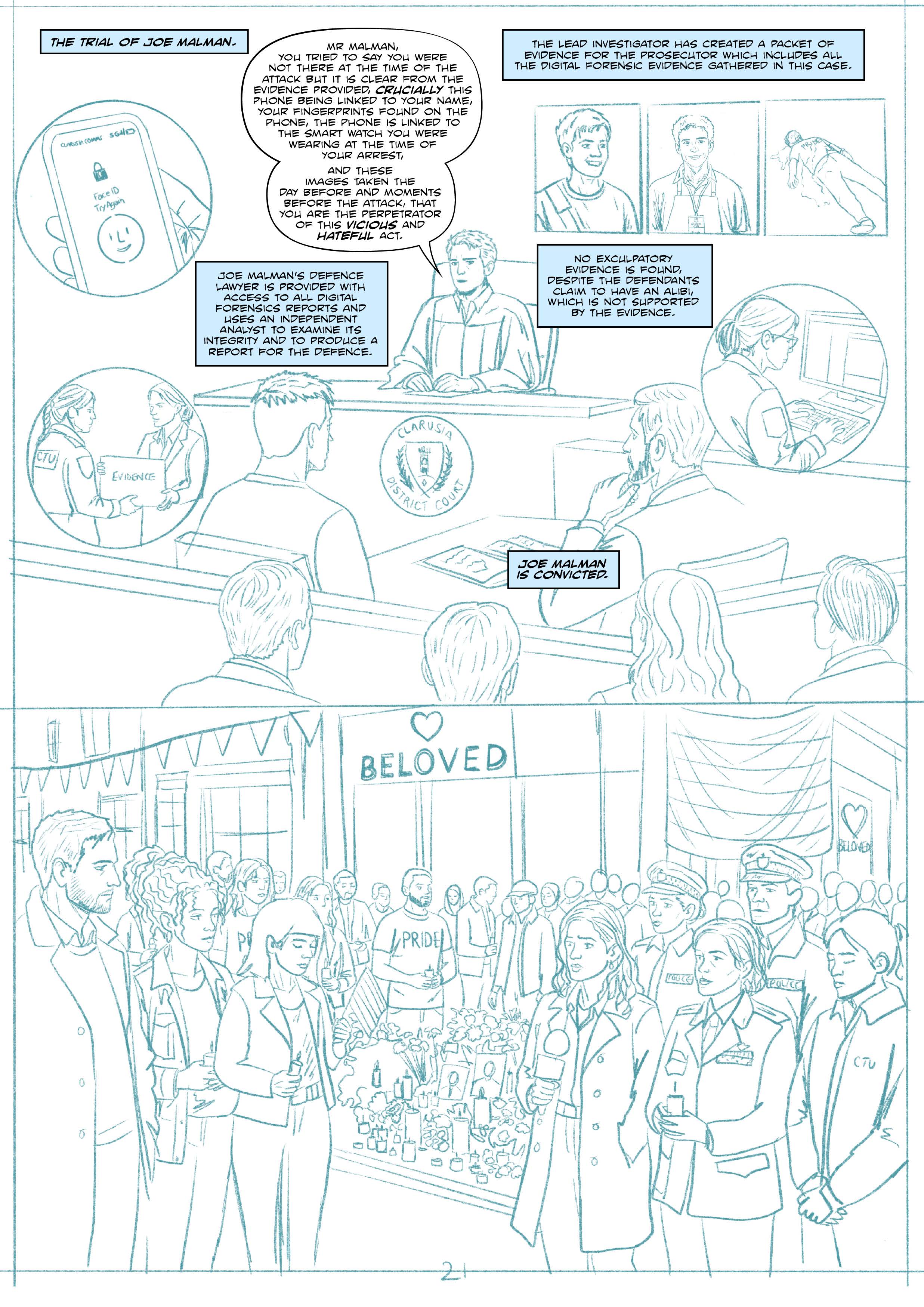
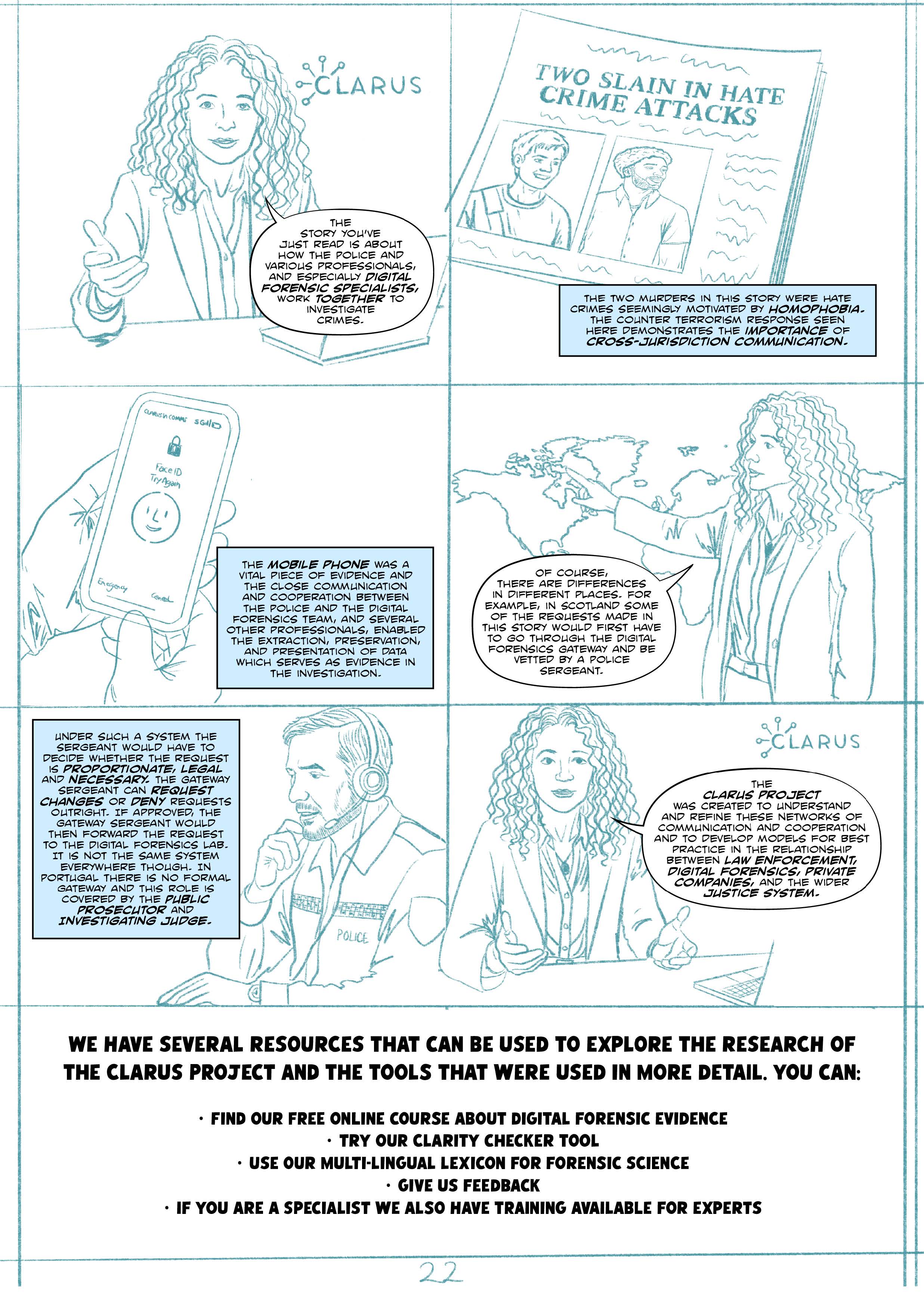
We are now going to return to Digital Detectives for the final part of the story. While this brings the comic itself to a close, it is not the end of the course.
As you read the final pages, think back over the investigation as a whole. You have seen how information has moved between different people and teams, where misunderstandings can arise, and how communication and other influences can shape the handling and interpretation of digital evidence.
In the next two modules, we will move from identifying these challenges to looking at practical ways of responding to them. You will be introduced to the tools developed through the Clarus project and consider how building them into everyday practice could create opportunities for clearer communication, shared understanding, and fewer misunderstandings as digital evidence moves through an investigation.
For now, read the final part of the comic and consider: where in this investigation might a Clarus tool have made a difference?
Move to the next page by clicking the arrow on the top right to move to the next page in this section.
4. The Role of Clearer Language and Better Systems
Moving beyond individual responsibility - The Clarus Research Recomendations
If system bias and miscommunication can arise from ordinary working conditions, then the solution is not simply to tell individuals to “try harder”. Clarus argues for improvements at the level of language, workflow, structure, and organisational design.
Managing information flow
One key recommendation is to analyse, design, and manage information flow across the digital forensic lifecycle more deliberately.
This means being clearer about:
- what information is needed
- who needs it
- when they need it
- what should not be passed on because it is task-irrelevant or unnecessarily biasing
Clarus also recommends keeping the benefits of informal communication while controlling the risks.
Informal exchanges should not disappear, because they are often essential for coordination and clarification. But where they contain important interpretive or task-shaping information, they should become more traceable so that later review and organisational learning are possible.
Creating a shared language
Language standardisation is another major area for reform. Shared terminology helps reduce the risk that one group thinks a term means one thing while another group understands it differently.
This is not only about glossaries. It is also about supporting shared conceptual understanding across professional groups and improving how technical findings are communicated to non-specialists without losing necessary nuance.
Clarus also highlights the value of:
- stronger feedback routines
- clearer reporting of uncertainty and limitations
- structures that support reflection rather than overconfidence.

How can the Clarus tools help?
The Clarus tools have been designed to support these goals.
The Multi-Lingual Lexicon for Digital Forensics promotes a shared understanding of key concepts and terminology, while the Clarus Clarity Checker helps users identify areas where written communication could be made clearer.
However, tools alone cannot reduce bias. To be effective, they need to be embedded within existing workflows and organisational practices so that they are used consistently and systematically as part of everyday professional decision-making.
Clearer language and better systems work together
From a systems point of view, this is a more productive way of managing bias.
When biases are treated only as individual cognitive shortcomings, little attention is paid to the organisational conditions that allow them to arise. A systemic framework, by contrast, supports the design of structures and workflows that are better able to:
- prevent bias
- detect bias
- mitigate bias
- correct bias
In that sense, clearer language and better systems are not separate ideas. They work together.
Coming next
Progress through to the Module C Quiz before heading into the next module.
In the next module, we turn to one of the Clarus tools designed to address this problem directly: the Multi-Lingual Lexicon for Digital Forensics.
There, you will explore how shared terminology can support clearer communication and more consistent understanding across the digital evidence process.