Planning your development as a professional researcher
| Site: | OpenLearn Create |
| Course: | Becoming a professional researcher |
| Book: | Planning your development as a professional researcher |
| Printed by: | Guest user |
| Date: | Friday, 20 November 2026, 11:50 AM |
1. Introduction
Studying for a research degree requires engagement with a variety of skills; some directly academic and others allied to a wider suite of capabilities. You may be clear about where you want your studies to take you after you finish your doctorate or you may be reflecting on this throughout your studies. Whatever your plans for the future, your ongoing professional development during the next few years will be fundamental to your success on your research degree programme and throughout your research career.
Effective skills development needs to be relevant to your needs and to your individual research project, while also being informed by the standards set by your academic discipline. Skills development is an ongoing cyclic process involving a repeated series of typical steps:
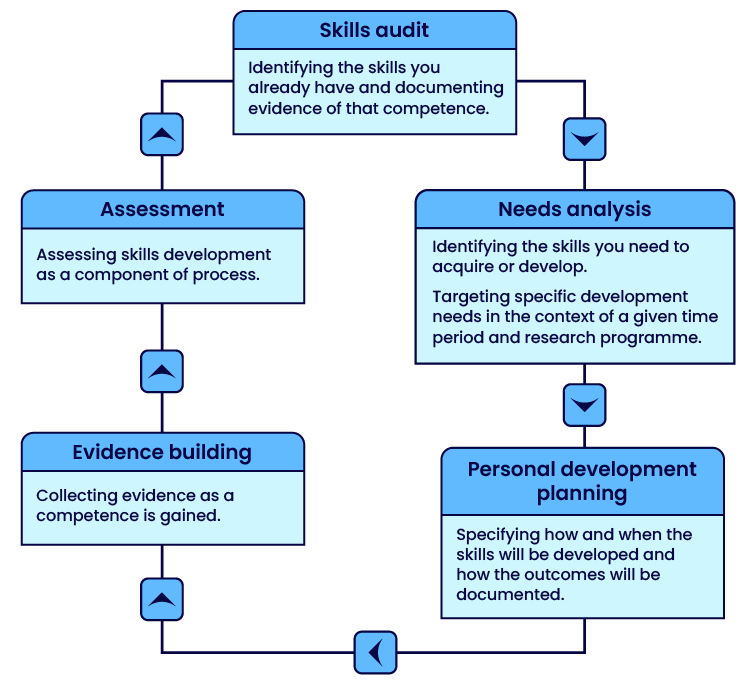
Figure 1: The Skills Development Cycle
In this unit we will be focusing on using the Researcher Development Framework (RDF) to audit your skills and to plan for and document evidence of your professional development.
The content in this unit relates to the following domains and descriptors of the Vitae Researcher Development Framework:
Researcher: 1.1 Development-focused, 1.2 Strategic, 1.3 Organised, 1.4 Curious, 1.6 Adaptable
After completing this unit you should be able to:
- Describe the key skills and behaviours associated with professional researchers as set out in the Vitae Researcher Development Framework (RDF).
Estimated study time for this unit: 2 hours
2. Becoming a professional researcher
A research degree is a professional training qualification. To qualify as a professional researcher, you will need to demonstrate that you have met the requirements of a UK doctorate by successfully submitting and defending a thesis. However, to maximise your employability as a researcher at the end of your research degree, you will need to demonstrate that you have developed a range of professional transferable skills. These might include skills in public engagement and research communication, enterprise and entrepreneurship, as well as teaching, project management, leadership and teamwork.
These skills are summarised in the box below.
Professional researchers can:
- Search for, discover, access, retrieve, sift, interpret, analyse, evaluate, manage, conserve and communicate an ever-increasing volume of knowledge from a range of sources.
- Think critically about problems to produce innovative solutions and create new knowledge; plan, manage and deliver projects, selecting and justifying appropriate methodological processes while recognising, evaluating and minimising the risks involved and impact on the environment.
- Exercise professional standards in research and research integrity, and engage in professional practice, including ethical, legal, and health and safety aspects, bringing enthusiasm, perseverance and integrity to bear on their work activities.
- Support, collaborate with and lead colleagues, using a range of teaching, communication and networking skills to influence practice and policy in diverse environments.
- Appreciate the need to engage in research with impact and to be able to communicate it to diverse audiences, including the public.
- Build relationships with peers, senior colleagues, students and stakeholders with sensitivity to equality, diversity and cultural issues.
(Quality Assurance Agency 2020, pp.4–5)
During your research degree, in addition to preparing your thesis, you need to ensure that you develop the skills that will enable you to fulfil the brief of becoming a professional researcher. Many of these skills will be addressed when completing your research – you will need to demonstrate skills in conducting, writing-up and presenting research in order to progress on your course and successfully defend your thesis at your viva. You should also ensure that you make the most of opportunities to develop professional skills and characteristics that exceed those required by your research degree itself.
As a postgraduate researcher, it is expected that you will take responsibility for your own professional development and that you will be actively involved in managing and directing both your own research project and your professional training. To do this effectively, you should undertake an audit of your experience and aspirations and work in consultation with your supervisors to prepare a development plan that addresses your specific needs.
2.1. Planning your development during the early stages of your research degree
Many postgraduate researchers (PGRs) find it useful to plan their development in stages, rather than trying to anticipate their needs over the whole of their doctoral journey. PGRs are often uncertain of their post-doctoral plans at the start of their research degree, making it difficult to foresee their future needs, and it can also be difficult to anticipate how your development needs will change as your project develops.
Further, as you saw in Figure 1, skills development is an iterative process, so it makes sense to build in regular checkpoints for reflection and re-evaluation. In this unit, we’ve focused on skills development during the early stages of your research degree, but the plans and activities are equally applicable for learners who are in the later stages of their doctoral studies.
A note about assessment terminology:
Most UK doctoral students will undergo at least two formal assessments of their research progress and skills development during their doctoral studies- a viva voce oral examination at the end of their degree, and a mid-course assessment.
Most students will be registered for a MPhil degree at the beginning of their studies, and transfer to PhD (Doctor of Philosophy) or PD (Professional Doctorate) registration is usually dependent on the successful outcome of this mid-course assessment, which is often called the ‘Upgrade’, but is also known by a variety of other names including ‘Transfer’, ‘Confirmation’, ‘Progression’, ‘Major Review’, ‘Probation Review’, or ‘Early Stage Assessment’. In this unit, we’ll use the most common term, ‘upgrade’, to refer to this type of formal-mid course assessment.
In the next section you will begin the process of auditing your skills and planning your development by familiarising yourself with a key tool, the Vitae Researcher Development Framework (RDF).
3. The Researcher Development Framework
The professional transferable skills defined by the Quality Assurance Agency (QAA) are addressed by the UK’s industry-standard professional development framework created by Vitae – the Researcher Development Framework (RDF). The framework is not just aimed at postgraduate researchers, but addresses researcher development across an entire career, from doctoral student to internationally-recognised research leader, providing a sector-wide shared vocabulary for talking about the key skills and characteristics of research professionals (Vitae, 2025).
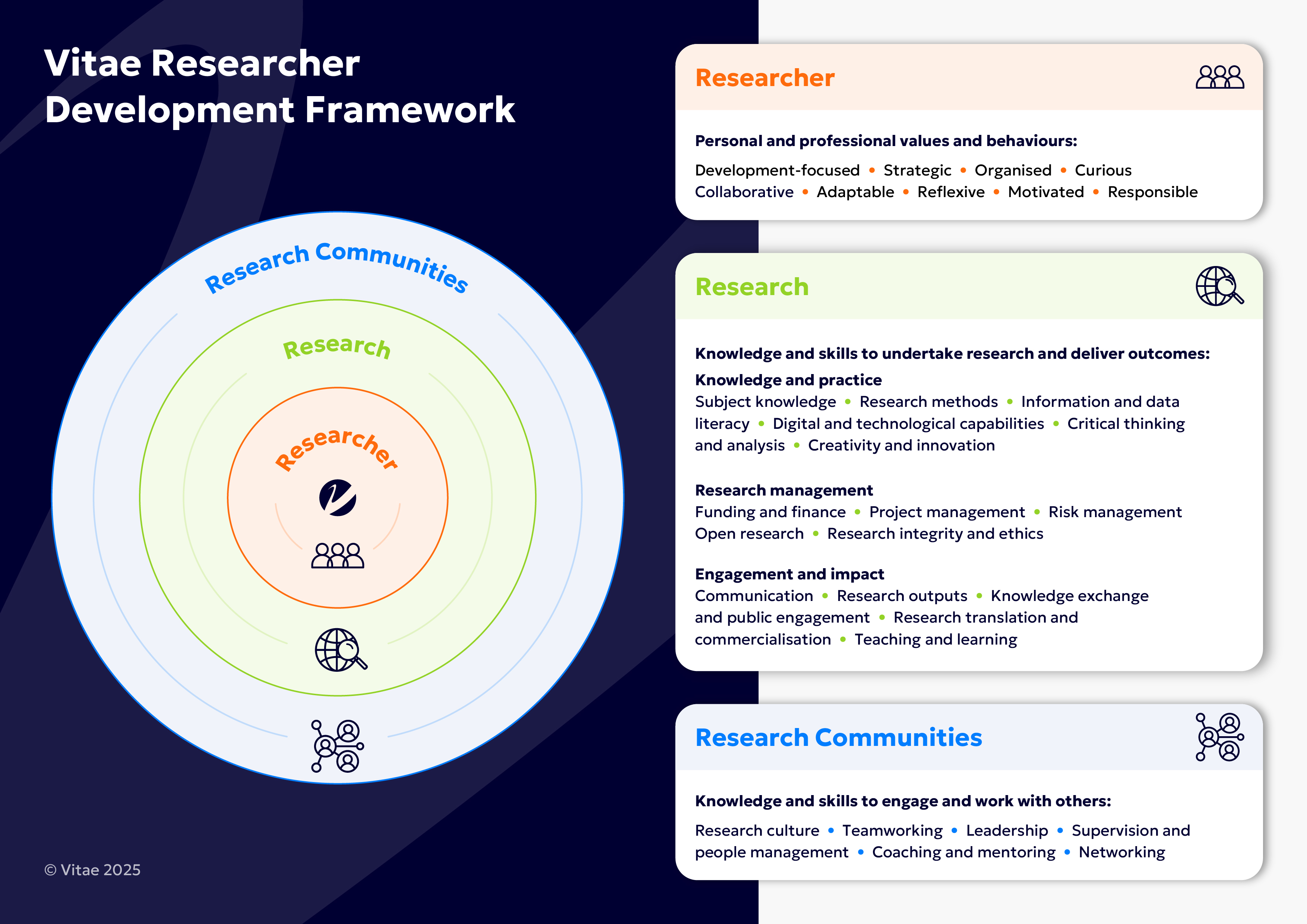
Figure 2: RDF 2025 infographic (Vitae, 2025)
As Figure 1 shows, the RDF consists of 31 skills descriptors arranged into three concentric domains. At the centre of the framework is the researcher. The skills in this domain describe the personal and professional values and behaviours that characterise effective researchers. The second domain addresses the knowledge and skills required to undertake research and deliver outcomes, and the third, outer domain is concerned with research communities- the knowledge and skills needed to engage and work with others.
The RDF can look daunting when you first begin to engage with it. Remember, you are not expected or required to show progress in all 31 skills during your doctorate, or later in your career. The RDF is a list of the characteristics of professional researchers as a group, no one individual is expected to develop all of these! The skills that you need to develop will depend not only on those you have already, but also on your goals and aspirations. For some people, learning a programming language might be essential – for others, it will be irrelevant. Some post-graduate researchers have several decades of experience of survey design, others are just starting out.
This unit will demonstrate how to use the RDF sub-domains and characteristics to audit your skills and make a training plan. You and your supervisors will then be able to track your progress towards your development goals month-by-month, as you book and attend training sessions or complete and record agreed tasks.
Activity 1 will help you familiarise yourself with the RDF and start thinking about areas for development. In the next section, you will begin the process of auditing your existing skills.
Activity 1: Familiarising yourself with the RDF
Allow approximately 15 minutes for this activity
For this activity you will need to refer to the Researcher Development Framework (RDF).
Look through the 31 characteristics of successful researchers (pp. 5-7 of the PDF) and select three skills that you already have, and three that you think you will need to work on between now and your upgrade assessment.
Make a separate note of your responses. Once you have answered the questions, select 'View Comment.'
View Comment
Hopefully, this Activity will have helped you to recognise that you already have many of the skills and characteristics of a professional researcher. It will also have helped you to identify areas for development during the first stage of your research degree.
For many early-stage post-graduate researchers the main priorities for pre-upgrade development are around:
- information and data literacy (2.3)
- literature reviewing (2.3)
- research design (2.2)
- research integrity and ethics (3.5)
- project management (3.2)
However, the skills you have identified will depend very much on your existing expertise and your particular project. You will reflect on your answers to this activity in more depth later in the unit.
4. Auditing your skills
A skills audit helps you to determine which skills you already have and if they are developed enough to match the needs of your work. It also helps you to identify skills that will be important to your research and reflect on your proficiency in them. This will give you a baseline from which you can determine your progress over time. Repeating the audit process over your course of your studies allows you to track your development.
Carrying out a skills audit
With your supervisory team you should:
- Discuss the formal expectations regarding the knowledge, skills, attitudes and behaviours you will acquire during your doctoral research programme.
- Carry out a systematic assessment of the research skills and knowledge you already have.
- Compile an accurate record of existing or developing competencies.
After a skills audit, a needs analysis helps you to identify the skills and competencies you will need to develop throughout the course of your studies. Like the skills audit, you will revisit your needs analysis throughout your doctorate to update it and track your progress.
A skills audit is a systematic assessment of your research skills and knowledge. An audit should provide evidence of existing or developing competence and a plan for developing relevant skills as you progress.
The purpose of the skills audit is to:
- Reflect on your own situation and aspirations.
- Reflect on your existing strengths.
- Identify evidence of competence (prior learning).
- Identify priority areas for further development (development needs).
It can be helpful to think about three levels of skills development:
- Generic research skills.
- Discipline-level research skills (interpreted within each discipline).
- Project-level research skills (interpreted within the supervisory context).
In this unit we will largely focus on generic research skills, but you (and your supervisors) will be able to identify further training in any methods or skills that are more specific to your research subject. This may include team working, network development and self-discipline skills, as well as perhaps less obvious but related skills such as assertiveness and relaxation.
4.1. Getting started with your skills audit

The idea of the skills auditing process is to help you identify the skills and experience that you already have a high degree of proficiency in (and therefore don’t need to develop further), those that you do need to work on in order to achieve your development goals, and those that aren’t relevant and can be disregarded.
It is a good idea to do an initial skills audit/analysis as soon as possible after starting your research degree. Your progress towards your development goals will be an important source of evidence that you have reached the standard required to pass your upgrade assessment. Later in your research degree, you will want to be sure that you are on track to develop the skills you will need to successfully move on with your post-doctoral career. Throughout your degree, it is a good idea to maintain a record of your training progress which accumulates records and evidence of each skill you develop, and many universities will require you to submit this as part of the upgrade process.
The next section will support you to reflect on and start to gather evidence of your existing skillset. You’ll then start identifying priorities for development during the first stage of your research degree, and incorporate this information into a skills development plan.
4.2. Collecting and logging evidence of your existing skills
In Activity 1, you identified three skills that you already have, and three skills you will need to further develop between now and your upgrade assessment. Activity 2 will ask you to look in more detail at the RDF, and the phases of development it identifies for different skills.
About the RDF Phases
Pages 8-23 of the Researcher Development Framework contains more detailed information about each of the 31 skills, broken down into 4 phases of development. These phases describe increasing levels of development within individual descriptors.
For example, look at the first descriptor in the Researcher domain, 1.1 Development-focused, on page 8:
- A researcher at Phase 1 in this descriptor is described as being able to ‘reflect on personal strengths, skills and development needs’ and as beginning to set clear professional development goals.
- At Phase 2, they are able to reflect more critically on their progress, and to adjust their goals and plans as necessary.
- At Phase 4, their commitment to continuous professional development is ‘visible, sustained’ and ‘set[s] a standard for others’.
It is important to be aware that, although these phases describe progression towards greater independence and capability across the RDF descriptors, they are not intended to map neatly onto stages of career development, and they are not a list of professional standards that must be met in order to progress in your career. They are simply intended to provide a framework for describing your professional skills and development progress.
Activity 2 asks you to map some of your existing skills against these phase descriptors. You may find that all of the skills you have identified are currently at Phase 1 of development, or that some of your skills are in the early stages of development, and others are more advanced. This is perfectly normal. The aim of this exercise is to help you to reflect on your current skillset and to identify priorities for development.
You are unlikely to need to develop all your skills to the same level. For example, take a look at the phase descriptors on page 13 of the RDF for ‘2.3 Information and data literacy’. For specialists in data management, development to Phase 4 may be highly desirable- but for many researchers, this level of specialisation will be unnecessary, and they may never need to develop their skills beyond Phase 2.
Activity 2: Reflecting on your existing skills
Allow approximately 15 minutes for this activity.
In Activity 1, you identified three skills that you already have. This activity will help you to assess your current level of competency in these skills.
For this activity, you will again need to refer to the Researcher Development Framework (RDF). This time, scroll to the phase descriptors on pages 8-23.
Review your answers from Activity 1. For each skill, identify the phase of development that you believe you have currently attained for this skill. You should then View Comment.
View Comment
Activity 2 should have helped you to get started with articulating the level of development that you have attained in some of your existing skills. Remember, the RDF phases are not prescriptive- they are there to help you describe your own levels of development within a particular skill, so that you can think about whether you need to develop your capabilities in that area further in order to meet your goals.
Now that you have reflected on some of your existing skills, you will move on to start to collate evidence of these.
Activity 3: Collating Evidence of your Skills
Allow approximately 30 minutes for this activity.
Candidates preparing for job interviews are often advised to use the acronym STAR (Situation, Task, Action, Result) to help them to give concise answers that evidence their skills and experience.
Use the STAR acronym to start collecting evidence of your existing skills for your skills audit.
The STAR examples and template file shows you how to do this and provides a couple of worked examples to get you started. Once you have completed this activity, you should View Comment below.
View Comment
Whatever your route into doctoral studies, you will already have a range of transferable skills that you will be able to apply to your research. Although many new doctoral researchers find the long list of skills descriptors in the RDF somewhat daunting, actually beginning to engage in the skills auditing process is often validating and reassuring. We hope you’ve found this exercise useful in helping you to identify the valuable skills that you already bring to your studies.
Now that you have audited your existing skills, logged evidence of your current competency and set some development priorities, you can move on to constructing your training plan.
5. Planning your development
This section of the unit will walk you through the process of planning your skills development.
You need to agree the form of your development plan with your supervisors. However you decide to do this, it should include:
- a clear but general articulation of each skill that has been identified to be developed during your research degree.
- an indication of the priority of each skill need.
- actions to be taken to develop the skills listed.
- criteria for successful acquisition of each skill (i.e. specification of what will constitute evidence of competence – what does success look like?)
- an outline schedule for the development activities and target dates for completion.
- an agreed schedule for review, including dates for supervisors to monitor and evaluate the skills development as it progresses, and dates to review and update the portfolio plan.
To help you get started, we’ve provided a simple development planning template in Activity 4.
Activity 4: Making your development plan
Allow approximately 25 minutes for this activity.
In Activity 1, you identified three skills that you want to develop during the first stage of your research degree. This activity will help you to make a plan to develop these skills.
For this activity, you will once again need to refer to the Researcher Development Framework (RDF), and to the phase descriptors on pages 8-23.
Review your answers to Activity 1.
Using the Development Plan Template and the RDF descriptors, make a plan for how you will develop each of these three skills between now and your upgrade assessment. The template contains some worked examples to help you get started.
You should then View Comment below.
View Comment
Now that you have completed the task in this activity, you should have a clearer idea of how to prepare an outline development plan. Remember to check your university’s development planning requirements as these vary significantly between institutions- and always work closely with your supervisors to agree your development goals, and to review your progress. Remember that your development goals are very likely to change during your research degree, as your needs and circumstances change. Being able to reflect critically on your own development needs and adjust your plans accordingly is a key research skill in itself, and one you will continue to develop throughout your doctoral studies.
6. Conclusion

In this unit, you have considered the transferable skills that characterise effective researchers, and you have familiarised yourself with the Vitae Researcher Development framework, which you can use to audit your existing research skills, and plan your development throughout your career. You have begun to assess your competence against the RDF descriptors, and to collate evidence of your existing skills. You have also started to prepare a development plan to help you to evidence how you are going to develop key skills during the first part of your research degree.
Becoming a professional researcher is an ongoing journey rather than a destination. The skills audit, development plan and evidence-building activities introduced in this unit provide a foundation for that journey. As you revisit and refine your plans during your research degree, you will be better prepared to meet the challenges of your project, demonstrate your achievements, and prepare for your next steps, whatever career path you choose to follow.
Now let's move onto Unit 3: Managing your supervisors and other professional relationships.
7. References
- Quality Assurance Agency for Higher Education (QAA) (2020) Characteristics statement – Doctoral Degree. Gloucester: Quality Assurance Agency. Available at https://www.qaa.ac.uk//en/the-quality-code/characteristics-statements/characteristics-statement-doctoral-degrees (Accessed: 30 August 2026).
- Vitae (2025) The Vitae Researcher Development Framework. Available at: https://vitae.ac.uk/vitae-researcher-development-framework/ (Accessed: 30 August 2026)