Module 1
| Site: | OpenLearn Create |
| Course: | CONTINUOUS PROFESSIONAL DEVELOPMENT (CPD) FOR MODERN CAREERS |
| Book: | Module 1 |
| Printed by: | Guest user |
| Date: | Monday, 23 November 2026, 6:21 AM |
Understanding CPD
Purpose
Introduce CPD, explain its value, and show how modern CPD differs from traditional tick-box approaches.
Learning objectives
By the end of this module you will be able to:
- Define CPD in your own words
- Explain why CPD supports career progression
- Describe CPD as a continuous cycle
- Distinguish CPD from competency development
- Describe how professional bodies approach CPD
1.1 What is CPD?
Continuous Professional Development (CPD) is the intentional, ongoing process of maintaining, improving and broadening your knowledge, skills and professional behaviours throughout your working life.
Three words matter:
- Continuous: development does not stop when you finish a qualification or reach a job title.
- Professional: it relates to the work you do and the career you want.
- Development: the goal is growth, not attendance. Sitting in a webinar is not development unless something changes in what you know, can do or do.
CPD covers a wide range of activity: courses and certifications, conferences, mentoring, reading, volunteering, stretch assignments, teaching others, and learning from projects and mistakes.
1.2 Why CPD matters for career progression
Careers rarely progress on length of service alone. CPD helps because it:
- Keeps you current as tools, regulations and methods change
- Makes your growth visible, giving you something concrete to point to in appraisals, promotion cases and interviews
- Builds transferable capability such as stakeholder management, data literacy and communication
- Supports recognition: many professional bodies require CPD to retain membership or chartered status
- Increases confidence and resilience in restructures, new technology and career moves
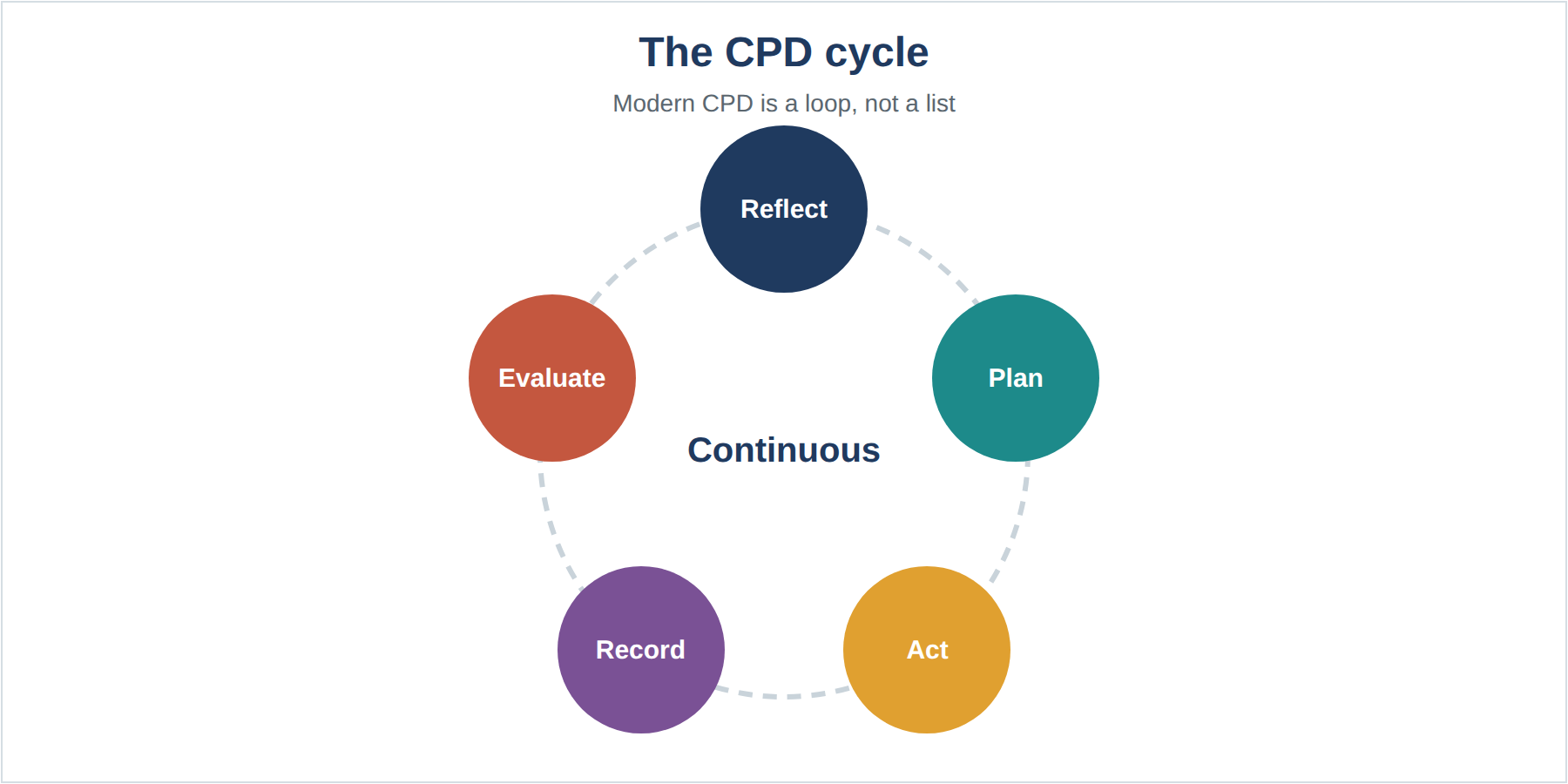
1.3 CPD as a continuous cycle
Modern CPD is a loop rather than a list. Bodies label the stages differently, but the cycle generally looks like this:
- Reflect: Where am I now? What have I learned recently?
- Plan: Where do I want to get to? What will I do, and by when?
- Act: Complete the development activity.
- Record and evidence: Log what you did and keep proof.
- Evaluate: What changed? What can I now do that I could not before?
The cycle then restarts, informed by what you learned.
1.4 CPD versus competency development
CPD is the activity: what you did. Competency development is the outcome: what you can now do, and how well.
| CPD | Competency development | |
|---|---|---|
| Focus | The activities you undertake | The capability you actually build |
| Question it answers | What did I do? | What can I now do, and how well? |
| Typical measure | Hours, activities, entries | Maturity or proficiency level |
| Risk if used alone | Tick-box mindset: lots of activity, unclear impact | Hard to demonstrate without a record of activity |
The most effective approach links the two. When you record CPD, also record which competency it supports and what difference it made.
1.5 Traditional versus modern CPD
| Traditional, tick-box CPD | Modern, competency-based CPD |
|---|---|
| Focus on hours collected | Focus on capability gained |
| Annual scramble to fill in a record | Little-and-often logging |
| Mostly formal courses | Mix of formal, informal and experiential learning |
| Activity chosen by availability | Activity chosen from a gap analysis |
| Attendance is the evidence | Outcomes and applied learning are the evidence |
1.6 CPD in professional bodies
Many professional bodies expect or require a CPD record. Approaches differ, so always check your own body's current rules. Examples:
- APM (Association for Project Management) encourages members to plan, record and reflect on CPD and links development to its competence framework.
- BCS, The Chartered Institute for IT, expects members to maintain a CPD record and uses the SFIA skills framework to describe levels of skill and responsibility.
- PMI (Project Management Institute) certification holders earn and report Professional Development Units (PDUs) over a renewal cycle.
Hours, categories and reporting windows change over time. Confirm current requirements on your professional body's website.
Key takeaways
- CPD is intentional, continuous development of your professional capability
- Modern CPD is outcome-focused, not hours-focused
- CPD works best as a cycle: reflect, plan, act, record, evaluate
- CPD is the activity; competency development is the result. Link them.
Activity 1.1: Reflection
Reflection - "What CPD have I done in the last 12 months?"
List everything that helped you grow professionally in the past year.
Go beyond courses: include books, podcasts, shadowing, new responsibilities, mentoring, presentations, and lessons from things that went wrong.
For each item write one sentence on what you learned or can now do.
Then answer:
- What was most valuable, and why?
- What did I do that I never recorded?
- Did my activity follow a plan, or was it opportunistic?
Keep this list. It seeds your CPD log in Module 4.