metrics, delivery results, cost or time savings, quality improvements
Learning records
certificates, transcripts, course notes, badges
Reflections
written reflections on what you learned and changed
Observations
mentor or manager observation notes
Important: before storing any work document as evidence, check that it is not confidential or commercially sensitive. Remove or anonymise client names, personal data and anything your employer would not want shared. Follow your organisation's policies.
6.2 How evidence supports competency claims
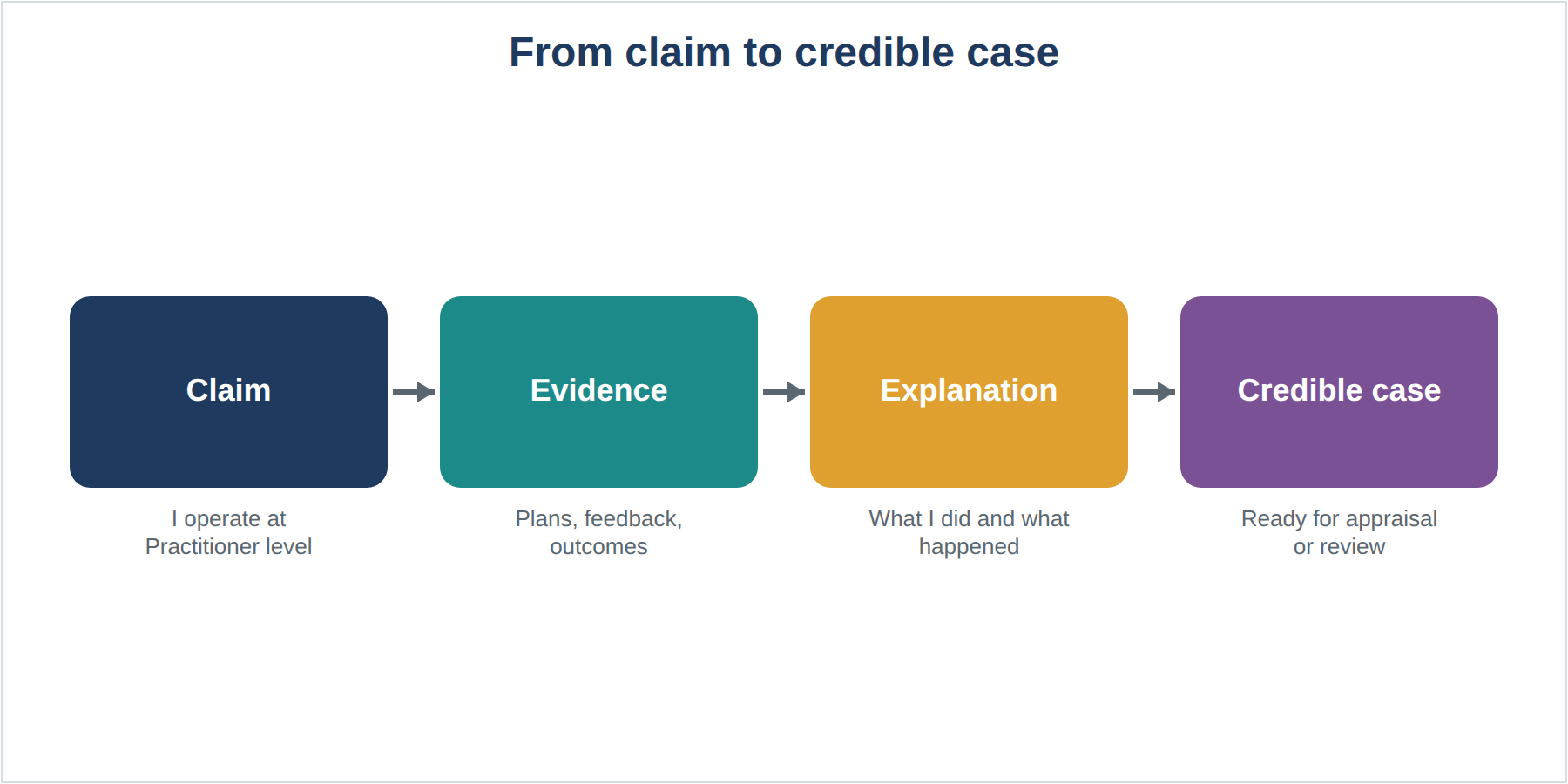
A claim without evidence is an opinion. A strong competency claim has three parts:
Figure 6.1 From claim to credible case.
Claim: "I operate at Practitioner level in stakeholder engagement."
Evidence: "Stakeholder map and engagement plan for the billing migration; feedback email from the programme sponsor."
Explanation: "I identified 14 stakeholders, tailored communications to each and resolved a conflict between finance and operations, which kept the go-live date."
6.3 Building an evidence vault
An evidence vault is an organised, backed-up place where you keep your proof.
Set-up steps:
Choose a location you will keep long term and can access if you change employer (a personal cloud folder works well).
Create folders by competency or by year. Pick whichever you will actually maintain.
Use a consistent file-naming convention, such as YYYY-MM_topic_type.
Keep a short index listing each item, date, competency and CPD log reference.
Back it up and review it quarterly.
Evidence index template
ID
Date
Item
Type
Competency
CPD log ref
Notes
E001
6.4 Using evidence in appraisals
Good evidence lets you move from "I think I did well" to "here is what I did and what happened." Before an appraisal, select your three to five strongest pieces, matched to the objectives or competencies being discussed. Quality beats quantity.
6.5 Linking evidence to CPD and development plans
Backward to the CPD log: each entry points to its proof
Sideways to competencies: each piece supports a rating
Forward to your development plan: gaps in evidence often reveal where to develop next
Key takeaways
Good evidence is relevant, authentic, current, specific and sufficient
A competency claim needs evidence and a short explanation
A simple, consistent vault with an index saves hours later
If a document cannot be stored (for example because it is confidential), write a short description instead: what it is, what it shows and where it is held.