Module 8
| Site: | OpenLearn Create |
| Course: | CONTINUOUS PROFESSIONAL DEVELOPMENT (CPD) FOR MODERN CAREERS |
| Book: | Module 8 |
| Printed by: | Guest user |
| Date: | Monday, 23 November 2026, 6:21 AM |
1. Creating a development plan
Purpose
Guide you through building a realistic, structured development plan that connects goals, competencies, CPD and evidence.
Learning objectives
By the end of this module you will be able to:
- Write clear development goals
- Link development, competency, CPD and evidence
- Time-box activities
- Track progress and review the plan
8.1 Setting development goals
Good goals are specific, observable and time-bound. A simple structure:
"By [date], I will be able to [observable behaviour or outcome] at [level], shown by [evidence]."
Weak: "Get better at risk."
Strong: "By 31 March, I will independently run a risk workshop and maintain a quantified risk register for my project (Risk Management, level 2 to 3), shown by the register and sponsor feedback."
Limit yourself to two or three main goals per six-month period. Too many goals means none get done.
8.2 The development chain
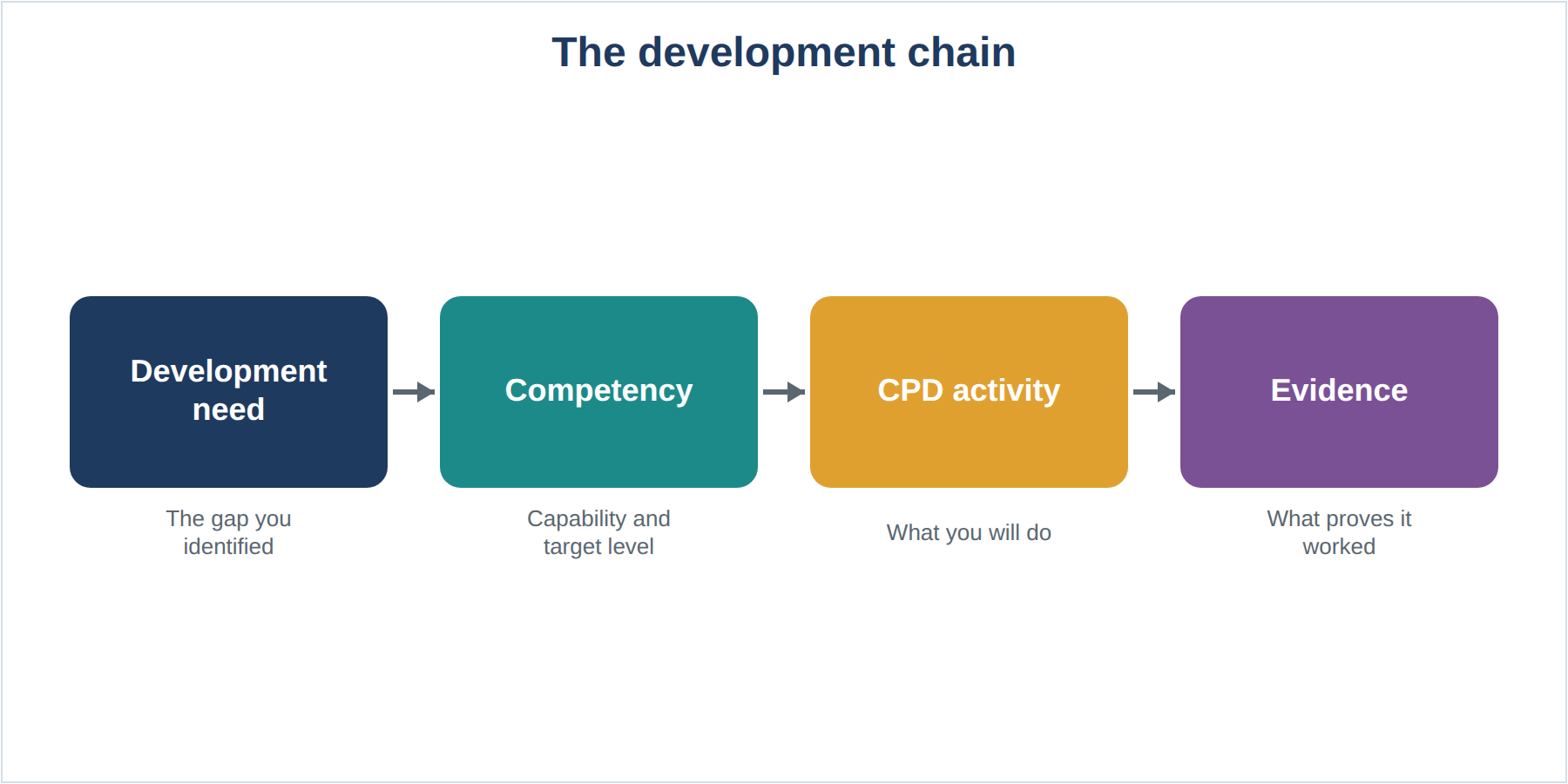
- Development need: the gap you identified
- Competency: the capability and target level
- CPD activity: what you will do
- Evidence: what will prove it worked
Example
| Development need | Competency (level) | CPD activity | Evidence | Due |
|---|---|---|---|---|
| Cannot yet quantify risk | Risk Management (2 to 3) | Complete a risk analysis course; run a risk workshop on my project | Course certificate; workshop output; manager feedback | 31 Jan |
If an item does not fit this chain, ask whether it belongs in the plan.
8.3 Time-boxing development activities
- Give each task a start date, an end date and an estimated effort
- Book time in your calendar, for example 90 minutes a week
- Pair activities with real work so learning and delivery reinforce each other
- Set milestones at 30, 90 and 180 days
8.4 Tracking progress
Keep a simple tracker with a status for each task: not started, in progress, complete or deferred. Review it monthly. When a task is complete, update your CPD log and add evidence to your vault straight away.
8.5 Reviewing and updating plans
- Monthly (15 minutes): progress and blockers
- Quarterly (60 minutes): goals, gap analysis and competency ratings
- Annually: full reset ahead of appraisal
An updated plan is a sign of a healthy process, not a failure.
Key takeaways
- Goals should be specific, observable and time-bound
- Link every task through development need, competency, CPD and evidence
- Time-box and schedule activities, or they will not happen
- Review regularly and adapt
2. Activity 8.1: 6 month development plan
Build a 6-month development plan.
Using your gap analysis, set two or three goals.
Draw a six-month timeline with milestones at 30, 90 and 180 days and a review date each month.
This is your development plan, a required Final Assessment item.
3. Activity 8.2: Development tasks
Add 3 development tasks linked to competencies.
Complete the development chain for three specific tasks.
Include dates, effort estimates and the evidence you will gather.