Use 'Print preview' to check the number of pages and printer settings.
Print functionality varies between browsers.
Printable page generated Saturday, 29 August 2026, 3:14 AM
Making sport safer for all
Welcome to Part 2

What further areas of responsibility should I be aware of?
This second part of the course covers three further areas of your safeguarding responsibility.
These are:
- Preventing harm by managing risks.
- How your beliefs, values and life experiences influence your approach to safeguarding.
- The importance of having codes of conduct which everyone in your organisation follows.
Learning about these areas will help you understand safeguarding better and will make your sport safer for everyone.
Let's begin with managing risk.
Managing risk

In the first part of this course, we identified three risks that were present in a youth ski training camp. One of the identified risks was sleeping in overcrowded dormitories with minimal adult supervision.
Good safeguarding practice means assessing and managing this risk by making sure that every athlete or player has safe and clean living conditions.
But how can this be achieved?
 Managing the risk of neglect
For each question, read the text about ‘Action to manage risk’ and ‘Why it prevents harm’.
The text has a missing word(s).
Select the correct word(s) from the options underneath.
There are three questions to be completed.
a.
sporting ability
b.
communication
c.
accomodation
The correct answer is c.
a.
athletes or players contract
b.
code of conduct
c.
application form
The correct answer is b.
a.
health and safety
b.
athlete or player behaviour
c.
training
The correct answer is a.

 |
| What does the risk management process look like? |
Preventing harm from abuse or neglect is a step-like process, as illustrated in the diagram above. This process seems very straightforward. However, it will be influenced by your experiences, beliefs and values. |
This influence is explained further in the next section.
How do beliefs and values influence your approach to safeguarding?
How you perceive the seriousness of the risks you identify, and the steps you take to manage these risks, is influenced by what you believe in and value.
Do you know the difference between your beliefs and values?
Let us check our understanding of what is meant by our beliefs and values.
Beliefs – these describe the things that we hold to be either:
- ‘right’ or ‘wrong’.
- ‘true’ or ‘false’.
For example, if you think it is ‘right’ that taking part in sport should be enjoyable – then this is a belief, it is something you believe to be ‘true’.
Values – these are the things that are important to you. ‘Respecting other people’ is a value. If you feel strongly about this, you will protect and attach more importance to it.
Let us look at how your beliefs and values are shaped by life experiences.
Understanding your beliefs and values
Listed below are five statements describing different behaviours.
Place each of the behaviours into an order by dragging each one across to the opposite column. Place what you believe is the most serious behaviour at the top and the least serious at the bottom.
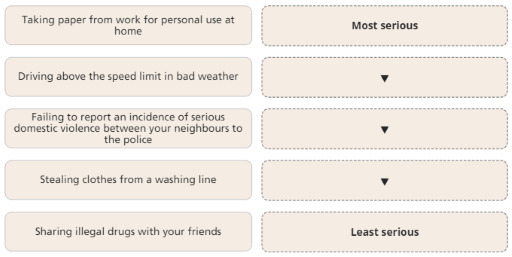
|
| Your previous life experiences, beliefs and values influence your approach to safeguarding |
We do not all share the same beliefs and values. Therefore, how we identify the seriousness of risks and the actions we take to manage them will be different. This is why it is important to develop codes of conduct, because they provide a way of describing common standards of behaviour which everybody understands and agrees to. |
We will examine codes of conduct in more detail next.
Agreeing behaviours for everyone in your sport

Because peoples’ beliefs and values are different, a framework describing agreed standards of acceptable behaviour is needed.
Creating codes of conduct can achieve this and help your organisation to develop a good safeguarding culture, but what should these codes of conduct include?
What should be included in a code of conduct?
a.
Never engage in bullying behaviour. Challenge any form of bullying behaviour among children or adults.
b.
Communicate in a positive way with children that is right for their age.
c.
Do not use personal social media accounts to communicate with children or make comments about a child.
d.
Never humiliate children or adults.
e.
Never hurt, or threaten to hurt, an athlete or player physically, sexually or emotionally.
f.
Never exploit an athlete or player for personal or financial gain.
g.
Provide opportunities for all athletes or players, including children, to share in decisions which affect them.
The correct answers are a, b, c, d, e, f and g.
Answer
All the statements above are typical of those that should be included in a code of conduct.
Creating codes of conduct for your organisation will make sure that risks can be better identified. For example, when you see behaviour that your code of conduct identifies as unacceptable, then action can be taken to stop this behaviour and hold people accountable.
|
| Who do codes of conduct apply to? |
Everybody in your organisation should know, understand and sign-up to your code of conduct. Nobody, for any reason, is an exception. |
In the next section, we discover how a code of conduct could have helped prevent the members of a Women’s Under-20 (U20s) Netball team being harmed by different forms of abuse.
How can codes of conduct help prevent harm?
An organisation committed to high safeguarding standards can help protect everyone from harm.
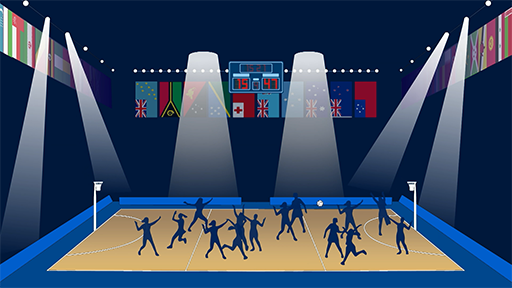
The following example of a Women’s U20s Netball Championship shows what can happen without a clear code of conduct.
Reducing the risk of harm through an effective code of conduct
Watch the video below and then answer the questions that follow.
Trigger warning: The following animation contains content related to abuse in sport which some viewers may find difficult or distressing. |
Transcript
a.
This limits the likelihood of other members of the team feeling left out.
b.
This limits the opportunity for adults to sexually abuse a child.
The correct answer is b.
b.
That's correct, avoiding being alone with a child who is not theirs, limits the opportunity for adults to sexually abuse a child.
a.
It is never acceptable for any kind of sexual ‘relationship’ between staff and athletes or players as, even if a coach is the same age as an athlete or player, it is still an abuse of power and position of trust.
b.
Having a sexual ‘relationship’ with an athlete or player can create problems in the future if the relationship breaks down and makes it uncomfortable for everyone.
The correct answer is a.
a.
That's correct. Even if a coach is the same age as an athlete or player, it is still an abuse of power and position of trust.
a.
This prevents children learning bad words and using them against their coaches.
b.
This sets a positive example and prevents behaviour that can make it easier for more serious abuse to happen.
The correct answer is b.
b.
That's correct, speaking to children respectfully and not using sexualised language or humour sets a positive example and prevents behaviour that can make it easier for more serious abuse to happen.
a.
Banning sexual abuse and harassment makes it clear that your sport does not accept this behaviour in any form.
b.
Banning sexual abuse and harassment will make sure adults do not get into trouble with the police and parents of children.
The correct answer is a.
a.
That's correct. Banning sexual abuse and harassment makes it clear that your sport does not accept this behaviour in any form.
a.
This prevents behaviour that could allow someone to have secret conversations with a child or make comments that harm a child’s wellbeing.
b.
Many children have social media accounts and use them a lot, so this prevents adults’ social media accounts being filled up with comments from children.
The correct answer is a.
a.
That's correct. It prevents behaviour that could allow someone to have secret conversations with a child or make comments that harm a child’s wellbeing.
a.
A code of conduct could have helped prevent the behaviours that were rumoured to have occurred.
b.
Everybody connected with the team would have known the difference between acceptable and unacceptable behaviour.
The correct answers are a and b.
a.
Both of these answers are correct.
b.
Both of these answers are correct.
|
| Where can I find examples of codes of conduct? |
Developing codes of conduct is an important part of your organisation’s commitment to safeguarding and should be linked to a safeguarding policy. Visit www.safeinsport.org to find out more about what a good code of conduct should include. |
Codes of conduct: summary

Codes of conduct: what is their purpose?
Codes of conduct are more than just a list of acceptable and unacceptable behaviours.
They can:
- Make people accountable for their behaviour.
- Demonstrate your organisation's commitment to safeguarding.
- Provide a point of reference to clarify if some behaviours are acceptable or not.
- Define standards of good practice.
Taking time to develop codes of conduct for your organisation is a necessary investment in making your sport safer for everyone.
Closing thoughts and main messages

Congratulations, you are now two-thirds of the way through the course.
By now you will have realised that safeguarding is an important part of your role in your sport; it is not an optional extra.
|
| The three main messages to take away from this second part of the course |
|
The final part of the course covers the response you and your organisation should follow when you have a safeguarding concern. Something might not seem serious, but the next session shows why and how you should respond every time you have a concern.
Your welfare
You may have your own lived experience of harm and abuse, and may find some of the content in this course difficult and upsetting.
Please make yourself aware of the support services that are available to you through your manager, your organisation or within your community, so that you know how to access this support if you need to.
Now go to the final part of the course.