Use 'Print preview' to check the number of pages and printer settings.
Print functionality varies between browsers.
Printable page generated Thursday, 24 September 2026, 9:13 AM
Session 1 The role of the Safeguarding Lead
1.1 Introduction

This session gets you started by exploring your key tasks as a Safeguarding Lead.

Learning outcomes
In this session, you will cover:
Your role and responsibilities. |
Who else can support you in your work. |
The qualities and knowledge you will need as a Safeguarding Lead. |
How to develop self-care strategies, to help you manage the challenges you might face in the role. |
1.2 What is it like starting out as a Safeguarding Lead?

In Course 2 you met Patience, an experienced Safeguarding Lead.
 Activity: Starting out as a Safeguarding Lead
Listen to Patience talking about her experiences in her role. Identify anything she says that you are also feeling about your responsibilities as a Safeguarding Lead.
Transcript
Comment
Some of you might identify with how Patience felt – as you go through the course you’ll hear and learn more from her.
Different aspects of Patience’s story will mean different things to each of you. If you are new to the role of a Safeguarding Lead, the feelings of being worried, or not knowing exactly what the role requires, may be at the front of your thoughts. If you are more experienced, the aspects of influencing others about the importance of safeguarding may reflect your own day-to-day experiences.
Now let’s explore some of your key tasks in more detail.
1.3 The Safeguarding Lead role: your key tasks

In the next activity, you consider all the tasks and responsibilities that your role includes.
 Activity: Clarifying what your safeguarding role involves
Make a list of all the tasks and responsibilities you understand your Safeguarding Lead role includes. These may include very general points (e.g. acting as a focal point for safeguarding) or more specific actions (e.g. receiving and responding to reported
Comment
Were you able to identify the range of tasks and responsibilities your organisation expects of you as Safeguarding Lead? Are these detailed or more general? Do you have a specific description for the Safeguarding Lead role or is it just added to another role you currently hold?
Whatever you identified, don’t worry – this training will help you and your organisation develop and build on this. As you work through the course, you will notice actions or responsibilities that you should note and perhaps add to your role description.
1.4 The main responsibilities of a Safeguarding Lead
You are now going to consider the key objectives of the Safeguarding Lead role.
Activity: Identify the main responsibilities for a Safeguarding Lead
Here are the five broad objectives of the Safeguarding Lead role.
Objective 1: Lead safeguarding in your organisation, including the development of your organisation’s safeguarding policy and procedures.
Objective 2: Ensure that everyone receives safeguarding training and raises awareness of good safeguarding practice through sharing information and guidance.
Objective 3: Identify and prevent organisational risks and help others to identify and reduce risks.
Objective 4: Establish working relationships and partnerships (within your organisation and with external organisations) to support your work.
Objective 5: Respond when safeguarding concerns arise, including making referrals in line with local legislation, and ensuring your organisation responds appropriately.
Now work through the list below and identify which responsibility falls under which of the five Safeguarding Lead objectives described above. Reflect on how these responsibilities fit with your own role.
 |
| The role is much more than responding to concerns |
A big part of the role is about education and awareness-raising to proactively prevent harm. It is also about helping everyone understand the part they play in safeguarding and how the organisation as a whole can |
1.5 Qualities that Safeguarding Leads need

Now you have explored the different responsibilities, let us consider the qualities that make you effective in your role.
Activity: Why might certain Safeguarding Lead attributes be important for children?
A group of child athletes were asked to describe what an ideal Safeguarding Lead would be like.
Below are the attributes that the child athletes said were most important to them – why do you think they chose these?
Select each in turn to see our suggestions. An ideal Safeguarding Lead should be:
Comment
We can see that a Safeguarding Lead’s interpersonal qualities can be as important for children as their technical safeguarding knowledge. There is a range of other qualities that help Safeguarding Leads to fulfil other parts of their role, which you explore next.
1.6 Other important Safeguarding Lead qualities in action
Let’s hear from Patience again, as she describes her Safeguarding Lead experiences.
 Activity: Patience describes her experiences
Listen to Patience’s description, identify the qualities or attributes she demonstrated in her Safeguarding Lead role, and type them in the boxes below. We have provided one example to help get you started.
Transcript
Open and approachable (made efforts to connect with children) |
Comment
Here are the qualities or attributes we came up with:
Open and approachable (made efforts to connect with children) |
Determined and courageous (continuing despite criticism) |
Adaptable (finding different examples to promote safeguarding messages) |
Patient and resilient (repeating messages, ignoring obstacles) |
Recognising how you already demonstrate these qualities is an important way to celebrate what you bring to this challenging area of work.
Now let’s think about who else can help you in your role.
1.7 Who can help me in my role?

Your work as a Safeguarding Lead will be greatly helped if you have a team of people in your organisation who understand and champion safeguarding, and external experts who you can call on for advice and support.
Activity: Identify the external support a Safeguarding Lead can access
Here are some examples of the type of advice that external organisations might be able to offer you – identify whether external safeguarding experts could provide valuable advice about the subjects listed below by choosing ‘Yes’ or ‘No’ in the dropdown menu.
Could external organisations offer valuable advice about each one of the following statements?
Comment
There are many tasks that external experts can support you with. It is important that you identify and form working relationships with them.
You can connect with Safeguarding Leads at other sports organisations, or your International Federation, National or Member Federation, National Olympic Committee or Commonwealth Games Association.
Other sectors can really help you too. For example, government departments or
People like police officers, social workers or teachers may all have great insight that can help you in your role.
1.8 Explaining to others why safeguarding is important
Part of your job will be to help other people understand that everyone is responsible for safeguarding in sport. Knowing what motivates different groups can help us explain safeguarding in a way that is relevant to them and increase the chances of them engaging with the process.
Activity: Identify stakeholders’ motivations and the benefits of safeguarding
Look at the example tiles below. One tile is a Stakeholder Group, one tile is the Motivation, and one tile is the Benefits of Safeguarding.
These three example tiles all match up. The junior athlete wants to have fun and if they like the club they will stay there. By selecting the three tiles correctly, the tiles disappear.
Follow these instruction to play the interactive
Look at the tiles for Stakeholder Group. Choose one of the tiles and select it.
Then look at the tiles for Motivation and select the correct one to match your chosen Stakeholder Group tile.
Finally, look at the tiles for Benefits of Safeguarding. Select the correct one to match your chosen Stakeholder Group and Motivation tiles.
If you get all three tiles correctly matched, the tiles will disappear. Repeat for the remaining tiles until they have all gone.
Select Next to start the interactive
Now you have reflected on how you can engage others, let’s think about the different ways you can influence people.
1.9 Different ways to influence others
In order to influence some key individuals, you need to build a relationship and a shared understanding. To do this, the following elements can be important.
Activity: Four steps to influencing key individuals
Read through the four steps in the figure below.
Think about how you might do this in your day-to-day practice. Make notes in the text box below.

Comment
Taking the time to understand other people’s motivations and perspectives, so you can build a positive relationship with them, will help you build a team of supporters for your safeguarding work.
Let’s now think about how the role might impact you – and how you can manage that.
1.10 Stress and the potential impacts on Safeguarding Leads
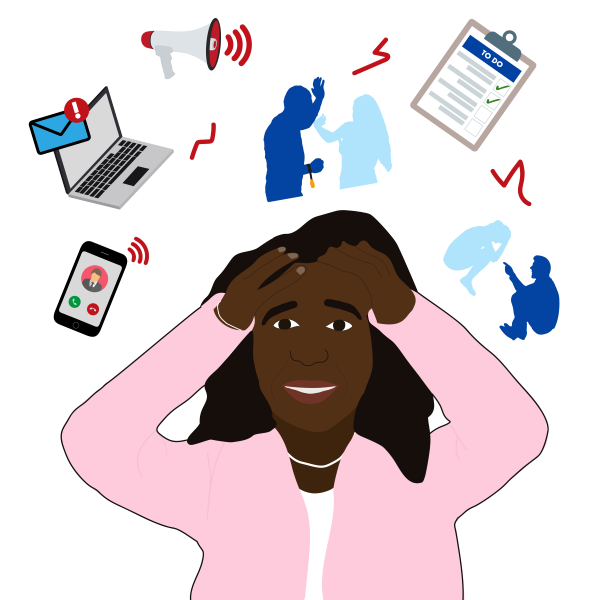
Most people will experience some negative impacts arising from their work. You have seen the sort of challenges Safeguarding Leads may face. What types of impact are likely?
What is ‘stress’?
Stress refers to physical, emotional, or psychological strain. Everyone experiences stress to some degree. The way you respond to stress makes a big difference to your overall wellbeing. Stress can be short or long term. Both can lead to a range of symptoms, but chronic long-term stress can have prolonged effects on health.
Sometimes even small daily stresses from work, family, and friends can impact your mind and body. Stress can also come from being involved with situations that carry extreme emotion and have a big impact on people's lives.
Here are some signs to help you recognise that you might be experiencing stress:
- Psychological signs, such as difficulty concentrating, worrying, anxiety, and memory difficulties.
- Emotional signs, such as being angry, irritated, moody, or frustrated.
- Physical signs, such as high blood pressure, changes in weight, frequent colds or infections, and changes in the menstrual cycle and libido.
- Behavioural signs, such as poor self-care, not having time for the things you enjoy, relying on drugs and alcohol to cope, or burnout.
Although not everyone experiences these effects, you should acknowledge the potential strains of this role and be proactive about seeking support and reducing the possible impact of the work. Act first – don’t wait for a crisis to happen.
1.11 Strategies to help cope with stress

Now you will hear from Patience again as she talks about how she coped with stress at work.
Activity: Identify examples of different types of support for Patience
Patience talks about the impact parts of her safeguarding role had on her, and what support helped her to manage this.
Identify examples of the two different types of action (professional and personal) that helped her cope. To help you get started we have provided one example for each below.
‘The most difficult part of the job is responding to complex cases or concerns – especially a serious abuse case. Hearing detailed safeguarding allegations is upsetting. And I always feel under pressure not to make a mistake – to get it right for the people who have been hurt, and for the organisation. Sometimes I can’t sleep and feel anxious, but I have found things that help.
I know I have my line manager’s support, and members of the Board – so I feel they are ready to protect and defend my work. I also have a friend in the organisation – she’s not a safeguarding expert, but I trust her – she takes me for a walk away from the office and lets me talk things through. I never share confidential information – I just talk about how work makes me feel.
Building in work time to reflect on what went well with a case and what I could improve is important – and helps me process some of my thoughts and worries.
I use external expert advice – even with cases – so I never feel I am making important decisions on my own. Having that network of trusted people and organisations is so important. One expert works in a charity and always lets me talk through safeguarding issues – and how they are affecting me. I also have regular meetings with Safeguarding Leads from several nearby sports clubs – this gives us the chance to share experiences with people in the same position.
But most importantly I learned how to monitor my own wellbeing and use self-care activities to help reduce my stress and look after my mental health. At work, I try to be efficient in planning my workload. Like being brave about deciding what tasks are top priorities and what I have to say ‘no’ to. In safeguarding, something unexpected often seems to disrupt my plans. But now, instead of panicking, I remember a good manager who said ‘accept that you will never get everything done’ – I reprioritise my work for the time available.
I have also set some clear boundaries between my work and personal life. I need my ‘me’ time. I now switch off my work phone and I never look at work emails at home. Obviously, if I am dealing with a complex case, or on call, I may need to be contacted out of office hours – but this is rare. I also plan leisure activities – this helps even when I am tired after a demanding day.’
| Professional actions (by the Safeguarding Lead) at work | Planning workload effectively and identifying top priorities |
|---|---|
| Personal actions away from work | Switching your phone off after work |
Comment
| Professional actions (by the Safeguarding Lead) at work | Planning workload effectively and identifying top priorities. |
|---|---|
| Consultation with an external safeguarding expert; access to a supportive colleague; debrief with manager. | |
| Access to advice and shared decision-making. | |
| Meetings with Safeguarding Lead colleagues from other sports. | |
| Personal actions away from work | Switching your phone off after work. |
| Creating work/home life boundaries; planning leisure activities. |
|
Recognising the signs of stress, and taking steps to reduce the impact it has, are really important parts of self-care. Everyone is different, so take time to understand how stress affects you, check-in with yourself to see how you are doing, and identify what works best to help you manage it. |
Safeguarding can be stressful at times, but by being aware and taking action, you can help reduce the impact on you.
1.12 Summary of Session 1

|
| The main learning and messages from this session are: |
|
When you are ready, move on to Session 2: Managing risk, where you will discover more about understanding and managing risk.