Use 'Print preview' to check the number of pages and printer settings.
Print functionality varies between browsers.
Printable page generated Wednesday, 14 October 2026, 3:18 AM
Preparing for elected office in Scottish local government
Introduction

What will you gain from being a councillor?
The knowledge and skills that councillors gain from carrying out their duties can benefit them in many other aspects of life and work. If elected, you will meet a wide range of people from different backgrounds and with different world views than your own. Learning to work effectively with people whom you do not always agree with builds strong interpersonal skills.
You can develop greater competence and confidence in various communications skills by listening carefully, speaking in public and explaining complex issues to the public. The role would also strengthen your problem‑solving and critical‑thinking skills, as councillors weigh evidence, balance competing priorities and make decisions that affect people’s lives. You would gain experience in teamwork, partnership‑building and constructive challenge.
The role requires resilience, and being able to balance the competing demands on your time is a great life skill to have. Overall, serving as a councillor offers practical leadership experience that can be transferred into many careers and other areas of life.
Don’t let feelings of not being confident or being worried about not being good enough get in the way. You can learn and develop on the job. The most important thing is to be motivated, committed and hungry to change. You have to have that feeling of wanting to do something and help people.
Activity: Before you begin
Use the space below to reflect on what you know about the role of a councillor. If you chose to stand and were successfully elected to a council, what would that mean for your life?
If you prefer, you can use a Learning Journal to collect your thoughts together in one place as you complete these reflective activities. You will then have a resource that you can draw on in the future to help shape your career as a councillor. For any activity that asks for you to note something down, there is a corresponding area for your answer in the Learning Journal. Using it is optional: if you prefer, you can note your responses down in the spaces below, or in a separate document, or on paper.
1 An overview of local government in Scotland
I mean ask yourself now, do you know how much your council spends? Do you know all the activity it covers? Do you know what relationships it has with external organisations? Do you know what the political complexion is? Would you know how to operate between officers and councillors?
Did I know the answer to those? When I went into the council I had some assumptions – big fat assumptions – which probably turned out to be largely inaccurate. Getting that understanding is very important.
If you're thinking about standing as a councillor, you should make yourself as aware as you possibly can of the wider role and what you’re going to have to actually do when you get appointed.
Scotland’s 32 councils were created by the Local Government etc. (Scotland) Act 1994. The 32 councils are ‘unitary’ local authorities, which cover all areas of local government responsibility and replaced the previous regional and district councils in 1996. As such, each council has a wide range of responsibilities, including providing education services, supporting economic development, maintaining roads and much more.
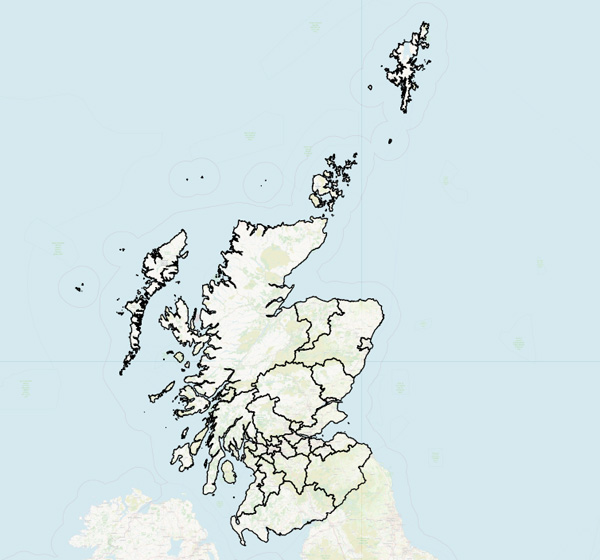
While Scottish councils carry out mostly similar functions and services to one another, there are vital differences that bring about different challenges:
- Councils in Scotland range in geographical size from 23 square miles (Dundee City Council, n.d.) to 10,226 square miles (The Highland Council, 2026).
- Populations for which councils are responsible range from 22,000 (Orkney Islands Council) to 650,000 (Glasgow City Council) (National Records of Scotland, 2025).
- Unsurprisingly, given the vast differences in the geographical size and populations, councils can have vastly different budgets, ranging from around £120 million (Orkney Islands Council) to £2.2 billion (Glasgow City Council) (Scottish Government, 2025).
- On average, a council in Scotland has 38 councillors. The councils for Clackmannanshire, East Renfrewshire and Midlothian have the fewest (18); Glasgow City Council has the most (85).
Wards
Councils are divided into wards for electoral purposes. Each ward is designed for electoral parity, with legislation requiring wards to have ‘as nearly as may be’ the same number of electors per councillor (Local Government Boundary Commission for Scotland, 2014).
In mainland councils each ward will elect three or four councillors. Councils with Island communities – Argyll and Bute Council, Comhairle nan Eilean Siar, North Ayrshire Council, Orkney Islands Council, Shetland Islands Council, and The Highland Council – can have wards with between one and five councillors. While most candidates live in the ward in which they are standing for election, this is not a requirement.
While councillors have a responsibility to ensure the interests of their ward are fed into the policy and decision-making processes of the council, they are expected to take decisions in the best interests of the whole council area. If elected, this is a tension that you will need to balance: on occasion you may view a decision as being right for the council as a whole but not in the best interests of your ward.
2 What do councils do?

Councils provide many essential local services, including:
- schools
- social care
- waste collection
- road maintenance
- planning and licensing
- cultural and leisure services.
Councils are creatures of statute; that is to say, the services they provide and the functions they carry out, are a result of certain powers and duties conferred on them by legislation made by the Scottish or UK Parliaments.
The services that councils provide are:
- statutory (mandatory), with Acts of Parliament laying down specific duties that councils must carry out
- discretionary (permissive), which councils can do if they wish – and they can charge for them, where legislation doesn’t prevent them from doing so.

Councils cannot take actions which are ultra vires – that is, ‘beyond the powers’ that Acts of Parliament confer upon them. Councils have a general power to advance wellbeing, which allows them to do anything that they think appropriate if it promotes the economic, social or environmental wellbeing of their areas and communities (Local Government in Scotland Act 2003).
Should you decide to stand for election and be successful, you will need to balance the need for the council to carry out its statutory duties appropriately while also deciding how to use the discretionary powers available to the council. You do not need to do this on your own because the council employs officers to help and advise you.
It may surprise you to learn about some of the things that your council must do, as well as what it can choose to do. Have a go at the following activity to find out how much you know about what your council needs to do versus what it can choose to do.
Activity: Statutory or discretionary?
Which of the following services are statutory (compulsory) and which are discretionary (optional)?
Click Check to confirm whether your responses are correct before selecting Reveal. You can click on Save if you want to return to this activity later, or Reset if you want to start again.
When you’ve completed the activity, click Reveal discussion to see an explanation for why a service is statutory or discretionary.
Discussion
The answers are discussed in the following table.
| Service | Statutory or discretionary | Explanation |
|---|---|---|
| Enforcing littering offences through fixed penalty notices | Discretionary | Councils can issue a fine – called a fixed penalty notice – for littering and other environmental offences such as graffiti and fly-tipping in public places. If the fine is paid, the person avoids going to court; if it’s not paid, the council can take legal action, which could lead to a much larger fine and a criminal record. These penalties serve as an alternative to prosecution and help to enforce cleanliness in public spaces. |
| Promoting and supporting the separate collection of recycling and waste | Statutory | Councils must make sure all domestic properties have the appropriate bins or containers to separate recyclable materials such as paper, plastic, metal and glass. This helps to make recycling easier and reduces waste going to landfill. Councils can take a different approach in some rural areas where separate collections might do more harm than good to overall waste goals. The aim is to support high-quality recycling while being practical and environmentally responsible. |
| Regulating the proper use of disabled parking | Discretionary | Councils have the power to regulate and enforce the proper use of disabled parking spaces. This means that they can designate parking bays for Blue Badge holders and make sure these spaces are used only by people who are entitled to them. Councils do this through Traffic Regulation Orders (TROs), which set the rules for where disabled bays are located and how they can be used. They also have enforcement powers to issue penalty notices if someone parks illegally in these spaces. |
| Dealing with stray dogs | Statutory | Councils must collect and care for stray dogs. This means they must make sure stray dogs are picked up, kept safe for seven days, and either returned to their owners or rehomed. Councils usually have dog wardens or animal control officers who carry out this work, and they must also provide somewhere for the dogs to be held during that time. |
| Providing and managing burial grounds | Statutory | Councils must provide at least one burial ground within their area if no other suitable provision exists. This means making sure there is a safe, respectful place for burials that is properly managed and maintained. Councils are also responsible for keeping burial grounds in good condition, inspecting memorials, and ensuring the space is accessible and dignified for families and communities. |
| Providing a crematorium or entering into arrangements for external provision | Discretionary | Councils can operate their own crematorium facilities or work with external providers to ensure that cremation services are available to the public. They can choose whether or not to take on this role based on local demand, financial considerations and strategic priorities. In areas where direct provision is not feasible, councils may collaborate with neighbouring authorities or private operators to meet community needs. |
| Providing and managing free public library services | Statutory | Councils must run and look after public libraries in their area. This means that they are responsible for managing, regulating and controlling how libraries work, including things like opening hours, staffing and services offered. They must also make sure that people can borrow books, ebooks and magazines to read at home for free. This helps to ensure that everyone has fair access to reading and learning, no matter what their income is. |
| Providing school crossing patrols | Discretionary | Councils have the power to provide school crossing patrols to help children cross roads safely on their way to and from school. These patrols can operate between 8 a.m. and 5:30 p.m., and patrol staff are trained and authorised to stop traffic to ensure children’s safety. |
| Appointing a council officer as a Returning Officer for local, UK and Scottish elections | Statutory | Councils must appoint a Returning Officer from among their senior council officers to oversee the conduct of elections, including those for local government, the Scottish Parliament, and the UK Parliament. The Returning Officer is legally responsible for managing all aspects of the electoral process, including nominations, issuing ballot papers, counting votes and declaring results in strict compliance with electoral law. Councils also have a duty to provide the Returning Officer with the necessary resources and support to administer elections effectively. |
| Providing education to any young person of school age | Statutory | Councils must ensure that any young person who is still a school pupil receives an education. This includes identifying those not in school and making sure they have access to suitable education, whether in school or through alternative provision. |
| Commissioning and delivering employability services | Discretionary | Councils can commission and deliver employability services to help people into work. Through the No One Left Behind approach, councils work with partners to design flexible, person-centred services that meet local needs. The Scottish Government provides funding and guidance, but councils have the freedom to shape services based on what works best for their communities. |
| Promoting and supporting local tourism initiatives | Discretionary | Councils can promote and support tourism in their area to help attract visitors, improve local attractions, and work with businesses and tourism organisations. They can run marketing campaigns, provide visitor information, and invest in things like signage, trails and events. These activities help to boost the local economy, supporting jobs, shops and hospitality, but councils decide what to do based on local needs and priorities. |
| Ensuring access to early learning and childcare for eligible pre-school children | Statutory | Councils must ensure that all eligible pre-school children can access 1,140 hours of free early learning and childcare per year. This entitlement applies to all three- and four-year-olds, and some two-year-olds, and must be delivered in a way that is flexible and high-quality, and meets local needs. This includes securing enough places and supporting families to take up their entitlements. |
You can find out more about the powers and duties of your council at The Duties and Powers Portal.
2.1 How do councils make decisions?
Every council in Scotland will have meetings of the ‘full council’, which involves every councillor taking part in a meeting and voting on the issues that are brought before them.
Provisions in the Local Government (Scotland) Act 1973 allow local authorities to devolve most decision-making to a committee, sub-committee or officers of the council. Local authorities in Scotland must take corporate decisions: there is no legal provision for policies being made by individual councillors.
These provisions allow local authorities to decide what decision-making arrangements they wish to have, which broadly follow one of two structures: a committee or cabinet/executive system.
Committee system
Around two-thirds of councils in Scotland operate a committee system. The remit for committees will be decided by the council and specified within its constitutional documents.
Committees are set up to have a mixture of responsibilities, such as policy development, decision-making and scrutinising the performance of council services.
Committees can be set up to cover specific service areas, such as education, or to have broader, thematic remits: children and young people, for example. There are pros and cons for each type of committee and it is up to the council to decide what will work best for them.
If you are elected and are chosen to serve on a committee, you will need to familiarise yourself with that committee’s remit and what your role is as a committee member.
Cabinet/executive system
Around one-third of councils operate a cabinet or executive system, whereby a small ‘executive’ group of councillors take most of the decisions. In legal terms, the cabinet or executive is still a committee.
Where an executive or cabinet model is chosen, it is necessary to create much more forceful structures to scrutinise these executive bodies. This tends to take the form of scrutiny committees (or panels) where non-executive or non-cabinet councillors can question and challenge the performance of the executive or cabinet in a manner that will enable public debate.
This type of system can allow for more streamlined decision-making; however, critics believe that it is less democratic.
Perhaps do not join every committee, board and external appointment available, but rather apply yourself to those where you have the greatest interest and skillset to make a contribution.
2.2 Political administrations

Apart from the three Island authorities (Comhairle Nan Eilean Siar, Orkney Islands Council and Shetland Islands Council), councils in Scotland operate with political ‘administrations’. Your council may have a different name for this.
Administrations have no formal, legal functions or powers as set out in legislation, although a council’s own constitutional documents may set out some of their powers.
In general, they are formed in councils with political party groupings to provide three informal functions:
- Letting the electorate know who to hold accountable (i.e. which political group or groups are in control).
- Letting councillors know where power lies within the council.
- Letting council officers know where power lies within the council.
The single transferable vote (STV) electoral system used in Scotland’s local government elections means that it is uncommon for majority administrations to be formed with one political group. Usually, they require two or more political groups, or even some independent councillors, to form a coalition or partnership to have a majority of votes in the council. This allows that administration to appoint councillors to senior positions within the council (Leader of the Council, Provost, Convener/Chair, etc.), which come with additional responsibilities and remuneration.
Minority administrations can also be formed, where usually one or more political groups makes informal alliances with other groups or independent councillors. These informal alliances allow the administration to get key votes on appointments to senior positions through council, along with key policy and budgetary decisions.
If you choose to stand and are successful in being elected to a council on the mainland, you could become part of a political administration. This in turn could lead to you being given additional roles and responsibilities. This will affect the amount of time that you might need to spend on councillor duties, as well as the level of public scrutiny of you as a councillor.
You may find that you are not part of a political administration, often referred to as an ‘opposition’ or ‘non-administration’ councillor. This role will likely mean less influence in setting policy and providing political direction, with a greater emphasis on scrutinising the council’s decisions.
2.3 Partnership working
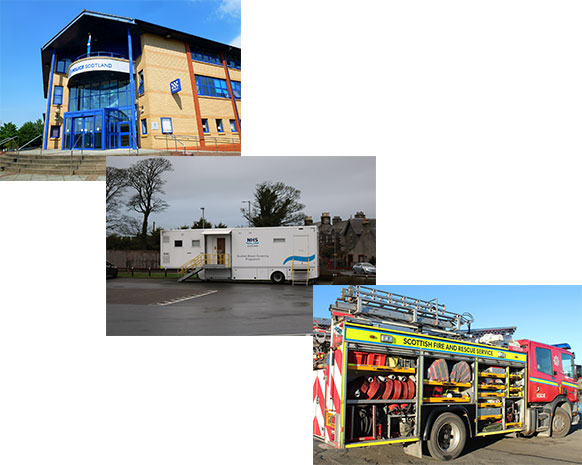
Local government in Scotland operates in a landscape where no single organisation can deliver the outcomes that communities need on its own. Councils are expected (and in certain cases are legally required) to work in partnership with other public bodies. This collaborative approach reflects the reality that challenges, such as health, poverty and economic wellbeing, cross-organisational boundaries and require joint solutions.
Councils can also create Arm’s Length External Organisations (ALEOs) to deliver specific services and functions such as leisure, culture, property management or economic development. ALEOs are separate legal bodies – they are often charities or companies – but they remain accountable to the council for delivering their objectives.
There are many partnership bodies that a councillor can be appointed to as a representative of the council. The two major partnerships are Community Planning Partnerships and Integration Authorities.
Community Planning Partnerships
Every council in Scotland is part of a Community Planning Partnership (CPP), a statutory body that brings together councils, NHS boards, police, fire services, colleges, other public bodies, the third sector and community representatives to plan and deliver better local outcomes. A CPP’s purpose is to focus partners’ collective efforts on improving services and reducing inequality across the local area.
CPPs give councillors a role in helping to align local priorities, championing community voices and ensuring that collaboration across public service organisations leads to meaningful change for communities.
Integration Authorities

Under the Public Bodies (Joint Working) (Scotland) Act 2014, each council and NHS board must jointly establish an Integration Authority (IA) to plan and fund integrated health and social care services. Most areas use an Integration Joint Board (IJB) as the body corporate model, whereas in the Highlands an Integration Joint Monitoring Committee (IJMC) is used.
IAs bring together councillors, NHS board members, third sector organisations, professional advisers, carers and service‑user voices to shape local health and social care strategy and investment.
Some councillors are appointed to decision-making roles on an IA, which brings with it additional responsibilities that will require time and personal resilience.
Councillors who are not appointed to such roles will still make decisions about how much funding the IA receives from the council, as well as scrutinising how health and social care services are planned and delivered effectively to meet the needs of communities.
With social care being one of the biggest areas of expenditure for councils, and with demand for services increasing, integration of health and social care will continue to be a major challenge for councillors.
Activity: Reflecting on what councils do
Use the space below or the Learning Journal to reflect on what councils do. Did it match your expectations? Which areas would you need to investigate further?
3 An overview of local government finance

If you decide to stand and are successful in being elected, you will be a member of a council responsible for setting a balanced budget and spending hundreds of millions, if not billions, of pounds of public money.
To be an effective councillor you will need to able to make choices about where and how the council spends this money. Understanding the financial context is crucial for appreciating the challenge that councillors face in balancing budgets and sustaining services.
All the statutory and discretionary services that your council provides need to be paid for. It is important to understand how councils are funded and some of the limitations that they have in being able to spend their budget as they wish.
3.1 Sources of funding
Council budgets are separated into two distinct areas:
- revenue funding for day-to-day services
- capital funding for infrastructure.
Although capital funding cannot be used to run day-to-day services, it will contribute to delivering those services by ensuring that the critical infrastructure that services require – such as land, buildings and equipment – are in place.
Revenue funding
The Scottish Government provides a block grant to councils that makes up around 85% of their net revenue expenditure (Scottish Government, n.d. 1). This block grant has three parts:
- The general revenue grant (GRG), provided to councils by the Scottish Government to support their core local services. Most of this money is not ring‑fenced, giving councils the flexibility to allocate it according to local priorities. However, some elements of the GRG are linked to national policy commitments. While this does not mean that the money is formally ring‑fenced, these amounts are given with the expectation that councils will use them for the intended services (Audit Scotland, 2025).
- Non‑domestic rates (NDR) are taxes on business properties, set and pooled nationally but raised locally. The total income is redistributed to councils using a formula agreed with the Convention of Scottish Local Authorities (COSLA). Each council receives a share based on its latest income returns, helping fund local services as part of overall revenue funding.
- Specific revenue grants are ring‑fenced funds that councils must spend on specific Scottish Government priorities. Allocations vary by council and are detailed in finance circulars. They support targeted policies such as:
- Gaelic language initiatives
- early learning and childcare expansion
- the Pupil Equity Fund
- criminal justice social work.
Councils also raise local funding to spend on the provision of services:
- Council tax, a local property tax paid by households that councils use to fund services. Councils can only set the Band D rate of council tax, with other band rates then calculated using nationally set multipliers based on 1991 property values (Local Government Finance Act 1992).
- Fees and charges such as parking charges, waste collection or leisure services. Councils can only charge for services where legislation allows it.
From July 2026 councils will also have the power to introduce a visitor levy – commonly known as a ‘tourist tax’ – on overnight accommodation. It will be up to individual councils whether they introduce a visitor levy in all or part of the council area. The funds generated from the levy must be used on services or facilities used by tourists (Scottish Government, n.d. 2).
While council tax, fees and charges are important levers for financing local services, national funding makes up the majority of a council’s budget.
If your council has housing stock, it is required to have a Housing Revenue Account (HRA). This is a ring‑fenced account that the council must maintain to record all income and expenditure related to its housing stock. HRAs must include rental income, income from selling or investing in HRA assets, and expenditure on managing, maintaining, repairing and improving council housing, as well as loan charges for housing‑related borrowing. HRAs are expected to be self‑financing (meaning that income must cover expenditure) and they cannot end the year in deficit (Scottish Government, 2026).
Capital funding
Capital funding supports Scottish councils’ investment in long‑term assets such as schools, roads, buildings, vehicles, and other infrastructure that lasts more than one financial year.
The Scottish Government provides two main types of capital grants:
- A general capital grant forms part of the annual Local Government Finance Settlement and can be used for a wide range of capital projects aligned with local and national priorities.
- Specific capital grants are also part of the annual Local Government Finance Settlement. They are ring‑fenced and must be used for particular projects.
In addition to government grants, councils finance capital spending through:
- borrowing
- capital receipts generated from selling council assets such as land or buildings – these can only be used for new capital investment or debt repayment
- revenue contributions from councils’ own revenue budgets or reserves.
There are strict rules on what a capital budget can be spent on. It cannot be moved over to the revenue budget (Falkirk Council, n.d.).
3.2 Long-term trends
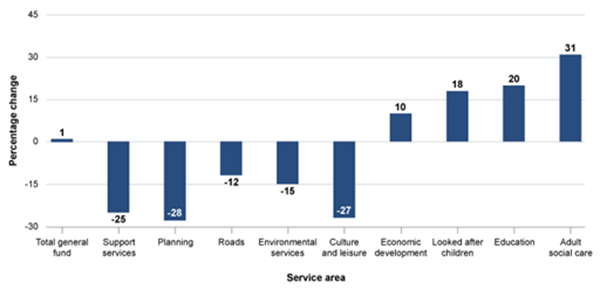
Data from the Local Government Benchmarking Framework (LGBF) (Improvement Service, n.d.) shows long-term trends that demonstrate a significant shift in the way councils have spent their budgets since 2010/11:
- adult social care: up 31%
- education: up 20%
- economic development: up 10%
- culture and leisure: cut 27%
- planning: cut 28%
- support services: cut 25%.
These trends point to a prioritisation of statutory services like education and social care, while discretionary services such as culture and leisure have faced deep cuts (LGBF, n.d.). This highlights the challenges facing councillors when it comes to setting a balanced budget. The need to prioritise the budget for the two biggest areas of council spending (education and social care) will have a major impact on funding for services that communities also rely on, and which can often be more visible (e.g. roads, parks or leisure spaces).
The Accounts Commission highlighted the budget pressures that councils are facing despite increased funding, with a revenue budget gap of around 3.4% of total revenue budgets in 2025–26 (Audit Scotland, 2025). This pressure is mostly due to:
- inflation and rising energy costs
- annual pay settlements and higher employer National Insurance contributions
- growing demand for social care and education.
With councils forecasting further gaps in years to come, their ongoing financial health will be challenging. Without significant fiscal reform or new revenue sources, councils will remain under pressure to make difficult trade-offs between statutory obligations and discretionary services.
4 The governance of Scotland
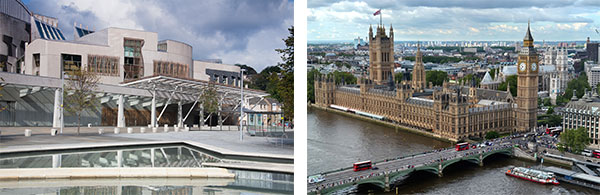
Councils in Scotland are an elected sphere of government, along with the Scottish and UK Parliaments.
It is important for prospective candidates to understand the relationship between the different governments and parliaments that contribute to the governance of Scotland because, ultimately, this impacts how councils are financed and what they do.
Community councils are also a part of the governance of Scotland, although they have limited powers and budgets, and very few require contested elections.
There will probably be one or more community council(s) operating in the electoral ward you may choose to stand in, so you should take some time to find out how many there are and what areas they cover.
The following video has more information about community councils (Improvement Service, 2018).
Transcript
UK Parliament
The UK Parliament is the supreme legislative body of the United Kingdom and comprises three parts:
- Sovereign (Monarch)
- House of Commons (650 elected MPs)
- House of Lords (appointed members).
It possesses legislative supremacy, holding ultimate authority and retaining power over reserved matters across the UK. Its functions include passing laws and public expenditure, as well as scrutinising the UK Government.
The UK Parliament sets its budget, which determines the size of the block grant allocated to Scotland through the Barnett Formula (Keep, 2026). This grant forms the largest portion of the Scottish Government’s funding and is adjusted based on changes in spending on comparable services in England. While Scotland has devolved tax powers, UK budget choices directly shape the resources available for Scottish public services and policy priorities.
The Scottish Parliament was established in the UK Parliament’s Scotland Act 1998 and was given the power to make laws on a range of issues known as devolved matters. The UK Parliament retains the power to make laws for Scotland on reserved matters.
UK Government
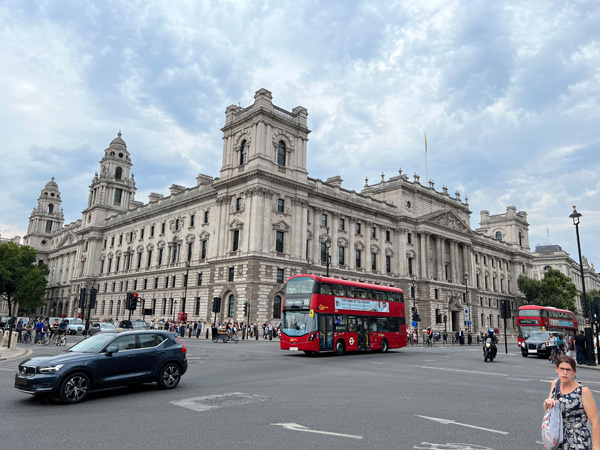
Comprising the Prime Minister, Cabinet and junior ministers, the UK Government has executive power and delivers national policies through introducing legislation, managing public services and overseeing taxation at the UK level.
It relies on parliamentary approval for laws and spending, and is accountable to MPs and Lords. Its authority is limited in areas that have been devolved to the Scottish Parliament, Welsh Parliament/Senedd Cymru and Northern Ireland Assembly.
The Scottish Parliament and the Scottish Government
Watch the following video describing the Scottish Parliament and Scottish Government, and the relationship between the two bodies:
Transcript
The Scottish Parliament is the law-making body in Scotland for devolved matters. It comprises 129 Members (MSPs) directly elected by the people of Scotland. The powers and duties of the Scottish Parliament are set out in legislation passed by the UK Parliament.
The Scottish Parliament is responsible for making laws and holding ministers to account. The Scottish Government, led by the First Minister, runs the country by developing policy and implementing legislation in areas that are devolved to Scotland.
Local government is a devolved issue and therefore falls within the legislative competence of the Scottish Parliament..
Local government’s position in Scotland and the UK
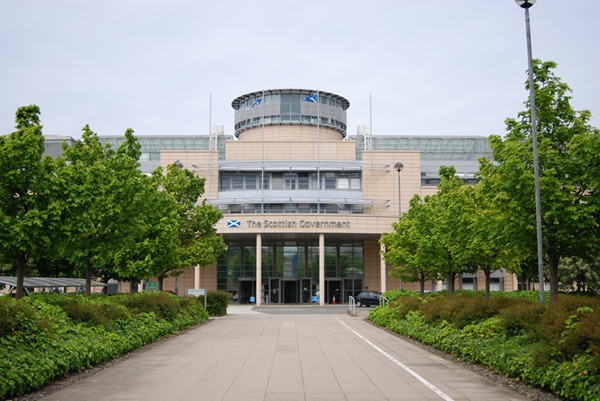
Local government in Scotland operates in a ‘multi-level governance’ environment. As covered previously in the section ‘What do councils do?’, councils in Scotland are public bodies created by UK legislation, whose functions and powers are conferred by Acts of the UK and Scottish Parliaments.
As covered in ‘An overview of local government finance’, councils are also in a dependent financial position. The decision taken each year by the Scottish Parliament on the Local Government Finance Settlement has a substantial and direct impact on councils’ overall budgets, influencing the level of services that they are able to deliver. While the Scottish Parliament has devolved tax‑raising powers, the size of its overall budget – and, consequently, the funding available to local government – is itself affected by spending decisions taken by the UK Parliament. As a result, councils’ financial position is shaped by decisions made at both devolved and reserved levels of government.
While councils depend on decisions taken by the Scottish and UK Parliaments, the dependency can be reciprocal. Both Parliaments rely on councils to deliver many statutory functions and public services that are essential to achieving national policy objectives. Where local and national priorities align, councils play an important role in shaping national policy objectives into effective local delivery,
There is regular, ongoing dialogue between the respective spheres of government across a whole range of policy issues, and councillors can be involved in discussions with central governments about the local implications of national policies.
5 What do councillors do?
The differences between councils – in terms of geography, population and number of councillors – impacts how they carry out their roles and responsibilities. A councillor in East Renfrewshire may experience the role quite differently from a councillor in nearby Glasgow.
Councillors working for the same council can also have different experiences. For example, the experience of a senior councillor who is part of the political administration is likely to be quite different to that of a non-administration councillor with no senior position.
For Island councils that operate without political administrations, councillors are still appointed to senior positions (Leader of the Council, Provost, Convener/Chair), which shapes their workload and level of public scrutiny.
Appointments to outside bodies and partnership organisations will also result in varying responsibilities, time commitments and level of public scrutiny.
This course is designed to help you prepare for elected office by building your understanding of local government in Scotland and the roles and responsibilities of a councillor. You will also need to undertake your own research into the council you wish to stand for election to and reflect on how different roles may influence the expectations placed upon you.
I would advise prospective candidates to look at what days council meetings are typically held. This will help them to understand whether they will be able to regularly participate in meetings and undertake their key duties.
5.1 The roles and responsibilities of a councillor
You don’t have much hard power as a councillor. You have only one vote.
You do have soft power, though – that is, the ability to influence and persuade others that your position on an issue is right. Being able to do that is key to getting things done and making a difference.
Becoming a councillor is a significant and rewarding commitment. The position would place you at the heart of local democracy, shaping services and helping improve outcomes for the people you represent.
It is not without its challenges. Legally and constitutionally, the councillors who are elected are ‘the council’. The powers and duties collectively lie with all the councillors. This requires councillors to govern the organisation and make difficult choices about where finite resources should be spent and how much funding needs to be raised locally to deliver services.
Community leadership

A key role of a councillor is to be a community leader.
If elected, this will require you to be visible, accessible and responsive to the concerns of the electorate. This includes what is typically known as casework: helping to make things right if they don’t get the service and support they should. It can also involve helping individuals or groups to navigate public services and signposting people to where they can get support with their issue.
Being an effective community leader also means championing local voices and ensuring their perspectives are taken into account in council decisions. Councillors also need to communicate council policies back to communities and explain why decisions have been taken. Increasingly, councillors are expected not only to represent communities and take decisions on their behalf, but also to encourage and support wider public participation in local democratic decision-making.
Decision‑making
Councillors take key decisions, such as setting the council’s budget and agreeing policy proposals that determine how the council’s resources are used. This will primarily happen through participation in full council and committee meetings, although there will be a significant amount of time needed outside formal meetings to attend briefings and read papers on the issues that will be put before you.
A council can do anything provided there is a budget to do so, it is legal, and you convince a majority of councillors to support it.
You should check whether your council operates any online or hybrid meetings, where you can join the meeting remotely using videoconferencing technology. This won’t necessarily be an option for every meeting, but where applicable, it could allow you greater flexibility to attend meetings and take decisions.
Strategy and policy development
Councillors collectively set the strategic direction of the council. If elected, you will play a role in shaping strategy and policy through committees, party groups or informal discussions with officers and councillors. To be effective a councillor must:
- understand existing strategies and policies
- assess whether they are suitable for local communities
- contribute to the development of new approaches where needed.
Scrutiny
Scrutiny is a vital part of good governance by councillors and includes:
- monitoring the performance of services
- ensuring that public money is well spent
- checking that policy decisions deliver the intended results.
If elected, you may find yourself sitting on a formal audit or scrutiny committee; even if you do not, you will still have an ongoing responsibility to question, challenge and evaluate the council’s work.
Partnership working
Councils are expected to work with many partner organisations to deliver more effectively for local people and improve outcomes. Collaboration and joined-up working is key. Consider these examples:
- If the council decides to cut local youth clubs, it may bring a cost saving in the short term. However, the police and criminal justice system may experience increased pressure if the closures result in increased anti-social behaviour among youths.
- If the NHS board in your area reduces its capacity for mental health support for young people, this may result in schools experiencing an increase in complex behavioural and wellbeing issues in pupils who require specialist support.
In both examples, savings are made for one public body at the expense of another.
There can be all sorts of consequences from decisions taken by public bodies. Therefore, having effective partnership arrangements in place to support better collaboration between public service partners is crucial.
Councillors help shape and scrutinise partnership arrangements, ensuring that collaboration is effective, transparent and focused on the needs of citizens. As we have covered already, councillors will be appointed to sit on boards and committees of various partnerships such as a CPP or IA.
Regulatory duties
Some councillors will serve on regulatory or quasi‑judicial committees such as planning or licensing. These roles are bound by legislation and require impartiality, training and adherence to the Code of Conduct for Councillors.
If you are elected and find yourself having to make decisions on planning or licensing applications, you will have to undertake mandatory training to understand the specialist requirements of these regulatory functions.
For me, being a member of the Planning Committee has been very rewarding. The decisions you take, or in some cases do not take, will have a lasting impact on the built environment people will hopefully enjoy for many years to come.
Party political or group role
If you are elected through a party, you may have additional responsibilities, such as:
- participating in group meetings
- engaging with local party members
- contributing to party policy discussions.
If you are a member of a political party, you may wish to speak to a sitting councillor in that group to understand what will be expected of you.
5.2 Balancing your roles and responsibilities

All these roles and responsibilities mean that being a councillor is not only demanding but also deeply impactful. The roles can be complementary but may also occasionally conflict with each other at times.
As community leaders democratically elected by people in the ward, it is natural for councillors to scrutinise how a policy or decision would affect that ward when sitting on a policy development or decision-making committee. Done properly, a councillor may be able to influence changes to proposed policies or the implementation of the policies that are better for individuals and communities in that ward. This can be a strength of local democracy, where the community leadership, scrutiny, strategy and policy development and decision-making roles work together to bring a better outcome for people and communities.
However, councillors are expected to take a decision in the best interests of people across the whole council area and not just people in their ward. The reason for this is simple: if all councillors simply advocated and voted for what was best for their ward or a few vocal individuals, it could be very difficult to develop and agree on effective strategies and policies that use the council’s powers, duties and resources effectively – ultimately resulting in poorer services for everyone.
If elected, you will need to learn to navigate these tensions and find a balance between the various roles and responsibilities.
5.3 Time commitment
The minimum commitment a councillor needs to make is to attend one formal council meeting every six months (Local Government (Scotland) Act 1973).
In reality, if you choose to stand to make a difference to people’s lives, becoming a councillor will involve a much more significant time commitment. Findings from a review into changes of councillors’ pay and expenses (Scottish Government, 2024) found that:
- more than half of councillors spend at least 26 hours a week on formal council duties
- almost half of councillors spend more than 16 hours a week on informal duties
- some councillors do far fewer hours but others reported spending more than 80 hours a week on councillor duties – especially if they held a leadership role
- 42% say their councillor role is full-time
- more than half of councillors have an additional full-time or part-time job
- nearly 60% of councillors are frequently approached for help whilst not engaged in council duties.
Prioritise your family and personal commitments, and make sure that you know how to manage your time. It can be all-encompassing and you need to ensure you carve out time for yourself so that you can give your best to the role.
Enjoy it! It is an enormous privilege. You will meet so many amazing people and be able to really make a difference to people’s lives.
A councillor’s duties include:
- reading meeting papers
- taking part in council and committee meetings
- holding surgeries and carrying out casework
- attending community council meetings
- attending local events.
There is flexibility as to when councillors can do their work, although this often means carrying out duties during evenings and weekends.
It can be a very stressful role that requires multi-tasking, so it is important to look after your health and wellbeing. I love the flexibility in between the different events, committees and surgeries. It has been a wonderful life learning experience.
5.4 Code of Conduct for Councillors

The Code of Conduct for Councillors (Scottish Government, 2021) outlines the conduct expected of councillors. You will need to comply with the ethical standards outlined in the Code should you be elected.
Areas covered by the Code include the following:
- General conduct: Councillors must behave respectfully towards everyone, including fellow councillors and employees of their local authority, when they are acting in the capacity of a councillor. The Code makes it clear that bullying and harassment are not acceptable.
- Gifts and hospitality: Councillors are permitted to accept gifts or hospitality only in very limited circumstances. This is to stop people or organisations from giving them gifts or offering hospitality to try to influence the decisions they make.
- Confidentiality: Councillors are often told things in confidence or given information that is not to be made public at that time. They must keep such information confidential, even if they think it should be made public.
- Registration of interests: Councillors must declare and register relevant financial and non-financial interests to ensure openness and transparency, and to prevent conflicts of interest.
- Declaration of interests: Councillors may have connections to matters being discussed by their council through their relationships with other people and organisations. Any conflicts of interest should be declared publicly. Councillors must not take part in discussing or deciding on a matter where an interest they have could be seen to influence them.
- Lobbying: Councillors might be lobbied by people with a particular interest; there are rules about how councillors should deal with anyone who attempts this.
- Quasi-judicial and regulatory decision-making: An outline of what councillors can and cannot do when making decisions on quasi-judicial and regulatory matters, such as planning and licensing applications.
If elected, you will receive advice and training on how to comply with the Code of Conduct for Councillors. It will be important that you quickly become familiar with your obligations.
Civility in public life
COSLA has spoken out on the rising abuse, intimidation and misinformation that councillors face, often amplified on social media, that are undermining local democracy. Robust debate is vital, but when discourse becomes threatening or toxic, it damages democracy and deters capable people from serving their communities (COSLA, 2025).
The Jo Cox Foundation urges candidates to commit to a civility pledge, which means:
- using a civil tone
- acting with integrity and compassion
- treating others respectfully.
This helps create a healthier political environment where diverse voices feel safe to participate.
If you choose to stand for election, we would encourage you to take the pledge. Details about the civility pledge can be found on The Jo Cox Foundation’s website (n.d.).
5.5 Working with council officers
If you are thinking about standing for election as a councillor, it’s important to understand how you will work alongside council officers. Both play essential roles but contribute in different ways, as shown in the following table.
| Question | Councillors | Council officers |
|---|---|---|
| What do you do? | Set the council’s overall direction Approve policies and budgets Scrutinise how services perform Represent local people if they need help |
Ensure that the council operates within the law Manage the resources that the council has delegated to them Deliver services to the standard agreed by the council Provide the professional advice that councillors rely on when making decisions |
| Where does your authority come from? | The democratic process – they have been elected by local citizens |
Having been appointed through a lawful recruitment process based on their qualifications, experience and professional position |
The two roles are distinct, but they overlap and depend heavily on one another if the council is to deliver effectively for communities. Effective councillor–officer working relationships rely on respect for each other’s authority. This relationship is often described as ‘strategic versus operational’ or ‘steering versus rowing’: councillors set the political direction (strategic/steering) while officers handle delivering it (operational/rowing).
In practice, the boundary isn’t as clear as that. For example:
- When undertaking casework, a councillor can find out detailed operational knowledge of how a service works. This could lead to that councillor considering how changes to council strategies, policies or budget could lead to a better outcome.
- If a member of the public hasn’t received the service they are entitled to, a councillor can ask officers why this is and what can be done about it.
You can go to officers and point your finger at them and demand this and that. I’ve found it’s better to say ‘I’ve got this problem, can you help me?’ Officers are human beings and you need to remember that.
The role of council officers is also more complex than implementing policy that councillors have developed and agreed. Officers contribute their detailed professional knowledge to policy development and budget decisions by advising on what is realistic, legal and deliverable. Officers therefore need to understand the politics of the council and be aware of what policies councillors are likely to support or oppose.
So the idea that councillors ‘steer’ and officers ‘row’ doesn’t convey the complexities of the relationship. If you choose to stand and are elected, it may take you some time to understand the distinctive but complementary roles of a councillor and officer.
Strong working relationships really come down to trust and respect. Officers need to get where the council is coming from – its priorities, its values and the political direction shaping decisions. And councillors need to feel confident that the advice they’re getting from officers is professional, impartial and grounded in evidence. Councillors bring the democratic mandate, officers bring the technical expertise – and you need both working well together for good governance.
The advice I give to any prospective councillors is: your leadership matters but you never lead alone. For the council to work well, councillors and officers need to work as a genuine partnership. Each will bring different strengths, but they should share a common purpose to deliver the best outcomes for local communities.
Have a go at the following activity to learn what actions are appropriate for a councillor to take when working with officers.
Activity: What can a councillor do?
a.
True
b.
False
The correct answer is a.
Answer
This is true, although a council officer may not be able to share certain information, such as legal advice.
a.
True
b.
False
The correct answer is a.
Answer
This is true, as long as it is done respectfully.
a.
True
b.
False
The correct answer is b.
Answer
This is false. It is a breach of the Code of Conduct for Councillors to instruct an officer to do this.
a.
True
b.
False
The correct answer is b.
Answer
This is false. A report is the responsibility of the officer who has prepared it.
a.
True
b.
False
The correct answer is a.
Answer
This is true. You are entitled to raise concerns about the performance of a service and ask what can be done to make improvements. You should do so respectfully and not publicly criticise individual officers who have no right to reply.
a.
True
b.
False
The correct answer is b.
Answer
This is false. While councillors have a right to access plenty of information held by the council, there are certain restrictions.
Activity: Reflecting on what councillors do
Use the space below or the Learning Journal to reflect on what councillors do. Did it match your expectations? Which areas would you need to investigate further?
6 Summary

We hope that this course has been helpful with your understanding of:
- what councils in Scotland do, including their powers and the broad financial context that they operate in
- the relationship between local government, the Scottish Parliament and the UK Parliament
- the broad roles and responsibilities of a councillor, including time commitments, expectations on ethical standards and working with council officers.
Do not be overawed at this point if you are thinking of standing for election: should you be elected, you will receive support. While this course should have helped you prepare for elected office, you will need to undertake a full and comprehensive induction provided by your council should you be elected.
Don’t be afraid to ask questions, learn and listen. There is a huge amount of information to pick up at first, but nobody expects you to be an expert in local government after a few weeks or months.
I hated it for the first four months as I felt I would never know everything – but once I realised that everyone has their area of specific focus or knowledge, and that you can lean on and learn from others, I soon realised I loved it. It is a role like no other and one that is always varied and interesting, and allows you to contribute to your community.
If you decide to stand, you should speak to your council’s elections team no later than the date of your nomination to find out when induction events will be held and what you are expected to attend. Even then, many councillors indicate that it takes them at least six months to a year to understand their responsibilities, and longer still to feel fully confident in carrying them out.
I thought I would need a break after a tiring campaign and hadn’t realised there would be a comprehensive induction provided by the council. I ended up missing important induction events, and it took me a lot longer to get up to speed with what I was there to do.
Additional support
Finally, if you haven’t already done so, please visit the Improvement Service website for local council candidates and the Electoral Commission’s webpages for candidates for local government elections in Scotland (n.d.).
These resources provide important practical information that you will need to know about who can stand for election, what councillors get paid, whether you get time off work to attend council meetings, how to put yourself forward for nomination and much more.
Quiz

We have included a short, optional quiz for you to complete to check your understanding of the key messages in this course. This quiz can be completed as many times as you wish and there is no pass or fail mark.
Feedback will be given on any incorrect answers to help your learning.
7 Next steps

Once you’ve completed the course and the quiz, try the following activity.
Activity: Reflecting on the course/next steps
Use the space below or the Learning Journal to reflect on the course as a whole, including any new thoughts you may have had about what councils and councillors do. What will you do next?
References
Audit Scotland (2025) ‘Local Government Budgets 2025/26’, briefing, May [online]. Available at https://audit.scot/uploads/2025-05/briefing_250522_council_budgets.pdf (accessed 4 March 2026).
Convention of Scottish Local Authorities (COSLA) (2025) ‘Raising the standard: a call for civility in public life’, News, 28 May [online]. Available at https://www.cosla.gov.uk/news/2025/may/raising-the-standard-a-call-for-civility-in-public-life (accessed 5 March 2026).
Dundee City Council (n.d.) ‘Strategic overview’, Council Plan 2022–2027 [online]. Available at https://www.dundeecity.gov.uk/council-plan-2022-2027/strategic-overview (accessed 20 April 2026).
Electoral Commission (n.d.) ‘Council elections in Scotland: guidance and resources that you need if you are a candidate or agent at council elections in Scotland’ [online]. Available at https://www.electoralcommission.org.uk/our-guidance/candidate-or-agent/council-elections-scotland (accessed 5 March 2026).
Falkirk Council (n.d.) ‘Explaining our budget and finances for 2025–2026’ [online]. Available at https://www.falkirk.gov.uk/budgets-spending-and-performance/explaining-our-budget (accessed 4 March 2026).
The Highland Council (2026) ‘Geography’, 16 January [online]. Available at https://www.highland.gov.uk/planning-area/highland-profile-key-facts-figures (accessed 20 April 2026).
Improvement Service (n.d.) ‘Local Government Benchmarking Framework’ [online]. Available at https://www.improvementservice.org.uk/products-and-services/data-intelligence-and-benchmarking/local-government-benchmarking-framework (accessed 25 March 2026).
Improvement Service (2018) ‘What is a community council?’, YouTube, 16 October [online]. Available at https://www.youtube.com/watch?v=3aP-sM6x1SU (accessed 4 March 2026).
The Jo Cox Foundation (n.d.) ‘Civility Pledge’ [online]. Available at https://www.jocoxfoundation.org/our-work/respectful-politics/civility-pledge/ (accessed 5 March 2026).
Keep, M. (2026) ‘The Barnett Formula and Fiscal Devolution’, research briefing, House of Commons Library, 22 January [online]. Available at https://commonslibrary.parliament.uk/research-briefings/cbp-7386/ (accessed 25 March 2026).
Local Councillor [online]. Available at https://www.localcouncillor.scot/ (accessed 5 March 2026).
Local Government Benchmarking Framework (LGBF) (n.d.) ‘Explore the data’ [online]. Available at https://www.improvementservice.org.uk/benchmarking/explore-the-data (accessed 25 March 2026).
Local Government Boundary Commission for Scotland (2014) ‘Fifth Reviews of Electoral Arrangements: Guidance Booklet’, pp. 13–14 [online] Available at https://www.boundaries.scot/wp-content/uploads/2025/09/Guidance_Booklet_1758892799.pdf (accessed 4 March 2026).
Local Government in Scotland Act 2003 [online]. Available at https://www.legislation.gov.uk/asp/2003/1/contents (accessed 4 March 2026).
Local Government Finance Act 1992 [online]. Available at https://www.legislation.gov.uk/ukpga/1992/14 (accessed 4 March 2026).
Local Government (Scotland) Act 1973: ‘Resignation and Vacation of Office’ [online]. Available at https://www.legislation.gov.uk/ukpga/1973/65/part/III/crossheading/resignation-and-vacation-of-office (accessed 4 March 2026).
National Records of Scotland (2025) ‘Mid-2024 population estimates’, 14 August [online]. Available at https://www.nrscotland.gov.uk/publications/mid-2024-population-estimates/ (accessed 4 March 2026).
Scottish Government (2021) ‘Code of Conduct for Councillors’, December [online]. Available at https://www.gov.scot/binaries/content/documents/govscot/publications/regulation-directive-order/2021/12/code-conduct-councillors-2/documents/code-conduct-councillors/code-conduct-councillors/govscot%3Adocument/code-conduct-councillors.pdf (accessed 4 March 2026).
Scottish Government (2024) ‘Councillors’ remuneration and expenses: recommendations’, 16 February [online]. Available at https://www.gov.scot/publications/recommendations-councillors-remuneration-expenses/pages/16/ (accessed 4 March 2026).
Scottish Government (2025) ‘Scottish Local Government Finance Statistics 2023–24’, 18 February [online]. Available at https://www.gov.scot/publications/scottish-local-government-finance-statistics-2023-24/documents/ (accessed 4 March 2026).
Scottish Government (2026) ‘2. Revenue expenditure and income’, in Scottish Local Government Finance Statistics 2024–25, 5 February [online]. Available at https://www.gov.scot/publications/scottish-local-government-finance-statistics-2024-25/pages/2--revenue-expenditure-and-income/ (accessed 4 March 2026).
Scottish Government (n.d. 1) ‘Local government’ [online]. Available at https://www.gov.scot/policies/local-government/local-government-revenue/ (accessed 4 March 2026).
Scottish Government (n.d. 2) ‘Tourism and events: Policy actions 3 of 3 – Local visitor levy’ [online]. Available at https://www.gov.scot/policies/tourism-and-events/tourism-tax-discussion/ (accessed 4 March 2026).
The Scottish Parliament (2018) ‘There shall be a Scottish Parliament – Scottish Government’, YouTube, 9 November [online]. Available at https://www.youtube.com/watch?v=wdSO0Ldx5R0 (accessed 4 March 2026).
Acknowledgements
Grateful acknowledgement is made to the following sources:
Homepage
Course image: Virtual-Pano/Wikimedia Commons; this file is licensed under the Creative Commons Attribution-Share Alike licence (https://creativecommons.org/licenses/by-sa/4.0/deed.en)
Video: provided by Improvement Service
Introduction
Kelpies: Ben Carless/Unsplash
Section 1
Map: adapted by Improvement Service; Crown Copyright and database right (2026) and Scottish local authority from the Spatial Hub
Orkney Islands Council sign: Improvement Service
Section 2
Classroom: JackF/Getty
Bins: Nareeta Martin/Unsplash
Snow plow: Mark Thomas/Pexels
Montage: police, David Cameron/Govan Police Office under a CC BY SA licence (https://creativecommons.org/licenses/by-sa/2.0/deed.en); NHS, Billy McCrorie/Wikimedia Commons under a CC BY-SA 2.0 licence (https://creativecommons.org/licenses/by-sa/2.0/deed.en); fire, Billy McCrorie/Wikimedia Commons under a CC BY-SA 2.0 licence (https://creativecommons.org/licenses/by-sa/2.0/deed.en)
Holding hands: National Cancer Institute/Unsplash
Section 3
Budget: Vitalii Petrushenko/Dreamstime
Social care: Age Cymru/Unsplash
Long-term trends: produced by The Open University from data by Improvement Service (https://www.improvementservice.org.uk/benchmarking/explore-the-data)
Section 4
Montage: Scottish Parliament building, Nigel Stripe/Getty Images; Westminster Parliament, krychkovskyi/123RF
UK Government building: Ferdi2005/Wikimedia Commons; this file is licensed under the Creative Commons Attribution-Share Alike licence (https://creativecommons.org/licenses/by-sa/4.0/deed.en CC BY-SA 4.0)
Scottish Government building: Benjamin Brock/Wikimedia Commons under a CC BY-SA 3.0 licence (https://creativecommons.org/licenses/by-sa/3.0/deed.en)
Section 5
Mural: Giorgio Trovato/Unsplash
Recycling bag: ready made/Pexels
Code of conduct: made by the Standards Commission using Canva
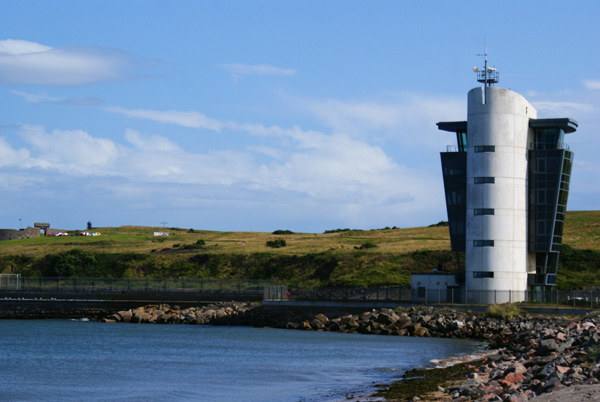
Marine operations centre: Gavin Kelman/Unsplash
True or false: Andrii Zastrozhnov/Dreamstime
Section 6
Congratulations: Torsten Asmus/Getty
Quiz time: kotoffei/Getty
Section 7
V&A: Steve Gilruth/Unsplash
Every effort has been made to contact copyright holders. If any have been inadvertently overlooked the publishers will be pleased to make the necessary arrangements at the first opportunity.