Use 'Print preview' to check the number of pages and printer settings.
Print functionality varies between browsers.
Printable page generated Saturday, 29 August 2026, 3:11 AM
Responding to safeguarding concerns
Welcome to Part 3

This final part of the course will help develop your knowledge about how you should respond to safeguarding concerns.
As part of this session, you will also see how both power and fear influence who speaks up about possible harm or abuse.
First though, you need to understand what is meant by ‘safeguarding concerns’, how you find out about them, and how you report them.
What is a safeguarding concern?
Earlier in the course, we discussed that safeguarding is about preventing any kind of harm or abuse from occurring.
To do this, it is important that we can recognise a safeguarding concern.
 |
| ‘A safeguarding concern’: What does this mean? |
A safeguarding concern is when you are worried about the safety or wellbeing of a child or adult because of something that is seen or heard, or information which has been given to you. It means a worry which needs to be reported. |
Think back to the first part of the course and the scenario about the youth ski training camp living conditions.

The following types of risks were identified:
- Missed education for the children increasing the risk of harm to their educational development.
- Unsafe water and sanitation facilities increasing the risk of harm to physical health.
- Lack of care and effective supervision as well as sub-standard sleeping conditions increasing the risk of harm to children’s emotional and mental health.
Concerns may be about actual harm or abuse, or they may be about situations that increase the risk of harm or abuse happening in the future.
How do you find out about safeguarding concerns?
 Finding out about safeguarding concerns
For each question below, there is a statement to read.
Decide which of these statements are common ways you may hear about safeguarding concerns.
There are six statements. Tick ‘yes’ or ‘no’ for each.
a.
Yes
b.
No
The correct answer is a.
a.
Media reports are sometimes the first way that we hear about a safeguarding concern.
a.
Yes
b.
No
The correct answer is a.
a.
Often staff will not realise why the behaviour is happening, but it will cause them to worry about the situation.
a.
Yes
b.
No
The correct answer is b.
b.
This is often very difficult for athletes or players to do. Especially children. They rarely talk if they are being harmed and often do not know what to do or where to go for help.
a.
Yes
b.
No
The correct answer is a.
a.
The correct answer is yes, parents and carers making a complaint is a common way to hear about a safeguarding concern, but often they do not know how to raise concerns about their children.
a.
Yes
b.
No
The correct answer is a.
a.
Recruitment processes need to be strong because they can help to prevent the wrong people from joining your organisation in the first place.
a.
Yes
b.
No
The correct answer is a.
a.
Yes! Sometimes this will be the first that we hear about a safeguarding concern and any information or report received should be treated confidentially and acted upon.
|
| Should every concern be responded to? |
Notice how safeguarding concerns can come from a range of places. An important principle to remember is that although safeguarding concerns will vary in seriousness, every concern should be responded to. |
Why are athletes or players not likely to speak out?
Young rugby players not speaking out
Watch the following video scenario and think about this question:
What stops these players from speaking out?
Trigger warning: The following animation contains content related to abuse in sport which some viewers may find difficult or distressing. |
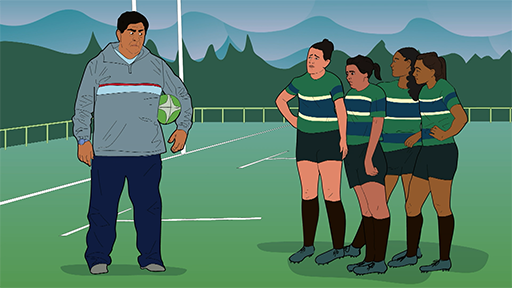
Transcript
Fear and being worried are often the main reasons for not speaking out.
For example:
- Fear of threats and negative actions (reprisals) against them and their family.
- Fear of being dropped from the team or not being selected for a competition.
- Being worried that they will get their coach into trouble.
- Fear that they will not be believed.
- Fear that other teammates would not believe what they say.
Many adults working in sport are passionate, committed and responsible. Unfortunately, some may misuse their position of trust and power for personal gain.
It can be very difficult for athletes or players, especially children, to tell someone they are being abused and they will only tell people who they trust and feel safe with.
Sometimes sexual abusers use ‘rewards’ like giving special attention, extra privileges, or gifts to certain athletes or players. This is part of a process called 'grooming'. The fear of losing these rewards is often very confusing for these athletes or players and can make it difficult for them to understand they are being abused or to tell someone about it.
Abusers may also ‘groom’ the adults around an athlete or player – by promising travel opportunities, money and fame. So, it can be very difficult for the athletes or players – who may be a child or a young adult – to know what to do as they want to make their family proud of them. If they tell someone about the abuse, their family may not allow them to continue playing the sport or be able to pay for them to compete in the sport.
It is important to note that many children who are abused do not speak out until they are adults or may never talk about their experiences. Experience of abuse as a child can have harmful long-term effects.
|
| How can I recognise a safeguarding concern? |
The least likely way you will find out about a child being abused is by a child telling you about it. Therefore, it is your responsibility to be alert and recognise and report safeguarding concerns at the earliest opportunity. Some signs of the possibility of child abuse include when a child:
|
Adults and reporting

Adults also face difficulties in reporting safeguarding concerns about others. There are many reasons for this.
Like children, adults may have fears such as:
- Fear that there will be negative consequences for them (e.g. loss of job or not picked for the team).
- Fear that they will get a colleague into trouble.
- Fear that they will not be believed.
Fear keeps people silent, and silence allows harm to continue. Adults may also fail to report concerns when they think it is someone else’s responsibility.
But as we know, safeguarding is everyone’s responsibility, and everyone should be supported to take action that is right. You can play an important role and so you must speak up if you have a concern.
|
| What is ‘poor practice’? |
People often talk about ‘less serious’ safeguarding concerns as ‘poor practice’. Poor practice is when people work in a way that falls short of expected standards as set out in a code of conduct. The relationship between poor practice and abuse is an important one to understand. |
The next section will help you think more about this.
How serious are these behaviours?
Read the following groups of statements.
For each statement, move the sliding circular marker to the right if you believe the behaviour should be rated more seriously, or to the left if you believe it should be rated less seriously.
In each group of statements, consider whether the next statement presented in the list becomes more or less serious than the previous one.
As you complete the activity, the feedback will ask what may happen if the least serious behaviour is not responded to.
What’s important here is that the behaviours may not seem that serious at the start, but we should be concerned and respond to all behaviours that are not in line with the code of conduct and not just those we believe are the most serious.
Remember, addressing what may seem like ‘lower-level’ concerns and poor practice can help serious harm from happening.
Even with behaviour that might seem less serious, if it becomes ‘the normal way we do things’, it can create an environment where abuse is more likely to happen. This is because everyone’s normal standards of behaviour are lowered. When you hear someone say “we have always done it like this” or “that’s the way it’s done here” you should be prepared to challenge them if it does not appear to be appropriate.
Remember, a good safeguarding tool to help prevent poor practice from becoming normal practice is the code of conduct you looked at in the second part of the course. This tool helps everyone know what good practice looks like.
|
| Why should I respond to lower-level safeguarding issues? |
Responding to lower-level safeguarding issues can help prevent more serious issues happening. |
How should you report concerns in your organisation?
Every organisation should have a clear way for people to report concerns about poor practice or abuse.
Why are internal reporting systems important?
As people become more aware of what safeguarding means in your sport, they will be more likely to raise safeguarding concerns, so internal reporting processes need to be ready for this.
Internal reporting processes must be linked to external expertise and the authorities (e.g. the police and child protection services) in each country. Poor practice concerns can be handled internally by the relevant disciplinary or ethics procedures of your organisation.
However, if a possible crime has occurred, it must be reported to the authorities.
What process should you follow?
Click on the image below and then follow each pathway through the slides. Think about who from your organisation should be part of your reporting process.
If your organisation’s process is unclear, or you don’t have one in place yet, you should work with local experts, such as social services, child protection services, the police and expert non-governmental organisations (NGOs), who can offer professional help to develop your system and make sure cases are properly investigated.
It is also a good idea to discuss this with other sports bodies, such as your Sports Federation, National Olympic Committee or Commonwealth Games Association, or other sports authorities.
|
| Who is responsible for investigating allegations of abuse? |
Responding to and investigating allegations of abuse are the responsibility of the authorities and trained professionals, such as the police and child protection services. Any internal investigation should be done after an official investigation by the police or other authorities is complete and they have agreed you can proceed. |
For more details visit www.safeinsport.org and see Safeguard 2: Developing a system to respond to safeguarding concerns of the International Safeguards for Children in Sport.
Closing thoughts and main messages

Congratulations, you have almost finished the course.
As you complete this final part of the course, you can see how you need a shared understanding across your organisation about how to respond to safeguarding concerns.
|
| The four main messages to take away from this final part of the course |
|
If you have enrolled, to get your Safeguarding Essentials Certificate you need to have viewed each page of this course and completed the end-of-course quiz.
Your welfare
You may have your own lived experience of harm and abuse, and may find some of the content in this course difficult and upsetting.
Please make yourself aware of the support services that are available to you through your manager, your organisation or within your community, so that you know how to access this support if you need to.
The next steps

You have now almost completed the Safeguarding Essentials course. You just need to take the end-of-course quiz to achieve your certificate and digital badge.
By completing the quiz and the course, you have started to think about what safeguarding is and the difference it should make to your sport. Yet it can be difficult to know where to start in putting all this information into practice.
The International Safeguards for Children in Sport has lots of clear information and examples to help you and covers eight Safeguards that will help your organisation make sport safer for everyone taking part.
Visit www.safeinsport.org to find out more.
|
Two important final messages are: |
|
Remember
Take the end-of-course quiz to achieve your certificate and digital badge.
Also, look out for the next online course to support this programme, which will be launched in 2024.
End-of-course quiz
A great way to check your understanding of this course
This end-of-course quiz contains 12 questions and the pass mark required is 70% and above to obtain the digital badge and course certificate.
If you don't pass the quiz at the first attempt, you are allowed as many attempts as you need to pass.
You can review the answers you gave, and which were correct/incorrect after each attempt has been completed.
Now go to the Quiz.