Use 'Print preview' to check the number of pages and printer settings.
Print functionality varies between browsers.
Printable page generated Monday, 14 September 2026, 1:39 AM
Unit 2: Context
2.1 Introduction to Unit 2: Understanding the context of change

In this unit we will focus on looking at the context of change; what are the factors affecting change, and the formal and informal spaces where change happens?
We will look at a range of different examples from around the world to help us to understand how variations in the context for change have implications on the strategies and tactics you should or could use as changemakers.
You will take some time to think more deeply about the change that you would like to focus on. Change may be about making progressive advances in laws, policies, norms or practices, but it could also be about resisting negative change occurring as a result of other factors, like attacks on human rights or the powerful few pursuing their own interests. By understanding the context of this change, you can begin to identify what specific actions you could take to contribute towards making the change happen.

 Learning outcomes
By the end of this unit you will:
- understand the wider context and factors affecting a change issue
- learn how to apply a change analysis tool to help you understand how change could happen
- understand the potential for conflict and how to navigate it
- envision the change you want to see.
2.2 Analysing the context of change
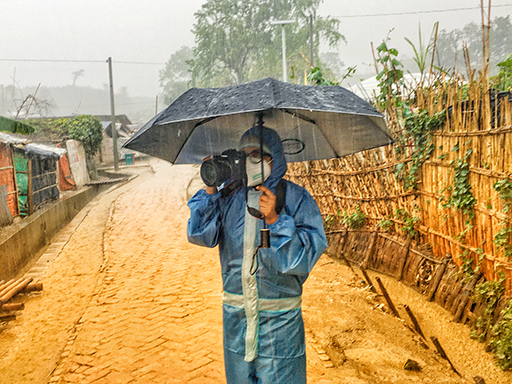
Analysing the external context is an important early step in understanding how change could happen on your issue and what your contribution could be. It encourages us to observe current trends, while also looking out for emerging issues. It enables us to take advantage of external opportunities for change, whilst also being conscious of the obstacles that exist. It is an exercise we should be reviewing regularly to stay alert to changes in the external environment and to help us adapt to them.
There are many ways of doing this. One well-known approach is to identify the political, economic, social and technological factors or trends that might affect the way change happens on the issue you are interested in.
This is known as a PEST analysis. It can also include an analysis of the legal and environmental trends (known as a PESTLE). These tools can be used to identify the national or global factors impacting on a specific change issue but can also be used and adapted to the local context for community-focused change issues. In the table below we have given you a few examples of the factors you may wish to consider, but there are many more.
| Factors at the global, national, local or individual level influencing the issue | Opportunities for change | Obstacles or constraints to change |
|---|---|---|
Politics and Power Dynamics e.g. elections, government policy, reform processes, leadership changes, decision-making timetables, public budget processes, changes in political space, new social movements, campaigns, capacity of citizen groups to engage in dialogue with institutions, international pressure, women’s participation | ||
Economics e.g. market trends, corporate interests, business practices, taxation, inflation, cost of living, minimum wage, recognition and value of care work | ||
Society and Culture e.g. public opinion, social norms, behaviours of public officials, public role models, shifting attitudes or beliefs, institutional cultures, religious influence, dialogue or tensions between different groups, position of the mainstream media, changing roles of different groups in society, gender norms, inclusion of racialised groups | ||
Technology e.g. changing communications and social media channels, changes in the way services are delivered, green technology, artificial intelligence, data collection | ||
Underlying, long-term trends and shifts e.g. climate crisis, demographic changes, resource degradation, drivers of conflict |
Remember an exercise like this is your own understanding of the context. People from other backgrounds and walks of life may have very different perspectives on the same context, and see opportunities where you see constraints, or the other way round. It is also important to remember that gender and intersecting identities are key considerations as we understand a PEST analysis. The more you can reach out to gain a diversity of perspectives when undertaking your context analysis, the more relevant and effective your changemaking efforts are likely to be.
 Activity 2.1: Analysing the context of change
Take some time to think through a PEST analysis for the change that you wish to see, that you visualised in Unit 1.
You can then ask yourself:
- What are key trends or factors that are most relevant for you or your community, and the change you are seeking?
- What specific opportunities or challenges might you need to take into account as you undertake your change activities?
Add your thoughts to the free text box, in the Make Change Happen Plan or in your own notebook.
In the next step we will be using a different analytical tool to help us think more clearly about how and where change happens and how we can map out a strategy for change. This will help inform what specifically needs to change and where we should put our energies as changemakers. This change analysis tool considers what the individual and systemic factors affecting change are, and the formal and informal spaces where change happens.
2.3 Applying a change analysis tool

Transcript
Watch the video to view a change analysis tool that can help you understand how change happens. The tool was developed as a way to think about gender equality, highlighting the ‘rules’ held in place by power dynamics within communities and to map a strategy for change. It is adapted from ‘Gender at Work’ by Rao, Kelleher and Stuart and locates change processes in four quadrants that all influence each other.
It is a useful way to build on your initial context analysis, guiding you in what questions to ask to better understand the issue you want to tackle, to recognise if change is already happening, and steering you in how you can foster change in a number of different ways. It presents a model of how change can happen.
There is an inter-connectedness between the different types of change in each of the four quadrants and change in one quadrant can influence or help change in other quadrants. Often all four of these quadrants are important for change to be significant and sustained. An assumption in this model is that if action is taken within multiple quadrants, change will potentially come about more quickly and ultimately be more lasting.
It is the task of the changemaker to identify where it is best to focus efforts across or within the quadrants to contribute to the positive changes that we want to see happen. It may be that certain quadrants are being adequately addressed by other groups in society, leaving the concerned activist to focus on where they can add most value to the challenge at hand. Different individuals and activist organisations will have different strengths in influencing in each of the quadrants. Different stages in the change process will generally require greater focus on certain quadrants, and less attention to others.
Sometimes using this tool helps identify areas of change that we might not have expected to be relevant but which are actually important to consider.
Example of applying this change analysis tool
Let’s consider the issue of the climate crisis and how all four of the quadrants are important to both understand the issue as it is now and to identify what needs to change to address it. The issue has roots in both individual and systemic responsibility, and in formal and informal responses. Therefore, change must happen in all these spaces to fully address it.
Formal and Systemic Change: Campaigning for the government to change or adopt policies to tackle or respond to climate changes.
This should be complemented by Informal and Systemic Change.
Informal and Systemic Change: Awareness raising and government incentives for significant numbers of individuals to change their attitudes and behaviours which contribute to the climate crisis, such as driving and flying less, changing what people buy or eat.
Formal and Individual/Collective Change: People and organisations having increased access to resources and money to make changes at home, in their community or in their organisation, such as installing solar panel or energy efficient devices.
This should be complemented by Informal and Individual/Collective change.
Informal and Individual/Collective Change: People having the confidence and knowledge to take personal responsibility for the choices they make.
As another example of this change analysis tool being applied to a real world issue, take a look at FRIDA’s ‘garden of change’. It looks in depth at the problem of young feminist leadership being undervalued and unrecognised in local social justice movements and what can be done to address this. Each quadrant identifies how greater access to resources and changed policies, attitudes, and norms can all contribute to a change wherein young feminist organisers are central to change movements.
Downloads
2.4 Examples of change from around the world
The map below features a selection of change stories involving individuals and communities all over the world, addressing changes in all areas of the four quadrants.
Choose to read at least three by clicking on the pins on the map. If you have any difficulty viewing this map, please go to the downloads area below for a PDF version of these change stories.
Using the change analysis tool that we discussed earlier, consider one of the examples that particularly interests you. Here are some guiding questions which may help you think about the change processes underway, though we appreciate you will not have all of the answers from these short descriptions.
- Was there a change in people’s awareness or belief that change is possible?
- Was there a change in peoples’ collective capacity to achieve change?
- Was there a change in formal institutions (policies, laws, rules, regulations)?
- Was there a change in informal cultural norms, attitudes, values and behaviours, etc.?
- Did the change happen as a result of a sudden event, or critical juncture, or was it part of an ongoing process?
Activity 2.2: Examples of change
Reflect on how the change analysis tool helps your understanding of the different case studies and how change happened in different situations? How does this understanding help inform how you could contribute to making change happen?
Add your thoughts to the free text box, in the Make Change Happen Plan or in your own notebook.
Downloads
2.5 A note about change and conflict
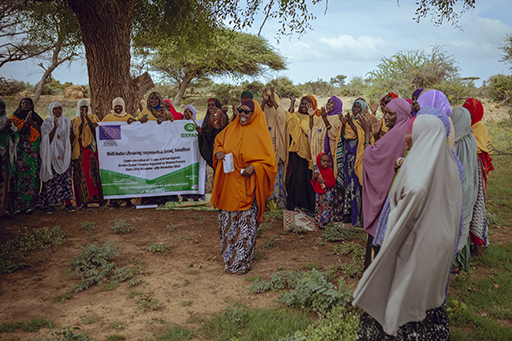
Making change happen is seldom an entirely peaceful process. If what you are trying to change challenges some people’s beliefs or interests, they are likely to oppose you, whether verbally or physically. Whether you are trying to achieve change at the national or local levels, you need to assess and monitor these risks and think about how you will manage them, for example, by being ready to counter verbal attacks, building solidarity or by building relationships with supporters in positions of power who can help defend against any aggression. We will cover more about assessing and mitigating these risks later in the course.
Questions to consider when thinking about conflict and risk as part of your analysis of the context include:
- Which groups of people are in conflict with each other? This does not need to be violent conflict, but what are the dividing lines along which people are separated?
- What are the issues that cause the most tensions between these groups? What are they competing over, or what drives their differences of opinion?
- How might these different groups perceive the kind of change that we are seeking to pursue? Which groups will support or resist it, and why?
2.6 Adapting to the context

Transcript
In this video we meet Chioma and Hadeel who share their experience of staying alert to and adapting to the changing context around the issues they are working on.
Oudai, Elena and Art also share their perspective on navigating conflict when working on change.
Changemaker Profiles:
Chioma Agwuegbo is Executive Director at TechHerNG and is convener of the #StateofEmergencyGBV Movement, a coalition of organisations igniting citizens to advocate for an urgent, comprehensive, and sustainable response to sexual and gender-based violence in Nigeria.
Sabah Khan is co-founder of Parcham, an organisation in India dedicated to breaking stereotypes based on religion, class, caste, gender and other markers of difference to create a society respectful of diversity.
Elena Mejia is a feminist rapper, organiser and facilitator working in Lima, Peru to address issues of gender justice, economic justice and narrative work for social movements in the Actua.pe labs.
Kelly Mundy is a Senior Campaign Manager for Oxfam Great Britain campaigning to tackle inequalities such as economic and gender, which undermine the fight against poverty.
Eric Njuguna is an organiser with Fridays for Future MAPA (Most Affected People and Areas) in Kenya, supporting protests aimed at putting pressure on world leaders to take action to advance climate justice and to amplify the voices of those most impacted by the climate crisis.
Hadeel Qazzaz is a Regional Gender Justice Coordinator for Oxfam International based in Ramallah, West Bank, and advocates for women's rights throughout the Middle East and North Africa region.
Art Reyes III leads an organisation called We The People: Michigan, that works to build multi-racial working class organising capacity in the state of Michigan, USA, fighting for a better state and community that all people deserve.
Neha Singh is an organiser who started a women's rights campaign called ‘Why Loiter?’ in Mumbai, India, that aims at reclaiming public spaces for women by loitering.
Oudai Tozan is a researcher and founding member of the Syrian academics and researchers network in the UK, working with the Syrian diaspora and those who experienced forced migration to mobilise, connect and support each other, but also to support Syria when the situation allows.
2.7 Understanding your change and defining change objectives
Having gone through your context analysis and got to know the change analysis tool, this is the opportunity for you to decide more specifically what the change you would like to see would look like in more concrete terms.
Having a clearly defined change goal will help you:
- Frame your change in a more specific way
- Identify specific objectives or key steps to achieve your goal
- Spot key stakeholders who have influence over what you want to achieve
- Determine your strategy and the tactics you will employ
- Develop your plan of action
- Monitor and evaluate your progress towards achieving your change goal and objectives
- Keep motivated throughout the highs and lows and to motivate others to join you.
We suggest you continue to use the change analysis tool we introduced earlier and apply it to your issue in order to help define the steps you and others will need to take in order to achieve change – your change objectives.
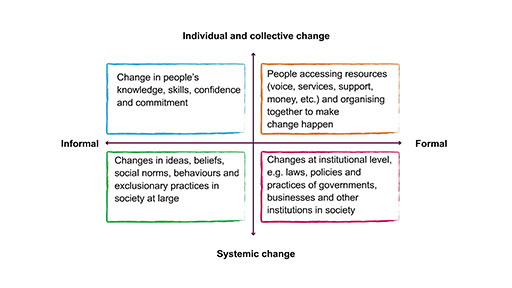
Consider the statements in each of the four quadrants and how they relate to the various challenges you need to address to achieve your vision of change – your change goal. Look at the different types of change at different levels, such as in policies, in resources, in norms and attitudes, and within individual’s awareness. What needs to change at each level to achieve your overall goal? In most cases changes will need to occur in more than one quadrant, although you might choose to focus on one area. That would be your contribution.
In order to identify your change objectives, take a look at the table below. Begin by confirming your change goal at the top. This should summarise your vision for change in a single sentence. For example, a change goal might be ‘Providing equal access to quality education for girls in my country’.
Then, for each area, write down some ideas which show how change could be achieved. These could become your change objectives. If you are struggling to identify an objective in one or more of the quadrants, don’t worry, not all change processes span across all four quadrants. The process of reflection and coming to this conclusion should be useful in itself.
So for the example change goal of girl’s education, the change objectives might be:
We can achieve more equal access to quality education for girls by:
- abolishing school fees and making education free and compulsory for all children
- shifting attitudes that create barriers for girls attending school, such as early pregnancy and child marriage
- local communities, mothers and girls themselves collectively advocating for better access
- local schools and classrooms having the commitment and resources to become more gender sensitive (e.g. sanitation and menstrual hygiene facilities).
Activity 2:3: Defining change objectives
Now it’s your turn to fill in the table for your change goal. You will find this in the Make Change Happen Plan, or you can use the free text box or your own notebook.
| Overall change – informed by your vision, and your context analysis | Your change goal: |
| Policy or practice change at the institutional or government level | Your change objective: |
| Changes in ideas, beliefs, social norms, behaviours or attitudes | Your change objective: |
| Changes in people accessing resources and their collective capacity to organise | Your change objective: |
| Change in people’s knowledge, skills, confidence and commitment | Your change objective: |
2.8 Summary of Unit 2
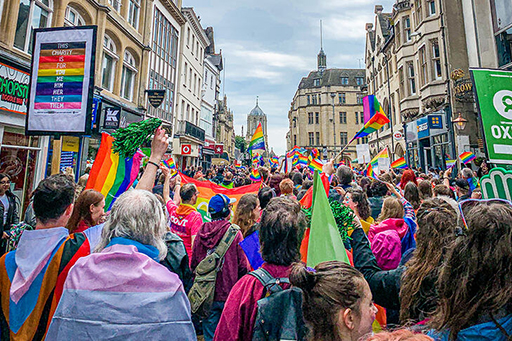
In this unit you have had an opportunity to think about how change happens at different levels, in formal and informal spheres, within individuals, and in systems (institutions, governments, policies, practices). The change analysis tool has helped us to look differently at a range of change stories from around the world.
Through the exercises, you have thought more deeply about your overall change goal, developed a better understanding of the context of change, used the change analysis tool to consider what might need to change across different areas to meet your goal, and finally you finished by identifying some change objectives.
In the next unit we will drill down further through a power and systems approach. This will help you to identify which approach is most likely to work and help you to focus your efforts to make change happen to best effect.
2.9 End-of-unit quiz
In Unit 2 of this course, the topics have been – understanding the context of change and the change you would like to see.
Now test your knowledge on what you have learned with this short quiz.
References
FRIDA Young Feminist Fund (n.d.) Garden of Change, [Online]. Available at: https://youngfeministfund.org/ GardenofChangeA.html (Accessed 15 August 2023).
Introduction to Systems Thinking (24 January 2023) YouTube video, added by From Poverty to Power (Oxfam) [Online]. Available at: https://youtu.be/ bYydvwaRuqw (Accessed 15 August 2023).
Meadows, D.H., (2008) Thinking in Systems: A Primer, Vermont: Chelsea Green Publishing.
Rao, Kelleher and Stuart, Gender at Work framework, [Online]. Available at: http://genderatwork.org/ analytical-framework/ (Accessed 15 August 2023).
Wilber, K. (2000) A Theory of Everything: An Integral Vision for Business, Politics, Science and Spirituality, Boston, Massachusetts: Shambala.