Use 'Print preview' to check the number of pages and printer settings.
Print functionality varies between browsers.
Printable page generated Monday, 14 September 2026, 1:44 AM
Unit 3: Power
3.1 Introduction to Unit 3: Taking a power and systems approach
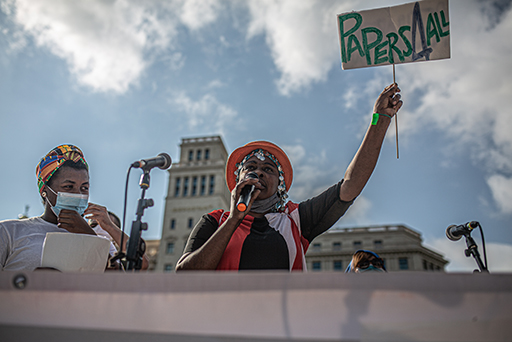
Enthusiasm to bring change is admirable and necessary, but not enough. Head and heart need to work in tandem. This unit builds on the context and change analysis we did last unit and looks critically at how change really happens.
Firstly, we will explore how thinking about change in our societies from a systems perspective can guide us in the activities we choose to undertake and the scale of our ambition.
And we will also consider power; what it is, its different forms and why it is important for changemakers. Power analysis is a tool to understand the power dynamic that underpins and informs a system and a particular change action within that. You will be introduced to two power analysis tools and have an opportunity to apply one of them to your change issue.
Both the systems thinking and power analysis are critical tools for ensuring that the actions we take are more likely to be effective and sustainable.
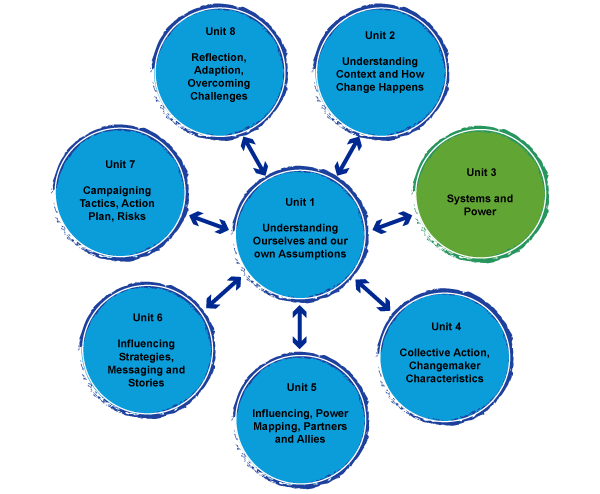
 Learning outcomes
By the end of this unit you will:
- understand complex systems and why they are important to understand change
- understand what power is and its different forms
- apply a power analysis tool to a case study
- apply a power and systems approach to your change action.
3.2 What is a system?

A system is an interconnected set of elements that interact with each other and change in response to different interventions. A society is a system, as is an economy.
A defining aspect of human systems is complexity. The sheer number of relationships within a human system means change cannot be reduced to simple cause and effect. Knowing a bit more about the systems around us, and how others view and interact with those same systems, can help us both understand the world a little better and think differently about how to change it. It’s important to recognise that if we influence or change one part of a system, we are likely to affect another part directly or indirectly as well.
How do systems change?
As we saw in the first two units of the course, the way societies or economies change is often a combination of widespread tides of change (such as the way the population is ageing in much of Europe, East Asia and North America, the growing youth population across much of Africa, urbanisation in most parts of the world, the advance of digital technologies, reducing public trust in formal politics and institutions more generally, or overall improvements in education or healthcare), and unforeseeable events, sudden shifts, or critical junctures (such as political scandals, economic crises, pandemics, disasters, the start or ending of armed conflict).
These critical junctures often disrupt social, political or economic power relations, creating an appetite for new ideas and opening the door to previously unimagined reforms. Understanding and responding to the windows of opportunity or threat created by critical junctures is a crucial part of being a changemaker.
Baking a cake is a simple straightforward process. All you need to do is find a recipe, buy the ingredients, make sure the oven is working, mix, bake, and there you have it, a cake! Some cakes are better than others but the basic approach is fixed, replicable, and reasonably reliable. Some may think that a change process is like this, that you can take a tried and tested formula (e.g. a demonstration or a social media campaign) that worked in one situation and apply it elsewhere.
But making change happen in complex systems requires an adaptive, collaborative, and flexible approach. The future is full of unpredictability, full of ‘known unknowns’, such as what will happen after a leader dies or is ousted, and of ‘unknown unknowns’, such as sudden financial crises or natural disasters. Just as what has worked in one situation will not work in every situation, what has happened in the past is not a blueprint for the future.
Adapting as you go
Changemakers need to adapt to this inherent unknowability about the future by becoming ‘reflectivists’ as well as activists, building in chances to learn, listen, reflect and adapt their actions. It’s right to analyse and plan but as you implement you need to not only be aware of what’s changing around you, but also what you are finding out about the system you are engaging with as you take action. How are you interacting and affecting the system? How will changes in the system affect your plans? How can you learn and adapt?
As Donella Meadows, the environmental scientist and systems thinker, says: ‘Before you disturb the system in any way, watch how it behaves. Learn its history. Ask people who’ve been around a long time to tell you what has happened… learn to dance with the system.’
3.3 So how do you ‘dance with the system’?
Now is a chance to take time to reflect on the system that surrounds the issue you are working on.
It is important to recognise that you will likely only see a partial picture of the different parts of the system that are connecting to your issue. Planning from the outset how you will stay alert to changes, gather feedback, learn and adapt as you go is essential.
 Activity 3.1: Dancing with the system
Building on the analysis of the change you would like to see that you did in Unit 2, here are some additional questions to stimulate your thinking about the different actors and factors, the opportunities and the blockages, and the various interconnections that compose the system.
- Which individuals, groups and institutions are most likely to influence the change you seek (whether as allies or opponents)?
- Which individuals and groups will not be heard, and why not?
- What examples of positive responses to the problem you’re wishing to address already exist within your community or further afield? What lessons can you learn or responses can you adapt?
- How will you stay alert to changes in the system?
Add your reflections to the free text box, in the Make Change Happen Plan or in your own notebook.
3.4 How do you understand power when making change happen?
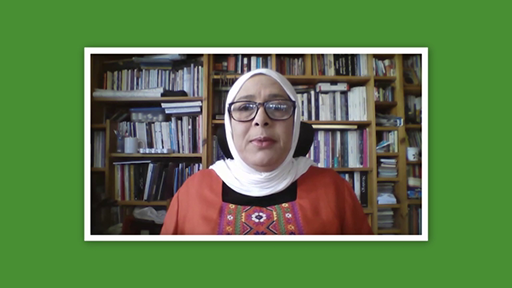
Transcript
In this video we hear from Elena, Hadeel, Chioma, Kelly, Art and Eric about how they think about power when working on change.
Hadeel, Oudai and Chioma also share their perspectives on how they strengthen their own power within.
Changemaker Profiles:
Chioma Agwuegbo is Executive Director at TechHerNG and is convener of the #StateofEmergencyGBV Movement, a coalition of organisations igniting citizens to advocate for an urgent, comprehensive, and sustainable response to sexual and gender-based violence in Nigeria.
Sabah Khan is co-founder of Parcham, an organisation in India dedicated to breaking stereotypes based on religion, class, caste, gender and other markers of difference to create a society respectful of diversity.
Elena Mejia is a feminist rapper, organiser and facilitator working in Lima, Peru to address issues of gender justice, economic justice and narrative work for social movements in the Actua.pe labs.
Kelly Mundy is a Senior Campaign Manager for Oxfam Great Britain campaigning to tackle inequalities such as economic and gender, which undermine the fight against poverty.
Eric Njuguna is an organiser with Fridays for Future MAPA (Most Affected People and Areas) in Kenya, supporting protests aimed at putting pressure on world leaders to take action to advance climate justice and to amplify the voices of those most impacted by the climate crisis.
Hadeel Qazzaz is a Regional Gender Justice Coordinator for Oxfam International based in Ramallah, West Bank, and advocates for women’s rights throughout the Middle East and North Africa region.
Art Reyes III leads an organisation called We The People: Michigan, that works to build multi-racial working class organising capacity in the state of Michigan, USA, fighting for a better state and community that all people deserve.
Neha Singh is an organiser who started a women’s rights campaign called ‘Why Loiter?’ in Mumbai, India, that aims at reclaiming public spaces for women by loitering.
Oudai Tozan is a researcher and founding member of the Syrian academics and researchers network in the UK, working with the Syrian diaspora and those who experienced forced migration to mobilise, connect and support each other, but also to support Syria when the situation allows.
3.5 ‘Power’ defined
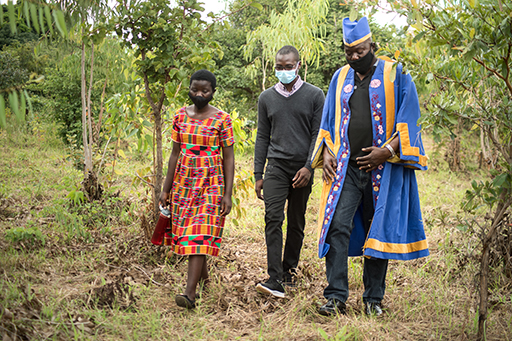
There’s more than one way of defining ‘power’.
According to the Oxford English Dictionary, ‘power’ is defined as:
- The ability or capacity to do something or act in a particular way
- The capacity or ability to direct or influence the behaviour of others or the course of events
So, power has two meanings – one personal, about what goes on inside an individual’s heart/head; the other about their ability to influence others. We discuss both of them in this unit.
Walk into any household, community, boardroom or government office, and there will be a web of power relations – some visible, some hidden, some invisible – that links and influences everyone present. Friends and enemies, parents and children, bosses and employees, husbands, wives and partners, rulers and ruled. No matter the political system, power – whether formal or informal – is always present.
At any given point, different kinds of power co-exist and interact with each other to produce a range of possible results that often defy our ability to plan and predict how change could happen. In that sense power can be seen as part of a ‘system’.
Examining power is an essential part of trying to understand and influence change. Those who have power can influence how people live their lives, can determine which rights people can enjoy, and even determine what a vision of society should look like. Power sets parameters on how social and political relationships evolve. Understanding who holds power, who does not, and why, is therefore fundamental to understanding change processes, obstacles to change and even conflict where it occurs. Who are likely allies or opponents of change? Who are those with most power and those with least power in this relationship? How have they treated each other in the past? Who listens to those who have less power? How do those with less power become more powerful? What is our own power in relation to others?
Power and identity
Seen in this way, many processes of social and political change are actually about the renegotiation and redistribution of power. Gender relations are, at their essence, relationships of power. Race relations are relationships of power. Similarly, other identities such as class, religion, sexuality, age, and (dis)ability all inter-relate with each other and with power. Taking this into account in a holistic way is often referred to as an intersectional approach.
For example, there are different kinds of power and inequality in relationships between women and men and non-binary people, shaped by the cultural and societal norms in which we live and shown through behaviours. The intersection between gender and power plays out and is learned in the home – in the private places in our lives. It is reinforced in public spaces with others and in the intimate world of our own minds. And it is affected by our other identities such as our race, ethnicity, age or economic status.
So, when we think about aspects of our identity we must always think about power. When we think about power, we must always think about identity.
What happens when you ignore power?
Power and influence is at the heart of human relationships. From the moment a child is born and becomes conscious of themselves and the world of relationships, the processes of influencing their parents and those around them, to address their needs, begins. At household, community, national and global levels certain people, institutions and groupings acquire and use power for their own interests and ends, in some cases denying or holding power over others. These power relations can become deeply entrenched, are not always immediately visible and can potentially cause the marginalisation and oppression of others. As such, power lies at the heart of change, and its denial.
As a changemaker you will need to influence people or institutions who hold decision-making power, influence and the resources to support or deny the change you are seeking. As a changemaker interested in making sustainable change at a community level or in people’s lives, then shifting power relationships so that your constituency or community has more say and more power to influence, will need to be part of how you achieve change.
Understanding power, your own and others’, and how to use and engage with it is the only sure way to achieve and influence change. Ignore power at your peril.
Activity 3.2: What is power?
What do you think of when you see the word ‘power’?
What different kinds of power can you think of?
When is power a good thing, when is it a bad thing?
Add your reflections to the free text box, in the Make Change Happen Plan or in your own notebook.
3.6 Introducing power analysis
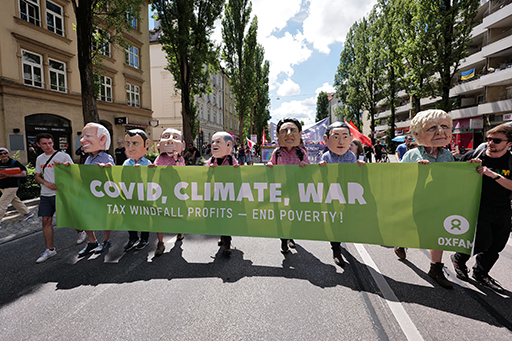
Power analysis is a tool to deepen understanding of where power lies in social change processes. It helps us identify who we need to engage with to achieve change and it stimulates questions that ensure that any action is built upon involving those that we seek to support and who we hope will benefit from the change.
The outcomes of change can be unpredictable and may cause harm to the very people we are trying to help or to others we had not considered. Ensuring that people are consulted and participate in any change process which affects them removes some of that unpredictability and ensures better outcomes.
There are lots of different ways to understand power.
Two frameworks that many activist organisations find useful are the Four Expressions of Power approach, and the Forms of Power approach. Frameworks like these can help us to understand different aspects of power and from that derive strategies that help us to influence or contribute to change. No one framework is right all the time, and indeed you may have your own. It is a case of trying different tools out and seeing which way of thinking about power is useful for a better understanding of any given situation.
We will look at the case study of the Chiquitano people of Bolivia to understand how these two frameworks, the four expressions of power and the forms of power, help us to analyse how change happens.
Chiquitano people of Bolivia
On 3 July 2007, after twelve years of unremitting and often frustrating struggle, the Chiquitano people of Bolivia – a group numbering some 9,000 people – won legal title to the one million hectare (2.4 million acre) indigenous territory of Monteverde in the eastern department of Santa Cruz.
Evo Morales, the country’s first indigenous president, attended the ceremony with several of his ministers. So did three elected mayors, ten local councillors (six women, four men), a senator, a congressman, and two members of the Constituent Assembly – all of them Chiquitanos.
Such an event would have been unthinkable a generation before both for the indigenous community and for women’s representation at the local level. Until the 1980s, the Chiquitanos lived in near-feudal conditions, required to work without pay for local authorities, landowners and the Church, and prevented from owning land.
Now, over 15 years after this historical win to access to their land, Chiquitano leaders have reported that their struggle is far from over. Access to healthcare, education and basic infrastructure such as a mobile phone signal is still lacking. They do note some positive changes, with some young people from their communities now accessing university education for the first time. This raises a new challenge, the risk of these same people leaving the Chiquitano communities for good.
An additional threat is deforestation by loggers and mining companies. The authorities do nothing because the officials are paid off by the companies. They also report that the companies buy off certain communities and community leaders, leading to social division. Logging and mining companies are often seen to be working with outsiders, people from the country’s highlands, closer to the centre of power, where decisions are made over the economic path Bolivia should follow. The government, still led by Evo Morales’ party despite moments of crisis in recent years, appears to need natural resource revenues to fund essential services.
3.7 Four expressions of power

Transcript
Watch the video for a closer look at the four expressions of power framework.
We can apply this framework to help us understand how change happened in the Chiquitanos case study:
Power Within: The change took place as part of a wider evolution of Indigenous identity. In the 1980s, inspired in part by Chiquitano language radio programmes, the Chiquitanos for the first time began to identify themselves as Indigenous people. Indigenous identity began to replace the class-based peasant identity promoted by the nationalism of Bolivia’s 1952 revolution. As one elderly woman explained, ‘Only a short while ago did we begin calling ourselves Chiquitano Indians... we look alike, we were all handed over to the bosses... they called us cambas or peasants until not long ago.’ More recently, access to education means that young members of the Chiquitano communities have been able to attend university for the first time.
Power With: The dawn of ‘power within’ rapidly led to ‘power with’ in the form of cultural associations, which rapidly acquired an explicitly political nature. The Chiquitano Indigenous Organization (OICH), represented more than 450 communities. A turning point came when the Chiquitanos decided to join up with Bolivia’s far more numerous highland Indians. ‘We met with one of the highlands leaders,’ recalls Chiquitano leader, now Senator, Carlos Cuasase, ‘and we said, ‘Look brother, you have the same problems that we do, the same needs.’ We agreed not only on [the law to nationalise] hydrocarbons but also to defend the rights of indigenous people of both highlands and lowlands.’ Working against these collective efforts however are the interests of logging and mining companies who are reported to seed social division by buying off certain leaders and communities.
Power To: After protests toppled President Sánchez de Lozada in October 2003, identity documents became easier to obtain and candidates were allowed to run independently of traditional political parties, which led to major gains for indigenous peoples in the 2005 municipal elections.
Power Over: In the words of a Chiquitano activist, ‘My father never realised our rights. We just did what the white people told us; only they could be in power, be president. We couldn’t even go into the town centre, people swore at us. But then we got our own organisation and elected our own leaders and that’s when we realised that we had rights.’ Chiquitano activists know that their struggle for rights is not over. The power of central government decisions around Bolivia’s economic model, particularly the emphasis on extractive industries means that their land is still threatened by deforestation.
Downloads
3.8 Forms of power
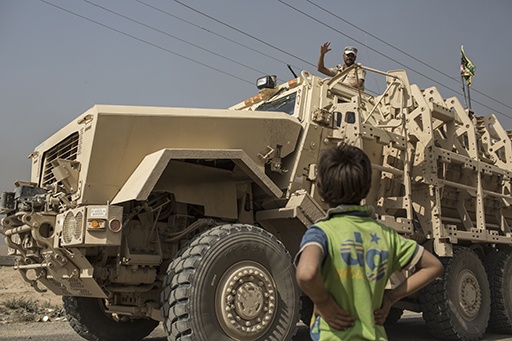
Now let’s look more closely at the second framework.
The forms of power we are referring to are: visible power, hidden power and invisible power. The relative importance of each changes with context.
- Visible power – this is power which is visible in public spaces or formal decision-making. It relates to observable power negotiated through institutions. So, this might refer to political bodies, such as legislatures, government bodies, local assemblies, or consultative forums and the way they work. It can also relate to the way decision-making works in our own organisations. This is the form of power that dominates discussions in the media – the to and fro of formal politics. It includes formal policy, regulatory and budgetary processes. It can also refer to rules and laws in society, and the authorities responsible for upholding these including the police, the military and the justice system.
- Hidden power – control over those with visible power through behind-the-scenes action/influence. How does money (e.g. campaign finances or bribery) shape political action/inaction? Who is lobbying whom? Who decides who gets invited to the meeting, or gets to speak? Who frames the discussion and sets the agenda? What gets onto the agenda and what is kept off? Whose views are judged ‘unhelpful’? How does individual gain affect the choices and actions of different individuals?
- Invisible power – this refers to aspects in society that shape people’s view of the world and their place in it, and includes norms, beliefs, ideologies, privilege, and culture. It often defines what is seen to be right and wrong, acceptable or normal. Invisible power can be used to create consensus, to empower people but can also be used to dominate others. It determines how we treat each other, whether some groups are systematically privileged or excluded, and whether groups are targeted as ‘the other’ on the basis of their gender, ethnic background, class, religion, or other identity.
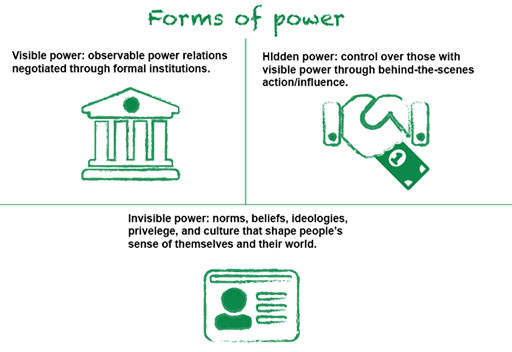
Now we will apply this framework to understanding the change process in the Chiquitanos case study:
Victory for the Chiquitano people required a profound change in invisible power, transforming their definition of who they were, as their self-identification as Indigenous became more prominent. With that came growing organisation and the ability to understand and confront the hidden power that, for example, prevented Chiquitanos from participating in formal politics or even entering the town square. Only then were they able to attain visible power, both at local and national level.
3.9 Power analysis of your change goal
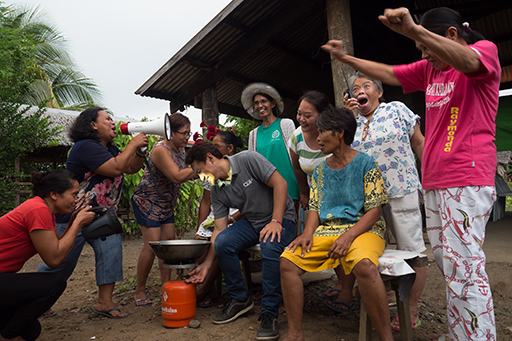
We have looked at two sets of guiding frameworks shown below, the Four Expressions of Power tool and the Forms of Power tool.

Now it is your chance to apply power analysis to the change issue you are working on. Using both tools, identify the relevant expressions or forms of power you will need to take into account as you develop your change action.
Activity 3.3: Power analysis of your change goal
Using the four expressions of power on the issue you would like to change, ask yourself the following questions:
- Who has the most power on the issue? What gives them that power and how do they use it?
- Who has the least power?
- What happens when power dynamics are challenged?
- What power do you have to effect change? How can you develop that power further?
Using the forms of power on the issue you would like to change, ask yourself the following questions:
- What aspects of visible power should you be focusing on?
- How does hidden power operate on your issue?
- What aspects of invisible power do you consider most relevant?
- What are the power dynamics related to gender, race, sexuality or other aspects of identity that you would want to understand more about in relation to your issue?
Write your thoughts on the expressions and/or forms of power you have identified as most relevant to your change action and why in the free text box, in the Make Change Happen Plan or in your own notebook.
Discussion
The two frameworks for power analysis aim to help you consider power dynamics that you may not have previously identified. Not all change actions need to cover all these expressions and forms of power, but when power is considered alongside the overall change goal, the likelihood of success increases. Even if you don't achieve your goal as planned, just beginning to engage deliberately with certain power dynamics can often be a positive outcome in itself.
3.10 Summary of Unit 3
In this unit we have investigated some important underlying issues which affect the success or failure of change processes.
We have looked at systems and how complexity is an inevitable part of the societies in which we live. Systems thinking values the ability to ‘accept the unexpected’ and take advantage of accidental opportunities. Being prepared for this will help you notice and react more quickly to opportunities and constraints and make better action plans. It also encourages us to make sure we are thinking about the unintended direct and indirect consequences of our changemaking.
We have also looked at power using two different tools; helping us to understand the expressions of power (within, with, over, to) and the forms of power (visible, hidden, invisible). We have applied this power analysis to understand change processes through a case study, and you have applied it to the issue that you are working on.
The power and systems approach encourages multiple strategies rather than a single linear approach, viewing failure, iteration, and adaptation as expected and necessary. Over the next units we will look at how you can develop your skills to do this and how you can increase your power to make change happen.
Further reading
Systems Thinking video – a useful short video explaining how a small change fits into a wider system.
Gender e-learning – an additional online course which looks in more detail about how gender and power interrelate.
3.11 End-of-unit quiz
In Unit 3 of this course the topics have been – taking a power and systems approach, defining power, the tools for analysing power, and understanding systems.
Now test your knowledge on what you have learned with this short quiz.
References
Mayne, R. and Coe, J. (n.d.) Power and social change [Online]. Available at: http://www.oneeastmidlands.org.uk/ sites/ default/ files/ library/ NC586_12b_power_social_change.pdf (Accessed 15 August 2023).
Oxfam (2014) Quick Guide to Power Analysis [Online]. Available at: https://policy-practice.oxfam.org/ resources/ quick-guide-to-power-analysis-313950/ (Accessed 15 August 2023).
Oxfam (2015) Systems Thinking: An introduction for Oxfam programme staff [Online]. Available at: https://policy-practice.oxfam.org/ resources/ systems-thinking-an-introduction-for-oxfam-programme-staff-579896/ (Accessed 15 August 2023).
PowerCube (n.d.) Background to powecube.net, [Online]. Available at: https://www.powercube.net/ an-introduction-to-power-analysis/ background-to-powercube-net/ (Accessed 15 August 2023).
Professor Kimberlé Crenshaw Defines Intersectionality (14 September 2018), YouTube video, added by Rich Russo [Online]. Available at: https://www.youtube.com/ watch?v=sWP92i7JLlQ&t=19s (Accessed 15 August 2023).
The Donella Meadows Project (n.d.) Dancing With Systems, [Online]. Available at: https://donellameadows.org/ archives/ dancing-with-systems/ (Accessed 15 August 2023).
Sources for Chiquitanos case study
Cáceres, E. (2008) Territories and Citizenship, the revolution of the Chiquitanos, Oxfam [Online]. Available at:https://oxfamilibrary.openrepository.com/ bitstream/ 10546/ 112383/ 1/ fp2p-cs-territories-citizenship-chiquitanos-140608-en.pdf (Accessed 16 October 2023).
Green, D. (2024) How Change Happens 2nd Edition, Duncan Green, Oxford, UK: Oxford University Press: https://fdslive.oup.com/ www.oup.com/ academic/ pdf/ openaccess/ 9780198899952.pdf
Green, D. (2019) ‘Return to Chiquitania: What’s changed in the 13 years since my first, mind-blowing visit?’, From Poverty to Power, 12 July [Online]. Available at: https://frompoverty.oxfam.org.uk/ return-to-chiquitania-whats-changed-in-the-13-years-since-my-first-mind-blowing-visit/ (Accessed 16 October 2023).
JASS Power Guide: https://justassociates.org/ power-guide/