Use 'Print preview' to check the number of pages and printer settings.
Print functionality varies between browsers.
Printable page generated Friday, 9 October 2026, 4:28 AM
Section 2: Trauma and the trauma-informed principles
Trauma and a trauma-informed approach
In this section, we will define trauma and its different types, and how it can impact on relationships. We will examine the significance of different trauma responses and the concept of our window of tolerance. You will also learn about trauma-informed principles and how to apply them in everyday interactions.
 Learning outcomes
After completing this section, you should be able to:
Describe different types of trauma, the five trauma responses and the potential impact on physical, emotional, behavioural and mental health.
Identify the five trauma-informed principles and discuss how these can be applied in personal and professional settings to support trauma-affected individuals.
The box below provides a selection of course download options for use offline or on other devices.
2.1 What is trauma?
What comes to mind when you think of the word ‘trauma’?
Unfortunately, we come across so many incorrect notions of trauma through the media when in effect it is as follows:
Trauma describes an individual event, series of events or circumstances, which have lasting adverse effects on mental health, physical health, emotional health, social well-being and/or spiritual well-being (Substance Abuse and Mental Health Services Administration (SAMHSA), 2024).
You may find it helpful to look back at the origins of the word since ‘trauma’ is the Greek word for ‘wound’. Therefore, rather than referring to trauma simply to describe an event or series of events, we can refer to trauma more accurately as the wound or wounds that the event creates.
These wounds can be short-term, or long-term, but crucially many who have experienced trauma highlight difficulties in finding the safety and trust in others which might then help them begin to heal the scars left behind from traumatic experiences they have encountered.
‘Trauma is defined as an overwhelming experience that exceeds our capacity to make sense of it, no matter how resilient we are.’
2.2 The three Es of trauma
The three Es of trauma is a framework (SAMHSA, 2014) which we can use to understand the impact of traumatic events on individuals.

Event
| The thing that happened. |
| The thing that did not happen but should have done. |
| How the thing caused or threatened to cause physical or psychological harm. |
Experience
| How the individual experienced the event. How they experienced the event determines the extent to which the event was traumatic. |
| Did they find it overwhelming or not? |
| Did they have social support? |
| Were they isolated or did they have a safe place to go to immediately afterwards? |
| Not everyone will experience events in the same way. What one person finds traumatic may not have the same impact on another. |
Effect
| Based on the event and how somebody experienced the situation, they may or may not have a traumatic response. For some the response manifests immediately following the event. For others it may take hours, days, weeks or months. |
2.3 Prevalence
 Self-care booklet
The course also emphasises the value of looking after yourself and knowing where to find further help and support for anyone who needs it.
You may find this self-care booklet useful.
If we look at the current picture highlighting the number of people in the UK experiencing a range of traumatic events, we find the following four pieces of information.
Click on each number to learn more.
It is important to note that not all ACEs will be experienced as trauma.
2.4 Types and sources of trauma
Trauma can be something which happens to oneself (direct), or it can be witnessed as something happening to another person (indirect). It may have occurred recently or happened in the distant past.
Trauma types can be described as the following:
- Type 1 trauma – one off, unexpected incidents and events.
- Type 2 or complex trauma – those which are repeated. Complex trauma is sometimes referred to as relational or developmental trauma and this occurs due to negative interpersonal experiences in relationships which should have been protective.
- Vicarious trauma – describes the indirect trauma that can occur when exposed to traumatic images and stories second-hand. This is often experienced by those in helping professions as they are regularly exposed to the trauma experienced by others.
- Collective trauma – refers to the psychological impact experienced by a group of people who have undergone a shared traumatic event or series of events. Unlike individual trauma, which affects a single person, collective trauma impacts entire communities, societies, or nations. This type of trauma can result from natural disasters, wars, genocides, terrorism, pandemics, or other catastrophic events that affect large groups of people simultaneously.
The diagram below shows different types of trauma experiences.

2.5 The effects and symptoms of trauma
While many people go through stressful and traumatic events without lasting effects, others may face ongoing difficulties. The reactions and responses to trauma are highly individual and subjective – an event that one person finds stressful might be experienced as traumatic by another.
Single, one-off traumas can cause short-term difficulties, depending on the incident's severity.
However, recurring trauma – referred to as type 2, complex, relational, or developmental trauma – is more likely to have significant and enduring long-term effects, impacting a person's ability to manage even everyday tasks and activities.
The following diagram shows different reactions and responses to trauma.

Physical
Aches and pains, tiredness, shaking, sweating, dizziness, headaches, disrupted appetite, memory difficulties, panic attacks, sleep problems, fatigue, increase in medical problems.
Emotional
Anger, numbness, scared, worried, irritable, confused, restless, shock, shame, self-blame, grief, overwhelm, anxious, loneliness, depressed mood, denial, concentration difficulty.
Behavioural
Self-neglect, sleep problems, panic attacks, flashbacks, intrusive thoughts, suicidal feelings, alcohol and substance misuse, resisting change, protective of personal space.
Relational
Difficulty trusting others, fear of intimacy, social isolation, attachment difficulties.
2.6 The five F trauma responses
The body's response to fear is automatic and instinctive. When the brain detects a frightening experience, it sends signals throughout the body’s nervous system, triggering various physiological changes to protect us from harm.
There are five common reactions which have been identified through the cumulative work of psychologists, therapists and physiologists over the course of decades (Cannon, 1915; Levine, 1997; Walker, 2013; Van der Kolk, 2014).
These are: fight, flight, freeze, friend, and flop and are shown in the following diagram.

To illustrate how the nervous system works in influencing the ways we respond to frightening experiences, consider each of the following two scenarios.
You may wonder why people react to fear and threats with the five F responses.
It is important to understand that these reactions are not a matter of choice – they usually stem from past trauma and the ways in which the individual has responded to similar events experienced.
This can result in complex trauma or post-traumatic stress, causing the five F responses to recur as the nervous system becomes formed and ready to be activated.
2.7 Window of tolerance
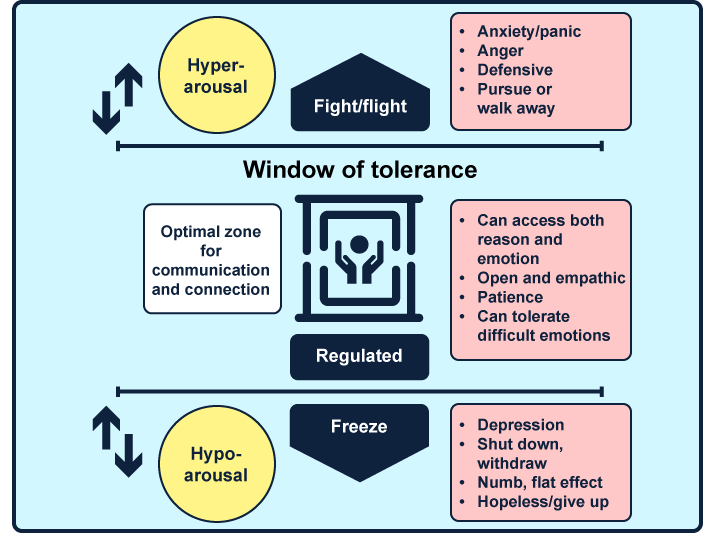
The window of tolerance was developed by Dan Siegel M.D. (1999) who is a renowned American psychiatrist. According to this concept, we each have an optimal zone in which we can function well and cope with stress without feeling overwhelmed. Within the optimal zone, daily tasks and life are easier to manage because stress and emotions can be dealt with effectively.
Everybody has a unique window of tolerance which is shaped by a combination of factors including genetics, life experiences, attachments, social support, and past trauma. Some people can experience high levels of emotional intensity without becoming overwhelmed. Somebody like this could be said to have a wide window of tolerance.
On the other hand, somebody with a narrow or disrupted window of tolerance is less likely to be able to tolerate difficult emotions, resulting in possible upset or withdrawal. Over time, sometimes even daily, the size of our windows can change but overall, the wider our window, the less opportunity for our tolerance to be pushed outside.
The following video animation, The River of Life and the Tale of Two Lands (Farrell, 2018), provides an illustration of how the window of tolerance works.
When pushed outside of the window, a physical imbalance occurs. Two opposing states then emerge, these are ‘hyper-arousal’ and ‘hypo-arousal’, as shown in the model below.
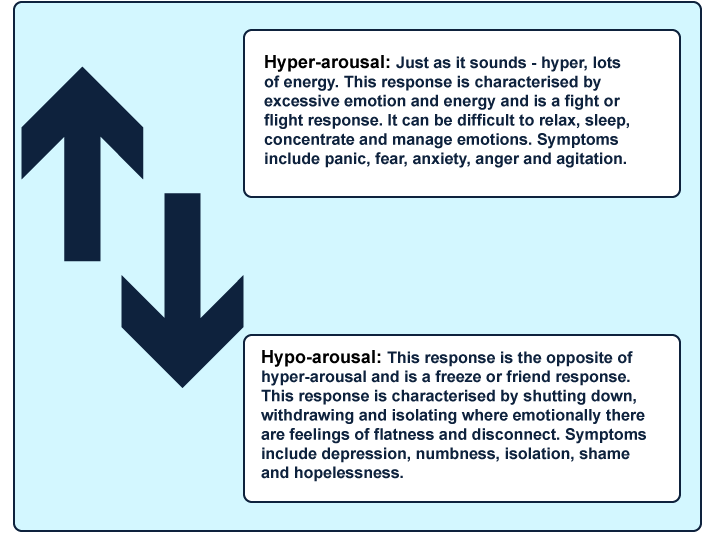
It is important for us all to recognise others' window of tolerance so that we can help them stay within what feels safe and comfortable or get back into their window if they have been pushed out. Knowing your own window of tolerance will also help you to understand when you are feeling overwhelmed, so you can take steps to work more effectively with your own emotions and regain a more balanced state.
2.8 Childhood and the window of tolerance
Self-care booklet
The course also emphasises the value of looking after yourself and knowing where to find further help and support for anyone who needs it.
You may find this self-care booklet useful.
The nervous systems of children are more easily influenced than those of adults, as they are still in the process of developing.
As a result, even being in an environment where there is tension, or being left to manage difficult feelings alone, can trigger the range of five F responses. We need to be aware that this type of activation of the nervous system is a helpful and natural survival response to manage physical, mental and emotional overwhelm.
However, when certain ways of coping become habitual and continued, even when there is no ongoing threat, they can be unhelpful, especially as learned coping mechanisms as a child can impact on our ways of coping throughout our lives.
In the interactive table below are eight examples of how children affected by trauma may respond.
Click on each number to learn more.
The following video (Freud, 2020) explains how trauma can affect children and the way that they might respond in different situations.
 Activity 1: The stages of the trauma response
In this activity, you’ll order the stages of the trauma response to understand how automatic reactions to stress impact thoughts, feelings, and behaviours. This is based upon the three Es of trauma which you have learned about (event, experience and effect).
Let's apply this concept to the case study of Jemma. She is a young person with a history of trauma who moved homes, communities, and schools several times within the care system. Jemma’s background and journey give insight into how continued exposure to stressors can affect daily interactions and relationships.
This step-by-step sequence helps highlight how our bodies react to and recover from trauma by using the three Es of trauma framework.
Understanding these responses can make us more mindful in daily interactions where recognising the signs of trauma and stress in others is essential.
Now that we have begun to look at trauma and the different responses individuals may have in relation to traumatic experiences, we can see how important it is for all of us, particularly when interacting with children and young people, to have a keen sense of how our own reactions might have a further and hopefully more positive impact.
2.9 Trauma-informed principles
To be trauma-informed, means to be aware of the impact that trauma might have on people, being able to identify it and respond in a reciprocal way that is supportive of another person’s strengths.
There are five trauma-informed principles which reflect the original definition developed by the United States Substance Abuse and Mental Health Service Administration (SAMHSA, 2011 and 2014). The more you become familiar with them, the easier it will be to think about whether you are using them in everyday interactions, connections and relationships.
The following model illustrates the five trauma-informed principles.
Click on each circle below to learn more.
2.10 Trauma-informed practice with children and young people
Let us now consider good approaches in professional practice which include the five trauma-informed principles when interacting with children and young people and which also help develop positive conditions for more effective communication.
In the following video (NHS Education for Scotland, 2019), see if you can identify where trauma-informed principles have been adopted.
Consider examples of supportive environments, fostering trust, promoting collaboration and empowering individuals based on their strengths and experiences.
2.11 Summary
In this section you have learned about trauma and in particular:
- How we might define and describe trauma, including distinct types of traumas, and the range of both short-term and long-term impacts it can have.
- How to recognise the symptoms and effects of trauma in different contexts.
- The five trauma responses and the window of tolerance.
- The five trauma-informed principles and what it means to be trauma-informed.
Moving on
When you are ready, you can move on to Section 3: Nurturing connections – building positive relationships.