Use 'Print preview' to check the number of pages and printer settings.
Print functionality varies between browsers.
Printable page generated Sunday, 25 October 2026, 5:37 PM
Session 5: Understanding inflation and interest rates
Learning outcomes
 Session learning outcomes
By completing this session, you will be able to describe:
Inflation and why it is important for financial decisions.
Interest payments.
How to compute interest payments in simple scenarios.
 Glossary
5.1 What is inflation?

Inflation measures the changes in the prices of goods and services over time. For most goods and services, prices tend to increase with time.
For example, the average price of 1 kg of potatoes in the UK increased from 32 pence in January 1994 to 93 pence in January 2025 (Office for National Statistics, 2025).
Why is inflation relevant to financial decisions?
Inflation is relevant because increases in prices affect what your money can buy.
For example, suppose the price of an apple is £0.50 and you spend £2 every week buying four apples. If the price increases to £0.60 per apple, then you will not be able to buy 4 apples for £2. This means that an increase in prices (inflation) reduces your purchasing power.
 A basket of goods and services
Watch this video to learn more about inflation. You will learn that inflation is measured based on the prices of a “basket of goods and services”.
Use the box below to make notes (or write it down in your notepad).
5.2 Interest rates
There are prices attached to goods (like ice cream or shirts) and services (like holidays and gym memberships).
The interest rate can also be considered as a price. When taking out a loan, the interest rate is the price of borrowing money. When depositing money into a savings account, the interest rate is the benefit provided by your savings.
Have a go at the two examples in the following activity to understand how interest rates work.
How interest rates work
a.
£110
b.
£111
c.
£120
The correct answer is a.
Answer
After 1 year, Sam will have to pay:
the amount that he borrowed (the principal), which is £100, plus
the interest payment of £10. The interest payment is 10% of £100. You can calculate this by multiplying 100 with 10% (which is 10/100 = 0.10).
So, the interest payment is
£100 × 10/100 = £100 × 0.10 = £10
Therefore, the total amount that Sam will pay back is the principal of £100 plus the interest of £10, which is £110.
Alternatively, you can compute the total amount that Sam has to pay by multiplying 100 (the amount borrowed) with 1.10.
That is, the amount that Sam will pay back is
£100 × 1.10 = £110
a.
£506
b.
£530
c.
£560
The correct answer is b.
Answer
Sarah will have £530 after 1 year. This amount includes:
£500 that Sarah deposited in her savings account.
Interest payment of £30, calculated as follows:
£500 × 6/100 = £500 × 0.06 = £30
You can compute the total amount that Sarah will have by multiplying 500 (the amount deposited) with 1.06.
That is, the total amount that Sarah will have is:
£500 × 1.06 = £530
5.3 Interest rate compounding
Interest rate compounding is an extremely important concept. The basic idea is that when you save money in a savings account, then you earn interest on:
The money you originally deposited.
And
The interest that you earn.
Have a go at the examples in the following activities to understand the power of compounding.
Quiz 1 – The power of compounding
a.
£556.20
b.
£560.00
c.
£561.80
The correct answer is c.
Answer
This example is slightly more complicated than the example in which Sarah deposited her savings of £500 for 1 year. In the present case, you can think about Sarah’s savings growing in two steps.
Step 1 – Savings after 1 year:
After the first year, Sarah will have £530. This is calculated as in the earlier example. Specifically, the amount after 1 year is calculated as:
500 × 1.06 = £530
After 1 year, Sarah has earned £30 of interest.
Step 2 – Savings after 2 years:
In the second year, Sarah will earn interest of 6% on her original savings of £500. In addition, she will earn interest on the interest she earned in the first year.
So, in the second year, she will earn:
interest on £500, which is equal to £500 × 0.06 = £30
interest on £30, which is equal to £30 × 0.06 = £1.80
After 2 years, Sarah will have in her account:
the original £500 that she deposited in the savings account.
£30 interest earned during the first year on the original £500.
£30 interest earned during the second year on the original £500.
£1.80 interest earned during the second year on the £30 interest from year 1.
The total amount in Sarah’s savings account will be:
500 + 30 + 30 + 1.80 = £561.80
Instead of doing the complicated computation above, you can compute the payment after 2 years as follows:
500 × (1.06)2 = £561.80
Computing payment with interest rate compounding
You can use the following formula to compute payment with interest rate compounding.
Suppose you deposit £X for N years in a savings account. The interest rate on the savings account is R% compounded annually.
The amount in your savings account after N years will be:
X × (1.0R)N
The following video explains the above formula with examples.
Quiz 2 – The power of compounding
a.
£64,326.12
b.
£72,430.16
c.
£89,850.08
The correct answer is c.
Answer
We can use the same approach that we followed to compute interest payment for two years in the previous example.
The key differences between this and the earlier example are:
the initial deposit is now £10,000 and not £500.
the interest rate is now 5% and not 6%.
the time period is now 45 years and not 2 years.
So, the amount that Ash will have in her savings account is:
£10,000 × (1.05)45 = £89,850.08
This example shows you how money grows in the form of long-term savings due to the power of compound interest.
5.4 Inflation, again!
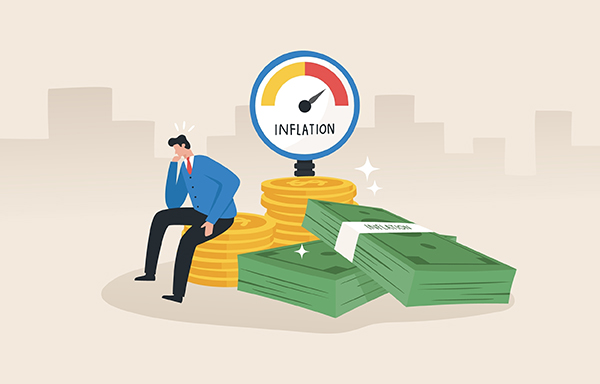
The interest received on savings is good as it makes your money grow. Unfortunately, inflation works in the opposite direction as it reduces the purchasing power of your money.
If interest rates are lower than the inflation rate, then over time your money in a savings account will lose value.
This happens because, even though your savings will earn interest, the prices of goods and services will increase by a higher percentage than the interest rate that you will earn on your savings.
Quiz
a.
True
b.
False
The correct answer is b.
a.
True
b.
False
The correct answer is a.
a.
True
b.
False
The correct answer is a.
a.
True
b.
False
The correct answer is a.
Moving on

References
Office for National Statistics (2025) RPI: Ave Price - Potatoes, old white, per kg. Available at https://www.ons.gov.uk/economy/inflationandpriceindices/timeseries/vkyy/mm23 (Accessed 16 July 2025).
Acknowledgements
Grateful acknowledgement is made to the following sources:
Every effort has been made to contact copyright holders. If any have been inadvertently overlooked the publishers will be pleased to make the necessary arrangements at the first opportunity.
Important: *** against any of the acknowledgements below means that the wording has been dictated by the rights holder/publisher, and cannot be changed.
Images:
565741 : Image: Man with magnifying glass + hiking interest rate : Diki Prayogo / Shutterstock
565743 : Image: Inflation gauge : Yellow_man / Shutterstock
565748 : Image: Man holding percentage and coin : eamesBot / Shutterstock
565753 : Image: Man sitting next to inflation gauge : Yellow_man / Shutterstock
565896: Image: Paper plane: Wirestock Creators / Shutterstock