Use 'Print preview' to check the number of pages and printer settings.
Print functionality varies between browsers.
Printable page generated Monday, 7 September 2026, 8:36 AM
Unit 1 Welcome to the course
Introduction

Welcome to Are you on mute? Best practice in online meetings – a badged online course on how to improve your online meetings.
No doubt, on more than one occasion, you have found yourself sitting in endless meetings with distracted colleagues who appear to be doing their email – and that’s if they’ve even turned on their camera! Or meetings where the chair never lets anyone else speak. And then there are the meetings that become really uncomfortable because someone thinks they’re being funny when actually they’re just not being very nice…
This course is designed for anyone who uses online meetings for work purposes. Everything you will learn here is evidence based. The team who put it together were part of a multinational research project on equitable online meetings. There were researchers in Germany, Iceland, Spain and the UK, which is why the course is available in six different languages too.
The course will take you through a few different topics around online meetings that the team found to be important in making meetings more pleasant and more productive. In this first unit you’ll be introduced to the different units in the course, so you know what to expect as you work through it. The course will take approximately 18 hours to complete, however you can step away and come back at any point to resume where you left off.
 Learning outcomes
By the end of this course, you will be able to:
- Understand effective and ineffective meeting practices.
- Understand how aspects of meetings affect men and women differently.
- Consider how humour can be used to support communication.
- Understand the role of identity in online meetings.
- Promote inclusivity within online meetings to improve productivity.
Welcome from the course authors
Listen to the course authors introducing the course, themselves and sharing what they enjoyed most about the GEiO research project.
Transcript
Lisa Lazard and Rose Capdevila
Irmgard Tischner
Annadís Gréta Rúdólfsdóttir
Gyða Margrét Pétursdóttir
Katrín Ólafsdóttir
Adriana Gil-Juárez
Barbara Biglia
Jordi Bonet Martí
Next, go to 1 The growing importance of online meetings.
1 The growing importance of online meetings

This course is a response to the changing nature of work where rapid technological developments have enabled an increase in remote and flexible working patterns in many sectors. With COVID-19 these working patterns intensified for many organisations and remain, to a greater or lesser extent, a routine feature of day-to-day working lives for many people.
At the same time, the globalisation of business has had an impact on the promotion of gender equity in the workplace through, for example, increased opportunities for women. However, existing research indicates that gender unequal practices continue to constrain those opportunities. For example, whilst there is an increased prominence of gender equity in workplace policy across Europe, there remains a lack of consideration of other inequalities that can and do intersect with gender. The integration of these concerns with a focus on digital work environments is a new and important area of attention. To this end, this course aims to shine a light on the ways in which digital videoconferencing innovations can be used to support or resist gender inequity at work.
2 What’s the course about?
There are six units to the course in total. These include the introductory unit you are working through right now, a course summary at the end, and four main topics that will be covered in Units 2–5. You are not expected to work through everything in one go and you can step away and come back later, or in a few days and your progress will be just where you left it.
Read through the summary of each unit next to get a flavour of what you’ll be learning about throughout the course.
Unit 1 Welcome to the course

This unit provides an introduction and background to the course and highlights why it’s important and why it’s needed. Overall, the aim is to make your work meetings more pleasant and more productive by making sure everyone is getting their say. This unit introduces the course and how the activities work.
You’ll also be introduced to the Social Identity Wheel interactive diagram, which helps users think about who they are and how this impacts the way they work.
Unit 2 Being a participant – how to play nicely!

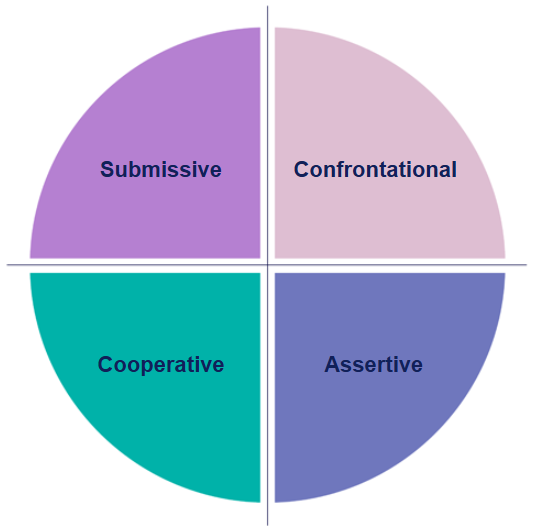
Here you will learn about the various ways you can participate in online meetings. Do you participate actively or do you keep a low profile? Or, more likely, does it depend on the meeting and who’s there? The aim of this unit is to reflect on the many different ways you can participate in these meetings and how you can help create a fairer workplace where everyone feels comfortable to contribute.
You’ll learn about different communication styles, which ones are more effective and how communication becomes gendered, even when you don’t really notice. You’ll learn how to recognise these different styles and how you can respond to them.
Unit 3 Leading the way – effective chairing
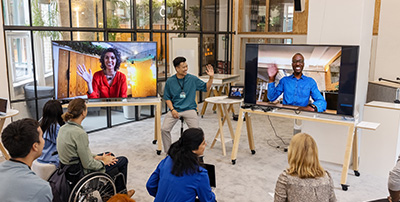
Unit 3 is about chairing online meetings and how different approaches to leadership produce different types of chairing. In turn, you’ll see how the chair can impact a meeting to make it more or less effective and, equally, more or less enjoyable and interesting for all involved. You will also review different chairing practices and have the opportunity to reflect on how and why they work (or don’t work).
Good leadership and chairing should ensure that everyone has a chance to bring their best ideas to the table. But it’s not all about style; who the chair is can also affect the success of a meeting. This unit will explore the role of gender and stereotypes in leadership as well.
Unit 4 50 shades of humour

It may not all be fun and games… but some of it is. This unit is about being funny in online meetings. Yes, you can! Humour is a common workplace feature that helps to build relationships among colleagues and teams. It can diffuse tension, lighten the mood and make people more comfortable, but it can be negative as well as positive.
Humour can be gendered, and it can be used to reinforce stereotypes and put people in their place. This unit will cover humour in online meetings and what a powerful tool it can be.
Unit 5 Could this meeting be an email?

‘Why am I sitting in this meeting when they could have just sent an email?’ Yours and other people’s time is a limited and valuable resource, and you don’t want to be wasting it. What you may also have noticed is that time doesn’t impact us all equally. Some of us have more time available than others. And time is gendered.
This unit will look at how time pressures affect men and women differently. Good time policies can contribute to gender equality and to improving the wellbeing of our co-workers.
Unit 6 What you’ve learned and farewell

This unit brings us to the end of the course and reflects on what you have learned across the units. It will go back to some of the ideas you had at the beginning of the course to see what may have changed. You’ll also revisit the Social Identity Wheel and consider how it might be a useful tool for others who participate in online meetings.
Finally, you will review what you’ve learned about leading and being part of online meetings to improve your practice and experience.
2.1 So where will you learn about this?
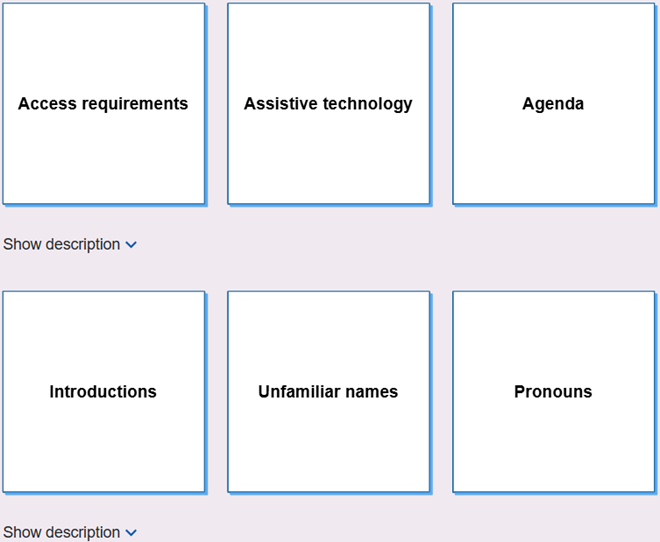
To give you a flavour of what you will learn about, click on the topics below.
3 How is the course organised?
Throughout each unit you will work through text, video, images, interactive media and engaging activities to test yourself as you consider the different ideas and evidence presented to you.
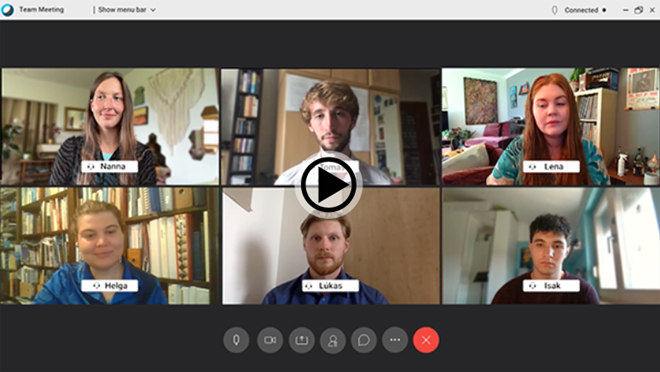
Here are some examples from each of the units:
Next, you’ll be introduced to the Social Identity Wheel which is a key tool used throughout the course to help you consider some of the nuanced aspects in online meeting scenarios.
4 The Social Identity Wheel
People have many social identities. Your gender is one. But there are many others like your ethnicity, sexual orientation, age and class that are also examples of the multiple identities a person may have. A social identity is one you get from being part of a group and we are all part of many groups. These are not necessarily within our control.
The Social Identity Wheel is a resource developed by the University of Michigan that helps you reflect on how your identities impact the ways in which you experience the world and how others might see and treat you.
You will come across the Social Identity Wheel in each unit to consider the relevance of social identity on each of the topics you will explore. It will help you gain insight into how privilege can normalise some identities over others. For instance, in a meeting with colleagues from different countries, if you are someone who speaks English as your first language you probably don’t often have to think about that as being part of your identity. However, colleagues for whom English is a second language will likely be very aware of it.
Introducing the Social Identity Wheel
To begin, click on each segment of the wheel to reveal a description of each identity.
 Activity 1 Who are you?
Now you’ve encountered the Social Identity Wheel and thought about the different identity groups, answer the questions below.
Unit 1 conclusion
This first unit has been a course overview that covers why it’s important and timely to study this topic. You’ve looked at what will be covered in each unit and have been introduced to some of the tools you will use in the course. We hope you will find the learning useful and that it supports you and your colleagues in making best use of your online meetings.
End-of-unit practice quizzes and end-of-course quiz
At the end of each unit you will have a chance to test your learning with a practice quiz. These are for your own learning and you will be able to go back to them whenever you like.
A free Open University ‘Best practice in online meetings’ digital badge is awarded for completing all units of the course and successfully passing the end-of-course quiz with a grade of 80% or more. You can have further attempts at the end-of-course quiz if you don't pass initially.
Your badge and statement of participation are downloadable from your OpenLearn Profile and can be shared on social media and displayed on LinkedIn or other e-portfolio platforms. For more information see Badged courses.
Unit 1 practice quiz
Now have a go at the Unit 1 practice quiz to test your understanding of this unit – you can attempt the quiz as many times as you like.
After you have completed the Unit 1 practice quiz move onto Unit 2 Being a participant – how to play nicely!
References
Abdoo, P. M. (2020) Social Identity Wheel. Available at: https://sites.lsa.umich.edu/equitable-teaching/social-identity-wheel/ (Accessed: 1 September 2025).