Use 'Print preview' to check the number of pages and printer settings.
Print functionality varies between browsers.
Printable page generated Sunday, 11 October 2026, 3:29 AM
5 Identifying workplace outputs and outcomes for wellbeing
5 Identifying workplace outputs and outcomes for wellbeing

To meet your overall goal for supporting workplace wellbeing, you will need to identify a number of outcomes. In other words, what you need to happen to achieve your goal. For example:
- To reduce absence on the grounds of burnout by 25% over the next two years.
- To have over 50% of employees participate in a wellbeing programme over the next year.
- To ensure that 80% of employees use their full annual leave entitlement over the next year.
- To reduce employee attrition rates by 15% over the next five years.
These outcomes are likely to involve producing a range of outputs. For example, to increase the level of employee engagement in a workplace wellbeing programme you may need to redesign the format and content of relevant workshops and webinars.
When considering outcomes and outputs, you will need to factor in the following:
- The ‘inputs’ (resources) you have available and any limitations on these.
- This could be in terms of finance and budget, workload, organisational expertise and attitudes, and existing policies and procedures (amongst others).
- The assumptions behind your goals.
- These should be based on evidence where possible, for example, existing research on burnout tells us that lessening work intensity can reduce the risk of burnout (LawCare, 2021). Therefore, we can assume that reducing work targets will help reduce levels of burnout.
- The risks associated with your goals.
- Proactively thinking about the challenges you may face and the impact of these will help you to address them appropriately should they arise.
Next, go to 5.1 Common wellbeing challenges and how to address them.
5.1 Common wellbeing challenges and how to address them
To help you think about outcomes and outputs, this section sets out some common challenges experienced within legal workplaces. It also suggests a range of evidence-based strategies to address these. You can use these as a starting point for identifying the outcomes and outputs for your own theory of change.
Now you've read through the ‘Wellbeing strategies’ tool, next work through Activity 5. Refer to the ‘Wellbeing strategies’ tool to assist you with the activity.
Activity 5 Wellbeing challenges and practical strategies
Read the four scenarios below.
Using the ‘Wellbeing strategies’ tool, identify each person’s wellbeing challenge, then complete the matching exercise to select the most suitable practical strategy for each scenario.
Scenario A: Monica – in-house counsel
Monica is a high-performing in-house legal counsel at a fast-paced tech startup. Known for her perfectionism and relentless work ethic, she often stays late to review contractual provisions, respond to urgent compliance queries, and support product launches. Her attention to detail and reliability have earned her respect across departments – but at a cost.
Over time, Monica begins to feel chronically exhausted, emotionally drained, and disconnected from her work. She finds herself sacrificing sleep and personal time to meet others’ expectations, yet neglecting her own wellbeing.
After speaking with Human Resources and her manager, Monica reflects on her stressors and realises her situation stems from two main sources: her inability to switch off from work and the constant pressure of time-sensitive legal tasks.
Scenario B: Priya – remote working human resources specialist
Priya works in HR for a multinational law firm that transitioned to fully remote operations two years ago. While she enjoys the flexibility, she’s noticed her daily interactions are limited to the same small group of colleagues. Meetings feel repetitive, and her creativity in designing employee engagement programs has started to wane.
Scenario C: Daniel – remote working legal associate
Daniel is a mid-level associate at a large international law firm. Since the firm shifted to hybrid work, most of his communication happens through scheduled Zoom calls and email threads – almost exclusively with his immediate litigation team. Over time, Daniel begins to feel intellectually stagnant. The cases feel repetitive, and the lack of exposure to different legal perspectives makes his work feel narrow and uninspired.
Scenario D: Aisha – junior solicitor
Aisha is a junior solicitor at a prestigious London law firm. The firm prides itself on delivering flawless work, and while Aisha is committed to excellence, she notices a troubling trend: associates are terrified of making mistakes, routinely overwork themselves and rarely ask for help. Over time, Aisha begins to experience anxiety and self-doubt, despite consistently meeting her performance targets.
Two lists follow, match one item from the first with one item from the second. Each item can only be matched once. There are 4 items in each list.
-
Scenario D: Aisha – junior solicitor
-
Scenario A: Monica – in-house counsel
-
Scenario B: Priya – remote working human resources specialist
-
Scenario C: Daniel – remote working legal associate
Match each of the previous list items with an item from the following list:
a.Consider how to break down siloed groups/teams
b.Build connections and reverse mentoring initiatives to promote cross-generational understanding
c.Promote striving for excellence and high standards
d.Encourage employees to reflect on their work stress and to design their own recovery activities
- 1 = c,
- 2 = d,
- 3 = a,
- 4 = b
Feedback
Scenario A: Monica – in-house counsel
Practical strategy: Encourage employees to reflect on their work stress and to design their own recovery activities.
The Human Resources Wellbeing Lead helps her create a focused recovery plan:
- Psychological detachment through exercise: Monica joins a kickboxing class three evenings a week, using the intensity and concentration to switch off from legal work and release tension.
- Restorative activities: At weekends, she takes slow park walks and listens to ambient music – calming activities that help her reset after demanding negotiations and compliance tasks.
- Proactive scheduling: She blocks recovery time in her calendar before major launches or board meetings, giving herself space to decompress and prevent a return to burnout.
Within weeks, Monica feels more energised and clearer‑headed, with a noticeably improved mood. She begins tackling legal challenges with renewed focus and starts encouraging her team to prioritise wellbeing and set healthier boundaries.
Scenario B: Priya – remote working human resources specialist
Practical strategy: Consider how to break down siloed groups/teams.
After reading internal research on online communication silos, Priya decides to act:
- Cross-team social events: She launches a monthly virtual ‘Coffee Roulette’, pairing colleagues from different departments for informal chats, sparking new conversations and connections.
- Collaborative projects: Priya brings in marketing and IT to co-design a refreshed onboarding experience, blending storytelling with technical insight.
- Network expansion: She joins a company-wide hobbies Slack channel, meeting colleagues she’s never worked with – including a data analyst who shares her love of photography.
Within a few months, Priya feels reenergised. Her work benefits from fresh perspectives, and she’s built a broader, more dynamic network across the organisation.
Scenario C: Daniel – remote working legal associate
Practical strategy: Build connections and reverse mentoring initiatives to promote cross-generational understanding.
Recognising the risk of siloed communication, Daniel takes action:
- Cross-practice collaboration: He launches a monthly ‘Legal Roundtable’ where associates from corporate, IP, family, and litigation share recent challenges, sparking new ideas and revealing overlaps in legal strategy.
- Firm-wide social initiatives: Daniel helps run a virtual trivia night open to all offices, encouraging informal interaction. He even connects with a Singapore partner who shares his interest in legal tech.
- Mentorship beyond his team: He seeks guidance from a senior compliance counsel, gaining exposure to regulatory areas he rarely sees in litigation.
Within months, Daniel feels reenergised. His legal reasoning sharpens through diverse input, and he’s invited to contribute to a cross-practice white paper on emerging privacy laws – an opportunity that came from stepping outside his communication silo.
Scenario D: Aisha – junior solicitor
Practical strategy: Promote striving for excellence and high standards.
After attending a professional development seminar, Aisha learns that perfectionism doesn’t improve performance – and often harms wellbeing. She shares this with her team lead during supervision, who agrees to pilot a cultural shift:
- Training and onboarding: The firm updates onboarding materials to clarify the difference between healthy standards and harmful perfectionism, reassuring new hires that mistakes are part of learning.
- Manager communication: Team leaders begin discussing this distinction in weekly meetings, highlighting how striving for excellence doesn’t mean chasing flawlessness.
- Wellbeing integration: HR introduces mental health check‑ins and encourages staff to reflect on how they handle pressure.
Within months, Aisha notices a meaningful shift. The team is more collaborative, less afraid of feedback, and more open to new ideas. The firm’s excellence remains – now grounded in resilience and growth rather than burnout.
5.2 Specific outputs and outcomes
SMART objectives are a simple framework used to set clear and effective goals. The acronym stands for specific, measurable, achievable, realistic and time‑bound, helping make objectives more focused, realistic and trackable. By using SMART criteria, individuals or teams can define what they want to accomplish, how success will be measured and when the goal should be complete.
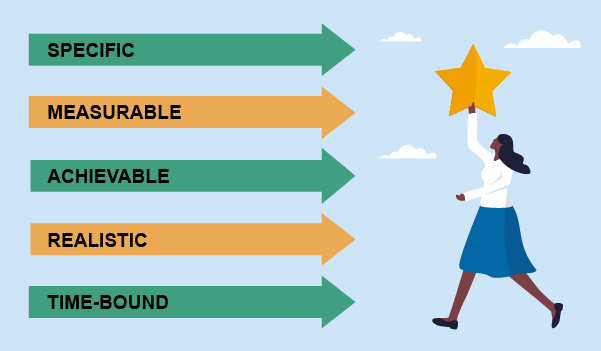
SMART objectives improve performance by making expectations clear, focused and achievable, which helps people work more efficiently and confidently.
Specific – A specific objective is clear, focused, and unambiguous. It states exactly what you want to achieve, who is involved, and sometimes where it will happen.
Measurable – A measurable objective includes a way to track progress or confirm success. This usually means numbers, indicators, or criteria that let you know when your objective has been achieved.
Achievable – An achievable objective is realistic given your resources, skills and time, but should still be challenging. It shouldn’t be impossible, but it shouldn’t be trivial either – something that can reasonably be accomplished.
Realistic – A realistic objective is sensible and achievable given the available resources.
Time‑bound – This helps maintain focus and ensure the objective has a clear deadline or timeframe.
Activity 6 Identifying outputs and outcomes
Spend some time thinking about what outcomes and outputs need to be in place for you to achieve the goal you identified in Activity 3.
Remember to factor in resources, assumptions and risks. It is important to ensure that your outcomes are: specific, measurable, achievable, realistic and time-bound (SMART).
Make some notes about your planned outcomes below, then copy and paste your best ideas into your theory of change record.
 |
|
 |
|
 |
|
 |
|
 |
Discussion
The outcomes and outputs you identify will depend on the remit of your role and the resources available to you. You can develop your theory of change to show the links between different resources, assumptions and risks and the outcomes and outputs you have selected.
Next, go to 6 Integrating evaluation into wellbeing work.