Use 'Print preview' to check the number of pages and printer settings.
Print functionality varies between browsers.
Printable page generated Friday, 20 November 2026, 12:40 PM
Effective engagement with governments and parliaments
About this course
Welcome to Effective engagement with governments and parliaments, a course developed by PolicyWISE at The Open University as part of the ESRC-funded Research Capability Hub (RCH).
If your research touches on public policy in any way, understanding how the UK is governed is not optional but essential. Yet the UK’s constitutional arrangements are often misunderstood, even by experienced researchers.
The differences between governments and parliaments, the distinction between devolved and reserved matters, and the correct terminology for engaging with policy-makers across the four nations are all areas where mistakes are common and can undermine credibility.
This course is adapted from the PolicyWISE original OpenLearn Create course titled Understanding and engaging with the governments and parliaments of the UK.
It reflects feedback and research training priorities from the RCH community and is designed to support social scientists at any career stage to navigate the UK policy landscape with confidence.
Over the next three units, you will:
- explore how the UK (and Ireland) is constituted and learn the correct names and terminology for the territories, nations and states
- examine the roles and responsibilities of the UK’s four governments and parliaments, including the distinction between devolved and reserved matters
- develop practical skills for communicating with policy-makers, including how to use accurate policy language and how to map your policy territory.
The course is relevant to researchers working across all disciplines and career stages, whether your research relates to policy in one nation or across the whole of the UK.
What does the course cover?
Unit 1: How the UK is constituted, and an overview of its governments and parliaments
This unit introduces the correct names for the UK and Ireland’s territories, nations and states, and addresses the most common mistakes that researchers make when referring to them.
Unit 2: Understanding policy roles and responsibilities across the UK
The second unit examines the difference between governments and parliaments, starting with the UK Government and Parliament at Westminster and then covering the devolved governments and parliaments in Scotland, Wales and Northern Ireland.
Unit 3: Communicating and engaging with policy-makers
The final unit of the course builds on the foundational knowledge from the first two units and introduces practical tools for policy engagement, including guidance on policy language and the ‘mapping your territory’ framework.
Suggested study time: 3 hours
Unit 1: How the UK is constituted, and an overview of its governments and parliaments
Welcome to the course
Objective: Introduce the scope of the course, the overview of how the UK is constituted, and the correct names for the UK and Ireland’s territories, nations and states.
By the end of this unit you will be able to:
- identify the scope of this course
- explain how the UK is constituted
- demonstrate your knowledge by addressing the most common mistakes that people make when referring to territories, nations and states.
Content:
- An overview of how the UK is constituted.
- How to avoid the most common mistakes in understanding UK policy.
Activities:
- A video guide to the UK and Ireland.
- A video introduction from a policy expert.
- An interactive quiz to assess prior knowledge.
Introduction to the course
Watch this short video for an overview of PolicyWISE and what we will cover in this course.
Transcript
By studying this course, you will develop a structured and practical understanding of the policy landscape across the nations of the United Kingdom: England, Scotland, Wales and Northern Ireland. This landscape is both complex and continually evolving.
By completing this course, you will be able to:
- distinguish between parliaments and governments
- identify the ways to engage with relevant policy actors and institutions
- explain what policy is and how it is developed
- describe how devolution operates across the UK
- correct common mistakes in language and terminology.
These are important skills – and advantages – for you as a citizen of the UK, for your engagement with how our nations are governed, and in understanding the ‘who, what and where’ of policy.
Testing your knowledge
Before you go any further, let’s start with a quick quiz.
Quiz
a.
Northern Ireland is part of the United Kingdom.
b.
Northern Ireland is part of Great Britain.
c.
Northern Ireland is part of the island of Ireland.
The correct answer is b.
a.
There is one system of value-added tax in the UK.
b.
There is one system of inheritance tax in the UK.
c.
There is one system of income tax in the UK.
The correct answer is c.
a.
The head of each government in UK nations has the title ‘Prime Minister’.
b.
Each parliament in the UK nations has a Presiding Officer or Speaker.
c.
Only the Westminster parliament that has two chambers or ‘houses’.
The correct answer is a.
Discussion
The following video discusses the answers to this quiz.
Transcript
What’s in a name?
Before we look at governments, parliaments and policy across the UK in more detail, we’re first going to look at something fundamental to being a researcher in the UK policy landscape.
We’re going to review and remind you of the names of our territories, nations and states.
This is something that often confuses people – you will often see incorrect names and references in the news or even in policy debates.
For example, did you know that:
- the United Kingdom and Great Britain are different to each other?
- governments and parliaments are different organisations, and different across the UK?
- Ireland is not part of the UK?
Policy language
You will now watch a short video that will take you through the correct names whilst pointing out some common mistakes so that you can avoid them in future.
Transcript
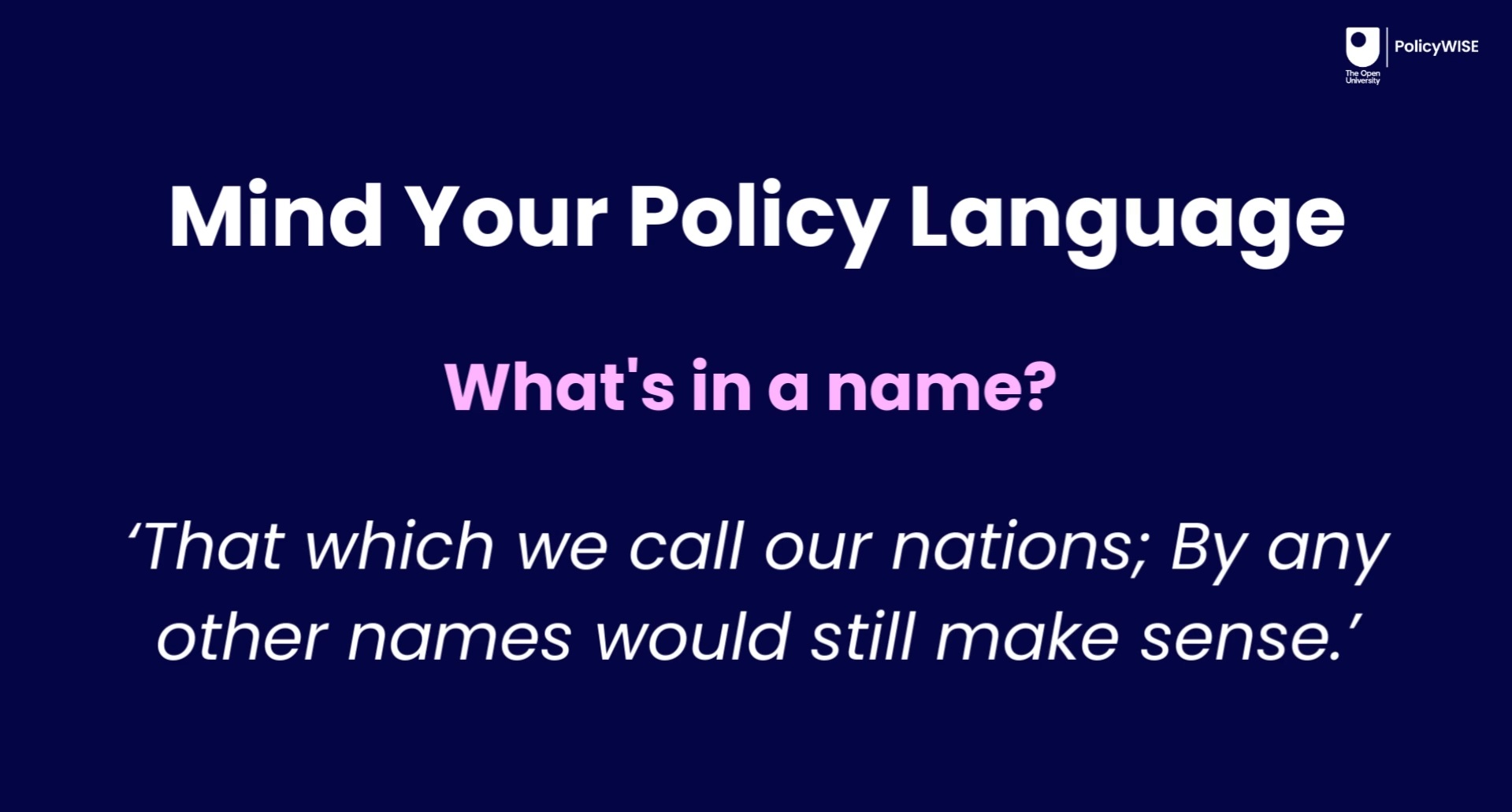
Mind your policy language
What’s in a name?
‘That which we call our nations; By any other names would still make sense.’
With apologies to Shakespeare, we know that the terms and names we call our nations, across these islands, can be complex and confusing, with many of us making common mistakes.
The United Kingdom of … what and where exactly? Our islands … all-Ireland … Great Britain or British Isles … England and Wales … but what about Scotland ...
Lines on the map, names of our nations, it can be confusing.
Here is your PolicyWISE guide to getting it right.
Here are two large islands.
The one on the right is the island of Great Britain.
To the left, is the island of Ireland.
(There are many smaller islands around these two main islands, but we’ll stick to these two larger ones for now).
Great Britain
Great Britain consists of the nations of England, Scotland and Wales.
Each of these joined together, in different ways, over the centuries, to form a union and the political state of Great Britain.
Scotland and Wales have their own parliaments and governments, with powers that have been devolved from the United Kingdom parliament in Westminster.
England does not formally have its own parliament or government.
However, much of the work of UK government departments, and the business of the UK parliament, directly affects only England.
United Kingdom
Along with Northern Ireland, these three nations form a union that is the nation-state named the United Kingdom of Great Britain and Northern Ireland.
Constituencies in each of the four territories elect members of the United Kingdom parliament in Westminster.
Ireland
Northern Ireland covers much of the northeastern territory on the island of Ireland. It also has its own parliament and government.
We use the term Ireland for the whole island – and sometimes call it all-Ireland.
The island of Ireland is traditionally made up of thirty-two counties, and six of these are in Northern Ireland.
The nation state which covers most of the island, and which is not part of United Kingdom, is also generally known by the name Ireland.
It consists of twenty-six of those traditional counties.
This country is sometimes referred to as the Republic of Ireland, to distinguish it from the whole island or Northern Ireland.
Ireland is its own nation state, a member of the European Union, United Nations and other international bodies and agencies. Just like the United Kingdom is … apart from the EU bit …
It is not a part of the United Kingdom – although it was once for a period.
A president is the head of state in Ireland – whereas a Monarch is head of state in the United Kingdom.
How to avoid common mistakes
Whilst we can use Ireland for the whole island and for the nation-state of the Republic of Ireland – we definitely can’t describe it as part of Great Britain, England or the United Kingdom.
Northern Ireland is part of the state of the United Kingdom of Great Britain and Northern Ireland.
But it isn’t part of the island or three territories that makes up Great Britain. And whilst we sometimes use Britain or Great Britain when we mean the whole United Kingdom, this is incorrect.
Whilst some use the term British Isles for the two large islands and the other smaller ones, it’s best to avoid this term, as it suggests that Ireland is part of Great Britain or the United Kingdom in some way.
Historically England was – incorrectly – sometimes used as the name for the whole of Great Britain, reflecting its dominant position and its role in the union of the different countries.
‘England and Wales’ is the term for the legal jurisdiction which covers both nations – although there is now, once again, a growing body of distinct Welsh law.
And that’s your guide to minding your policy language when talking about our nations, territories, Ireland, Britain and the United Kingdom.
This is an essential foundation of building your knowledge of how the UK is constituted. It will help you refer to the different nations, and the UK as a whole, with confidence. As you have seen, different terms can refer to different institutions or levels of decision-making. Therefore, using the correct names helps to make sure that you’re talking about the right place or people – this is important when understanding and engaging with policy or policy-makers.
- Think about an issue you are particularly interested in. It could be something that affects you or your family, or an area of work or research.
- Does your interest or work lie in one nation, such as Wales or Scotland, or does it apply across the whole of the UK, in England, Scotland, Wales and Northern Ireland?
- Remember to note that the Republic of Ireland is a completely different nation state – but it shares the island of Ireland with Northern Ireland, which is part of the UK.
Let’s have a brief re-cap.
United Kingdom
The United Kingdom of Great Britain and Northern Ireland is the state and political union of England, Wales, Scotland and Northern Ireland.
During the 19th and early 20th centuries it included the whole of Ireland.
There are four governments and parliaments across the UK.
Great Britain
Great Britain is the island, and is the name of the union, of England, Scotland and Wales.
It does not include Northern Ireland.
Therefore, it is not the same as the United Kingdom – although it forms a large part of the UK.
Ireland
The island of Ireland includes both the state of the Republic of Ireland (also generally known as ‘Ireland’) and Northern Ireland, which is a constituent part of the United Kingdom.
The Republic of Ireland is not part of the UK and is a separate member of international communities such as the United Nations and the European Union.
It has its own government and parliament.
Reflective activity: Helping a Researcher
A Researcher has produced the following three statements, which include some inconsistencies – especially on the use of terminology related to the UK’s territories, nations and states. Can you identify the inconsistencies in the following sentences and correct them?
- The integration and governance of AI in secondary schools in Great Britain varies substantially across the four nations. This results in inequitable opportunities for pupils, inconsistent approaches to assessment and uncertainty for school leaders.
- Our comparative research on five jurisdictions (viz., England, Scotland, Wales, Northern Ireland and the Republic of Ireland) reveal the unequal distribution of AI policies to guide school education. The findings get more interesting when the whole British Isles are compared.
- The island of Ireland is uniquely positioned to deal with any matter related to Europe because it is a member state of European Union.
Answer
- ‘Great Britian’ is the wrong term . Perhaps Researcher ‘A’ means ‘the UK’ here, as they talk about the integration and governance of AI in secondary schools across four nations. Great Britain only covers three nations: England, Wales and Scotland
- The use of the term ‘British Isles’ is problematic. This term suggests that Ireland is part of Britain or the UK. Instead, if needed, Researcher ‘A’ could say ‘The findings get more interesting comparing the different jurisdictions across Britain and Ireland’.
- Here Researcher ‘A’ considers the island of Ireland as a single nation state, which it is not. It comprises of the Republic of Ireland, which is a member state of the EU, and Northern Ireland, which is constitutionally a part of UK and so not a member of the EU.
Let’s take a quiz to review what we’ve learned.
Quiz
a.
Three
b.
Four
c.
Five
The correct answer is b.
a.
Only when referring to the UK.
b.
You should avoid using it in any context.
c.
When referring to Britain and Ireland.
The correct answer is b.
a.
Constituencies only in England.
b.
Constituencies only in Great Britain.
c.
Constituencies only in the UK.
The correct answer is c.
Discussion
The following video discusses the answers to this quiz.
Transcript
Unit 1 summary
This unit introduced the names of territories, nations and states, and how they are commonly used. It also highlighted some of the common inconsistencies and misunderstandings in how these terms are applied.
In the next unit we will build on this by introducing what governments and parliaments are, and the key differences between them.
First you’ll look at the UK Government and Parliament, often referred to as ‘Westminster’.
Then you’ll look at the different governments and parliaments in Scotland, Wales and Northern Ireland, and the different policy roles that they have. Having done so, you will be able to understand different policy roles and responsibilities across the UK.
Unit 2: Understanding policy roles and responsibilities across the UK
Introduction
Objective: Provide an in-depth overview of the governance structures and policy-making processes across the nations of the UK.
By the end of this unit you will be able to:
- distinguish between the roles and responsibilities of governments and parliaments across the UK
- explain how devolved and reserved matters determine which body is responsible for a given policy area
- identify the appropriate government or parliament to engage with on a specific policy issue.
Content: An overview of what governments and parliaments are, focusing first on the UK Government and Parliament (often known as ‘Westminster’) and then on the governments and parliaments in Scotland, Wales and Northern Ireland, and the different policy roles that they have.
Activities:
- An interactive digital map with key information on the governments and parliaments.
- A case study analysis of policy divergence (for example, healthcare or education policy)
In this second unit you will learn the difference between what a government is and does, and what a parliament is and does. This will help you identify who to reach out when you plan for the policy engagement.
You will then look at the different governments and parliaments across the nations of the UK, and at what their roles, responsibilities and powers are.
Knowing and understanding these differences, and how it relates to the policies that affect our daily lives – wherever you live – helps you to understand how decisions are made, who is responsible, and how to engage with the right policy and policy-makers where relevant.
In this course, we’re concentrating on the ‘national’ governments and parliaments across the UK. We are not looking at regional devolution within England – the system of mayors, combined authorities and city regions.
Points to ponder
Before you begin, take a moment to consider how familiar you currently are with the governments and parliaments of the UK and their roles.
Don’t worry if you don’t know answers at this point. In fact, these questions are designed to help you reflect as you go through the upcoming sections.
Quiz
a.
The separate devolved governments in Scotland, Wales and Northern Ireland
b.
The UK Government and Parliament at Westminster
c.
The regional mayoralties
d.
A joint committee consisting of MLAs, MSPs and MSs
The correct answer is b.
Answer
Immigration and defence are reserved matters, meaning that the Westminster Parliament retains authority to make laws on these issues for the entire UK.
a.
Engage directly with the Scottish and Welsh Governments and Parliaments
b.
Lobby the Secretary of State for Education at Westminster
The correct answer is a.
Answer
Education is a devolved matter, meaning that the Scottish Government and Parliament and the Welsh Government and Senedd possess independent authority over their nations’ education policies.
The UK Government and Parliament
Westminster
Let’s start with two of the most famous buildings and addresses in the UK, if not the world.

Although there’s a close relationship between what happens in both places, they have different roles and responsibilities: one is where the head of the UK Government lives and works – the authority that is accountable to the UK Parliament, runs public departments and agencies, and proposes new laws, policies and taxes; the other is where the UK Parliament meets – the body that we elect people to, and which debates the issues of the day.
This relationship (albeit with different roles and responsibilities) is replicated in the other governments and parliaments of the UK.
Parliaments and governments
We have designed the following card-sorting activity to help you understand how parliaments and governments are formed and what they do. Let’s find out the differences between parliaments and governments. For this, you have to drag each card and drop it to the correct category.
The UK is a parliamentary democracy. Because a monarch is head of state, it is a constitutional monarchy.
The Westminster Parliament is made up of the House of Commons and the House of Lords (and the monarch). Parliament’s role is to:
- represent the people of the UK
- check and challenge the work and spending of the UK Government
- make and change laws
- debate current issues
- set taxes.
The House of Commons
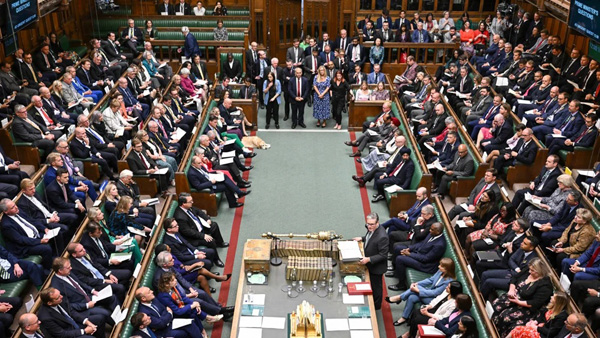
The House of Commons is the democratically elected house. It has 650 members (MPs) who are elected by the public. The most recent general election to elect members was in July 2024.
The House of Lords
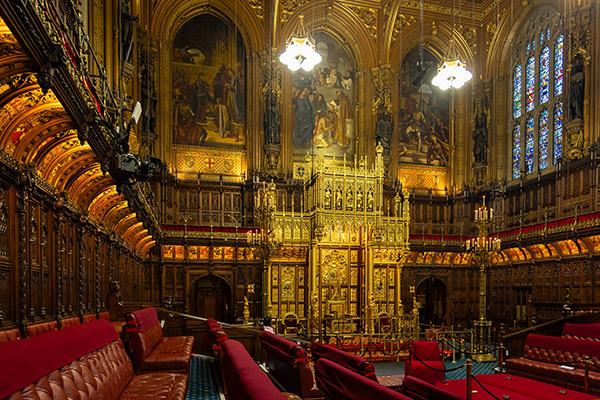
The House of Lords is the non-democratically elected house where members are appointed by the monarch on the advice of the Prime Minister. Members of the House of Lords are sometimes referred to as peers. The 800 members often have active careers in business, culture, science, sports, academia, law, education and health. Most members are appointed for life.
The state opening of Parliament
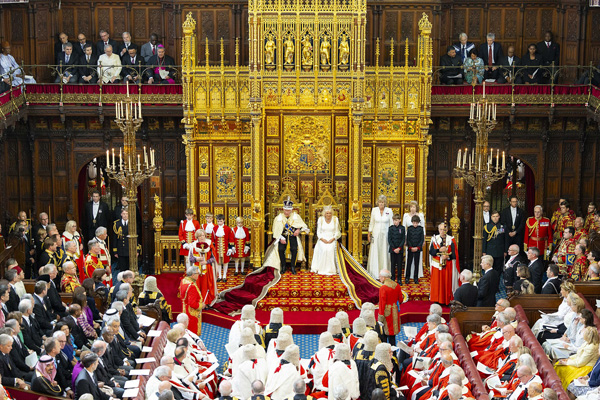
The UK Government is made up of MPs and peers (in the House of Lords) who command the confidence of the House of Commons. They are accountable to Parliament, run public departments and propose new laws to Parliament.
The UK Government is led by the Prime Minister and includes a Cabinet made up of Secretaries of State who lead individual departments such as the Treasury, Work & Pensions and the Foreign Office. Government departments are staffed by civil servants.
So we now have a sense that a government and a parliament are different bodies: a government is responsible for running public services and departments, and proposes new laws, policies and taxes; a parliament is made up of members elected by the people, holds government to account, debates the issues of the day and votes to approve laws, policies and taxes.
On some policy issues the UK Government and Parliament continues to be the authority for all parts of the UK (England, Scotland, Wales and Northern Ireland).
For many policy issues, the devolved governments and parliaments in Scotland, Wales and Northern Ireland are responsible for making and changing laws, setting some taxation, and debating issues for their nations. Therefore, on those issues, the UK Government and Parliament are only directly responsible for England.
Devolved and reserved matters
It’s now going to get a little more complicated, but it’s easy if you remember these three things:
- On some issues – such as foreign affairs, most tax and fiscal issues, and security – the UK Government and Parliament, makes laws and policy for the whole UK.
- On many other issues – such as health, education and housing – the UK Government and Parliament is only directly responsible for laws and policies that affect England.
- That’s because the separate governments and parliaments in Scotland, Wales and Northern Ireland pass their own laws and make policies on those issues.
Reserved areas are issues that remain under the authority of the UK Government and Parliament at Westminster.
Devolved areas are issues where powers have been transferred from Westminster to the governments and parliaments of Scotland, Wales and Northern Ireland.
Devolved and reserved areas
The following interactive activity sets out the devolved and reserved matters as they relate to Scotland. There are slight differences in the devolved powers – and the extent of those powers – in both Wales and Northern Ireland. Examples include the taxation powers devolved to Wales and the powers on law and order devolved to Northern Ireland.
Sort out which matters in the box are devolved and which are reserved matters by dragging each card and dropping it to the correct category.
This means that, in effect, citizens in Scotland, Wales and Northern Ireland have two governments and parliaments: the government and parliament in Westminster that deals with reserved policies, and the devolved governments and parliaments that deal with devolved policies.
There is no official separate government or parliament for England; the UK Government and Parliament are, in effect, also the government and parliament for England.
Other UK governments and parliaments
This is a timeline of selected policy milestones and policy firsts during the modern devolution era since 1999. It does not include constitutional milestones such as referendums, transfers of power or Brexit-related developments. Instead, it highlights some key policy developments – new laws, taxes, reforms – in or by the devolved governments and parliaments of the United Kingdom. The milestones have been selected by PolicyWISE as a brief overview looking at the three devolved nations together. Each of the UK’s parliaments has briefings and information that go into more detail on their respective jurisdictions.
Timeline of selected policy milestones and policy firsts
| Nation | Government | Parliament |
|---|---|---|
| Scotland | The Scottish Government is made up of Members of the Scottish Parliament (MSPs), who command the confidence of the Scottish Parliament. It is led by the First Minister and Cabinet of Ministers; it runs public departments and services and is staffed by civil servants. It is accountable to the Scottish Parliament. | The Scottish Parliament is democratically elected, examines what the Scottish Government is doing, makes and agrees new laws and taxes, and debates the issues of the day. There are 129 MSPs. |
| Wales | The Welsh Government is made up of Members of the Senedd (MSs), who command the confidence of Senedd Cymru. It is led by the First Minister and Cabinet of Ministers, runs public departments and services, and is staffed by civil servants. It is accountable to Senedd Cymru/the Welsh Parliament. | Senedd Cymru/the Welsh Parliament is democratically elected, examines what the Welsh Government is doing, makes new laws and taxes, and debates the issues of the day. There are 96 MSs. |
| Northern Ireland | The Northern Ireland Executive is led by the First Minister and Deputy First Minister, who are nominated by the largest parties of the two largest political designations in the Northern Ireland Assembly in what is known as power-sharing. The Executive Committee is made up of Members of the Legislative Assembly (MLAs) determined by party share in the Assembly. It runs public departments and services and is staffed by civil servants. It is accountable to the Northern Ireland Assembly. | The Northern Ireland Assembly is democratically elected, examines what the Northern Ireland Executive is doing, makes new laws and taxes, and debates the issues of the day. There are 90 MLAs. |
Across the UK we also often use the location of our parliaments as shorthand for naming them: the UK Parliament is sometimes known as ‘Westminster’; the Scottish Parliament as ‘Holyrood’; Senedd Cymru/the Welsh Parliament as ‘Cardiff Bay’; and the Northern Ireland Assembly as ‘Stormont’.
It is essential to remember that responsibilities are dispersed across the nations, governments and parliaments, as it will help you to know where to engage on a policy matter.
For example, if you wanted to influence education policy across the UK, it would require engaging with the different governments and parliaments; if you wanted to engage with policy as it affects schools in England, you would engage with Westminster – but this wouldn’t directly influence policy in the other nations of the UK.
Let’s take a quiz to review what we’ve learnt in this module.
Reflective activity: Scenario analysis
Scenario 1
Your research relates to improving mental health support in schools across all four nations of the UK. Which governments and parliaments would you need to engage with, and why?
Answer
Education and health are devolved matters, so you would need to engage with:
- the UK Government and Parliament
- the Welsh Government and Senedd Cymru
- the Scottish Government and Scottish Parliament
- the Northern Ireland Executive and Northern Ireland Assembly.
This demonstrates that the same policy issue may require engagement with multiple governments and parliaments across the UK.
Scenario 2
A think tank based in the UK wants to influence military investment and national defence policy. Who should it primarily engage with and why?
Answer
It should engage with the UK Government and UK Parliament. Defence is a reserved matter and is the responsibility of the UK Government and Parliament.
Let’s take a quiz to review what we’ve learnt in this unit.
Quiz
a.
Devolved
b.
Evolved
c.
Reserved
The correct answer is a.
a.
The House of Lords
b.
The House of Windsor
c.
The House of Commons
The correct answer is c.
a.
Wales
b.
Northern Ireland
c.
Scotland
The correct answer is b.
Discussion
The following video discusses the answers to this quiz.
Transcript
Unit 2 summary
This unit introduced what governments and parliaments are, focusing on the UK Government and Parliament (Westminster) and those in Scotland, Wales and Northern Ireland. It also outlined their different policy roles, including the distinction between devolved and reserved matters.
In the next unit you will focus on practical skills, tools and approaches for engaging with policy and policy-makers.
Unit 3: Communicating and engaging with policy-makers
Introduction
Objective: Equip participants with the skills to effectively engage with policy-makers and navigate multi-nation policy environments.
By the end of this unit you will be able to:
- use accurate and appropriate policy language when communicating with policy-makers across the UK’s nations
- apply the ‘mapping your territory’ framework to identify relevant policy actors, responsibilities and engagement opportunities for a research issue
- tailor a policy communication for a specific national context and audience.
Content:
- Identifying relevant policy-makers and stakeholders.
- Developing tailored communication strategies for each policy setting.
- Avoiding common engagement mistakes and strategies for effective advocacy.
Activities: Mapping interactive tool/‘mapping your territory’ exercise.
In this unit you will build on your foundational knowledge to develop your practical communication and engagement strategies. You’ll be learning the tips, skills and tools for engaging with policy and policy-makers that you can use whether you’re focused on policy in multiple nations and policy areas, or only one.
When working in the UK, we’d encourage you to use the lessons from what you’ve learnt so far so that you think carefully about where policy is happening, who is involved and what authorities are responsible.
Points to ponder
Before you begin, take a moment to reflect on the following questions.
Quiz
a.
‘We are eager to work with the Scottish Government on this UK-wide policy …’
b.
‘Our research offers key insights for regional administrations across the UK, including the Scottish Executive …’
c.
‘This briefing outlines how Scottish policy can address this critical educational challenge …’
d.
‘We are examining how similarities across the nations can inform future strategies …’
The correct answer is b.
Answer
The second option contains two major policy language errors. It refers to a national devolved government or parliament as a ‘regional administration’, which diminishes its status as a representative of a national polity, and it uses the term ‘Scottish Executive’ – the official accepted term is the Scottish Government.
a.
The term ‘north-east’ can only legally be used when discussing trade zones.
b.
It is politically sensitive because the north-east of England has its own devolved parliament.
c.
It lacks specificity: every nation of the UK has its own north-east, so you have to specify the north-east of which nation you are referring to.
d.
Using directional terms like ‘north-east’ is considered too informal for official policy briefs.
The correct answer is c.
Answer
Geography in the UK is entirely relative. Without specifying the nation (e.g. ‘north-east England’), the reader may not be able to interpret the location, which can lead to immediate confusion.
Minding your policy language
When engaging with policy or communicating with policy-makers, it’s important to get it right in the language that you use.
You’ve already learnt how to avoid some of the common mistakes that people make when referring to the UK, Britain and the individual nations. It’s also helpful to think about policy language – and getting it right – in three contexts: identity, geography and political
Identity
Avoid using the terms ‘local’ or ‘regional’ when you describe, or engage with, the national devolved parliaments such as those in Scotland and Wales.
Using those terms are likely to cause offence and will make policy engagement more difficult than it should be. Although they are devolved institutions, the governments and parliaments of Scotland and Wales are representatives of national polities.
Some people used to use the description ‘devolved administration’ to describe the devolved governments. However, ‘government’ is now the official description used by the devolved governments themselves and by the UK Government when describing them – so you should also use this description.
Geography
Try to be specific when using such geographical terms.
When engaging with policy in the UK, think carefully about how and when you use terms such ‘north-east’ and ‘north-west’: are you referring to that region’s place in the entire UK or within one of the UK’s nations?
So, for example, you might say ‘the north-east’ when referring to the region that includes Newcastle upon Tyne, Northumberland and so on. But it would be more accurate to say ‘north-east England’.
Remember that there are parts of the UK that are further north and further east than north-east England – and that each nation within the UK has its own north-east.
We’ve gone through the names of the different territories across our islands already:
- The United Kingdom is different to Great Britain.
- The Republic of Ireland is not part of the UK, but Northern Ireland is.
- However, Northern Ireland is not part of Great Britain.
- England is the name of the specific and largest nation within Great Britain and the United Kingdom, but it is not the same as Great Britain or the United Kingdom.
Political
Always think about the political context of your policy engagement. If you’re referring to ‘the government’ or to ‘parliament’, which government or parliament are you specifically referring to?
In which nation, for which policy, are you communicating or engaging with? Remember that there are four governments and parliaments across the UK’s nations.
Try to think about where your policy is relevant to, who is responsible, and which government and parliament is responsible.
And just to finish on language, here are some common mistakes to avoid when referring to our institutions:
- It’s the Scottish Government, not the Scottish Executive; and it’s the Scottish Parliament, not the Scottish Assembly.
- The Welsh Government is the Executive (government) and Senedd Cymru/the Welsh Parliament is the legislature (parliament). Neither is known as the ‘Welsh Assembly’ – that’s the former name for Senedd Cymru/the Welsh Parliament.
- It’s the Northern Ireland Executive and the Northern Ireland Assembly – not ‘Northern Irish’ or ‘Ulster’. The Executive is the government; the Assembly is the legislature.
Mapping your territory
Now that you are ready to engage with policy, with an understanding of the ‘who, what and where’ of policy in the UK, it’s time to share a tool that we use at PolicyWISE.
We call it ‘Mapping your policy territory’.
It is a unique way of understanding and engaging with policy. Unlike other tools, which ignore devolution or focus solely on one context, this tool engages with how the UK is actually governed, where policy happens and who is responsible.
It’s a three-part process:
- Defining and locating the challenge.
- Understanding what’s being done.
- Comparing what’s being done.
At PolicyWISE we map our policy territory each time we write or edit a ‘Wise in 5’ briefing. Wise in 5 is a snapshot comparative guide to public policy issues across the nations of the UK and Ireland.
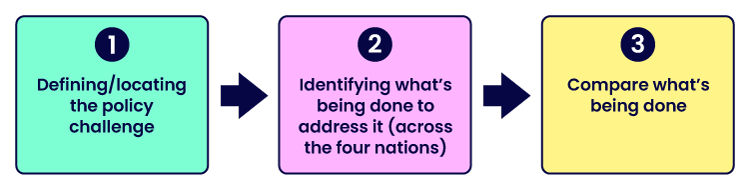
To start, you need to define and locate the policy issue or challenge. Keep these questions in mind:
- What issue(s) or challenge(s) does your research relate to (in the UK)?
- Where does this challenge exist/occur?
- How does your research or work address, or relate to, this challenge?
Then identify and understand what is being done.
- What’s the current legislative or policy situation?
- What are governments doing/what do the governments want to do?
- What’s happening in the parliaments?
- Who else is involved/interested? (Agencies, think tanks, advocates, etc.)
And then, recognising that the situation might be different in the different nations, compare what’s being done:
- What are the similarities/differences across nations/contexts?
- Where is progress/evidence/advocacy most advanced?
- What could the nations learn from one another?
- Where are the best opportunities for engagement?
The figure below is an example of Active Travel as a policy challenge and issue that has been mapped.
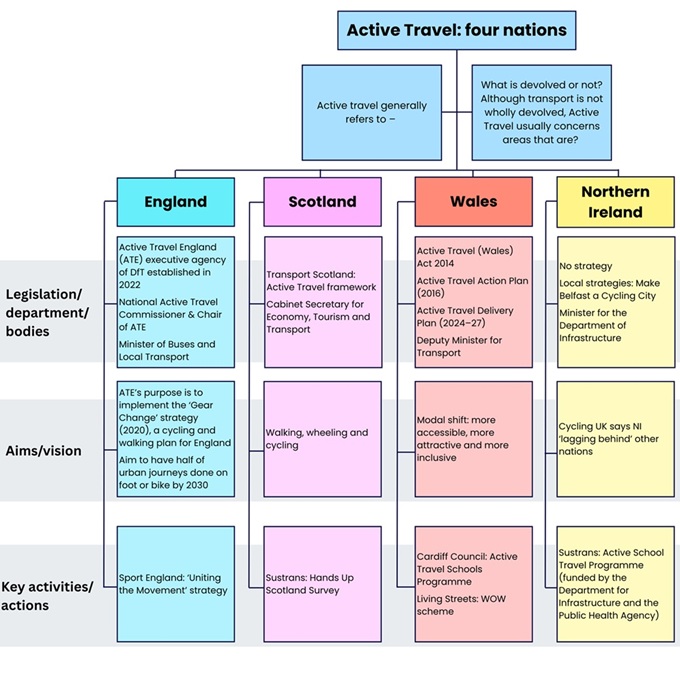
Mapping your territory is a very helpful exercise to conduct before engaging with policy and policy-makers, and it is a tool that you can keep using and updating. It helps you to:
- test whether others have the same view of the challenge as you do
- develop an understanding of the complexity of the issues and actors involved
- build an awareness of what’s happening on the issue across parliaments, governments and other agencies
- anticipate when the issue or challenge might be topical or discussed by policy-makers
- locate what is different in the policies, laws, processes or authorities across the UK.
Remember as you map your territory that each stakeholder might have very different roles and responsibilities – as well as views – on your particular issue or challenge. When you are ready to communicate with them, make sure to bear this in mind.
We’d encourage you think right across the four nations of the UK, but you can equally map your territory, using this model, within one nation or a smaller region.
Remember to:
- define and locate the challenge or issue
- assess and understand what is being done on that issue
- compare what is being done elsewhere on that issue.
Everything you’ve learnt across these modules will help you in that three-part process with the advantage of understanding how policy and power is distributed across the UK.
In following this three-step process, remember to ask yourself the following questions, which apply in any public policy context.
- What’s the current legislative or policy situation? Has there been recent legislation on this issue? Has there been legislation elsewhere? If so, is that legislation subject to regular reviews, and does it set statutory requirements for people or organisations?
- What are governments doing/what do the governments want to do? Does the relevant government (or authority) have plans to do something on that issue? Is there a manifesto or policy consultation? Has the minister made a speech or statement?
- What’s happening in the parliaments? Have members of the parliament been asking questions on this issue? Are any of the committees looking at this issue, or have they already looked at it?
- Who else is involved/interested? Does this issue involve another agency such as a government-sponsored body (for instance, non-ministerial departments of the UK Government staffed by civil servants such as the Food Standards Agency (FSA) and Charity Commission)? Do they have statutory powers to deliver policy? Are any think tanks interested in this specific policy?
You can use all the information across this training to help you answer these questions.
Remember to keep updating your policy territory and filling in the map as you continue to engage with your challenge or issue – or identify a new issue.
Reflective activity: How I engage with policy in the UK
Choose one issue connected to your research or interests and work through the following prompts:
- Step 1: Define and locate the challenge.
- What is the policy challenge or issue?
- Where does it exist (UK-wide, one nation, multiple nations, or a specific place)?
- Which populations or sectors does it affect?
- Step 2: Understand what’s being done.
- Which government(s) is (are) responsible?
- Which parliament(s) scrutinise this area?
- Is there legislation, strategy, consultation or current debate?
- Who else is involved (agencies, regulators, advocates, commissioners, think tanks)?
- Step 3: Compare what’s being done.
- Does this issue need to be addressed differently in Scotland, Wales, Northern Ireland and England?
- Are there noticeable differences in ambition, framing or progress?
Unit 3 summary
This unit focused on applying your understanding to communication and engagement with policy. It introduced practical skills, tools and approaches for engaging with policy and policy-makers across different nations and contexts, and emphasised the importance of understanding where policy happens, who is involved and which authorities are responsible.
Course summary
Thank you for completing this course on how the UK is constituted and how to engage effectively with its governments and parliaments. You’ve explored the core structures, responsibilities and decision-making processes that shape policy, and you’ve built practical skills to navigate them with confidence.
In Unit 1 you began by grounding yourself in how the UK is structured constitutionally. You examined the key features of the state, the distribution of powers and the most common misunderstandings that arise when engaging in UK-wide policy work. This introduction laid the foundation for understanding why clarity in language, terminology and policy roles is essential.
Unit 2 took you deeper into the roles and responsibilities of the UK’s parliaments and governments. You explored the functions of the UK Parliament and Government (Westminster), followed by the powers and policy-making responsibilities of the devolved parliaments and governments in Scotland, Wales and Northern Ireland. This module clarified who does what and why it matters for anyone engaging with policy anywhere in the UK.
Finally, Unit 3 focused on communication and stakeholder engagement. You learned how to identify relevant policy-makers, tailor your approach for different nations and contexts, avoid the common pitfalls of multi-nation engagement, and advocate more effectively.
We hope that the course has strengthened your understanding and given you practical tools you can use immediately.
Our closing thoughts
Watch this video to wrap up the module.
Transcript
End-of-course quiz
End-of-course quiz
Now it’s time to take the end-of-course quiz.
Remember that to gain your digital badge for this course you will need to score at least 80% in this quiz.
Further reading
Bennett Institute for Public Policy, University of Cambridge (2019a) Engaging with UK Government: A Guide for Academics [online]. Available at https://www.bennettschool.cam.ac.uk/publications/engaging-uk-government/ (accessed 20 October 2026).
Bennett Institute for Public Policy, University of Cambridge (2019b) Engaging with UK Parliament: A Guide for Academics [online]. Available at https://www.bennettschool.cam.ac.uk/wp-content/uploads/2020/12/A_guide_to_engaging_with_UK_Parliament_Dec._19.pdf (accessed 22 October 2026).
GOV.UK (n.d. 1) How government works [online]. Available at https://www.gov.uk/government/how-government-works (accessed 20 October 2026).
GOV.UK (n.d. 2) Devolution [online]. Available at https://www.gov.uk/regional-and-local-government/devolution (accessed 20 October 2026).
Jacobs, M. and Knight, D. (2026) ‘Devolution’, in M. Jacobs and R. Chowdhury-Turner (eds) Ending Business as Usual: Policy Options for a Progressive Government, Compass, pp. 39-49 [online]. Available at https://www.compassonline.org.uk/wp-content/uploads/2026/09/Ending-Business-As-Usual-Official.pdf (accessed 20 October 2026).
UK Parliament (n.d. 1) Devolved parliament and assemblies [online]. Available at https://www.parliament.uk/about/how/role/relations-with-other-institutions/devolved/ (accessed 20 October 2026).
UK Parliament (n.d. 2) Parliament and the Government[online]. Available at https://www.parliament.uk/about/how/role/relations-with-other-institutions/parliament-government/ (accessed 20 October 2026).
UK Parliament (n.d. 3) Understanding UK Parliament and Government, free online course [online]. Available at https://learning.parliament.uk/en/session-workshop/online-teacher-training-parl-and-gov/ (accessed 20 October 2026).
Acknowledgements
Grateful acknowledgement is made to the following sources:
Course image: Antartis/Dreamstime
Dangoor Education logo: Dangoor Education
Introduction video: 10 Downing Street, Sergeant Tom Robinson RLC, reproduced under the terms of the OGL (www.nationalarchives.gov.uk/doc/open-government-licence); Scottish Parliament building, Nigel Stripe/Getty; Houses of Parliament, David Milnes/Getty; Welsh Parliament/Senedd Cymru, ChrisHepburn/Getty; Stormont, Wikimedia Commons (https://commons.wikimedia.org/wiki/File:Stormont_Parliamentary_Building_01.JPG#/media/File:Stormont_Parliamentary_Building_01.JPG) – this file is licensed under the Creative Commons Attribution-Share Alike Licence (https://creativecommons.org/licenses/by-sa/3.0/deed.en)
Mind your language video: ‘Ducking and diving’ music, Audio Network Rights Ltd
Figure 1: 10 Downing Street, Sergeant Tom Robinson RLC, reproduced under the terms of the OGL (www.nationalarchives.gov.uk/doc/open-government-licence); Houses of Parliament, David Milnes/Getty
Figure 2: © House of Commons (https://www.flickr.com/photos/uk_parliament/54856658346/) – this file is licensed under the Creative Commons Attribution-Non-commercial-No Derivatives Licence (https://creativecommons.org/licenses/by-nc-nd/4.0/deed.en)
Figure 3: Alexey Fedorenko/Shutterstock
Figure 4: Roger Harris/House of Lords (https://parliament.assetbank-server.com/assetbank-parliament/images/assetbox/4dac4dc4-53e2-435a-acbe-0899649ea426/assetbox.html) – this file is licensed under the Creative Commons Attribution Licence (https://creativecommons.org/licenses/by/3.0/deed.en)
Figure 5: map created using Highcharts; Houses of Parliament, David Milnes/Getty; Scottish Parliament building, Wikipedia (https://en.wikipedia.org/wiki/Scottish_Parliament_Building#/media/File:Scottish_Parliament_Building_-_aerial_-_2025-04-18_(cropped).jpg) – this file is licensed under the Creative Commons Attribution-Share Alike Licence (https://creativecommons.org/licenses/by-sa/4.0/); Welsh Parliament/Senedd Cymru, public domain; Stormont, robertpaulyoung/Flickr (https://en.wikipedia.org/wiki/Northern_Ireland_Assembly#/media/File:StormontGeneral.jpg) – this file is licensed under the Creative Commons Attribution Licence (https://creativecommons.org/licenses/by/2.0/)
Timeline: Forth Rail Bridge, jgshields/Getty; Scottish Parliament building, Nigel Stripe/Getty; Severn Bridge, Tpjhpix/iStock/Getty; Belfast cranes, Ballygally View Images/Getty; Cefn Viaduct, Alasdair James/Getty; Giant’s Causeway, pkphotography/Getty; Tay Road Bridge, Jamie Ballantine/Getty; St Andrew’s Castle, BMPix/Getty
Figure 6: Scottish Parliament building, Wikipedia (https://en.wikipedia.org/wiki/Scottish_Parliament_Building#/media/File:Scottish_Parliament_Building_-_aerial_-_2025-04-18_(cropped).jpg) – this file is licensed under the Creative Commons Attribution-Share Alike Licence (https://creativecommons.org/licenses/by-sa/4.0/); Welsh Parliament/Senedd Cymru, User: (WT-shared) Cardiff at wts wikivoyage/public domain via Wikimedia Commons; Stormont, robertpaulyoung/Flickr (https://en.wikipedia.org/wiki/Northern_Ireland_Assembly#/media/File:StormontGeneral.jpg) – this file is licensed under the Creative Commons Attribution Licence (https://creativecommons.org/licenses/by/2.0/)
Every effort has been made to contact copyright holders. If any have been inadvertently overlooked the publishers will be pleased to make the necessary arrangements at the first opportunity.