Use 'Print preview' to check the number of pages and printer settings.
Print functionality varies between browsers.
Printable page generated Tuesday, 14 July 2026, 10:44 AM
V10s: The potential of technology
Course information

You will need access to:
- a computer with a web browser.
Duration of the course: 7 hours over six weeks
- Online total: 3 hours
- independent study: 1 hour (e.g. course preparation, reflection)
- collaborative: 2 hours (e.g. forum discussion, posting reflective experience)
- Offline total: 4 hours
- face-to-face: 2 hours
- workplace: 2 hours (planning employer engagement to support delivery of The potential of technology unit).
Learning outcomes
Professional and reflective practitioner skills
At the completion of this course, you should be able to:
- identify opportunities to develop and assess learners’ personal, learning and thinking skills through delivery of The potential of technology unit
- recognise how the retail industry can support delivery of the Diploma in IT through different types of engagement including work experience placements.
Practical skills
At the completion of this course, you should be able to:
- apply the assessment criteria for the appropriate awarding body to learners’ outcomes generated by activities in the e-skills UK resources
- recognise and assess the functional skills demonstrated by learners as they complete tasks and activities in The potential of technology unit
- understand how to embed available resources into a delivery plan for The potential of technology unit
- work with learners on the tasks and activities available within the retail lifecycle resource to produce outcomes appropriate for assessment
- make effective use of the retail lifecycle ‘successful selling’ activities to support students engaging in enterprise projects.
Knowledge and understanding
At the completion of this course, you should be able to demonstrate:
- that you understand how to use e-skills UK teaching and learning resources in conjunction with local employers to deliver The potential of technology unit
- that you know how you and your learners access the e-skills UK learning resources through the Staffroom and Back to School websites.
Cognitive skills
At the completion of this course, you should be able to:
- identify how work experience placements in the retail sector can be used to support delivery of The potential of technology unit
- identify opportunities to make use of local employer engagement within the retail sector to support learners’ understanding of how technology supports business.
Course schedule
| Week | Activities | Type | Duration |
| 1 | Activity 1 Registering for the Staffroom | Online | 10 minutes |
| Activity 2 Exploring the Staffroom and Back to School websites | Online | 30 minutes | |
| Activity 3 The specification for The potential of technology unit | Online | 20 minutes | |
| 2 | Face-face-to-face session | Facilitated | 2 hours |
| 3 | Activity 4 Posting in the forum | Online | 30 minutes |
| 3 - 5 | Activity 5 Planning to work with a local retailer to support delivery of The potential of technology unit | Collaborative | 2 hours |
| 6 | Activity 6 Reporting back to the forum | Online | 1 hour |
| Activity 7 Course evaluation | Online | 30 minutes | |
| Total 7 hours |
Introduction
This is one of several courses designed to support Diploma in IT practitioners in delivering the work-related learning component of the specification. Further courses are also available focusing on Multimedia, Project management and Exploring organisations.
This course will focus on the John Lewis retail lifecycle learning journey, which is available as a set of resources in the e-skills Staffroom to deliver The potential of technology unit of the Diploma in IT. Delegates will be shown the Staffroom and how learners can be allocated access to the resources, as well as how the content has been structured to provide offline activities that can be assessed through the Staffroom LMS. The course will also consider how work experience within the retail sector can support delivery of this unit and how learner outcomes can be assessed through all three awarding body requirements.
The reflective cycle
Vital courses are based on a cycle of professional reflective practice as shown in the diagram below.
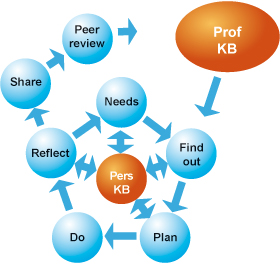
This cycle draws on, and develops, personal and professional knowledge bases. The latter may be seen in the literature, resources, policies and other materials that are used to inform practice.
Throughout the course small icons will indicate the stage of the cycle being addressed.
NB Prof/Pers KB = Professional/Personal knowledge base.
Preparation for the face-to-face session

Activities 1-3 will take around one hour. We expect you to complete these before the face-to-face session as the course facilitator will need you to be registered and have some familiarity with the layout of the Staffroom and Back to School websites.
 Activity 1 Registering for the Staffroom
The objective of this course activity is to enable you to access areas of the Staffroom that will be used during the face-to-face session.
Before the facilitated session, go to the e-skills Staffroom http://staffroom.e-skills.com. From here you can register by clicking on the grey register button on the right side of the page. You will need to register your school for access to the Staffroom. There is a database of schools already available on the Staffroom. If your school is not listed, contact cc4ghelpdesk@e-skills.com as soon as possible, and at least four days before the facilitated session. Insert ‘Vital course registration’ as the subject of your email and your registration will be organised within 24 hours of receipt.
Activity 2 Exploring the Staffroom and Back to School website
The objective of this course activity is to enable you to become more familiar with the layout, content and structure of the Staffroom and the Back to School website.
Enter the Staffroom and visit the 14-19 learning content area by using the drop down menu option on the right hand side of the page. Browse the learning journeys available and familiarise yourself with the structure of a learning journey and its component nuggets of learning.
Visit the e-skills Back to School website (http://backtoschool.e-skills.com). This website has been created for employers to demonstrate ways in which they can engage with students, particularly those studying the Diploma in IT. Scroll down to the bottom of the landing page, and click on the Search button under ‘what is your company like’. This will take you to a page that explains how guides have been created to support employer engagement. Read this page and click on the Retail check box to see the list of 15 guides linking work experience placements in the retail sector to The potential of technology and exploring organisations units at higher level. To download the guides, you will need to register. However, guides will be available to you at the facilitated session together with advice about how to use them. This site is useful for local employers with whom you are trying to engage and can be recommended.
Assessment requirements
Activity 3 The specification for The potential of technology unit
The objective of this course activity is to familiarise yourself with the assessment requirements for The potential of technology unit.
The three awarding bodies that accredit the Diploma in IT are AQA/City and Guilds, Edexcel and OCR. You may have already made a decision about which of these boards you are using for the diploma. Go to their website and look at the assessment criteria for the higher level unit, The potential of technology. You may already be familiar with them. If not, look at the four learning objectives that are assessed during this unit. These are summarised in Table 2.
| Learning Objective | AQA/City and Guilds | Edexcel | OCR |
| LO.1 | Understand the role, contribution and impact of technology on society and to the success of a range of organisations, including its impact on their efficiency and competitiveness | Understand the function of key components of technology systems used in organisations | Understand the role and contribution of technology to the success of a range of organisations |
| LO.2 | Understand how technology, including the Internet and mobile communications, is changing the way organisations, individuals and societies communicate and operate | Understand reasons why an organisation should implement or improve a technology system | Understand the effects that technology is having on organisations, individuals and society |
| LO.3 | Know the key components of technology systems and the function and purpose of each in different business situations | Understand the role and contribution of technology to the success of an organisation | Be able to demonstrate how the key components of technology systems may combine together to create an effective solution to business needs |
| LO.4 | Be able to explain and suggest why example organisations should implement new and/or improve their existing technology and/or communication systems | Understand how technology is changing the way organisations, individuals and society operate | Individually and as part of a team, learners are to use their understanding of the benefits of technology to justify the adoption of a new, or of an improvement to, an existing technology system |
Read through the details of your chosen awarding body specification in preparation for the section on the face-to-face session that reflects on how The potential of technology unit can be assessed using any of these criteria.
Principal learning for higher level can be found at the following:AQA/City and Guilds (page 20)
www.diplomainfo.org.uk/ documents/ IT_level_2_Principal_Learning_ammended.pdf
Edexcel (page 103):
OCR (page 3):
www.ocr.org.uk/ download/ kd/ ocr_9850_kd_diploma_centre_sec_12.pdf
Information about the face-to-face session

You will have received information about the venue and time of the face-to-face component of this course. You will have 2 hours with a facilitator and other delegates during which ideas for delivering The potential of technology unit by using e-skills UK resources on the Staffroom and Back to School websites with local employers will be demonstrated. The course will also consider how the unit will typically be assessed by all three awarding bodies for principal learning and functional skills. Opportunities to assess personal learning and thinking skills (PLTS) will also be covered. A participant forum associated with this course will open when this session is completed. The pre-course preparation is important for this course. You should have registered with the e-skills Staffroom and familiarised yourself with The potential of technology unit assessment criteria for your chosen awarding body prior to attending the face-to-face session.
Following the face-to-face session

Contacting participants
 Activity 4 Posting in the forum
The objective of this course activity is to make contact with other participants of the face-to-face session and have the opportunity to share ideas emerging from the course so far.
The course forum is available to all participants in the course after the end of the two hour facilitated session.
Go to the forum and post a message to the other participants. You may wish to reflect on the course so far or your plans for making use of the demonstrated resources with employers.
Planning delivery of the unit

Activity 5 Planning to work with local retailers to support delivery of The potential of technology unit
The objective of this course activity is to identify opportunities to work with local retailers to support delivery of The potential of technology unit using the John Lewis learning resource as a model.
The retail lifecycle learning resource demonstrates to learners how technology can change both large and small retail outlets.
- Identify local retailers who could support delivery of The potential of technology through either offering work experience, making use of the Back to School work experience guides for The potential of technology, or by talking to learners about how technology has changed, or could change their business. Retailers may be happy for learners to visit, or they may be willing to come into school or college to talk to a group of learners.
- Generate a brief for a retailer that advises them on what learners need to know for this unit, which might include how a business can improve through implementation of a new system or an upgrade of an existing system. The John Lewis resource considers what happens when technology fails or is problematic, so the retailer may share anecdotes and experiences of technological problems, or ‘what if’ scenarios that illustrate how important back up and recovery systems are. Retailers who have recently implemented new systems, such as text messaging clients to remind them of appointments, may want to share before and after experiences.
- Map the brief to the learning objectives for The potential of technology unit to show retailers who are engaging with you how they are contributing to delivery of the diploma. Use this to work with local retailers to support your learners in this unit. Work experience placements may also be generated as a result of this contact.
Reporting back
Activity 6 Reporting back to the forum
The objectives of this course activity are:
- to communicate again with participants from the face-to-face course
- to report and reflect on your experiences of using e-skills UK resources with employers to deliver The potential of technology unit.
Go back to the course forum and post a reflective comment about the experience you have had with your learners and The potential of technology unit so far. Respond to any other posts that other participants have posted – this might include sharing your experiences of approaching and working with local retailers to support their contributions to diploma delivery.
Shared learning

The reflective practitioner cycle is based on developing the professional knowledge base. We have now come to the end of the personal reflection phase and are to develop a common understanding of what we have learnt. We will share the key learning points as a group so that these may be collated and added to the community knowledge.
Go to the course forum and, in the Discussion called ‘Shared Learning’, post the key learning points that have emerged for you during the course. With your facilitator, agree on the common shared learning from the group.
We hope you will continue to make use of the John Lewis resource to support the delivery of this unit. Other employer-generated learning resources are available on the e-skills Staffroom to support delivery of this unit and others. We welcome any feedback from your use of these resources – visit the Vital community forum and post a message there and we will respond as soon as possible.
Evaluation and certification
Activity 7 Course evaluation
The objectives of this course activity are to complete an evaluation form and, if you wish, print a course completion certificate and rate and review the course.
Your task is to complete the evaluation questionnaire, which can be found on the course page. There are also links there to print a certificate and rate the course. The certificate will be ‘released’ by your facilitator.
References
- AQA/City & Guilds (2007) IT Level 2 Principal Learning http://www.diplomainfo.org.uk/ documents/ IT_level_2_Principal_Learning_ammended.pdf Accessed 13 January 2010.
- e-skills Back to School http://backtoschool.e-skills.com Accessed 14 January 2010.
- e-skills Staffroom http://staffroom.e-skills.com/ Accessed 14 January 2010.
- Edexcel (2009) Level 1 and Level 2 Principal Learning in Information Technology, Issue 3 (March 2009) http://www.edexcel.com/ migrationdocuments/ Diploma/ DP021040-Principal-Learning-in-IT-L12-Phase-1-Issue-3.pdf Accessed 14 January 2010.
- OCR (2006) ‘Extract from OCR Centre HandbookSection 3 – Accredited Units’ in OCR Level 2 Principal Learning in IT H825 www.ocr.org.uk/ download/ kd/ ocr_9850_kd_diploma_centre_sec_12.pdf Accessed 13 January 2010.