Use 'Print preview' to check the number of pages and printer settings.
Print functionality varies between browsers.
Printable page generated Monday, 19 October 2026, 3:16 AM
Week 4: Developing your own practice with OER
Introduction
This week focuses on how you can develop your own practice, using OER, to support teachers in developing more participatory, student-centred processes in their classrooms. The four activities will support you in thinking about your own needs, as well as those of the teachers you work with. The Assignment for this week is Activity 4.3.
Teachers are continuously involved in making decisions that are of great importance to their students. There are no fixed answers or rules that can be put in a manual or applied systematically in different situations. This is why teachers often find changing their routine practice is challenging. It is not uncommon for teachers to be resistant to change and give different reasons for not being able to take a different approach or try new ideas. This reluctance is understandable – after all, moving away from the relative comfort of routine practice involves taking some personal ‘risks’ as teachers.
Activity 4.1: Identifying teacher needs
As a teacher educator, you need to know about the needs and views of the teachers you work with.
- [
] Note your thoughts in response to the following questions:
- What challenges are facing teachers in your area? Are teachers implementing a new curriculum? Are new topics being introduced into certain years? Are teachers expected to teach in different ways? Do they need support with their subject knowledge?
- What are the implications of these challenges for your work as a teacher educator? What role could you play?
- Ask your colleagues the same questions. How did their ideas match yours? Which ideas were most common? Note any changes in your thinking as a result of these conversations. It can be useful to find out about how the teachers you work with feel about their practice and the challenges they face.
- Try to find out at least one teacher’s view of teaching and learning in their classroom. Some possible questions to use in a conversation or feedback form, which you can amend to suit your context, are provided in this ‘Feedback form’.
It is likely that you and your colleagues have identified a number of different priorities for teacher development to improve student learning in their classroom.
One of the issues often highlighted by teacher educators and District Officials is teachers’ subject knowledge. Often, pre-service teachers learn about the subject and about teaching methodologies in separate departments with different people, which can make it difficult for them to develop expertise in teaching different topics. By engaging with the TESS-India OER activities, teachers develop both subject knowledge and their repertoire of teaching approaches. This is because all the approaches are modelled in the context of the school curriculum.
In Activity 4.3 you will think about how to use the TESS-India OER to address some of the priorities that you have identified. But first you consider your own professional development needs.
1 Considering your own professional development
In Week 2 you considered the need for teacher educators to model the pedagogy that teachers are expected to use in their classrooms. Teacher educators cannot rely on lecturing and are faced with changing their views and ways of working with teachers and pre-service teachers. Therefore, as a teacher educator, you need to pay attention to your own needs and professional development so that you are better placed to support the needs of others.
The issues that classroom teachers face in changing their practice apply to teacher educators too. For example, more time will need to be spent on planning for active learning. Collaborating with colleagues – such as through joint planning, observation and reflection – can be very beneficial. In Activity 2.2 you analysed the knowledge and skills needed to use active, participatory teaching approaches successfully. As part of planning your own professional development, you need to identify your current skills and the ones for development. A skills audit is a useful starting point.
Activity 4.2: Identifying your professional needs
- Complete the teacher educator audit of ‘Skills to support active participation in learning’. Identify three skills that you want to focus on first.
- Use the ‘Personal action plan’ template to record these development priorities and what actions you will take to develop these. For example, you might plan to gain experience of these through practice in your teaching, asking a colleague for feedback or doing some additional reading.
Not only will the audit and action plan help you to reflect on your current practice and goals, but they are also tools that you can use to monitor your development as you go forward.
Reflection point
Which active learning approaches would you feel confident to try? Which ones are difficult? Where could you get help? How will your colleagues respond to these ideas? It is always helpful to share your ideas with other colleagues to find out their experiences of trying new ideas and ask for feedback on your idea and actions. By working collaboratively, you can learn from each other and draw on each other’s areas of expertise to the benefit of all.
2 Using OER with teachers
Change is challenging, often leaving teachers feeling unsettled, vulnerable and no longer in control of their classroom.
Some active teaching approaches are easier to implement than others. It is unrealistic to expect a teacher who has always lectured from the front to immediately start organising role plays and groupwork, or to be successful on their first attempts. Change takes time and starts with small, easy steps – but even these can make a difference to students’ learning. For example, asking open questions, promoting pair work or conducting a brainstorm will encourage students to be more involved and give the teacher the confidence to try other approaches. This will also help students to adapt to a new environment in which more is being asked of them.
As a teacher educator, you need to be able to support teachers in developing more participatory and inclusive teaching approaches. Previously, you considered the importance of modelling these approaches in your own teaching. You can use OER to introduce and promote change in teachers’ classroom practices.
Activity 4.3: Assignment 4 – Using TESS-India OER with teachers
This activity is Assignment 4 and is part of your portfolio of participation.
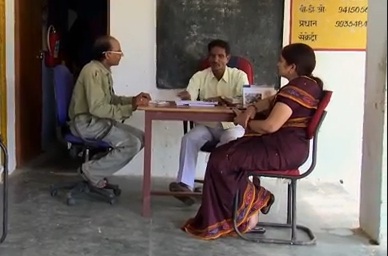
- First read the document ‘Active teaching and learning methods’ and listen again to Professor Patricia Murphy’s talk in Week 1.
- Identify what knowledge, skills and ideas you want teachers to learn. This might link to a session you are running on teaching a particular curriculum topic or approach, or the work you do with teachers in school.
- Choose one TESS-India Teacher Development OER that you could use to support teachers’ learning.
- Consider how you will use the OER with teachers. Think about the following:
- What are the learning outcomes you want the teacher to achieve?
- How will you introduce it to the teacher(s)?
- What parts of the OER will you use with your teachers – the whole unit or particular parts of it? Which activities will they do?
- What evidence will you look for to evaluate the teachers’ learning?
- How will the teachers be expected to use their learning in their future planning and teaching?
- [
- Discuss your ideas with some colleagues or peers.
- [
3 Reviewing your learning
Activity 4.4: Reviewing your learning
[] Note the key things that you have learned this week:
- What have you learned about teacher change?
- What has surprised you?
- Has your thinking changed in any way? How, and why?
- What have you learned about yourself as a teacher and teacher educator?
- How do you feel about developing your own practice? What personal risks and challenges do you face?
4 Moving forward
You have now considered how you might use OER in your work as a teacher educator.
Next week you will look at how you can select, evaluate and modify OER to suit your context.
Now go to Week 5: Selecting and using OER.
Acknowledgements
Except for third party materials and otherwise stated, this content is made available under a Creative Commons Attribution-ShareAlike licence.
Specific content from the TESS-India OER, including images from the TESS-India video resources, are made available under this licence unless otherwise stated.
The TESS-India project is led by The Open University, UK and is funded by UK AID from the UK government.