Assessment in secondary music
Use 'Print preview' to check the number of pages and printer settings.
Print functionality varies between browsers.
Printable page generated Thursday, 2 April 2026, 5:47 PM
Assessment in secondary music
Introduction
This free course, Assessment in secondary music, explores assessment in music education. You will consider issues around the purposes of assessment in music, the forms that it takes, how you can ensure that these forms of assessment are appropriate and perceived as legitimate, and how young people can be fully involved in the assessment of their work, including making decisions about what is assessed and how it is assessed. Most of all, however, the course will have at its heart considerations of how music assessment can be musical.
The course identifies and explores some of the key issues and debates around assessment and music in secondary schools. Through coming to understand these issues and debates you will be able to reflect upon and develop your assessment practice. In particular, you will gain greater understanding of how assessment can support the development of young people’s musical understanding.
Now listen to an introduction to this course by its author, Gary Spruce:
Transcript
Introduction to Assessment in secondary music by Gary Spruce
My experience of teaching in secondary schools taught me that assessment is one of the most difficult tasks for music teachers. Often what you want and need to assess in music does not map well onto the general school assessment systems. And the demands of these systems can lead to assessment which is inherently unmusical. For me it is important then that music teachers understand what assessment in music education is for and how it is best carried out in the classroom.
Music teachers need to make the case for approaches to assessment in music that support young people’s musical development and that assess musical learning through musical means. Some creativity is needed in crafting these assessment systems.
This course is aimed at beginner teachers of music in secondary schools. It starts by looking at different forms and functions of assessment, what teachers should be assessing in music, how to make assessment musical. From there it identifies key approaches to assessment in the music classroom which will support young people’s musical development and the key aspect here is involving young people themselves in the assessment processes.
Finally, the unit explores how assessment can be used to help teachers plan for further musical development, not to mention fostering a better understanding of the young people we teach.
Assessment is important and this approach should stimulate your thinking around this tricky area of teaching.
As you work through the activities you will be encouraged to record your thoughts on an idea, an issue or a reading, and how it relates to your practice. Hopefully you will have opportunity to discuss your ideas with colleagues. We therefore suggest that you use a notebook – either physical or electronic – to record your thoughts in a way in which they can easily be retrieved and re-visited. If you prefer, however, you can record your ideas in response boxes within the course – in order to do this, and to retrieve your responses, you will need to enrol on the course.
This OpenLearn course is part of a collection of Open University short courses for teachers and student teachers.
Learning outcomes
After studying this course, you should be able to:
recognise the purposes and forms of assessment and their application in, and implications for, music education
understand what to assess in music education
promote assessment for learning in music education
understand how to use assessment to plan for further learning.
1 Key issue 1: What is assessment for?
You can experience this free course as it was originally designed on OpenLearn, the home of free learning from The Open University – www.open.edu/ openlearn/ education/ assessment-secondary-music/ content-section-0
Assessment is typically categorised into two main types:
- formative – assessment for learning
- summative – assessment of learning.
| Informal assessment | Formal assessment |
|---|---|
Formative assessment:
| Summative assessment:
|
1.1 Summative assessment
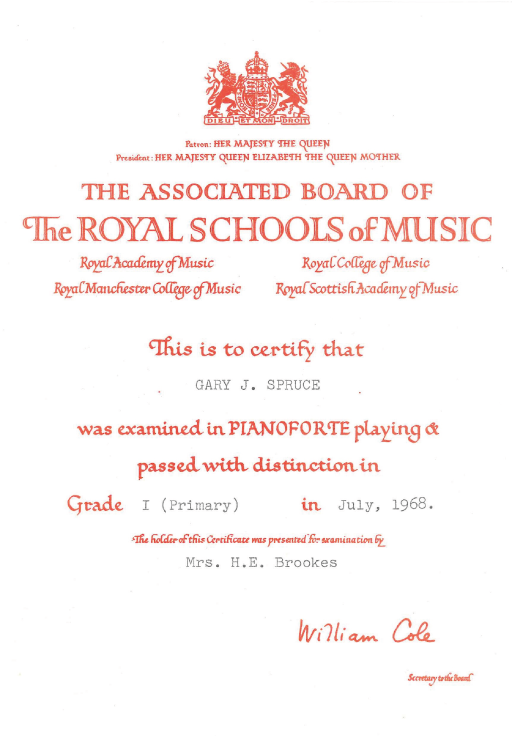
Traditionally, one of the primary purposes of summative assessment has been for selection. Many will associate assessment in music education with formal examinations, such as A Levels or GCSEs, or instrumental and vocal grade examinations or, perhaps, music competitions and auditions. The results of these assessments were then used by others, either directly (for example in the case of auditions) or indirectly (in the case of examination marks/grades) to decide who should gain entry to bands, choirs, colleges or universities, etc.
These examinations/auditions, along with assessments such as end-of-term ‘tests’ and end-of-year examinations or assessment at the end of particular projects or modules, are all examples of summative assessment or ‘assessment of learning’ (AoL). Summative assessment is used to provide a snapshot of what a student has achieved in their learning (at its best it will show what they know, understand and can do) at a particular point in time in relation to specific and pre-defined criteria. It is assessment that looks back over what has been achieved.
1.2 Formative assessment
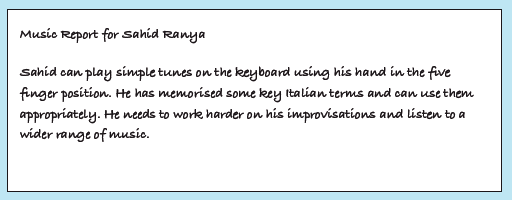
The main differences between summative assessment and formative assessment is that formative assessment is an ongoing process, looks forward and focuses on the development of musical learning. Its primary purpose is to help the teacher to gain an understanding of the young person and the young person to gain an understanding of themselves as a musical learner. It helps to identify any difficulties or misconceptions that the young person might be experiencing as well as where the young person is achieving particularly well.
An important aspect of this form of assessment is that it will involve the young person in the assessment of their learning – often through focused questioning – and thus support them in coming to an understanding of that learning. For example, verbal feedback for Teresa Green could be:
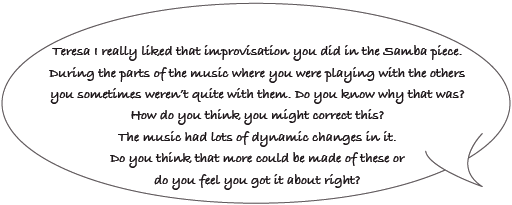
‘Assessment for learning’ (AfL) by its very nature focuses not only on a young person’s learning but also on a teacher’s teaching. Teachers who use AfL most effectively – and who are often the most successful teachers – are those who reflect upon the information gained from AfL and ask themselves the question, ‘So what does this mean for my teaching?’ They use AfL as a means to evaluate their own teaching and then draw upon this evaluation to inform their planning.
1.3 Evaluating assessment
Both summative and formative assessment represent different ways of getting to know students as musicians and musical learners. However, they are not mutually exclusive. As Fautley and Savage (2008) have pointed out, aspects of, and information from, summative assessment events can be used formatively (Figure 4). Equally, the evidence gained cumulatively from ongoing, formative assessment can also be used in a summative way and for selection.
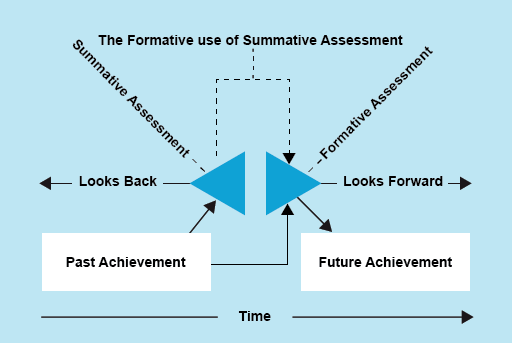
The main focus in this course will be on the way in which assessment opportunities and information can be used to support students’ progressive development as musicians and to inform teachers’ planning for musical learning.
Activity 1
Perspective 1
This activity asks you to consider formative and summative assessment practices from three perspectives.
Think back to your own experiences of music assessment during your early teenage years. Identify one example of formative assessment and one example of summative assessment. Complete the table below, describing both the occasions and the ways in which they helped you to recognise your strengths and what you needed to do to improve.
| Assessment type | Description of assessment event | How it supported further musical learning and understanding |
|---|---|---|
| Formative assessment | ||
| Summative assessment |
Perspective 2
Identify one example of formative assessment and one example of summative assessment from your own practice. Complete the table below: for each instance describe how it helped you to come to know the young person/people better as musicians and how it enabled you to support them in making musical progress. Finally, comment on how the assessment process and what you gained from it helped you in your planning.
| Assessment type | Description and analysis |
|---|---|
| Formative assessment | |
| Summative assessment |
Perspective 3
Identify a particular musical idea, concept or example of a musical genre that you might wish a class to learn about. Identify the concept, then describe how you might use formative and summative assessment in support of young people’s musical learning.
| Musical concept/idea | Uses of assessment |
|---|---|
2 Key issue 2: What are we assessing in music and how should we assess it?
You can experience this free course as it was originally designed on OpenLearn, the home of free learning from The Open University – www.open.edu/ openlearn/ education/ assessment-secondary-music/ content-section-0
There are three kinds of musical knowledge:
- Knowledge ‘about’ music: the ‘facts’ of music, such as the number of strings on a violin, who had the Christmas number one in 2015, what an ‘ostinato’ is, etc.
- Knowledge of the ‘how’ of music: for example how to maintain a regular pulse or how to be able to play scales correctly.
- Knowledge ‘of’ music: gained from immersion in musical experience and activity and leading to an understanding of music’s unique expressive character – much in the way that one would know a person.
The last of these types of knowledge is the reason why we engage with music; it is that unique individual and collective relationship that we have with it. The other kinds of knowledge can support and enrich our knowledge of music but they are never sufficient of themselves and consequently should not be taught or assessed in isolation.
However, knowledge of music provides significant challenges for developing assessment strategies for music learning. It is much easier to pin down knowledge ‘about’ or knowledge of ‘how’, which is why music assessment has often focused on these types of knowledge: because of their ease of assessment not because they are more valuable or legitimate.
Year 7 End-of-term test (Knowledge ‘about’)
Q1: How many strings does a violin have?
Q2: Here is a Gamelan. Name the different instruments.
Q3: To what notes are the guitar strings tuned?
Year 8 Test (Knowledge ‘how’)
Q1: Write out a C major scale and indicate where the tones and semitones occur.
Q2: What instrument is playing at the beginning of this extract of music that you will now listen to?
Q3: Write out this four bar phrase in the alto clef.
Some of these examples are somewhat extreme (however, they are all taken from actual examples of music assessments) and it is the case that ‘knowing’ these things can be useful. However, the usefulness of such knowledge is limited if it is abstracted from a musical context where knowledge ‘of’ music might be developed. It then becomes potentially damaging if used exclusively (or even primarily) as a means of assessing musical understanding and assessment. However, the responses are easy to mark!
2.1 How do we best assess musical learning and understanding?
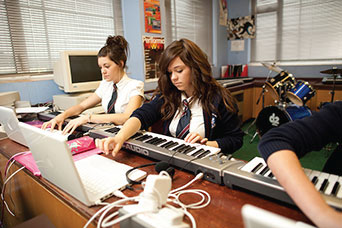
If developing young people’s knowledge of music is to be at the centre of your teaching, it should also be at the centre of both the way in which you assess and what you assess. In this section we set out seven principles that we believe should underpin all so that it supports the development of knowledge of music.
First, and foremost, assessment should be musical. It should, over a period of time, encompass the full range of what it is to be musical and reflect the many ways in which people engage with music across a range of styles, traditions and cultures. For example, teaching and assessment that focuses exclusively or primarily upon performing and composing using notation provides a narrow musical experience and an inadequate basis upon which to assess musical understanding and achievement. These assessments should provide opportunities for all young people in a class or group to demonstrate their musical understanding and achievement.
Second, assessment should be integrated into teaching and take place through and within music-making and responding to music. Young people should be assessed as they engage in activities that would be recognisable as musical ones outside the context of formal music education.
Third, assessment should focus on developing the quality of young people’s musical work. This then moves the emphasis of assessment away from the musical object – the composition, the performance, the listening test – to the learning student; how they demonstrate engagement with music across a range of musical activities and experiences. Assessments that depend on a single musical event or example of work will by definition be inadequate as they will not give a true picture of the young person’s attainment and consequently fail to provide the formative support they need to move forward.
Fourth, assessment criteria should be specific to the project or topic being studied and the context of the musical activity and assessment should grow from this context. For example, it would be inappropriate to assess the performance of a song from Wicked by the same criteria as a folk song or an aria from a Mozart opera. Equally, one would not assess a minimalist composition by the same criteria as a reggae song. The starting point for assessment criteria is the music: what is important and of value within the particular musical tradition or culture within which the young person is working.
Fifth, assessment processes and criteria should be open to ‘unexpected’ learning that has not been planned for as well as to learning that is brought into the classroom from musical learning beyond the school. Teachers should try to avoid assessment ‘myopia’ by only recognising learning they had planned for and expected!
Sixth, assessment should involve young people in assessing their own work and that of others through discussion and self and peer assessment. Discussion between the teacher and young person is particularly important so that the teacher can gain an understanding what the young person is trying to achieve and also what they think they have achieved. This points up the importance of agreed and shared criteria and, as the young people develop into agentive musicians, criteria that is negotiated between them and the teacher.
Seventh, assessment done well will help teachers to evaluate the effectiveness of their teaching and support them in future planning for young people’s musical learning. We cannot say that teaching has occurred if there is no evidence of musical learning. As Jo Glover (2008, p. 1) says, ‘The connection between teaching and learning is not hard wired – we cannot say “I teach therefore you will learn”.’
If these principles are followed, then assessment has a good chance of providing feedback and information that supports young people in reflecting upon their learning and developing understanding of what they need to do to improve.
Activity 2
Develop a strategy of assessment that shows how you could address the seven principles across a series of lessons.
Think specifically of how you will plan for these assessment occasions, the learning you will seek to assess and the assessment strategies that you will use.
3 Key issue 3: How do we promote assessment for learning?
You can experience this free course as it was originally designed on OpenLearn, the home of free learning from The Open University – www.open.edu/ openlearn/ education/ assessment-secondary-music/ content-section-0
Black et al. (2003) identify four main ways in which assessment for learning can be promoted:
- through questioning
- through feedback
- through sharing criteria
- through self and peer assessment.
You will explore each of these in turn and then briefly examine the importance of talking with young people about their assessment and their music-making.
3.1 Questioning
As we have noted, one of the main purposes of assessment is to help us to come to know our students better as musicians. Questioning in the widest sense of the word is a key way to achieve this. Traditionally, questioning has been used primarily to test understanding of propositional knowledge; for example:
- How many strings does a violin have?
- What does pianissimo mean?
- Who shot John Lennon?
These are what are known as ‘closed questions’ and tend to focus on knowledge about music. They are questions that are rooted in ‘facts’ about music and there is a tendency when asking such questions to require instantaneous or near-instantaneous responses – a kind of musical pub quiz.
However, questioning can be used in much more subtle and enriching ways to engage young people in their learning, to find out what they are trying to do in their music, and to encourage them to reflect upon and critically evaluate their work. Such questioning encourages young people to think about their music-making and what they are trying to achieve.
Black et al. suggest that in order to ensure that questioning is at its most effective, teachers should:
- spend effort framing questions that are worth asking, i.e. questions which explore issues and which develop students’ understanding
- allow young people the time to think and expect them to contribute to the discussion
- plan follow-up activities to check that the question has had impact upon learning and teaching.
Examples of questions that explore a child’s engagement with music and their understanding of its expressive power (their ‘knowledge of’ music) might be:
- That piece you have just played, what feeling or mood did you want the music to express?
- How would you change the way you played it if you wanted it to express the opposite feeling or mood?
- If you were composing some music to create these feelings what would you do?
Examples of questions that you might use to ensure that you and the young people have a common understanding of what they and you are trying to achieve and which explore ‘success criteria’ might include:
- What are we learning today?
- What are we going to do [musically] to help us to learn this?
- How will you know if you’ve learned this?
However, if such questions are to be effective then they need to be used in a thoughtful way and not mechanistically.
Activity 3
Think about a lesson that you are going to teach. Devise a set of questions that will help you:
- Assess the knowledge the student brings to the lesson. Try to avoid the question: ‘Do you remember what we did last week?’ Remembering that ‘we played “Love me tender” last week’ is no indication that learning has taken place. Linking your questioning to a listening activity based on the repertoire will tell you much more.
- Ensure that so far as is possible, you and the young people have a shared understanding of what, musically, they are trying to achieve.
- Move them forward in their learning, perhaps by asking them more complex or detailed questions about their music-making.
- Encourage the young people to reflect on their music-making: ‘What were the successful and less successful aspects of that performance? What might improve it?’ e.g. ‘What happens if I play that section more legato? Why did you decide to do that at that point?’
3.2 Feedback
Feedback is critical in ensuring that young people make progress in their musical learning. Feedback can take a number of forms. Occasionally it may be written but more often it will be verbal feedback that is rooted in dialogue between teacher and pupil. Feedback should identify what has been done well, what can be improved and ways in which such improvements can take place.
To be effective, however, feedback also needs to be detailed and undertaken sensitively and at appropriate times and places. Feedback should provide a basis for moving forward. It should be rooted in what the child can do and offer a clear way forward for taking the ‘next steps’ in their learning. These steps should be negotiated, clearly defined, achievable and engaging.
The point at which a teacher intervenes to give feedback is important and goes to the centre of the creative process. Most models of creativity are predicated on the idea of the creative process being one of the stages of engagement with musical materials and ideas. Young people need to be given the space in order to develop at their own pace and engage with music in their own way. As Philpott says, ‘suggestions and interventions in what is already a successful creative process can breed resentment and alienation’ (Philpott and Spruce, 2007, p. 215). Interventions might be used for the following reasons:
- to praise and reassure the young people that what they are doing is on the right track
- to suggest and discuss musical ideas with the young people
- to refocus young people back onto the aims of the lesson when their concentration has slipped.
In all of this, however, we must not lose sight of the fact that it is possible to ‘feedback’ musically – through music. This can be done simply by performing to the young person another way of playing a phrase (many instrumental teachers do this) or by demonstrating what the addition of a particular dynamic nuance could add to their composition. It could also be through a form of musical dialogue, perhaps within the context of an improvisation.
Activity 4
Describe in detail a lesson or a section of a lesson that might provide opportunities for different forms of feedback, including feedback through music. Indicate the intended learning that will take place, the resources that you will draw on and the activities that will take place.
3.3 Sharing criteria
We identified the importance of shared criteria in one of key principles for music assessment that were discussed in the previous section.
It is important that the teacher and young people have a shared understanding of what the criteria for success might be, whether this is negotiated or imposed. If what the young people are trying to achieve and the criteria that are being used to assess the effectiveness of their work do not correspond, then it is unlikely that the assessment process will be seen by the students as relevant or legitimate, or provide meaningful information about their musical learning.
Sharing criteria is, as we have suggested, a potentially much richer process than simply devising criteria (however laudable these might be) and then simply informing the students what these are – ‘sharing’ in the sense of ‘telling’. Shared criteria can form the basis of pupil–teacher dialogue, which can result in students feeling they have a stake in the assessment process rather than it simply being an externally driven force that is being done to them.
An important part of this dialogue is negotiating with students the criteria by which their work is to be assessed. This may involve, as Gipps says, ‘extended interaction between pupil and teacher to explain the task’ (in Spruce, 2002, p. 127) and the basis for what the teacher counts as success either in their own terms or in terms of an externally imposed set of criteria such as examination criteria. Young people are then in a position to apply such criteria in an informed way to their own and others’ work.
Young people can also be involved in defining the terms of assessment and the criteria for success. As Ross and Mitchell argue:
the teacher’s assessment [needs] to take full account of the pupil’s subjective world – that world where her particular aesthetic projects are conceived and her unique aesthetic judgements are made.
In other words, an important part of assessment is to ascertain what it is that the pupil is trying to achieve and express; ‘teachers and young people should sit down together in regular shared acts of assessment through talk’ (Ross and Mitchell, 1993, p. 100). Talking with students enables teachers to understand what it is that the young people are trying to achieve and to ensure that this is taken into account in the assessment of their work.
Activity 5
In a forthcoming lesson, find an opportunity to discuss with a young person what they are looking to achieve from a particular musical activity and experience. Compare their thoughts with your own. If there are differences, consider how you might bridge the gap between them. Write a brief report on the conversation and any changes to your teaching or assessment that resulted from it.
3.4 Self-assessment
Self and peer assessment is a key element in enabling students to engage critically with their own work and that of others. Through doing this they can identify their strengths and plan how to move forward in their musical learning. Self and peer assessment encourages young people to actively engage in their own learning and to gain ownership of that learning. However, if self and peer assessment is to work well it needs to be carefully planned. It needs to be seen by the students as of value by complementing and adding to assessments carried out by the teacher or other external authority.
Dialogue between teacher and pupil(s) also forms an important part of self and peer assessment and is linked to the sharing (in the true sense of the word) of criteria discussed in the previous section. Criteria that are negotiated, agreed and founded on a shared understanding of what is to be achieved and how that achievement is to be valued allows for:
- a dialogue about assessment between pupil and teacher based upon a common and agreed understanding
- young people evaluating how well they have achieved against the learning objectives and outcomes. This results in greater learner autonomy and independence, which leads to…
- the knowledge and understanding that allows young people to decide (with the support of teachers) what it is they need to do next to develop their musical learning.
Activity 6
Plan to develop your assessment for learning practice over a sequence of three or four lessons. Consider:
- the lesson plan, which should indicate your planned learning outcomes and AfL opportunities
- how you are going to address the four main ways of promoting AfL, as outlined at the beginning of this section.
4 Key Issue 4: How do we use assessment evidence to plan for learning?
You can experience this free course as it was originally designed on OpenLearn, the home of free learning from The Open University – www.open.edu/ openlearn/ education/ assessment-secondary-music/ content-section-0
In this final section you will consider the ways in which assessment information can be used to enable a teacher to evaluate and reflect upon their own assessment and teaching in relation to their students’ learning. We pose a series of questions and discussion points to enable you to structure your thinking when planning for teaching, learning and assessing in the music classroom. We ask you to consider issues relating to evaluating and reflecting upon your own teaching under three main headings:
- Assessment: a question of value
- Teacher as observer
- Teacher as musical critic.
4.1 Assessment: a question of value
In this section you will focus on the extent to which assessment is of ‘value’ to the teacher and their students. Questions relate to the assessment’s fitness for purpose, how it is planned for and the appropriateness of what students are being asked to do.
| Questions to consider | Related issues |
|---|---|
| Am I focusing sufficiently upon the musical quality of the students’ work? | How do I define musical quality, ensuring that I take into account what this means across the full range of musical activities and in the context of different musical styles and traditions? |
| Am I making assessment an integral part of the lesson structure? | How is assessment integrated into my lesson planning? How do I make assessment an integral part of my teaching and my students’ learning? |
| Is the work of interest and relevance to students? | How do I ensure that those things that are of interest and relevance to students are used to support the musical learning aims I consider to be important? How do I encourage students to explore other areas of musical experience, repertoire, etc.? |
| Does what the young people are being asked to do build on what they have done before? | How do the lesson planning and assessment aid progression? |
4.2 Teacher as observer
This second section identifies the things a teacher should be considering and the questions they should be asking of themselves as they observe the young people working in their lessons. These questions add a qualitative dimension to the assessment process that focuses upon students’ engagement with their musical learning.
| Questions to consider | Related issues |
|---|---|
| Are the students working effectively on the task? | What is the quality of the young people’s musical engagement? |
| Are you using assessment to support the differing needs of all your young people? | How are different young people’s needs defined and how does the assessment meet their needs? |
| Are students developing ideas as well as skills? | When planning and assessing, how do I balance the need for the development of ideas to be supported by skills? |
4.3 Teacher as musical critic
In this final section, you will consider the questions teachers might ask when evaluating the extent to which their assessment approaches support young people’s musical learning.
| Questions to consider | Related issues |
|---|---|
| What are the criteria for musical success in the tasks I have set for the young people? | How do I define the criteria for musical achievement and how do I communicate this to my young people? How do I support students in developing their own understanding of musical achievement and what they need to do to improve? |
| How can I demonstrate to young people the musical possibilities of the task they are undertaking? | How might I use my own musical skills to demonstrate what I want the young people to achieve? |
| Is the young people’s work musically coherent and interesting? | How do the young people and I define musical coherence and interest? Does what I assess and how I assess support the development of interest and coherence? How is interest and coherence exemplified in different musical styles and traditions? |
4.4 Your assessment practice
These two final activities are designed to bring together your learning from this course and to encourage you to reflect on your assessment practice.
Activity 7
Download the pro forma, Evaluating assessment practice, and use it either while observing or teaching a lesson so that you can analyse what you see or do, or following the lesson as a form of reflection.
Write a brief analysis (400 words) about what you learned about your assessment practice from this process and how you used it to plan for subsequent lessons.
Activity 8
Using your learning from this course, together with the principles of assessment that we have outlined, over a period of four or five weeks develop an assessment profile of three young people whom you teach.
Part 1
Describe the approaches to assessment that you took, relating these to your understanding of assessment practice in music gained from this course and elsewhere. Particularly focus on how you ensured that assessment was musical and how you involved the young people in the assessment process.
Part 2
Note down and analyse what you found out about your students’ musical learning, particularly:
- areas of strength and any difficulties they were experiencing
- the extent to which they achieved the planned learning objectives
- any difference between what they felt they were supposed to – or wanted to achieve – and what you wanted them to achieve
- how you used this information to plan future lessons.
Conclusion
You can experience this free course as it was originally designed on OpenLearn, the home of free learning from The Open University – www.open.edu/ openlearn/ education/ assessment-secondary-music/ content-section-0
In this free course, Assessment in secondary music, you have looked at assessment in music from a range of perspectives. You began by looking at the broad differences between formative and summative assessments and their workings out and implications for music education. You then learned about some key principles for ensuring that assessment in music education is always musical assessment. From there, you moved on to look at the different ways in which assessment for learning might be promoted in the musical classroom. The course concluded by considering ways in which assessment can be used by music teachers to support their planning.
References
Acknowledgements
This free course was written by Gary Spruce.
Except for third party materials and otherwise stated (see terms and conditions), this content is made available under a Creative Commons Attribution-NonCommercial-ShareAlike 4.0 Licence.
The material acknowledged below is Proprietary and used under licence (not subject to Creative Commons Licence). Grateful acknowledgement is made to the following sources for permission to reproduce material in this free course:
Every effort has been made to contact copyright owners. If any have been inadvertently overlooked, the publishers will be pleased to make the necessary arrangements at the first opportunity.
Course image
© courtesy Jason Kubilius
Figures
Figure 1: courtesy of Gary Spruce
Figure 4: Fautley, M. and Savage, J. (2008) Assessment for Learning and Teaching in Secondary Schools, Exeter, LearningMatters
Figure 5: Redsnapper/Alamy
Don't miss out
If reading this text has inspired you to learn more, you may be interested in joining the millions of people who discover our free learning resources and qualifications by visiting The Open University – www.open.edu/ openlearn/ free-courses.