Assessment in secondary mathematics
Use 'Print preview' to check the number of pages and printer settings.
Print functionality varies between browsers.
Printable page generated Sunday, 7 June 2026, 3:24 AM
Assessment in secondary mathematics
Introduction
In this free course, Assessment in secondary mathematics, you will be asked to look at many issues that surround assessment. Assessment is about establishing where a student is in their learning. Sometimes the intention behind that assessment is to sum up and/or certify what a student has attained over a period of learning – this is known as summative assessment and is often used to direct students towards learning experiences and career choices that may be appropriate for them.
Another form of assessment is more powerful in helping learning. It recognises progress at the micro and the macro level, and involves the students themselves in both understanding what they want to achieve and in taking steps to attain their goals. This is formative assessment, or assessment for learning. Black et al. (2003) established that formative assessment can make a huge difference to students’ attainment as well as to their attitudes towards learning.
This course will ask you to question what it means to make progress in mathematics, to consider what and how to assess, and to challenge assumptions about assessment. Most importantly, you will learn how to use assessment to enable mathematical learning
Summative assessment can be a gatekeeper – those who gain high marks can go onto more challenging mathematical learning experiences or particular careers. Those whose marks are lower may be barred from such experiences of careers. In mathematics, success in examinations gives substantial cultural capital and it is therefore unsurprising that many teachers focus on helping their students attain the best they can at examinations such as GCSE, which is taken at age 16 in England.
However, research shows that ‘teaching to the test’ is not the best way to allow students to attain well, and is certainly not the best way to enable students to be able and willing to continue to study mathematics, or to empower them to use mathematics in their day-to-day lives and careers. Formative assessment allows students to understand how they are progressing in their learning and where next to focus their efforts. Therefore it requires teachers who understand what it means to:
- make progress in mathematics
- know what to assess and how to assess
- use assessment to enable mathematical learning.
Now listen to an introduction to this course by its author, Clare Lee:
Transcript
As you work through the activities you will be encouraged to record your thoughts on an idea, an issue or a reading, and how it relates to your practice. Hopefully you will have opportunities to discuss your ideas with colleagues. We therefore suggest that you use a notebook – either physical or electronic – to record your thoughts in a way in which they can easily be retrieved and revisited. If you prefer, however, you can record your ideas in response boxes within the course – in order to do this, and to retrieve your responses, you will need to enrol on the course.
This OpenLearn course is part of a collection of Open University short courses for teachers and student teachers.
Learning outcomes
After studying this course, you should be able to:
recognise what it means to make progress in mathematics
know what should be assessed and how it should be assessed
use assessment to enable mathematical learning
understand why assumptions about assessment should be challenged.
1 Key issue 1: What does it mean to make progress in mathematics?
This is an important first consideration when thinking about assessment.
Reflection point
Consider what progress in mathematics means to you. Does it mean answering questions on harder concepts? Or does it mean answering more complex questions? Are you better at mathematics because you can complete lots of questions that are all the same, or because you can persevere with a problem and suggest different ways of tackling it?
Your students may think that all of these things show their progress in mathematics. Many students want you to tick the questions they have done as correct, as that shows that they can follow a procedure. Whether or not this is progress may depend on many things, for example the kind of questions asked and whether they can they still use that procedure correctly in the next lesson.
Activity 1 Assessing what counts
Read the articles on assessment by Helen Drury and Todd Rose.
Can the GCSE-style tests mentioned in the first article tell you about how well someone has mastered mathematics skills and knowledge? What do the results tell you? The author mentions the students’ pride when they achieve a high grade in these tests. Think about the students who receive a lower grade – what is likely to be the effect on them? Is it possible that the lower-attaining student is still making progress?
List the key messages of the second article. What do these key messages mean for teaching mathematics?
1.1 Assessing real progress
Formative assessment can be embedded in each lesson and means making judgements about the progress that your students make as they are learning. Formative assessment approaches demand that both you and your students are:
- aware of the intended learning objectives
- consciously devising or engaging in activities that will provide learning experiences and evidence about whether or not individuals have met the objectives and what their next learning needs are
- deliberately investigating the nature of any difficulties, or where problems exist, and establishing and engaging in remediation measures once difficulties have been identified
- providing and engaging in activities that will deepen or extend learning, including (but not restricted to) becoming a resource for helping others in their learning.
For example, suppose you have been doing some work on place value and decimals and you want to find out if students have a good understanding of these concepts. You ask the students to put the following numbers in order, smallest first: 0.3, 0.7 and 0.4. You may find little out from the result!
Suppose, instead, that you asked them to write these numbers in order, smallest first: 0.7, 0.3 and 0.36 on mini-whiteboards. You will find that the three most common responses are:
- 0.3, 0.36, 0.7 (correct)
- 0.3, 0.7, 0.36 (student ignores decimal point)
- 0.36, 0.7, 0.3 (student may think that the largest number after the decimal point gives the smallest decimal).
Students could well offer other answers, for a range of other reasons. Not all errors necessarily imply misconceptions; students can also make mistakes. They can misunderstand – or fail to understand – what is being asked of them. Asking some students to explain what they have written will uncover misconceptions, mistakes and misunderstandings, and allow them to learn from any mistakes made. A question such as the one above gives you, and the students themselves, a better understanding of what your students need to learn, and will enable you to plan appropriate next steps.
Although there are commercially available tests that may help in assessing your students, it is important to realise that test results will only tell you about a student’s response to a particular question on a particular day. Responses may indicate that common misunderstandings exist, or that the student was able to get the right answer using a specific method, and this is useful information when planning to teach. However, general judgements about individuals made on the basis of such tests could be flawed, even when tests are well designed, as many students suffer from anxiety when completing tests. You will usually find out more by assessing the knowledge, skills and understanding that students bring to a mathematics lesson by setting up a challenging but interactive task where students are encouraged to reveal how they currently understand a topic.
You could, for example, ask them to do any of the following tasks:
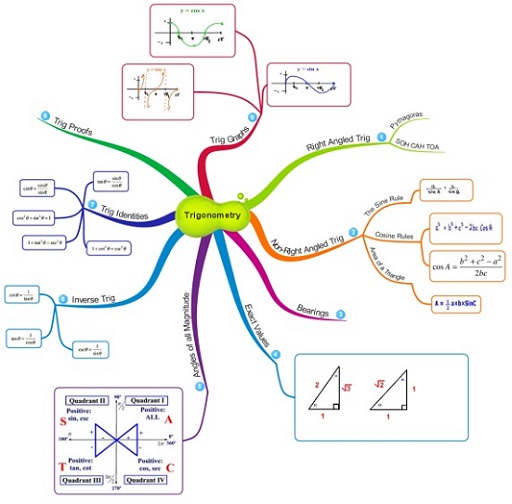
- Complete a collaborative mind map of all the ideas and connections they can think of about fractions, or whatever the topic is today. Linking mind maps about fractions to those about decimals and percentages can begin to help students to connect these ideas together and to think about proportionality in a mathematical way. (Figure 2 shows an example of a mind map about trigonometry.)
- Write a definition of a specific quadrilateral on a mini-whiteboard, giving each group a different quadrilateral. Then you can play quadrilateral matchmaker, helping students to understand that only some have parallel sides or right angles, but having four sides or a sum of interior angles of 360° is no way to find their soulmate!
- The students make up their own questions about Pythagoras, working in pairs to make up an easy one and a hard one.
- The students tell each other what they already know about straight line graphs, noting down ideas that are always true, sometimes true and never true about them on three different colours of sticky notes. You can then collect all their ideas together on three posters.
Each of the ideas listed above gives you access to the students’ real knowledge about a topic, from which you can plan how you can help the students move their ideas forward. As you move through the work you have devised on a given topic, the students can add to their mind maps, make up much more challenging questions or ask for more sticky notes for the posters. That way they can show you – and, perhaps more importantly, themselves – that they are making progress.
Activity 2 Planning to assess
Pick a topic and use a mind map to record and connect all the different vocabulary and ideas that your students would need to know in order to:
- say that they fully understand that topic
- connect the topic to other areas of mathematics that they have studied.
Now plan assessment activities, using the ideas above or others that you know. When would you use those activities in the lessons? Would they allow the students to show what they really know? Would you be able to modify what happened next in the light of what you find out? Think what it would mean for a student to really know, understand and use the topic, and devise activities that would enable the students both to learn and to show you the progress they make.
2 Key issue 2: What should be assessed and how should it be assessed?
Good assessment is seen as both valid and rigorous. Testing for validity means asking whether grades generated by a testing system represent a student’s achievement in the whole of mathematics. Can a series of timed, written tests at the end of a key stage assess all those things we think are important for students to learn about in school mathematics? Teacher assessment is often seen as having a lower status than the results of tests, even though it is more likely to be valid in these terms.
An over-reliance on the results of tests may lead to making generalisations and judgements about a student’s capability in all aspects of mathematics, based on the formal testing of a subset of what they are likely to know. For example, a grade ascribed on a short answer test may say little about an aspect of the topic that was not on the test, and says nothing about a student’s problem solving or creative skills in mathematics, nor about their ability to work in groups or engage in extended tasks. Perhaps all that can be said is that tests tell us about the capabilities of students to answer questions at a particular time and of a particular type (and in the conditions and circumstances of the test): no more and no less.
Reliability questions whether a student’s performance on a given test changes (or not) depending on the particular questions that are set. Ideally, assessments should give every student optimal opportunity to demonstrate what they know. In practice, however, tests have been found to be biased against students from particular backgrounds, socio-economic classes, ethnic groups, or gender (Pullin, 1993). Equity issues are particularly important when assessment results are used to label students or deny them access to courses or careers in the future.
Cooper (1998) conducted research using the English National Curriculum KS3 test questions, which suggests some potential lack of fairness in testing regimes. It is likely that these issues raised by Cooper’s research relating to assessment apply to all testing regimes. Consider the implications from this (and other) research, which shows that poorer children:
- … go into lower sets …
- … so they are entered for lower tiers of examination papers …
- … and therefore they have to answer more ‘realistic’ test items …
- … so they achieve lower test results …
- … so they are confirmed as being appropriately placed in lower sets for mathematics …
- … so they may experience a less rich mathematics curriculum, and will learn less content …
- … which restricts their opportunities to get high grades in examinations at the end of their schooling …
- … which restricts their career opportunities …
- … which means they and their family may be locked into a cycle of underachievement.
Reflection point
Are tests fair?
2.1 Marking students’ work

If making progress in mathematics is about getting lots of questions correct, remembering procedures and being able to reproduce them, then marking and giving so many out of 10 or 20 may make some sense. If, on the other hand, you see mathematics as effectively learned only by experimenting, questioning, reflecting, discovering, inventing and discussing, then assessing by giving a grade will not show you that the students are progressing. If you want students to become more independent and to use their own initiative, looking less often to their teacher for direction, then you will want to use other ways to assess that allow students to become more self-reliant and active in their learning.
Activity 3 Deciding what, how and when to assess
Part 1
Think about the last work that you marked from a class that you have taught. How did you mark it? Why did you mark it? When did you mark it? Note down your answers.
Part 2
Now consider the following:
- How did you mark it? Did you give a grade or a comment, or both? If you gave a grade, even alongside a comment, then the students will view this as a summative assessment and will not learn from it. They will see the grade or level as indicating that they are ‘OK’ at this topic, or that they are ‘no good’. They will not see any purpose in putting effort into ‘improving’, as they have already been judged.
- Why did you mark it? Did you mark it because the work would allow you to gain a good understanding of each students’ current understanding and allow you to plan further learning experiences? Or was it because you are required to mark certain pieces of work?
- When did you mark it? Is there both time and opportunity after the students have read your marking for them to modify the way they are learning in the light of the marking?
How, why and when you mark is important in making sure that the students use your feedback to help them improve. You should mark work that is worth marking, at a time when the students can use the feedback you give to make a difference – otherwise your effort may be wasted.
Part 3
Now think about the next topic you are going to teach. Consider each piece of work that you might ask the students to do and look at the following points.
- Decide which pieces might be best marked together in class so that the feedback is speedy.
- Choose one or two pieces that would be worth your while to mark, as they have the potential to explore the students’ understanding and therefore will inform you and the students of where to go next, to help the students make progress in their learning.
- Which pieces would be best for students to peer-mark, so that they gain ideas about how to make progress themselves?
3 Key issue 3: Using assessment to enable mathematical learning
Reflection point
Can assessment be integrated into the learning process?
There are four important issues for teachers to bear in mind when thinking about assessment as integral to learning:
- Identifying exactly what to assess and then use an activity that will allow those ideas to be assessed: Effective teachers identify what they are trying to achieve in their mathematics classroom in both general and specific terms, then assess how successful their students are in achieving these goals. They assess their students as they work on unfamiliar or extended problems, or as they communicate about their mathematics, whether orally or in writing. They assess not just how well students can perform individual mathematical techniques and skills, but also how well they understand wider concepts and can apply those skills in less familiar contexts.
- Assessing students as individuals: Students learn at different rates; they learn different things from each other; some make quick progress and some develop misconceptions. Students therefore need to be assessed as individuals in order to ensure that teaching is well matched to their particular needs. Assessment will be for a clear purpose, be designed to give the teacher and the student themselves information about the student’s progress.
- Integrating assessment into every lesson: In order to match teaching to individual needs, assessment must be integrated into day-to-day teaching. Therefore, assessment is best when built into lesson planning and the information that is gained from assessment used in planning subsequent activities. In fact, it is only when the evidence from assessment ‘is actually used to adapt the teaching work to meet learning needs’ (Black et al., 2004) that such assessment becomes formative assessment. Remember, it is only formative assessment that evidence shows will make a difference to students’ learning and attainment.
- Assessing their own effectiveness: As well as assessing what students have learned, effective teachers must also assess their own actions. Decisions are made about teaching approaches in every lesson: what approach to use, what resources, which activities, what sort of activity and for how long, and so on. Assessment allows teachers to learn about the effectiveness of each of the decisions that they take and to modify their actions accordingly.
3.1 Ideas to enable you to assess your students’ mathematical learning
Ask a question worth thinking about

When you have asked a question worth thinking about, then the discussions needs to continue. You might collect answers from the whole class, write them on the board without comment and then ask some people to explain why that answer was given. You might also ask other students to comment on the explanation, either to correct it, or (more likely) to add some other insight. You may have to emphasise that the discussion is a common quest for understanding, not a competition to be the one with the right answer.
Or you might ask the students to work in pairs to devise an explanation and then ask them to give that explanation to a larger group. The discussion would then be about putting together the best explanation using all the ideas expressed. Each group then gives their explanation to the class. If there is a ‘wrong’ explanation, as opposed to an incomplete or not very clear one, then the class might be asked if they could see why the pair had got the idea. Thus ‘wrong’ answers are seen as interesting and challenging for the class, and often open up ideas and misconceptions that others share.
Students writing their own questions
Towards the end of teaching a topic, ask the students to write their own questions on it. This allows you to assess what they have understood. It may take some time at the start, but once you and the students are familiar with this method, you will find that you can pick out what the students have found straightforward and what they found difficult by the questions they write.
Students need time to know what constitutes a good question, as this could be where misconceptions lie rather than in the content knowledge. Sometimes it is best to ask the students to write the questions at home, perhaps five questions each. The lesson can then be spent looking at the questions and working out which seemed to be good questions and why. The students will probably agree that a good question was one that was challenging, fair and based on their own experience where possible.
Questions written in this way will be the result of students thinking hard about what they know about a topic and therefore the range of questions was a good indicator of what the students understand and where there are still misconceptions.
Last five minutes – students saying what they know now but didn’t before
The last five minutes of a lesson can be used to allow the students to tell the class, including you as teacher, what they have learned during the lesson. This can encourage students to reflect on their learning and to self-assess what they have learned. One student could be appointed as a spokesperson for each lesson. (Use a register to make sure that everybody is given a turn.) The teacher goes to the back of the class and the appointed person comes to the front and tells the class what they have learned in that lesson, often using the objectives that the teacher has written on the board at the start as prompts.
The job of the rest of the class is to listen and say if anything is left out. They are also encouraged to ask the spokesperson questions about the topic. The questions from the class can be very revealing and may help you to plan the next lesson. The necessity to explain to the class helps some students to grasp ideas more fully and the reflection prompted by the need to ask questions helps others become sure of the learning from the lesson.
Each of the above ideas, when integrated into lessons, assesses the learning intentions of the lesson, assesses individual students and allows the teacher to assess their own planned lesson.
Activity 4 Five key strategies for integrating assessment into lessons
Watch Michael Rystad’s video on assessment for learning.
Then fill in the following table:
| Key assessment for learning strategy | What does this mean? | An example I could use in a classroom |
|---|---|---|
| Clarifying, understanding and sharing learning intentions | ||
| Engineering effective classroom discussions, tasks and activities that elicit evidence of learning | ||
| Providing feedback that move student learning forward | ||
| Activate students as learning resources for one another | ||
| Activate students as owners of their own learning. |
If you are interested in learning more about these ideas, read Embedded Formative Assessment by Dylan Wiliam.
4 Key issue 4: Challenging assumptions about assessment
Reflection point
What do you see as effective assessment?
Having read this far into this course, you will recognise that assessing students’ learning:
- rarely means using a test or short questions, unless you need to assess their ability to take a test
- is not done towards the end of a topic, as assessment is best used to help your students to improve their learning and they will need time to make those improvements
- means getting to the heart of students’ understanding, and hence requires activities that explore and challenge students
- involves the students themselves, as they are the ones who are doing the learning.
Those who assume that assessing mathematics is straightforward and easy often do not have a broad view of what mathematics is, but see learning mathematics as learning to get simple questions correct and use straightforward procedures. Such an interpretation is likely to be part of the poor view that society has about mathematics and many people’s reluctance to study mathematical or mathematics-related subjects at university level. As more people see mathematics as a way of thinking and modelling the world so that efficient solutions can be found to complex problems, so assessing students’ progress will be seen to be complex and multifaceted.
Formative assessment can take a number of forms, some of which are more formal than others and all of which offer the potential for teachers and students themselves to truly understand where progress is successfully made and what the students’ next steps in learning may be. One big assumption is that it is the teacher that does formative assessment to the students. However, research shows that the more the students themselves are involved in the assessment of their work, the more effective the assessment is in guiding and moving forward their learning.
Activity 5 Why use self- and peer assessment?
Watch Dylan Wiliam’s video about self- and peer assessment, noting down all the benefits he describes of using self- and peer assessment in your classroom. (Alternatively, you can read a transcript.)
Now consider these examples of self- and peer assessment:
-
Asking the students to identify whether or not they feel they have met the objective(s). Asking each student to refer to the objectives and to write about:
- any difficulties they had
- what they did to try to overcome them
- what still puzzles them
- what they would like to do next to improve that understanding.
- Asking the students to assess a (fictitious or anonymous) piece of work and deciding if the work demonstrates understanding of the objectives.
- Asking the students to discuss and resolve situations that relate to standard misconceptions. For example: ‘Does multiplication always make numbers bigger?’
Identify explicitly how the three ideas above are examples of self- and peer assessment. Also, consider how they may offer the benefits that Dylan Wiliam indicates in the video.
But it’s the teachers’ job!
Many teachers find that their students say they do not like using peer and self-assessment, saying, for instance:
- ‘The student marking my work may not like me and may give me a poor mark out of spite.’
- ‘It is the teacher’s job to do the marking.’
- ‘Only the teacher can know if my work meets the standards or not.’
If your students are making similar remarks, it may be for one of the following reasons:
- The point of what they are being asked to do has not been well explained. One teacher refers to peer marking as ‘seagulling’: her students are asked to go and look at others’ work and identify the good bits (chips) that they can then ‘steal’ to improve their own. Peer assessment is not about marking or grading, but about sharing good ideas and understanding the quality of work required.
- The peer-marking is being done at the wrong time and the students are not being given the time and opportunity to use the knowledge they have gained in the exercise to improve their work.
- The students are being asked to grade another student’s work and they are not qualified to do this.
Conclusion
In this free course, Assessment in secondary mathematics, you have been asked to consider many ideas about assessment. You have been asked to think about what must be assessed as well as what counts as learning in mathematics. Issues of fairness have been raised as well as the meaning of validity and reliability in assessing mathematics. Most of the reading has been about assessing mathematical thinking and reasoning. Seeing mathematics as an important way of thinking means assessing how well students can use and control mathematical ideas rather than how well they can reproduce procedures.
References
Acknowledgements
This free course was written by Clare Lee.
Except for third party materials and otherwise stated (see terms and conditions), this content is made available under a Creative Commons Attribution-NonCommercial-ShareAlike 4.0 Licence.
The material acknowledged below is Proprietary and used under licence (not subject to Creative Commons Licence). Grateful acknowledgement is made to the following sources for permission to reproduce material in this course:
The full URLs if required should the hyperlinks above break are as follows:
Terms and conditions link http://www.open.ac.uk/ conditions
Creative Commons link: http://creativecommons.org/ licenses/ by-nc-sa/ 4.0/ deed.en_GB
Course image
Catherine Yeulet/istockphoto.com
Figures
Figure 1: Kudryashka/Shutterstock
Figure 2: Shnilly
Figure 3: DJTaylor/Shutterstock
Figure 4: Monkey Business Images/Shutterstock
Videos
‘Assessment for learning’ courtesy of Michael Rystad
‘Self and peer assessment’ Crown Copyright; http://www.nationalarchives.gov.uk/ doc/ open-government-licence/ version/ 3/
Every effort has been made to contact copyright owners. If any have been inadvertently overlooked, the publishers will be pleased to make the necessary arrangements at the first opportunity.
If reading this text has inspired you to learn more, you may be interested in joining the millions of people who discover our free learning resources and qualifications by visiting The Open University – www.open.edu/ openlearn/ free-courses.