Teaching secondary mathematics
Use 'Print preview' to check the number of pages and printer settings.
Print functionality varies between browsers.
Printable page generated Saturday, 3 October 2026, 2:03 AM
Teaching secondary mathematics
Introduction
This free course, Teaching secondary mathematics, first discusses why people learn mathematics and how it is learned. It then moves onto a discussion of what it means to act and be mathematical. When teaching mathematics a consideration of why it is important to learn mathematics will help you decide how you expect your students to learn and what they need to learn to consider themselves ‘mathematical’. The course further considers what it means for teaching mathematics if students are to be lifelong learners and users of mathematics. Finally, the course considers teaching implications of taking the view that mathematics is a creative discipline.
This course will identify and explore four key questions that underpin all mathematics teaching. You will develop your practice as a mathematics teacher because the course will help you to:
- come to a more developed understanding of these questions and the issues that they raise
- explore these issues through the examples and activities provided
- reflect upon the implications of these examples for your own teaching.
Now listen to an introduction to this course by its author, Clare Lee:
Transcript
As you work through the activities you will be encouraged to record your thoughts on an idea, an issue or a reading, and how it relates to your practice. Hopefully you will have opportunities to discuss your ideas with colleagues. We therefore suggest that you use a notebook – either physical or electronic – to record your thoughts in a way in which they can easily be retrieved and revisited. If you prefer, however, you can record your ideas in response boxes within the course – in order to do this, and to retrieve your responses, you will need to enrol on the course.
This OpenLearn course is part of a collection of Open University short courses for teachers and student teachers.
Learning outcomes
After studying this course, you should be able to:
understand why people learn mathematics and how it can be taught effectively
know what it means to act and be mathematical
change teaching so that students are happy to be lifelong learners and users of mathematics
understand how can mathematics be creative.
1 Key issue 1: Why do people learn mathematics and how can it be taught effectively?
As a teacher, you will have to deal with attitudes towards mathematics and explain the mathematics that you expect your students to learn.
Reflection point
Why do you think it is important that all students continue to study mathematics to the age of 16 or beyond?
1.1 Why do people learn mathematics?
Ward-Penny (2016) gives six reasons for mathematics featuring so prominently in school curricula across the world:
- Everyday mathematics and the development of numeracy: One of the fundamental purposes of mathematics education must be to ensure that all learners can apply basic skills of number and measure in commonplace situations.
- Preparation for work and vocational development: Many professions demand aspects of mathematics to be used as part and parcel of the job.
- Thinking skills – habits of mind and personal development: Learning and doing mathematics leads to good thinking habits and develops the brain in a unique and valuable way.
- Citizenship, democracy and social development: Mathematics education supports the growth of critical citizenship. It has the potential to develop a distinctively valuable set of tools that students can understand and use to interrogate many elements of the social and political worlds around them.
- Mathematics as an intellectual pursuit: An aim of mathematics education must also be the continuance of mathematics. Although there are different ways of viewing mathematics itself, it is always seen as an intellectual endeavour that can be considered as one of the crowning achievements of humanity.
- Mathematics as a gatekeeper: This is the most-often quoted reason for learning mathematics, which is very likely to be why Ward-Penny left it until last.
Activity 1 ‘Teacher, why do we have to learn this stuff?’
Part 1
Mathematics is a statutory part of most school curricula across the world. Which of the above reasons do you think would be the primary reason that governments legislate to ensure students learn mathematics?
| Example | The feature it is an example of e.g. everyday maths or an intellectual pursuit | Rank these examples according to the importance you place on them |
|---|---|---|
| Adults regularly use aspects of logical thinking in their organisation and decision making processes, doing mathematics can develop cognitive ‘muscles’ such as proportional reasoning, pattern-spotting and visualisation. Mathematics lessons have the potential to teach learners how to think, preparing them not only for specific everyday contexts or commonplace careers, but also for unexpected moments, and in preparation for jobs that do not yet exist. | ||
| Developing fluency with numbers by practising simple problems that have immediate applications, such as students being able to work out how many cans of fizzy drink or bars of chocolate they can buy with the cash they have. | ||
| Encouraging public interest in mathematics, and ultimately to ensure its continuation by bringing up the next generation of mathematicians. | ||
| Mathematics develops statistical understanding that allows learners to test and weigh up many political claims and can develop an understanding of probability that assists learners in making sense of risk, chance and prediction. By working mathematically students can build up a cognitive toolbox that can help them function as a full member of a modern, democratic society. | ||
| The reason that many people have for learning mathematics is that without a mathematics qualification they will be excluded from many professions. The higher the qualification in mathematics that someone has, the greater their earning potential. | ||
| Many professions rely on good mathematical knowledge. Nurses use formulae to calculate safe dosages; account managers use formulae when setting up spreadsheets; and special effects organisers use them to calculate safe distances when working with pyrotechnics. Thus practising writing and reading formulae is vital preparation for employment, since the ability to express relationships symbolically and work with algebra is essential in so many careers. |
Part 2
Consider a mathematics enthusiast, such as Eugenia Cheng or Marcus De Sautoy. Which of the above might they give as their primary reason for why people should learn mathematics? Use your preferred search engine to find out something about these two people and to explore further.
Now consider your own motivation. Why do you think that students should spend time learning mathematics? Try to give an honest answer. Should they spend so much of their young lives becoming numerate? Is basic numeracy really vital? Will you teach mathematics just because your students need to pass examinations? If you see there is more to mathematics than this, how will you help your students appreciate those reasons and see mathematics as important to them?
1.2 How can mathematics be taught effectively?
The evidence suggests that schools make much less difference to student outcomes than you would expect – only about 10 per cent of variation in student outcomes is attributable to the school. The evidence shows that teachers make a great deal more difference. Hattie (2012, p. 23) suggests that:
the differences between high-effect and low-effect teachers are primarily related to the attitudes and expectations that teachers have when they decide on the key issues of teaching – that is, what to teach and at what level of difficulty, and their understandings of progress and of the effects of their teaching.

Hattie and his colleagues have carried out a review of the literature and have identified five ‘dimensions of excellence’ that characterise what they term ‘expert teachers’. These are listed below.
Expert teachers can identify the most effective ways to represent their subject
This is not just about having good subject knowledge. Expert teachers organise their subject knowledge effectively, relating concepts to previous experiences and everyday contexts, and can detect and concentrate on the ideas within the subject that have the most relevance. They can predict the topics that students will find difficult and can respond to the students’ needs.
Good teachers of mathematics have a connectionist (Askew et al., 1997) view of mathematics, not teaching discrete chunks of mathematics but supporting students in seeing how each topic draws on and extends the ideas that they have worked with before. Being a connectionist teacher also requires you to think about how the mathematics that your students are learning is part of the real world and why learning is important to them not just later when they are employed but at the age they are now.
Expert teachers can create an optimal classroom climate for learning
An optimal classroom climate for learning is one in which there is an atmosphere of trust. It is one in which students are able to make mistakes without losing confidence; they ask questions and are engaged in learning.
What happens if your students make a mistake when answering a question? Is the mistake quickly moved on from or is it explored and celebrated because it gives the class an opportunity to learn more? Do you ask for conjectures or only for answers? Do you want to know what your students think or just what they know? Students are especially reluctant to reveal their lack of confidence in their knowledge in mathematics, where they often consider there is one right answer and one right way to get to it. Tackling such ideas is a vital part of enabling your students to learn well.
Expert teachers monitor learning and provide feedback
Lessons rarely go exactly as planned, and expert teachers are able to monitor how their students are doing and respond appropriately. They can detect when interest is waning and know who is finding difficulty in understanding the lesson. The feedback that they provide focuses on moving learning forward. These ideas are tackled in the assessment course, which has been written as a companion to this course.
Effective mathematics teachers use students’ descriptions of their methods and their reasoning to help establish and emphasise connections and address misconceptions.
Expert teachers believe that all students can reach the success criteria
This is about more than having high expectations. Expert teachers are passionate about ensuring that all their students are learning, and understand the importance of organising success.
Highly effective mathematics teachers have knowledge, understanding and awareness of conceptual connections within and between the areas of the mathematics curriculum. This means that if students are not making progress they have alternative explanations and representations that can be used to ensure success.
Expert teachers influence student outcomes
An expert teacher will have an influence on student outcomes – not just on examination results, but on developing deep and conceptual understandings. They will help students to become autonomous learners that are willing to take risks.
Effective teachers of mathematics do not just help their students to convert from a fraction to a decimal; they also demand that they think about when one should be used in preference to the other, or whether the two forms of representation are always equivalent. Students who habitually make such connections use efficient strategies for all purposes including mental arithmetic.
Activity 2 Mastering mathematics teaching
Consider the last two points of Hattie’s dimensions of excellence above. The ideas involved in ‘Expert teachers are passionate about ensuring that all their students are learning, and understand the importance of organising success’ and ‘on developing deep and conceptual understandings’ relate closely to Maths Mastery.
Use your preferred search engine to search for information on ‘Maths Mastery’. In particular, look for information on the NCETM website.
List five key ideas that distinguish teaching for Mathematics Mastery from more traditional ways of teaching mathematics. Then write two paragraphs on how your five key ideas could lead to a deep and conceptual understanding of mathematics.
2 Key issue 2: What does it mean to act and be mathematical?
What it means to act and be mathematical is an important consideration for teachers. What do you want to pass on to your students? Is being numerate enough? Or are the fundamentals of mathematics and mathematical thinking more than simple arithmetic?
Reflection point
What do you think it means to act and be mathematical? Try and set out your thoughts in two or three sentences.
Articulating a view that is informed and coherent, and that you actually believe in, can be difficult. But once you can do that, you will be in a good position to use this as a basis for thinking about teaching mathematics. It is possible to see mathematics simply as a bag of tools – a set of unconnected skills that can be used whenever necessary. Thus, the skills of ‘finding a percentage of something’, ‘finding a fractional part of something’ and ‘finding proportions of something’ are common topics in textbooks. These are often taught as quite separate techniques, and students are expected to learn them separately. However, these ideas are essentially all the same. There is a ‘sameness’ about percentages, fractions, proportions – and helping learners connect ideas and know that they represent different ways of, essentially, seeing the same thing is important to building fluency with ideas in mathematics and not overloading memory.
The idea of connectedness is important not only because it is a powerful way of representing mathematics knowledge, but also because once learners are aware of these connections, they have access to more mathematics when tackling unfamiliar problems and challenges. It is also true that, if teachers stress those connections, students’ learning is improved. If students’ attention is drawn to the notion of ‘square’ as it appears in geometry, in number and in algebraic expressions such as (2a +b)2, they are likely to develop a more integrated understanding of the mathematics and may also avoid typical difficulties associated with what 32 or πr2 means. A problem in trigonometry might be solved more easily if students are aware of the connections between concepts of numerical ratio and geometrical similarity. This is about making time to explore and think about the generality of ideas and to select from that generality a strategy appropriate for tackling a particular problem.

In their book Thinking Mathematically, Mason et al. (1982) identified four essentials in mathematical thinking:
- specialising – trying special cases, looking at examples
- generalising – looking for patterns and relationships
- conjecturing – predicting relationships and results
- convincing – finding and communicating reasons why something is true.
Mathematical thinking consists of conjecturing, testing those conjectures, convincing yourself and others of the truth, and relating those truths to others – for example, by asking the following:
- ‘Is this always/sometimes/never true?’
- ‘Are there special cases or exceptions to the rule?’
- ‘Does this result apply to a wider set of problems?’
Such questions and prompts test the limits of students’ understanding and provoke them to think about generalities and connections. By asking such questions a teacher asks for deep learning rather than surface remembering, and by listening to the students’ tentative answers they can uncover misconceptions and act to facilitate a surer understanding.
Dylan Wiliam (1998, p. 6) states the following:
If we are to develop in young people the ability to move towards capability as mathematicians, then we should spend less time on projecting our ideas about what it means to ‘be mathematical’, and more time ‘being there’ in the mathematical situation – mathematical be-ing.
Activity 3 Think mathematically
- Choose any two-digit number. In this example, 87 is used
- Add together the digits. For example, 8 + 7 = 15.
- Take this number away from the original. 87 – 15 = 72.
- Specialise by trying another number. If you decide to try 86, 85 or 84, the final answer would also be 72.
Based on the number used, you might make a conjecture that all numbers will yield 72 after completing the steps above. However, a little more specialising will reveal that is not the case. So you might make another conjecture, and specialise, and try to generalise in order to convince yourself and communicate your ideas to others.
Working in this way is important. For example, if a student does not understand what a question is asking, they can learn to try an example (specialise) to see what happens, and if they learn to construct convincing arguments, then they can learn reasons rather than rules.
Apply this way of thinking mathematically to a real-life context that your student might encounter. For example: how much should be charged for a ticket to a school play?
2.1 Mathematics and the curriculum
The English national curriculum (DfE, 2014) states the following about mathematics:
The national curriculum for mathematics aims to ensure that all students:
- become fluent in the fundamentals of mathematics, including through varied and frequent practice with increasingly complex problems over time, so that students develop conceptual understanding and the ability to recall and apply knowledge rapidly and accurately
- reason mathematically by following a line of enquiry, conjecturing relationships and generalisations, and developing an argument, justification or proof using mathematical language
- can solve problems by applying their mathematics to a variety of routine and non-routine problems with increasing sophistication, including breaking down problems into a series of simpler steps and persevering in seeking solutions.
The implication of this national curriculum is that being mathematical is about fluency in fundamental ideas, reasoning mathematically and solving problems.
Activity 4 Connecting the curriculum
Relate the ideas about connected knowledge and mathematical thinking discussed above to the aims of the English national curriculum (or to your own curriculum, if you are studying in another country).
Access your statutory or advised curriculum. Does the way that the curriculum is set out help you in your job of connecting mathematical ideas?
Does it encourage you to challenge your students to see how ideas in mathematics depend on one another and need to be seen as a whole interconnected system?
Can you teach the ‘content’ of the curriculum in your country using John Mason’s ‘essentials of thinking mathematically’? These include:
- specialising – trying special cases, looking at examples
- generalising – looking for patterns and relationships
- conjecturing – predicting relationships and results
- convincing – finding and communicating reasons why something is true.
3 Key issue 3: How can you teach so that students are happy to be lifelong learners and users of mathematics?
For students to be lifelong learners and users of mathematics they will need to be able to do more than merely answer questions that are just like the ones they have practised with a teacher. They will need to feel sufficiently confident to be able to tackle unfamiliar problems in unfamiliar contexts using the mathematical ideas and skills at their disposal. After all, when they are working and are asked to solve a problem, it can be no excuse to say, ‘I can’t do that because I haven’t done things like that before.’
Reflection point
What does being a lifelong user and learner of mathematics mean to you?
In the English Key Stage 4 National Curriculum Programme of study (DfE, 2014), students are required to solve problems that:
- develop their mathematical knowledge, in part through solving problems and evaluating the outcomes, including multi-step problems
- develop their use of formal mathematical knowledge to interpret and solve problems, including in financial contexts
- make and use connections between different parts of mathematics to solve problems
- model situations mathematically and express the results using a range of formal mathematical representations, reflecting on how their solutions may have been affected by any modelling assumptions
- select appropriate concepts, methods and techniques to apply to unfamiliar and non-routine problems; interpret their solution in the context of the given problem.
The implication of the above is that the curriculum must be extended beyond structured questions on a single theme to making connections, choosing appropriate mathematical skills, modelling situations and interpreting their outcomes. The ‘problems’ often found at the ends of exercises in textbooks are unlikely to fit the demands made in the above list. Instead, students must be exposed to problems that are unfamiliar and where they could not reasonably be expected to know a path to the solution. In other words, they must find themselves in situations not unlike those they will experience in their lives and careers.
The problem solver will have a great deal of autonomy, looking at various possibilities and deciding what to try. This mixture of unfamiliarity and autonomy is also likely to result in students being stuck, which is also important. Thus students will face difficulties when working in this way and some will say that this is not ‘maths’. They will need support and to learn that lifelong learners and users of mathematics problem solve, helping them feel OK about being stuck is just one part of this.
The Cockroft report (DES, 1982, para. 249) states that:
the ability to solve problems is at the heart of mathematics. Mathematics is only ‘useful’ to the extent to which it can be applied to a particular situation and it is the ability to apply mathematics to a variety of situations to which we give the name ‘problem solving’.

Activity 5 Changing practice, changing roles
Using problem-solving as a learning experience means that the role of a teacher will change. Make a list of at least five aspects of a lesson that you see as typical that may have to change in a problem-solving lesson. Think about the changes in your role that each change may necessitate.
Now think about the students. How would their role change? Think about what they would be expected to do and how they would be expected to work. Again, list at least five changes in what they would do or how they would act. Does thinking about the students and their role suggest even more changes in your role as a teacher?
If you were to help your students take on more autonomy and work more collaboratively, then you as a teacher should avoid making suggestions or offering explanations wherever possible. Instead you could keep your comments at a strategic level, discussing how the students are tackling the problem rather than the mathematical details of the problem itself. You might reply to students who ask for help as follows:
- ‘What do you think …?’
- ‘What if you …?’
- ‘Did any other approaches occur to you?’
Add at least three more questions that you might use to this list, possibly thinking in terms of making connections and stimulating mathematical thinking, as discussed earlier in the course.
Make yourself an aide memoire of ‘good questions to ask students’. You could laminate a card to keep in your pocket or a large size card to attach to the classroom wall.
When you have the opportunity, share these with your students and encourage them to ask each other these questions.
4 Key issue 4: How can mathematics be creative?
‘What if …?’ questions can be useful to help establish a creative and enquiring approach in a classroom. The classroom can then become a place where mathematics is something that can be explored and created, and somewhere where the students can engage in genuine and creative enquiry. Many students enjoy practical work and practical representations can help difficult or abstract ideas become accessible to students. Practical mathematics can be described as mathematical activity involving the use of concrete materials, representations and situations where a student is physically engaged in the activity. Most often it involves one or more of:
- doing (for example, measuring, weighing, extracting information from a complex source, rolling dice)
- moving (for example, moving themselves to illustrate, for example a trend line, using a mirror to generate different images, rotating an object, exploring an outside environment)
- making (for example, models, a board game, a plan or scale drawing)
- using (for example, compasses, weighing scales, a database)
- visualising (imagining an image and operating on it).
You will find ICT applications that will ‘do the practical work for you’, for example showing a wheel rolling along a surface and showing the circumference of that wheel as a straight line. However, research (e.g. Miller, 2007) has indicated that such visual demonstrations do not aid students’ learning as much as if they do the practical activity themselves, although it is useful for the students to see what to do using ICT. Some ICT applications provide an environment where creative practical work is possible in a way that the students could not easily perform using paper and pencil or other modelling techniques:
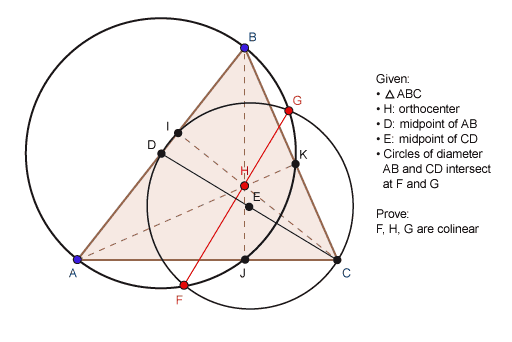
- Dynamic geometry packages such as Cabri (or the free version on the Geogebra website) help the students understand what happens when objects move. The packages can be used to measure accurately so that the students can specialise, conjecture, generalise and convince. (See an example in Figure 6.)
- Graphing packages such as Autograph, which now go above and beyond simply drawing graphs, or other learning environments – for example, Grid Algebra, which enables students to ‘see’ algebraic concepts.
You can choose creative activities that have a clear idea of what learning you want to take place, the learning intentions made clear to students and (if possible) activities built into the task that focus on the desired learning outcome. (For example, the activity could be: ‘After ten throws, note what surprises you, try to predict what will happen next …’.)
However, it is not always necessary to know the learning outcomes at the start. Highly creative activities can also be used because they provide a rich mathematical environment that can be learned from. In both cases (but especially the second), time must be built in for reflection on the activity and the mathematics, and on what has been learned. Your role is to always plan explicitly so that students have the opportunity to make links between doing the activity and understanding and using mathematical concepts.
If you are organising practical and creative activities, you need to think about:
- time – to explain, rearrange furniture and students, distribute equipment, engage in the task/collect results, collect equipment, rearrange furniture again …
- equipment – what, from where, how many, if it needs to be booked out/distributed by you or selected by the students, recording what equipment has gone out so you know what’s to be collected back in …
- student grouping – how many, possibly not more than two or three, selected or self-selected groups, helping them to work together effectively …
- materials – worksheet with how much guidance, ‘real’ timetables, maps, paper, glue, how to store materials if the task continues beyond one lesson
- safety – what the hazards are and how they are to be avoided
- classroom – appropriate size and layout, to allow access to particular equipment.
Sometimes setting up a creative classroom involves changing routine problems into something that can be explored.
Example 1
The first example is a problem involving a tethered goat. (They always tend to be ‘tethered’ and they always tend to be goats, for some reason – although donkeys can also be substituted!)
A goat has been tethered with a 5m rope to the outside corner of a 3×4m shed. What area of ground can the goat cover?

So there’s the problem – can Example 1 be changed into an exploratory activity? Using the ‘what if …?’ approach involves posing some questions that add or change some of the constraints in the question. For example, what would happen if:
- the size of the shed or the length of the rope is changed?
- the shape of the shed is changed? (Triangular, circular, more complex ‘add-ons’ and so on.)
- walls, fences or trees were in the way?
- goats could fly?
- the area the goat could cover was specified (what length rope or what particular circumstances?).
The students can be involved by choosing which constraint they explore or adding to the list of constraints. By working in this way, ‘standard’ and routine problems can be transformed into something that asks for creative ideas and for the students to work in much more real-life ways – using collaboration, offering ideas, going up dead-ends and re-assessing progress.
Example 2
As another example, start with a statement of Pythagoras’ Theorem:
The square of (or ‘on’ depending on how you’ve approached it) the hypotenuse of a right-angled triangle is equal to the sum of the squares of/on the other two sides.
You may think this doesn’t look like a promising start for exploration! But if the constraints are changed, it is possible to find what would happen if:
- ‘square’ was replaced with other shapes – rectangles, triangles, semi-circles
- ‘right-angled triangle’ was replaced by other sorts of triangles
- ‘right-angled triangle’ was replaced by other sorts of shapes – quadrilaterals, pentagons
- other changes were made (what else might change?).
Reflection point
Try this yourself using a dynamic geometry package such as Geogebra, where measures can be exact and squares, triangles, etc., can be drawn accurately. Reflect on what it feels like not to have to use paper, pencil, compasses and rulers.
There are lots of ideas about teaching creatively on the NRICH and the Bowland Maths websites, as well as in publications such as People Maths: Hidden Depths (Bloomfield and Vertes, 2005) and many others published by the Association of Teachers of Mathematics (ATM) and the Mathematical Association (MA). However, simply presenting any of these as tasks may automatically limit opportunities for students to ask their own questions. Yes, they are a good start and a good source of ideas, but once you and your students are familiar with working this way, look for ways of using them as starting points for genuine questions and genuine creative enquiry.
Activity 6 Working in a creative mathematics classroom
Watch the video by Dan Meyer about mathematics classes. (Alternatively, you can read a transcript.) Make notes on the ideas he puts forward for a creative curriculum.
Conclusion
In studying the material in this free course, Teaching secondary mathematics, you will have started to think about the nature of mathematics and why it takes such a prominent position in the curriculum of all schools. You will also have considered what it means to act and be mathematical, and what that implies for how mathematics is taught. You will then have thought about how teaching mathematics can allow students access to the ideas and ways of working they will need when learning and using mathematics in their lives beyond school and the changes in practice that implies. Finally you will have thought about how mathematics can be creative and how involving students in making choices and asking questions can establish a creative classroom.
References
Acknowledgements
This free course was written by Clare Lee.
Except for third party materials and otherwise stated (see terms and conditions), this content is made available under a Creative Commons Attribution-NonCommercial-ShareAlike 4.0 Licence.
The material acknowledged below is Proprietary and used under licence (not subject to Creative Commons Licence). Grateful acknowledgement is made to the following sources for permission to reproduce material in this course:
The full URLs if required should the hyperlinks above break are as follows:
Terms and conditions link http://www.open.ac.uk/ conditions
Creative Commons link: http://creativecommons.org/ licenses/ by-nc-sa/ 4.0/ deed.en_GB
Course image
Catherine Yeulet/istockphoto.com
Figures
Figure 1: Venomous Vector/Shutterstock
Figure 2: Scott Maxwell/LuMaxArt
Figure 3: netfalls/123rf
Figure 4: amasterphotographer/Shutterstock
Figure 5: Kobol75/Shutterstock
Figure 7: NikkiHoff/Shutterstock
Every effort has been made to contact copyright owners. If any have been inadvertently overlooked, the publishers will be pleased to make the necessary arrangements at the first opportunity.
If reading this text has inspired you to learn more, you may be interested in joining the millions of people who discover our free learning resources and qualifications by visiting The Open University – www.open.edu/ openlearn/ free-courses.