Learning to teach: making sense of learning to teach
Use 'Print preview' to check the number of pages and printer settings.
Print functionality varies between browsers.
Printable page generated Friday, 22 May 2026, 5:28 PM
Learning to teach: making sense of learning to teach
Introduction
Making the decision to become a teacher can be a life-changing moment for many people. For some, they will have known for a long time that this was the career they wished to follow. For others, it may be a rather more dramatic change of direction. What may not be apparent at that early stage, is the challenge of choosing a route into teaching from the plethora of courses and qualifications available or differences in opinion that surround how we develop student teachers.
These differences are demonstrated in the way that the development of teachers is described. For some ‘teacher training’ best describes what the provider feels they are doing, while for others the term ‘teacher education’ better represents their view of what they are striving for. This may seem like a trivial distinction, but it reveals fundamental differences of opinion, underpinned by different perspectives on what is expected of teachers and indeed of what teaching is. For ease, the term ‘Initial Teacher Education (ITE)’ will be used throughout this course but this course will provide an introduction to these differences, both at a theoretical and practical level.
Many of the ideas in the course have been developed through our experience of running a PGCE course at The Open University. This course no longer runs, but the ideas discussed in this course remain current and will help you to understand the different routes into teaching.
This OpenLearn course is part of a collection of Open University short courses for teachers and student teachers.
Learning outcomes
After studying this course, you should be able to:
know the differences in opinion about what Initial Teacher Education (ITE) is trying to achieve
understand the differences in perception of the student teachers’ role in ITE
recognise some of the ways in which these differences manifest themselves in the UK
understand effective student teacher learning and how students themselves perceive the process of learning to teach.
1 Views of learning to teach
Activity 1: Reasons to become a teacher
Listen to the clip of Jonny Saunders explaining why he decided to become a teacher.
Transcript: Audio 1
My name is Jonny Saunders and I am a teacher. Before I was a teacher – which I’ve been for 18 months – one academic year-and-a-half – I was a sports reporter for the BBC for 12 years. And I knew that at some stage in my career that I would go and become a teacher, it just so happened that I’d worked on the radio and, I suppose, reasonably successfully (I’d worked with Chris Evans for six years)... but I felt towards the end of it – and I'm sure that getting up at 3:45 every morning wasn’t helping my mental state at all – I felt that towards the end of it that I was getting tired and that the challenges of broadcasting were not quite as great as they had been, and I felt that in a sense I’d achieved everything I wanted to achieve in radio, and I’m of a volition that you only live your life once and you try and experience as many things as possible. And because I wanted to be a teacher and because I had those beliefs I felt that I wanted to perhaps try something different, and it made a bit of a news story at the time because it was this idea of somebody giving up a perceived glitzy and glamorous lifestyle to go and do a job that is not perceived as glitzy and glamorous. I suppose another way that I’d look at it: it was that for 12 years I had in a sense fuelled my own ego by being on the radio and talking on the radio and being listened to by nine million people every day; to go and do something not fuelling my own ego in a sense. And it’s kind of a pious way of looking at it… but being selfless rather than selfish is another way of looking at it.
I was sort of two thirds of the way through my Open University degree in English literature. So, I already had a degree before that from Durham University, but I felt that if I was going to be a credible candidate as an English teacher I needed to prove that I was really in love with English. And then it was a question of applying for jobs and I managed to get a job here at St. Edward’s School in Oxford. And immediately this year now I’m getting my PGCE, so on the job whilst I’m teaching.
Teaching is wonderful. It is fantastic because there’s just so much sheer variety. You have to be mega organised, however much you want to instill a love of your subject into people – and I think that is hugely, hugely important – the idea that exam results are very important is without question. So I took over, in my first year, a group of 12 pupils who were predicted C grades, most of them, for their GCSE English and when their results came out, five of them got A grades, five of them got B grades and two of them got C grades. And that day of those results... And I did a lot during my broadcasting career, I had some incredible highs. I remember broadcasting on the first day when we took over from Terry Wogan on the breakfast show and we had an estimated… well, I don't know how many people were listening to that show, but obviously it was big news when Chris Evans took over for that. But that moment of these 12 students achieving something... Now, it was down to them, don’t get me wrong, it wasn’t me who took the exam! But I had hopefully helped them along the way: that was a comparable, if not a better, feeling – the results they got that day – than perhaps it was being on the radio show January 11th 2010.
I think as well, at the end, anecdotal things... At the end of a lesson when you see children get up and they’re still discussing something that they’ve been discussing during the lesson, and being really engaged in the subject that you’ve been talking about. I get a real buzz from that as well. And you can see them improving in terms of the way that they’re writing and the way they’re engaging with a particular text that they’ve been taught.
The most important thing when I came into teaching was that I had to have the attention of the pupils, and that I think you have to lay down the guidelines. So that was a challenge. I think just the day-to-day planning a lesson – education had changed hugely since I’d left school. So, I had a gap of 19 years between leaving school myself and coming back into education as a teacher. And the transformation in education and pedagogy and how people teach and the focus on what children learn as opposed to... when I was at school it was just a teacher, usually standing up at the front of a classroom: if you choose to engage, you engaged; if you didn’t, well you were kind lost for the rest of the lesson. It’s much more interactive now, the teaching; the focus is on what the pupils are learning during the course of the lesson, rather than how much the teacher actually knows.
A good teacher – I don’t even begin to assume that I would fall into this category, but I’ve seen a lot of other good teachers – I think it’s about striking the right relationship with your pupils. So that you can communicate with them, so that you can know what makes them tick, but at the same time they’ve got to have that mutual respect for you so that they will work and they will get down to it – you can’t be too chummy, you can't be too distant. You have to hit the right area in terms of the relationship, and I think that that is hugely important. The material you’re working with is also very important: I've taught some poems which some pupils don’t enjoy, if they don’t enjoy it they’re not going to engage in the lesson. Alternatively, I’ve taught some texts which the pupils really enjoy and when they’re enjoying it they learn more. So, the material is down to it. Your organisation – you’ve got to be completely organised so that you’re moving from one place to the next so that you’ve got a coherent narrative going through your lesson, so that you’re moving to an end point so that all the learning is taking place as well. So, organisation, striking the right relationship – really, really important factors.
Learning to teach, the most valuable thing you can do is reflect on the lessons you have taught, and that’s part of the process I’m going through at the moment in terms of getting my qualification. We are actively asked, quite rightly, to reflect on our teaching practice – what was good about that lesson? What could have been improved? And it’s quite hard, I suppose, being your own critic and saying ‘well, they didn’t quite learn what they should have done there. Why was that? Probably because I hadn’t made it clear enough.’ It’s generally the teacher’s lack of focus and preparation that will lead to that learning not occurring. Pupils generally are very willing to do it and they are very able to be led, but they’ve got to be led in the right direction.
My advice to other student teachers would be: be organised. Be prepared, so that you’ve got a lot of material. Also, be prepared not to use all of that material: be prepared to go off-piste if you have to go off-piste. Be prepared for the unexpected – you never know what’s going to happen in a classroom. Be prepared to laugh at yourself, take the Mickey out of yourself on occasions. Don’t be too rigid, but at the same time don’t let the children trample all over you. It’s a fine line. And I think a lot of it comes down to instinct. But I think organisation’s absolutely vital.
Reflect on the reasons why you decided to become a teacher, and what you had to or will need to learn.
Key to understanding the different routes into ITE is to understand how different providers consider the role and nature of teacher education. Although this discussion draws on research to provide an introduction to thinking about this area, many of the ideas are contested and it is difficult to portray particular approaches as black and white, with many courses occupying a position somewhere in between. Therefore, the following discussion will provide an introduction to considering these perspectives.
1.1 Four paradigms
Zeichner, in his research into teacher education, identifies four paradigms (Zeichner, 1983). These are useful as a starting point to discuss the considerable differences in approach to ITE. They cannot be applied without critical reflection on their relationship to particular models or experiences of ITE however. It is highly likely that an ITE course will combine aspects of the four but may have a tendency towards one paradigm.
The four paradigms, with examples from behaviour management, are:
- Behaviouristic
This is about adopting particular behaviours as prescribed by the course which might be derived from statutory standards or competencies.
For example, the student teacher will be given the set of school rules or expectations, which are likely to represent one view of classroom management.
- Personalisitic
This paradigm is concerned with psychological maturity and personal growth of the student into the role of teacher. This aligns with the idea of developing a teacher identity.
For example, developing a classroom management approach that works will be seen as developing from the growth of the student teacher into the teacher identity. Therefore it may be very gradual and discussions of behaviour management may be dominated by discussion of how the student sees themselves in the classroom and their experience of dealing with behaviour.
- Traditional craft
This can best be described as the apprenticeship model where students are expected to assimilate knowledge by working with expert teachers in the classroom.
For example, this model will involve student teachers watching and copying their mentor’s approach to managing a class.
- Enquiry orientation
In this paradigm teachers act on ethical, political and pedagogical issues in a considered, skillful and reflective way to construct their own knowledge from a range of sources. The enquiry-orientation is concerned with problem solving.
For example, each learning opportunity is used to try different approaches, to evaluate the success of different approaches and then the student can construct their own understanding of behaviour management. Different approaches might include trialling a behaviourist or traditional-craft approach, but includes the flexibility to question, critique and reject ideas in favour of their own researched and trialled solutions.
Zeichner’s ideas of different views of initial teacher education are supported by research done by Taylor (2008). Through her research into HEI and school partnerships, she found four ways of describing ITE learning:
- Cascading expertise
Information and expertise is transmitted from experts to novices.
- Enabling students individual growth as teachers
Where personalisation of approach and nurturing results in student’s individual growth. Intensive mentoring is associated with this type of learning as is initiation into a particular school context.
- Developing student teaching
Where skills are learned through emulation of experts.
- Students as teachers and learners
A more holistic, questioning approach, where students are encouraged to think critically about theory and practise in order to develop their own learning.
Activity 2: Compare views of ITE
Compare Zeichner’s and Taylor’s models. In what ways do the categories align or differ from each other?
Discussion
Zeichner’s and Taylor’s research reveals some common themes in thinking about the underpinning philosophy of ITE courses. Both make a distinction between the ‘transmission’ of knowledge and skills (Behaviouristic, Traditional Craft, Cascading expertise, Developing student teaching), and a more student-teacher centred approach (Personalistic, Enquiry Orientation, Enabling individual growth, Students as teachers and learners).
1.2 Differences between the paradigms
Fundamental to the distinction between the paradigms is the debate around what knowledge is and how it is created. In this case the difference is between knowledge being in the power of others and ‘given’ to student teachers, or knowledge being something that is co-created and able to be influenced by all participants (including student teachers and pupils).
Having considered Zeichner’s and Taylor’s rather abstract views of the differences in teacher education, it is possible to demonstrate how these differences might play out (in both positive and negative ways) in the expectations around a common classroom issue, behaviour management.
Behaviour management
The issue of behaviour management is far from simple. We know, through experience and research, that approaches to behaviour management may work with one class one week, but then not have the same impact the following week. We also know that how young people behave is built on a complex cocktail of individual and group dynamics and circumstances, and the nature of the curriculum they are engaged with.
This level of complexity suggests the need to develop student teachers awareness of their own impact on the situation. This is purely individual, as it will involve the student teachers characteristics, beliefs and values, relationships and identity and therefore is akin to the Personalistic paradigm and enabling students individual growth as teachers.
Transferring learning between contexts
The majority of student teachers spend time teaching in different school contexts. Schools, like any institutions, have their own atmosphere, ethos and policies which make the straight transfer of skills and knowledge a challenge. Student teachers have to be able to transfer their learning between contexts but in such a way that the learning is adaptable and flexible. At the extreme end of the spectrum (although not hugely uncommon in an issue such as behaviour management) the student teacher may effectively have to re-learn skills and knowledge that are suitable to the context and in doing so develop their in-the-moment responses for the specific context.
A criticism of adopting the behaviouristic or craft paradigms in this scenario could be the perception of there being ‘a solution’. What is the impact on student teacher learning when the solution doesn’t work with a particular class or on a particular occasion? Although it may be highly appropriate to adopt strategies that are observed to work with a particular class, having the ability to transform, adapt and actually reject these can be seen to be a core part of what Taylor describes as ‘Students as teachers and learners’ (2008) and Zeichner as the Enquiry Orientation (1983).
Time available
ITE courses are very short, and therefore unable to deal with the complexity of the research evidence and multitude of issues around behaviour management (alongside all the other issues) that need exploring.
The outcome of ITE is to reach the basic standards in order to teach. It could be argued that this could be rephrased to reaching the basic standards to teach and to develop the skills necessary to continue to learn as a professional. Student teachers aren’t going to experience every possible manifestation of classroom behaviour during their ITE course, and aren’t going to be able to read every seminal text about managing behaviour. If this is accepted, then the question is how can we ensure that student teachers continue to learn beyond the ITE course and what skills do they need to do so? Again, this points to Zeichner’s Enquiry orientation, which emphasises a student teachers ability to identify issues, research them using a range of sources, critically reflect on the findings and in the process, construct new knowledge (Zeichner, 1983). For further information, study Learning to teach: An introduction to classroom research.
This discussion has only looked at the issue of classroom management in relation to Zeichner and Taylor’s research. There will be times during an ITE course where certain approaches are used highly effectively to help student teachers make progress. However, this discussion has raised two crucial questions:
- What type of teachers do we want to produce from ITE courses?
- How do we achieve this?
The next section will highlight that answering these questions requires us to consider what the role of student teachers is in their ITE course.
1.3 The role of student teachers in ITE
A student teacher’s role during ITE is to learn. This may sound rather obvious. However, looking at Zeichner's ideas and Taylor’s research, there is a clear distinction in the way student teachers are perceived and expected to behave as learners, in the paradigms and approaches.
Activity 3: Examine paradigms
Looking at each of Zeichner’s paradigms (1983) from Section 1.1, make some notes on how you might complete the table below.
| Paradigm or approach | Where knowledge comes from | Student teacher’s role in learning process |
|---|---|---|
| Behaviouristic | ||
| Personalistic | ||
| Traditional craft | ||
| Enquiry orientation |
Discussion
Analysing where knowledge comes from, and the student teachers’ role in the learning process, may have led you to draw a distinction between paradigms. The ‘behaviouristic’ and ‘traditional craft’ paradigms require student teachers to copy and adopt pre-existing practice and accept knowledge as presented by an ‘expert’ such as a university tutor or school based mentor. The ‘Personalistic’ and ‘Enquiry orientation’ paradigms require student teachers to develop individually and play an active part in creating new knowledge and understanding.
This can be characterised generally as the differences between a transmission model of teaching (akin to a traditional lecture mode of delivery) and a student-centred model of co-construction of knowledge.
1.4 Transmission approach
Some argue that the ‘transmission’ style of ITE is characterised by a ‘top tips’ approach, where experienced practitioners, either in schools or universities, consider their solution to be the correct one. It is here that there is a difficult balance for student teachers to understand. One the one hand they have expert tuition and guidance from professionals who have found solutions or their best practice ideas that work for them and their context. On the other hand, student teachers are individuals who exert different influences and bring ideas into the classroom. Their interactions and relationships are unique to themselves and therefore they need to develop their own versions of ‘best practice’. In this way the transmission view of learning can be critiqued in the following ways:
- Knowledge in teaching is not reliably transferable – It is very difficult to identify a solution to a problem that will work in every context and every time. Transmitting knowledge as ‘the way to do it’ can be counterproductive if the student teacher then experiences situations in which the suggested solution it isn’t successful.
- Teaching is highly complex and context specific – Schools have their own underlying principles, beliefs and values that manifest themselves in the way they teach pupils and in how they expect teachers to behave. Again, a teacher moving between contexts may find one approach is not effective in other contexts.
- Student teachers start ITE with different levels of knowledge and skills, and different understandings of pupil learning – The transmission approach can neglect the individualisation of the learning process of the student teacher.
The argument in favour of this type of approach is that it allows for the standardisation of knowledge and skills. It is relatively easy to sit every student teacher in a lecture hall and make sure they know facts about child protection, or to coach a student teacher to copy how a mentor delivers a particular lesson. For some topics, such as understanding a particular legal framework or how to use particular ICT software, this might be the most effective approach. However, you may lose some good teachers who don’t respond to learning in this way if it is used inappropriately.
1.5 Student teacher-centred approach
The ‘student teacher-centred approach’ asks students, mentors and tutors to critically engage with issues that arise and find solutions through a process of exploration and critical reflection. In this way student teachers don’t just emulate existing practice but will take more personal responsibility to adapt, question, challenge and experiment with a range of different solutions and techniques. In this way the learning cannot be controlled in the same way as in a transmission model as it is difficult to predict learning outcomes too specifically, or that each student teacher (or young person) will experience exactly the same, or make the same meanings and connections as others in the same context.
Therefore the challenging aspects of this approach include:
- Time – A questioning, critical approach takes a lot of discussion, research and time for experimenting. It requires a high level of skill from teacher-educators to accommodate the level of individualisation that results.
- Amount of information – In order to adopt a critical approach, student teachers need to draw on a range of opinions from mentors, tutors, their own practice and the literature. This can be overwhelming, although developing critical reflection can help student teachers learn from their experiences (see Learning to teach: Becoming a reflective practitioner).
- Proactive learners – Student teachers have to be proactive in taking charge of their own learning. This involves the student teacher being aware of their own learning process (metacognitive awareness) including their assumptions, values and beliefs, which may impact on their reactions to situations. It involves them recognising the individualistic nature of learning and how their active approach to researching, meaning making and exploration are fundamental to their development.
The arguments for this approach are that they take full account of individual needs. It supports student teachers to be co-creators of their own knowledge, finding solutions that work for them and developing the skills to be flexible and adaptable to different contexts and approaches.
Reflection point
Think about situations in which you have experienced a transition mode of teaching and a more learner centred approach.
- What were your experiences and reactions as a learner to these different situations?
- What do you feel you gained from each?
- What were the drawbacks?
Having explored the different paradigms that can be argued underpin ITE courses, the different way knowledge is perceived and the different expectations of how student teachers should learn, it is not surprising that this has resulted in a plethora of different routes into teaching in the UK. The next section will consider these differences in relation to the previous discussion.
2 Different routes into teaching in the UK
When people talk of different routes into teaching in the UK, they are often referring to differences in how courses are structured and run. The following section will explore these differences including:
- the design and delivery of ITE courses
- qualifications they will lead to
- nature of school experience
- other learning opportunities.
2.1 Who designs, delivers and monitors the course
In the UK you may come across the terms Higher Education Institute (HEI) led or school-based ITE. These are not routes in themselves as each contains a number of different models of ITE, but they do recognise fundamental differences in how courses are organised.
| Design of course | Delivery | Quality assurance | |
|---|---|---|---|
| School led | A diverse range of programmes come under this category, many of which reflect the local context. If the course is linked to an externally validated qualification, such as a PGCE, then the school will work in partnership with the awarding body to design the course. | Generally delivered within the school and it’s extended network. The sessions might include lectures, workshops, visits, project work, individual study and teaching. | Inspectorates (e.g. Esytn, Ofsted). If the course offers an academic qualification, then the awarding body QA procedures will apply (e.g. external examiners). |
| HEI led | HEI in partnership with schools. Partnership schools often design ‘in school’ provision. | Mixture of school and HEI-led sessions run by a combination of education lecturers, subject specialists, school-based staff and visiting experts. These might include lectures, workshops, visits, project work, individual study and teaching. | Inspectorates (e.g. Esytn, Ofsted). HEI QA procedures (e.g. external examiners). |
All ITE courses are subject to national regulations and inspection frameworks. The nature of the delivery will depend on the underpinning philosophy of the course but also the qualifications that are to be achieved (e.g. a masters level course will differ from an undergraduate route in the nature and level of critical engagement in assessment).
Even though the design of ITE courses may be quite individual, how courses operate and who is there to support you can be discussed more generally. It is possible to identify four types or groups of people who might be involved in an ITE course:
- The course tutor may also be known as the subject leader, university tutor or specialist tutor. This person’s role is to facilitate a holistic, joined up and well-supported programme for the student. They may be based outside the schools in which student teachers are working, will have a broad experience of the subject or phase they are teaching and extensive experience of working with student teachers.
- The school-based mentor is the student teachers daily contact and support system when working in schools. They provide the expertise of the particular school context and will help students to apply what they have learned about educational issues with particular classes. They will also provide regular feedback to the student and opportunities to discuss their developing teaching.
- School-based ITE coordinators are often senior members of staff within a school who coordinate ITE provision across the different departments or phases. They may organise seminars, workshops or specific experiences for all student teachers working in the school and they will also observe student teachers to ensure standards are being applied consistently. They will also ensure that the mentor is supported in their role and will moderate assessment judgements.
- Other student teachers may feel an unlikely addition to this list but the influence of working with other student teachers, sharing issues, finding solutions together, discussing educational practice and theory and supporting each other emotionally is a very important aspect of learning to teach. Whether you are on an HEI led course but are on school experience placements away from your peers, or are based within a school for all of your course, there are times where face to face contact with other student teachers is more challenging. However, there are many online platforms (both general educational forums and subject specific) which support ongoing conversation between student teachers which are highly valuable in providing opportunity to broaden your outlook, debate key issues and share ideas.
The roles of the mentor and tutor will be discussed in more detail in Learning to teach: Mentoring and tutoring student teachers.
3 Qualifications
Underpinning all ITE courses is the requirement for teachers to achieve Qualified Teacher Status (QTS). This status signifies that the person has met the standards necessary to become a teacher and it is a prerequisite for the vast majority of teaching positions in the UK.
There are opportunities to complete a QTS only route into teaching although many providers offer an academic qualification, which indicates a student teacher’s high level engagement with theory and practice. The nature of these qualifications is diversifying at a quick rate to adapt to recent government policy decisions and therefore care needs to be taken to check the actual qualification on offer.
| Qualified Teacher Status only | Undergraduate qualifications+QTS | Postgraduate qualifications+QTS |
|---|---|---|
| You have met the required standards for you to work as a teacher in your nation. | You have met the required standards for you to work as a teacher in your nation and have demonstrated ability to engage with educational issues and debate at an undergraduate level, which is likely to have involved small-scale research. | You have met the required standards for you to work as a teacher in your nation, have demonstrated ability to engage with educational issues, educational theory and practice at a postgraduate level. You will have read and analysed a range of educational literature and undertaken small-scale research. You may have accrued some masters level credits which can be used to work towards a masters in education qualification. |
Traditionally, HEI’s have offered two different levels of academic ITE qualifications: undergraduate and postgraduate. Undergraduate courses involve completing a degree as well as ITE over a three or four year period (e.g. BEd courses), or completing a degree in a subject followed by a one year ITE course at professional level (level 6), (e.g. Professional Graduate Certificate in Education or PGCE) in addition to an existing degree.
Postgraduate qualifications are taken by people who already have a first degree and want to complete ITE at a postgraduate level. This is usually in the form of a Post Graduate Certificate in Education (PGCE), and often involves opportunity to gain masters level credits.
The qualifications on offer from a particular provider often indicate the types of professional skills and understanding they feel teachers need to be effective and their view of the student teacher’s role as a learner. Accessing key educational ideas from researchers, and learning within school placements will be evident in both routes, although the nature of the qualification will indicate the relative importance and emphasis given to each.
Activity 4: Researching ITE courses
Spend 30 minutes on the internet looking at two contrasting ITE course. This may involve downloading prospectuses. Think about:
- What information can you find out about how the course is designed and delivered and the qualifications they offer?
- Is there any evidence of the underpinning paradigms or approaches to their ITE provision?
4 School experience
For all ITE courses there are national requirements that have to be met. For example, there are rules about the minimum amount of weeks that student teachers are required to be in school.
The nature of the school experience and the expectations about how students learn from the experience are indicative of the underpinning philosophy of the ITE course. We can consider this through a case study of The Open University PGCE approach to school experience (please note that The Open University’s PGCE course has now been discontinued but is typical of many university run PGCE courses):
Case study: School experience
The OU PGCE course had three levels, each with a school experience placement. The first and last placements were taken in the same school to create an ABA placement pattern. The three levels introduced key educational ideas and theories, allowing students to experience, research and develop these ideas through the school placement, and then allowing them to reflect, learn from their experience and consolidate their learning in assessment tasks. The three levels represented three stages of development; orientation, consolidation and autonomy. Most university PGCE courses run on a similar basis with students starting in a highly supported environment and gradually taking on more responsibility.
During the orientation phase student teachers were introduced to the school and the subject department of school A through gradually building up to teaching classes. They were expected to teach whole classes by the end of a five-week period, during which time they were expected to:
- observe a range of teachers and classes (including those from other subjects to observe particular types of practice, e.g. managing practical group work)
- meet key members of staff who they will need to work with, e.g. Special Educational Needs Coordinators
- begin to develop an understanding of the broader school context by attending meetings, events and supporting a tutor group
- plan lessons with the subject mentor and evaluate the planning and teaching
- teach lessons, or parts of lessons, to build up knowledge of classes, schemes of work and a range of approaches to common class issues
- complete investigatory activities which support them understand the school context, the pupils, the approach to teaching and learning in the school and issues that they have discussed in preparatory workshops and will complete assessments on at the end of the placement.
After the five weeks, the student teachers had a period of reflection and consolidation of their learning. This included a series of assessment tasks that integrated the ideas and theories with their experiences in school and their post-experience reflections on their learning.
This pattern of study, school experience and post-experience reflection and consolidation of learning was repeated at each level with a greater emphasis on taking responsibility for teaching classes and researching practice as the course progressed.
Activity 5: School experience
Re-read the PGCE case study, above, and listen to Sarah and Dave talking about learning to teach. (Please note that The Open University’s PGCE course mentioned in this audio has now been discontinued but is typical of many university run PGCE courses.)
Transcript: Audio 2
Diegetic
Non-diegetic
Diegetic
Non-diegetic
Think about these questions:
- What are the benefits of learning to teach in two different schools?
- Does the way in which the course organises its school experience reflect particular paradigms or approaches to ITE, as defined by Zeichner and Taylor?
- If yes, then what is the evidence?
Sarah reflects on what she was apprehensive about and on the importance of building relationships.
- If you are thinking of becoming a teacher, what do you think you will be most apprehensive about? What experience do you bring to the profession that will help you in developing good relationships with your classes and your colleagues?
- If you are a teacher, do you agree with Sarah? How do you think you can support student teachers in developing good relationships with their classes and with their colleagues? What is the key piece of advice you would give to student teachers?
Discussion
Sarah makes a number of points, but one of the most significant is that learning to be a teacher is about developing your own ‘teaching personality’. Learning to be a teacher involves drawing on your previous experiences, and the opportunities that you have as a student teacher, in order to develop that personality. And it will change as your career progresses and you gather more experience.
In reality, choosing an ITE course may come down to very practical considerations such as availability of places or personal experiences of a provider, rather than the philosophy which underpins a course. However, as with any learning, it is how individuals take control of their own learning that will influence the type of teacher they become.
To that end, it is worth examining the views student teachers themselves about what helped them to learn effectively.
5 What students say about learning to teach?
Hagger et al. (2008), in their longitudinal study of student teacher’s reflections on their learning, found that responses could be categorised into five dimensions:
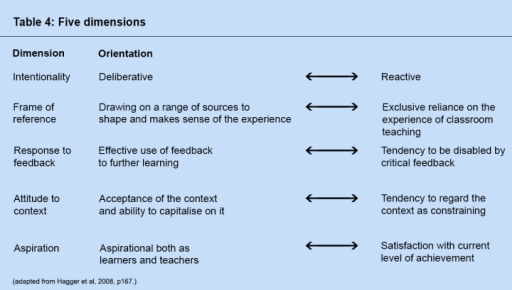
What is particularly interesting about their research findings, is that student teachers themselves recognise the significance of their own responsibility as learners.
These ideas are reflected in a number of studies that examine student teachers own perceptions of themselves as learners.
Intentionality
As in Hagger et al’s research, Taylor (2008) found evidence of effective learning when students deliberately set their own schedules of learning and influenced the implementation of these. She found that, ‘Students achieve this through reflection on self in terms of their own individual development and of their development as teachers, and through reflection on wider educational theory.’ (Taylor, 2008 p. 79).
Interestingly, Mutton et al. (2010) found that student teachers identified a lack of power, meaning a lack of ability to influence or experiment with alternative approaches to teaching, as a potential constraint to effective learning. This could be seen to be a criticism of approaches to ITE that require students to replicate existing practice, such as Zeichner’s traditional craft paradigm (1983) or the transmission approach, but could equally be a criticism of student teachers who adopt a reactive approach to learning.
Frame of reference
Hagger et al. (2008) found that effective student teachers drew on a range of sources of information.
The value of other sources of learning isn’t overwhelmingly recognised in research that highlights student teacher’s opinions. Maldrez et al. recognise that some student teachers indicated that they felt such ‘theoretical’ studies were only of peripheral relevance (Maldrez et al., 2007). However, she did find evidence that some student teachers acknowledged that they might be using it ‘subconsciously’.
‘“I feel that things like learning about theories of how children learn and things are useful, but I can’t honestly say I’ve ever put them in my teaching… But maybe I do subconsciously, but I don’t know...” [Female, 20–24, BA QTS, secondary, MFL]’ (Maldrez et al., 2007, p. 235)
If considering this evidence to Zeichner and Taylor’s research, then it is possible to see that the Enquiry Orientation (Zeichner 1983) and development of students as teachers and learners (Taylor 2008), both promote a type of learning that draws on a wide range of sources.
Response to feedback
Caires et al. (2012), like Hagger et al. (2008), provide evidence that student teachers value the feedback they receive, if it supports effective learning. Caires et al. define effective feedback as ‘the sharing of experiences with their supervisors and other student teachers, the joint exploration of beliefs, perceptions and affects involved in teaching practice and/or the joint construction of meanings’ (Caires et al. 2012, p173). They argue that these can support effective learning as they lead to ‘self-exploration, exploration of the teaching profession, mutual knowledge and the strengthening of complicity relationships amongst student teachers, their supervisors and colleagues’ (Caires et al., 2012, p. 173).
Mutton et al’s research indicates that student teachers value feedback which raises questions and issues as much, if not more so, than being offered solutions (Mutton et al., 2010).
Reflection point: Why do you think the student teachers in Mutton et al’s research felt the way they did about feedback? How does it relate to the discussion of paradigms and approaches to ITE?
Attitude to context
Hagger et al. identify a difference between students who can capitalise on a context in order to learn, and those who see the context as a constraint (Hagger et al., 2008). This is reflected in Taylor’s research which found examples of students who were aware of the different opinions and opportunities that different contexts brought to their learning, as evident in the following quote:
… I think people need to be open-minded about the whole process, rather than thinking this is how I’m going to teach because when I first came onto the course I just had one view of teaching… However, I’ve been opened up to all these different ideas, working with my mentors and tutors, and also other students and other teachers … and you have to accommodate working with others so you’re always going to be learning and you’re always going to be learning different ideas [and] some of the things you learn, I didn’t always agree with, but I feel that you have to be completely open-minded and you have to try and change things. (Student 1)
Aspiration
Interestingly, aspiration, as defined by Hagger et al.(2008), concerns not only aspiration as a teacher but also aspiration as a learner. This is supported by Taylor’s research which identified that students ‘make connections between principle and practice, thought and action to make sense of teaching and its impact on education in general, schools and particularly children and their learning’ (Taylor, 2008, p79). In describing this dual, although fundamentally interlinked identity, Taylor discusses student’s development as both learner experts and expert learners.
This section has focused on what student teachers consider to be important to their learning. It is clear that those working with student teachers, their view of the learning process and attitude to ITE have a great influence on the effectiveness of the learning experience. However, Hagger et al’s research (2008) reminds us that central to effective student teacher learning is the attitude and approach of the student themselves. This will be influenced by the nature of the ITE course (i.e the paradigm or approach that underpins it, the route, level or qualification) but also the opportunities afforded to the students to take responsibility for their own learning.
Conclusion
This course has highlighted differences in perception about the nature of ITE by exploring different paradigms and approaches that underpin different beliefs about the role of ITE and the role of student teachers as active participants within it.
It then considered how this has manifest itself in the plethora of different routes into teaching in the UK. It concluded by examining research into how student teachers perceive they best learn during ITE courses.
Central to this course is the question ‘What type of teachers do we want in our schools?’. It is clear that there is not a single shared vision within the field, the profession or at government level that can answer this question. Maybe the question ought to be addressed to those who can influence the outcome, the student teachers, by asking: ‘What sort of teacher do you want and what experiences will best support you to achieve this?’
Activity 6: Characteristics of a good teacher
Listen to the clip of Tom, Mark and Sid talking about their school days.
Transcript: Audio 3
As you listen, make a list of what they consider to be the characteristics of a good teacher.
Are good teachers born or made? Reflect on this question in the light of the list that you have made.
What qualities do you bring to teaching, and which will you/did you need to learn? In the light of what you have read in this course, how best can these things be learnt?
Discussion
Clearly, the different skills might be learned in different ways and much will depend on the skills, experience and attributes that a student already has. There will be times when students learn by copying what experienced teachers do, there will be times when they want to try new and novel things, and there will be times when they feel as if nothing is working. One of the purposes of an ITE course is to provide students with the tools to get through those times so that they emerge as better and more effective teachers.
References
Acknowledgements
Except for third party materials and otherwise stated (see terms and conditions), this content is made available under a Creative Commons Attribution-NonCommercial-ShareAlike 4.0 Licence.
The material acknowledged below is Proprietary and used under licence (not subject to Creative Commons Licence). Grateful acknowledgement is made to the following sources for permission to reproduce material in this free course:
Table 4: adapted from Hagger, H., Burn, K., Mutton, T. and Brindley, S. (2008) ‘Practice makes perfect? Learning to learn as a teacher’, Oxford Review of Education, vol. 34, no. 2, p. 167.
Every effort has been made to contact copyright owners. If any have been inadvertently overlooked, the publishers will be pleased to make the necessary arrangements at the first opportunity.
Don't miss out
If reading this text has inspired you to learn more, you may be interested in joining the millions of people who discover our free learning resources and qualifications by visiting The Open University – www.open.edu/ openlearn/ free-courses.