Learning to teach: mentoring and tutoring student teachers
Use 'Print preview' to check the number of pages and printer settings.
Print functionality varies between browsers.
Printable page generated Wednesday, 25 February 2026, 3:06 AM
Learning to teach: mentoring and tutoring student teachers
Introduction
This course introduces the roles of the mentor and tutor in supporting student teachers. It explores the similarities and distinctions between these two roles, the need to balance student teacher support with appropriate levels of challenge and some commonly used approaches for supporting student teachers development.
Student teachers may be supported by a mentor in school and a tutor at university or by mentors and tutors who are both based within school contexts. The aim of this course is to highlight how student teachers benefit from the involvement of two professionals with distinct, but different, roles.
Supporting beginner teachers, whether as a mentor or a tutor, can be a professionally rewarding experience, despite the time and energy involved. It provides opportunities to share good practice, and to connect with the latest research and developments in both subject pedagogy and broader educational practice. It provides an opportunity to engage in critically reflective dialogues about practice, with both the beginner teacher and others who support them.
For many, mentoring or tutoring is a valuable CPD opportunity as well as providing important evidence on a CV of involvement in the latest educational developments. This course is underpinned by the belief that, from the student teacher’s point of view, both roles are important in supporting and guiding them, wherever the people concerned are based, and it aims to explore the differences and similarities between these two roles.
This OpenLearn course is part of a collection of Open University short courses for teachers and student teachers.
Learning outcomes
After studying this course, you will be able to:
understand the differences between tutoring and mentoring in Initial Teacher Education (ITE)
consider the similarities and differences between tutoring and mentoring pedagogy
develop a range of strategies for supporting beginner teachers.
1 What is the difference?
The roles of mentor and tutor vary between courses, national systems and school contexts. For the purposes of this course, the term ‘mentor’ is used to indicate the person (usually a member of the school staff) who works with the beginner teacher on a daily basis in the school context supporting their development while on placement.
The role of ‘tutor’ may include providing academic support, if the student is studying for an academic qualification, and visiting the school to observe teaching in order to moderate and coordinate grading with the school mentor. It may also involve leading tutorials or seminars that help students to link theory and practice. The tutor is unlikely to be from within the immediate school context (i.e. from the same department) and may be from a Higher Education Institution, external teacher education provider or from a different school within an alliance of schools.
Tip: It is strongly advised that whatever your role within ITE, you read both the sections about mentoring and tutoring as inevitably the two roles have much overlap, and in different contexts may have different remits.
Fundamental to the success of Initial Teacher Education is the collaboration and coordination of these two roles in providing a coherent experience for the beginner teacher. However, the distinct nature of the two roles and what they bring to the student teacher, require separate consideration. To help do this, it is useful to keep in mind the student experience.
Maldrez et al. (2007), through their large sample of student teachers, identified four key themes that underpin the process of learning to be a teacher:
- the concept of teacher identity or sense of self as teacher
- the importance of potential and actual relationships with a number of ‘significant others’
- the role of emotion in student teachers’ reasons for becoming a teacher and (more strongly) in their accounts of their early experiences in schools
- student teachers’ concerns about the relevance of ITP (Individual Training Plan) course provision.
Mentors and tutors both have a role in supporting student teachers in these aspects, but in sometimes quite different ways, as we will begin to explore throughout this course.
2 Mentor role
The mentor has a crucial role in Initial Teacher Education. Essentially, the mentor’s responsibilities for a student teacher are to:
- act as a positive role model
- enthuse the student teacher about their subject and subject pedagogy so that student teachers, in turn, will contribute to enthusing pupils of all abilities, aptitudes and backgrounds to want to learn, enjoy and achieve
- help the student teacher to understand something about the context of the school and how this affects practice
- help the student teacher to develop in a planned way using an appropriate balance of support and challenge determined by the student teacher’s progress
- be familiar with the aims and expectations of the ITE curriculum
- understand how to assess the student teacher’s progress and be able to do this accurately
- set the student teacher SMART targets in relation to the ITE professional standards/competencies and the course requirements
- facilitate the student teacher’s links with colleagues and professional development opportunities beyond the student teacher’s subject area.
Activity 1: Characteristics of an effective mentor
Listen to the audio below and note down the key characteristics of an effective mentor, as described by the teachers and student teachers. Do you agree with their views? Would you add anything to your list?
Transcript
Despite the mentoring model being commonly used in schools involved with Initial Teacher Education, Maldrez et al. (2007) found considerable variation in mentors’ understanding of their role which we will now go on to explore in more depth.
2.1 Mentoring relationships
The relationship between mentor and student teacher is complex and demanding (Maldrez et al., 2007). However, it is clear, from the audio you listened to in Activity 1, that it can have an impact on student teacher outcomes.
The working relationship between the student teacher and mentor needs careful consideration. The mentor must avoid patronising the student teacher and should be sensitive to their adult status. Conversations between two adults, where one is the teacher and the other the student teacher, can be uncomfortable and non-productive unless both participants feel that their contributions are valued.
This can particularly be the case if the student teacher has had previous experience of other school contexts or alternative approaches to subject pedagogy. Appreciating this and understanding what the student teacher is learning on their ITE course can provide a starting point for discussion.
As with any effective teaching, understanding where the student is coming from is important. Good mentors explore the assumptions, values and beliefs held by the student through questioning and keeping dialogue open to differences of opinion. Such questioning helps to establish a productive climate in which critical reflection and valuable learning can take place.
2.2 Balancing support and challenge
As with any effective student-centred learning, development and progression in Initial Teacher Education is based on achieving the right balance between support, appropriate to the stage in their learning and challenge to move the student teacher forward in their thinking or practice. This balance is represented in Figure 1.
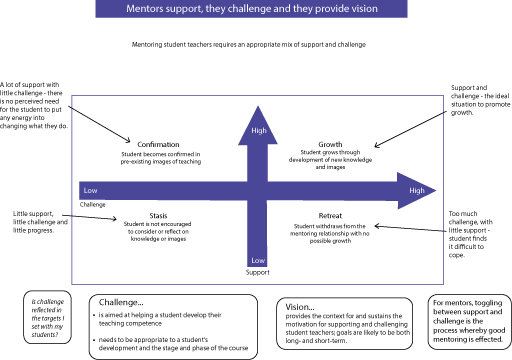
Although this model can be taken to represent the overall balance between support and challenge, it is quite likely that student teachers will need different levels of support and challenge in different scenarios. This may change from week to week or even day to day. An obvious example is when students are at different levels of the course. A shorter term example may be if they are struggling with one issue, such as behaviour management, with a particular class or individual. Recognising the level of support or challenge that is needed in a particular circumstance and being flexible in your approach is a key mentoring skill.
Activity 2: Challenge and support
Using the model above, think about mentoring a student teacher. What student behaviours might indicate a need to modify the balance between challenge and support?
Discussion
You may have noted down some general emotional or personal indications such as a dip in confidence, signs of significant stress, or a lack of organisation.
You may have thought about performance indicators such as not taking on advice where before they did, lack of detail in lesson planning or struggling with particular aspects for a long period of time without having new strategies or ideas to overcome them.
3 Supporting the student
It is common to hear mentoring in ITE referred to as a supportive role, but what does this mean in practice? It is invariably more complex than the term suggests (Calderhead and Shorrock, 1997, Maldrez et al., 2007). For the purposes of this section we can break support down into the following two areas:
- support in developing an identity within the school community
- emotional or pastoral support.
3.1 Identity
The body of literature around teacher identity is substantial, and impossible to cover within this space. However, it has been demonstrated that development of a teacher identity was seen as a key part of the learning to teach, by student teachers (Kagan, 1992, Maldrez et al., 2007).
Maldrez et al (2007) identify three perspectives from which to think about the issue of developing identity, which give rise to a number of strategies.
Firstly, within a socio-cultural perspective, the critical role of the mentor is in ‘supporting student teachers’ development of a comfortable and congruent sense of self as teacher (Maldrez et al., 2007 p239).
The second perspective they draw on is that of ‘robust reasoning’ within an investigation-articulation approach to teacher education. In this approach, revisiting questions about identity at regular intervals helps the student teacher to articulate their developing sense of self. The questions might include ‘who am I as a teacher?’ and ‘who is my professional community?’ (Maldrez et al., 2007 p 239).
The final perspective is that of developing a personal narrative, suggesting that ‘beginning teachers moved significantly towards establishing their own identities as teachers through creating their own stories’ (Maldrez et al., 2007 p239).
These three perspectives can be supported by the following practical strategies for mentoring.
- nurturing and modelling
- questioning and reflecting
- exploring and facilitating the development of narratives.
The strategies you develop and draw on are likely to reflect your underlying beliefs about teacher education but may also reflect the nature of the student teacher you are working with and their own beliefs. Being aware of these different perspectives gives you access to a range of tools to support you.
3.2 Pastoral support
Teaching practise is perceived as a particularly stressful and demanding period, which involves considerable amounts of distress, changes in psycho-physiological patterns and an increasing sense of weariness and ‘vulnerability’.
Although we have separated identity and pastoral support for the benefit of this section, it can be argued that they are inextricably bound together (Timostsuk and Ugaste, 2012). Some authors suggest that the expression of emotions are external expressions of ‘self’ (Beauchamp and Thomas, 2009).
Sutton and Wheatley (2003), suggest that emotions affect learning in a number of ways. Firstly, ‘negative emotions attract attention and focus… Emotional occurrences are remembered more than neutral ones [and] intense emotion…overshadows background information’ (Timostsuk and Ugaste, 2012). Secondly, ‘a person’s mood at the time of receiving information influences its memorization… high anxiety, for example, can reduce the resources for working memory’ and finally ‘teachers who experience more positive emotions may generate more ideas and strategies … and [generate] … different ways to solve problems’ (Timostsuk and Ugaste, 2012).
This linking of a person's emotional state to their ability to learn is reflected in Stephenson’s findings (1995). He found that ‘the quality of trainees’ school-based experience depended principally on their emotional condition, which was itself related to the quality of the mentoring process.’ (Stephenson, 1995). This relationship between mentoring and emotional state suggests that the pastoral role of the mentor should involve interpreting the student teachers’ emotional state, providing opportunities for the student teacher to face, reflect on, step back from and ultimately change their emotional state and thereby support them to learn as effectively as they can.
Activity 3: Effects of support
Read the vignette below and note down why you think the mentor suggested co-teaching the class. What effect did the mentor hope to achieve in terms of supporting Jaime’s developing sense of identity and her pastoral needs at that moment in time?
Jaime had a successful first few weeks in her final placement school. As the weeks progressed the timetable was increased a year group at a time. By the sixth week, Jaime was beginning to show signs of stress with lesson planning becoming less well thought through, and her ability to reflect on lessons was dominated by negative reactions. In particular there seemed to be negativity towards teaching the year 9 group. Her mentor, realising what was happening, suggested that in week 7, she co-taught the year 9 class with her.
Discussion
These co-planned lessons enabled the student teacher to focus on specific parts of the lesson, planning thoroughly and feeling positive about the outcome. This positivity enabled her to reflect more effectively about the difficulties she was facing, which turned out to be a lack of confidence in the subject material being taught and concern at the level of differentiation needed for the class, both of which had been modelled and discussed in detail through co-teaching.
By allowing Jaime the space to concentrate on planning and facilitating part of these lessons, the mentor gave her the opportunity to experience positive outcomes with the class, thereby changing her perception of the class but also to maintain her identity as their teacher.
4 Challenging the student
Providing appropriate challenge for student teachers requires understanding their individual needs and progress. It involves having a range of mentoring strategies that can challenge student teacher’s thinking and understanding of issues. The next few sections will consider some commonly used strategies to do this.
4.1 Sharing practice
Learning to interpret classrooms from the teacher’s perspective, and understanding the actions that lie behind what teachers do is the first – and most difficult – task that student teachers have to undertake. The teaching of an experienced teacher is often so fluent that it looks easy. Important decisions and processing of information about the pupils is hidden from the inexperienced observer. Observers only see what they understand and, in the early days of learning to teach, student teachers may have little understanding of the complexities of teaching.
Student teachers need a great deal of help when observing lesson, even when they are mature candidates with a wide range of other life and career experiences. The mentor has a key role in helping the student teacher to examine critically the strengths and weaknesses of lessons through carrying out an analysis of their own teaching: evaluating and sharing practice with their student teacher and modelling the process of critically reflecting on practice.
This process involves:
- the student teacher observing the mentor
- the mentor talking about what the student saw during the observation.
It is valuable for mentors to discuss both the strengths and weaknesses of their own practice, for several reasons:
- being open about weaknesses in the lesson can help to establish a relationship based on mutual trust in which areas of practice are seen to be available for discussion and analysis
- it shows the student teacher that things do go wrong in lessons, even for experienced practitioners, but that professional teachers will evaluate and adapt their planning in the light of that analysis
- it reveals that experienced teachers continue to evaluate their own practice in order to improve it, emphasising that professional development is a commitment that runs throughout the teacher’s career
- it provides the student teacher with a model of how the experienced teacher does that analysis.
The mentor, therefore, is seen as a role model for the student teacher, in their development of a self-evaluative and reflective approach to teaching.
4.2 Collaborative planning and teaching
Planning and evaluation are essential aspects of teaching, but very difficult to observe. Through working together and collaboratively planning, teaching and evaluating lessons, the student teacher can learn how experienced teachers carry these out. Involving student teachers in the minutiae of lesson planning is an important part of helping them to develop competence in this key area of teaching. In particular, it will help them to understand how the parts of a lesson fit together. This is a worthwhile activity at any level of a course, as different issues (e.g. differentiation or assessment for learning) come into focus for the student teachers.
In terms of the challenge this approach affords, working together involves the mentor and the student teacher in making decisions, which in turn creates a dialogue about pupil learning and teaching approaches. In this dialogue it is important that the student and mentor have an equitable relationship including justifying and explaining their intentions and challenging each other to ensure that the outcome is best suited to the class, year group and curriculum demands. The mentor as questioner or challenger is an essential part of the role.
4.3 Co-analysis of practice
A common situation in which mentors challenge student teachers is through the process of observing lessons. Carrying out observations of the student teacher is an important part of mentor activity and one of the major ways that mentors gather evidence to improve practice.
Observations are most useful as a learning tool when they are followed by an opportunity for the mentor and student teacher to debrief the session, consider the implications of what happened and set targets for further development. This process of observation and debriefing is called co-analysis of practice and provides opportunity for formative assessment and for critical self-reflection.
Post observation analysis
The discussion after an observed lesson should be structured so that the mentor and student teacher analyse the session together. It should challenge the student teacher to go beyond simply what ‘went well’ or ‘went badly’ to produce a critical analysis. An important aspect of this process is to draw attention to what evidence either the mentor or the student teacher can bring to support their view.
A balance needs to be struck between giving feedback that is positive in order to build the student teacher’s confidence; giving guidance and suggesting changes in order to develop; and supporting reflectivity and self-evaluation. Later, the purposes of these co-analysis activities will shift. As the student teacher progresses through the course they will need to be challenged to set their own agenda for development, and to develop a rigorous approach to self-evaluation.
Effective observation of the student teacher for formative assessment can be encouraged through:
- planning the observation together
- agreeing the focus for the observation
- agreeing what role, if any, the mentor will have during the lesson
- ensuring that pupils are not confused by the mentor’s role in the lesson
- finding an unobtrusive place to observe
- making notes during the observation that will help during the feedback session.
5 Tutoring role
Being a tutor to a student teacher requires many of the same approaches as that of a mentor, but in subtly different ways. This section will explore the role of the tutor and the particular pedagogy that is associated with it.
The ITE tutor takes a holistic overview of the student teacher’s development. It involves:
- liaising with school based mentors to provide consistency of support and challenge both within the placement and at points of transition
- developing a student teacher’s individual training plan, including the setting of appropriate developmental targets to support their holistic development across the different contexts or sections of the course
- monitoring a student progress and providing interventions to support progress where necessary
- observing a student teacher in school contexts, and in discussion with the mentor, agreeing future targets and, as appropriate, the current level of achievement in order to moderate assessment across different school contexts
- provide academic support and guidance on assessment, as appropriate
- developing student teachers ability to critically reflect.
Although this list outlines the difference in tasks between tutors and mentors, it doesn’t necessarily capture the differences in pedagogy between the roles, which we will explore in the next section.
5.1 Pedagogy for tutoring
Activity 4: Tutors important functions
Listen to ‘What’s in a name: Mentoring and Tutoring’, where Dave and Sarah discuss how they see their role as tutors. (Please note that The Open University’s PGCE course mentioned in this audio has now been discontinued but is typical of many university-run PGCE courses.)
Transcript
Diegetic.
Non-diegetic.
Diegetic
Non-diegetic
Diegetic
Non-diegetic
Diegetic
Non-diegetic
As you listen, note down the particular functions of tutoring that they think are important. Are there any you would add?
Discussion
Both Dave and Sarah emphasise the holistic nature of the tutor role. They are not there to offer solutions to all the questions or difficulties that the student has, rather to pose questions that will help the student to reflect on the issues.
There is much less in the way of research literature about the nature of tutor pedagogy compared to that of mentoring. What is clear is that tutoring requires different types of pedagogical knowledge and skills. Murray (2008) explains this difference using the idea of first order (practitioners in school) and second order (teachers of teachers) fields. She suggests that it is critical to:
understand teacher educators as second order practitioners (Murray, 2002)... Clearly, having experiential knowledge of teaching in the school sector is important for many teacher educators... but second order practice demands new and different types of professional knowledge and understanding, including extended pedagogical skills, from those required of school teachers as first order practitioners.
(Murray, 2008)
So what might this professional knowledge and understanding and extended pedagogical skills look like? Murray (2008) identifies some key areas:
- producing and reproducing discourses and practices with and for their students
- producing and reproducing of academic discourses about education
- having an overt knowledge of how one teaches and why (i.e a self-consciousness of pedagogy)
- functioning simultaneously as both researcher and practitioner which may including engagement in the field of enquiry through sustained reading and reflection by:
- systematic enquiries into personal practice, informed by research
- involvement in individual practitioner research and action research
- communal participation in small-scale studies
- writing books and teaching materials for practitioners in the school sector, or involvement in large national research projects.
Across all of Murray’s points it is possible to identify the common thread of knowledge creation, dissemination and questioning. For her, a tutor is someone who is at all times aware of the assumptions, beliefs and values that underpins knowledge, and deliberately opens up this knowledge to discussion, debate and examination with their student teachers. Thus, she argues, it is not necessary for a tutor to necessarily be a published researcher, as it is the act of scholarship and research that provides the opportunity to develop professional knowledge and understanding and develop what she calls extended pedagogical skills.
5.2 Dialectical relationships and ZPD in ITE
Murray’s ideas articulate the need for a particular type of relationship between student teachers and tutors, where knowledge is viewed as dynamic, subject to interpretation and change by all those involved in the process.
This view of dynamic knowledge, as opposed to a fixed set of things to be learned, requires the tutor to engage in a dialectic relationship with the student teacher in which knowledge is developed collaboratively through experience, discussions and consideration of the literature.
Alternative perspectives that open up the student teacher are needed to develop a student teacher’s awareness of knowledge (and the world) as a dynamic phenomenon (including schools, curricula, pedagogy and education research). This could involve:
- drawing on literature that challenges the practice being observed
- ensuring the student is aware of developments within the subject
- challenging student teachers assumptions about learning in the subject.
Student teachers also need be aware that the knowledge that they are developing is constructed from a combination of the ‘personal’ (their experiences) and the ‘collective’ (the literature and the professional wisdom of experienced teachers). They need to understand the particular context they are in, how the personalities and backgrounds of the staff has informed the curriculum and pedagogy of the department and how working with different personalities and teams would lead to different approaches.
Reflection point: Think of a situation from your own learning in which you have experienced a dialectic relationship. What were the key features of the relationship? What strategies were used to support the learning?
In thinking of approaches to developing a dialectical relationship, you may have considered the types of questions you may ask, the type of responses you may give and the manner in which you feed back to students. Underpinning any dialectical relationship is the need to recognise the value of the knowledge and understanding of the student teacher, and to appreciate the process of the co-creation of knowledge that results from such a relationship. Key to this is avoiding a power relationship of tutor knowing all the answers and the student teacher purely emulating the wishes of the tutor and mentor without critical consideration of their own knowledge, understanding and skills.
The idea of dialectical relationships resonate closely with the Vygotskyian idea of Zone of Proximal Development (ZPD). As Warford (2011) states, student teachers ‘take the facts and appropriate their own meanings by means of cultural tools ... This process ...grows in systematicity and complexity as teacher knowledge is continually re-shaped to accommodate the dynamic nature of schools and classrooms; consequently, a Vygotskyan approach to teacher development sees the education of teachers as situated learning’ (Warford, 2011 p252). Warford sees a Vygotskian approach to ITE as involving a three way conversation between:
- student teachers’ prior experiences as learners and often tacit beliefs about pedagogy
- pedagogical content of the teacher education program
- observations of teaching and learning in the field placements.
This three way conversation can lead to tensions, conflicts of beliefs or direct contradictions.
5.3 Tutoring in practice
In addition to Murray’s ideas, more practical and tangible elements of the tutor role (as opposed to the mentor role) can be identified as:
- broadening student teachers’ views beyond context specific experiences and thus developing a wider profession identity
- making explicit links between research, theory and practice to enable student teachers to consider alternative perspectives, best practice examples and underpinning assumptions about their practice.
In Section 3 Supporting the student, we discussed the development of student teacher identities. Within a mentoring context, this identity is likely to involve induction into the particular ethos of the school. While this is important, this is only a small part of their professional identity. The likelihood of a student teacher being employed in that school or staying there throughout their career is very small and therefore it is important that tutors support student teachers in developing a wider professional identity. This may be through exposure to different types of school contexts, different views of subject pedagogy, professional associations or just through discussion of alternative sources of opinion such as research or peer support groups. Much of this can be summarised by the identification of a professional community (Maldrez et al., 2007 p 239).
There is much literature to suggest that student teachers, in the early stages of their development, struggle to understand the relevance of theoretical or research perspectives (Maldrez et al., 2007, Warford, 2011). However, there is also evidence that student teachers, whether consciously or unconsciously, draw on theory and research, and that the use of research literature becomes more prominent as their careers develop (Richter et al., 2011). A tutor’s role is to mediate and model the links between research and theory to enable student teachers to draw on it more consciously and explicitly, thereby understanding and appreciating the potential for doing so.
Conclusion
Although the mentor and tutor role have distinctive functions, there are many aspects of the roles which are similar. Where the relationship between the two works best is where the similarities and differences are recognised and understood by tutor, mentor and student teacher. Successful initial teacher education relies on all partners working effectively together, to create an environment where student teachers can learn effectively by observing, questioning, discussing and critically reflecting on their experiences in a structured way to allow progress.
References
Acknowledgements
Except for third party materials and otherwise stated (see terms and conditions), this content is made available under a Creative Commons Attribution-NonCommercial-ShareAlike 4.0 Licence.
The material acknowledged below is Proprietary and used under licence (not subject to Creative Commons Licence). Grateful acknowledgement is made to the following sources for permission to reproduce material in this free course:
Course image: © track5/istockphoto.com
Figure 1: adapted from Martin (1996), Daloz (1986) Effective teaching and Mentoring, San Francisco, Jossey Bass.
Every effort has been made to contact copyright owners. If any have been inadvertently overlooked, the publishers will be pleased to make the necessary arrangements at the first opportunity.
Don't miss out
If reading this text has inspired you to learn more, you may be interested in joining the millions of people who discover our free learning resources and qualifications by visiting The Open University – www.open.edu/ openlearn/ free-courses.