Looking at, describing and identifying objects
Use 'Print preview' to check the number of pages and printer settings.
Print functionality varies between browsers.
Printable page generated Saturday, 24 October 2026, 7:58 PM
Looking at, describing and identifying objects
Introduction
This OpenLearn course concentrates on describing objects. You will be reading and writing descriptions and considering why descriptions are important. Throughout the course you will be exploring how things and words written about things are inextricably linked.
You will focus on an object in isolation from the society which made it and work on developing the meaning of an unfamiliar object through the use of description.
Next you will focus on using observation as the basis for developing a model of an object life cycle (its production, consumption and afterlife) to structure an object biography.
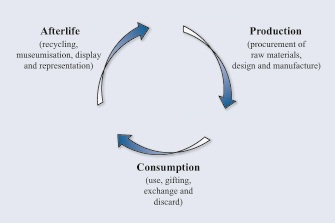
The case study in this OpenLearn course is object-centred, in that it prioritises the history of individual objects, without excluding the need to understand the social group they belong to.
This course is an adapted extract from the Open University course A105 Voices, texts and material culture.
Learning outcomes
After studying this course, you should be able to:
demonstrate skills of observation and description of objects
interpret objects and work towards writing object life cycles
understand artefact databases.
1 Meeting an object
I would like you to read the following comic poem about meeting an object:
The Blind Men and the Elephant
I
It was six men of Indostan
To learning much inclined,
Who went to see the Elephant
(Though all of them were blind),
That each by observation
Might satisfy his mind.
II
The First approached the Elephant,
And happening to fall
Against his broad and sturdy side,
At once began to bawl:
‘God bless me! – but the Elephant
Is very like a wall!’
III
The Second, feeling of the tusk,
Cried: ‘Ho! – what have we here
So very round and smooth and sharp?
To me ’tis mighty clear
This wonder of an Elephant
Is very like a spear!’
IV
The Third approached the animal,
And happening to take
The squirming trunk within his hands,
Thus boldly up and spake:
‘I see,’ quoth he, ‘the Elephant
Is very like a snake!’
V
The Fourth reached out his eager hand,
And felt about the knee.
‘What most this wondrous beast is like
Is mighty plain,’ quoth he;
‘’Tis clear enough the Elephant
Is very like a tree!’
VI
The Fifth, who chanced to touch the ear,
Said: ‘E’en the blindest man
Can tell what this resembles most;
Deny the fact who can,
This marvel of an Elephant
Is very like a fan!’
VII
The Sixth no sooner had begun
About the beast to grope,
Than, seizing on the swinging tail
That fell within his scope,
‘I see,’ quoth he, ‘the Elephant
Is very like a rope!’
VIII
And so these men of Indostan
Disputed loud and long,
Each in his own opinion
Exceeding stiff and strong,
Though each was partly in the right,
And all were in the wrong!
MORAL
So, oft in theologic wars
The disputants, I ween,
Rail on in utter ignorance
Of what each other mean,
And prate about an Elephant
Not one of them has seen!
This poem pinpoints a set of challenges faced by everyone meeting an object for the first time. The central verses each use the same structure to carry their narrative. A man meets an elephant, makes an observation using his senses (‘happening to fall/Against his broad and sturdy side’), tries to understand his observation by interpreting it in terms of his previously acquired knowledge (‘the Elephant/Is very like a wall!’) and then communicates his interpretation. Now it’s your turn to use these same three stages: observation, interpretation and communication.
2 Observation, interpretation and communication
Activity 1
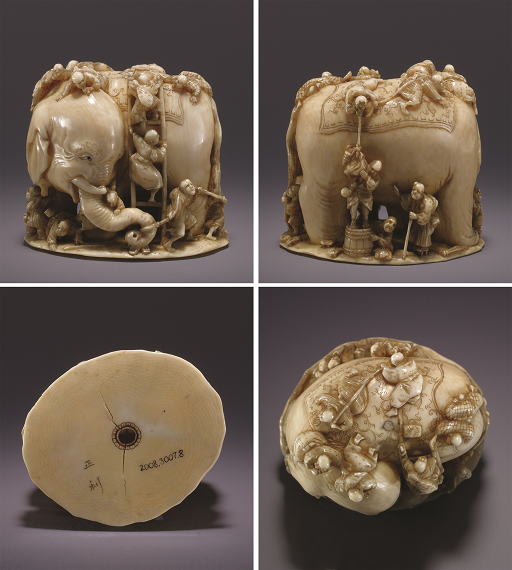
Look at Figure 2. It shows four sides of an object. This is probably the first time you have met this object. In order to answer the questions below, you will need to:
- observe the object in the photographs (the caption provides a little information to help)
- interpret your observation
- communicate your observation.
Now answer the following questions:
- How big is the object?
- What is the object made of?
- What shape is the object?
- How was the object made?
- What colour is the object?
Discussion
- The caption helps: the object is 4.7cm long and 4cm deep. We might estimate it is 5cm high.
- The caption tells us it is ivory, but without that information we would struggle to say something like ‘a light-coloured, brownish-yellow substance with a reflective surface’. We might guess it to be ivory, but it could easily be stone or plastic. Even if we had guessed it is ivory, what kind of ivory is it? Is it elephant, mammoth, hippopotamus or walrus ivory? Only very detailed observation could tell us this. Perhaps an expert with a lens or a scientific analysis could provide an answer.
- The base is oval or nearly circular, the sides vertical and the top domed, although the surfaces are shaped further by the carving. The observation of this overall shape is consistent with the identification as ivory because the shape is generally that of a piece of tusk, possibly the pointed end, the material from which the object was fashioned.
- There are few visible clues as to how this object was made. Presumably the object was carved, but there are no obvious tool marks. The details of the design are very finely cut into the surface: the wrinkles around the elephant’s eye and tusk have been very carefully cut with a fine, sharp tool. Some of the details (the elephant’s eyebrows and the ground, for example) have been dotted in, presumably with the aid of a sharp tool. The hole in the underside was presumably drilled with a fine tool.
- The object has a variable colour. It is mostly brownish yellow, but the cut decoration is generally darker. Perhaps a coloured substance has been rubbed into the cut surface, but the darker areas could just be accumulated grime.
Limitations to your observation
It is worth remembering that you have been looking at photographs. If you had been able to hold the object in your hand, you would have had an immediate impression of its size (rather than having to get this information from the caption). By using your sense of touch you would have been able to make more observations – about the object’s weight and texture, for example. While holding it, you could have rotated the object to understand it in three dimensions, looked underneath it, examined the material (ivory) from which it has been crafted. With a magnifying glass, you could have seen more detail and been able to observe aspects of the object not visible to the naked eye.
Any observation of any object will always be limited in some way. Perhaps the object is dimly lit, or behind glass, or perhaps touching it is prohibited. Or, as in this case, perhaps you are seeing only a representation of the object. Nevertheless, our brains subconsciously do a lot of work on our behalf and help us to understand what we see in an image of an object as if it were a real object in front of us. Some aspects are difficult to grasp from a photograph, particularly a sense of scale (this object is only 4.7cm long) and an accurate perception of colour. So, all in all, any description based on photographs will never be able to capture all aspects of an object.
If observations are limited by various factors, then our ability to interpret what we observe is also limited by our previous knowledge or our ability to work out what we are looking at. With the object you have been studying, you might have observed the shape and details making up the various parts of an elephant. You probably also observed and recognised the ladder and the human figures. Some of the smaller parts are more difficult to observe and identify. As in the poem by Saxe, your interpretations are shaped by what you can observe.
3 Life cycle: production and consumption
Production
This kind of observation (close looking) produces the raw material for the first stages of reconstructing an object’s biography, structured through the life cycle model (production, consumption and afterlife). By piecing together observations and assumptions about what has been observed, it is possible to outline the production of the object.
Activity 2
Combine what you have observed about the object in Figure 2 and the discussion in the activity above to write a brief account of the earliest stage of this object’s biography – its production.
Discussion
Despite the lack of certainty around some of the observations, it is possible to outline a basic sequence of events. Here is my attempt:
Somewhere in Africa or India an elephant grew a tusk (assuming the object is made of elephant ivory). The elephant died and its tusk was removed and taken to a workshop. A small piece, possibly the end of the tusk, was cut off. This was intricately carved to create a small (4–4.5cm) object in the shape of an elephant with a blanket on its back. The elephant is standing upright with its head turned back and lowered. A ladder runs up one flank of the elephant and a rope dangles down the other. Numerous small figures crawl over and around the elephant, some climbing up or down from the elephant’s back. The figures were created by carving into the ivory, cutting out the figures in high relief. The surface was smoothed and polished. Details such as faces, wrinkles and clothes were carved into the surface with a fine tool. These details may have been coloured by the application of a dark brown substance. A hole was drilled on the underside and further decoration added to the otherwise flat underside.
Consumption
At this point it is possible to identify the end of the production process of the object. The object might then be said to be ‘finished’ and ready for use, or consumption – the next stage of its biography.
Activity 3
Look again at the object (Figure 3). Are there any features of the object that you think might be related to its use? Is there any evidence of damage or wear on the surfaces?
Discussion
There is not much to go on. The object is small – it could fit into a hand. It is intricately decorated, suggesting that it was intended to be seen, and perhaps used, in a place where it could be closely inspected and admired. The hole in the centre of the underside is unexplained. It is not apparent how deep the hole is or if it goes right through the object. There are two cracks to either side of the hole, which may suggest that the object is old, or that it has been exposed to variable humidity and the consequent expansion and contraction have caused it to crack. There does not seem to be significant wear around the edge of the hole. On the upper side, all of the protruding parts – the heads of the human figures especially – seem very smooth and highly polished. They are a lighter colour and very shiny. This may be the result of rubbing or constant handling of the object. This suggests that the object may have had an active life, although there are no signs of damage such as missing heads.
4 Identification
Overall, there is little evidence to enable us to identify the function of the object. From the evidence we have it is difficult to answer the questions ‘What was it for?’ or ‘What did it do?’
At this point we have reached the limits of what can be achieved by observing the object alone. We need to use our own prior knowledge, or, failing that, ask someone else or consult a reference source that might be able to identify the object.
Activity 4
Do you know, or think you know, what the object is? If so, write down the reasons you think you know what it is. If you don’t know what it is, go straight on to the discussion.
Discussion
If you know what the object is, what is it that gave you that understanding? Is it something specific, like the size, shape or material? Or is it a combination of characteristics, like the size, shape and material together? Or did you just know what it is because you have seen something like it before? It is often difficult to pinpoint why you recognise something as ‘similar’, but this probably involves some very general features such as size, shape and material, and perhaps some details about the way an object has been shaped or decorated.
Ask an expert
Obviously enough, our mystery object doesn’t look like an everyday object you might find at home or at work. So another approach to identifying the object could be to take it to a museum and ask an expert curator to identify it.
In the twenty-first century we can also use the internet to help identify objects. However, using a search engine would be even less helpful than wandering around a large museum hoping to spot something similar (searching Google for ‘ivory object’ images yields hundreds of thousands of results). A more academic approach is to search the collections of a museum that are available online: these can be used like reference works.
Activity 5
For this activity, you will need to look at the online database of the collections of the British Museum. You can do this by following the link below. Tip: as you need to access the database again for Activities 6 and 7, hold Ctrl and click the link to open it in a new tab.
British Museum collections database
Once you are on the British Museum website, you should search the collections database by typing ‘ivory elephant’ into the search box. Click on the option for ‘images only’ and start the search. Then examine the first page of results. Are there any objects similar to our mystery object?
Discussion
At the time of writing this search produced more than 200 objects. The first page of results included an image resembling our object. It is only generally similar – a roughly carved and somewhat hairy elephant, described as a ‘toy; gaming-piece; figure’ from the Roman period. This description could conceivably apply to our object, but it is not very precise. We need a better search to find a more similar object.
Activity 6
Now return to the online database of the collections of the British Museum and this time type ‘ivory elephant men’ into the search box. Click on the option for ‘images only’ and, again, start the search.
Examine the first page of results. Are there any images similar to our mystery object? This page should include a small picture of a familiar item. Click on the image and you will be shown all of the information the museum keeps on record about the object.
Discussion
At the time of writing, under the heading ‘Description’ I found this: ‘Netsuke. Blind men climbing over an elephant. Made of ivory.’ This is a description written by the museum staff. It is very brief – especially when compared with the detail that we have been discussing. It also does not appear to be an account that is based purely on observation. Is it possible to identify the men in the object as ‘blind’? Also, what does ‘netsuke’ mean?
This sort of description is an identification. Now you know what this object is called, you could use the identification to go on and search for more information. A netsuke (pronounced ‘netski’) is a small toggle used to attach a cord to the belt of a Japanese kimono. Items such as boxes or pouches could then be suspended from the cord.
Activity 7
Go back to the information about our netsuke on the British Museum collections database. Look at the categories of information presented about the netsuke and decide whether they are based on observation or on prior knowledge. If the information is based on prior knowledge, think about how this might have been acquired.
Jot down your findings in the form of a table like Table 1 below. On the left, list each category of information; in the middle, note whethaller you think observation or prior knowledge (or both) is involved here; on the right, note the probable source of the information (if this applies).
| Category | Observation or prior knowledge | Probable source |
Discussion
Table 2 sets out my thoughts on what is presented on the web page of the museum’s database.
| Category | Observation or prior knowledge | Probable source |
| Object types | Prior knowledge | Learning or reading about Japanese objects |
| Museum number | Observation and prior knowledge | It is written on the base |
| Description | Observation and prior knowledge | There is some observation, but ‘blind’ and ‘netsuke’ are prior knowledge |
| Date | Prior knowledge | Learning or reading or possibly scientific techniques such as radiocarbon dating |
| Production place | Prior knowledge | Don’t know; perhaps they are commonly found or still manufactured in Japan. Perhaps their specialised use on a kimono is relevant only in Japan |
| Materials | Observation | |
| Technique | Observation | Although some knowledge is also required. (Technique is a term used in museums to mean ‘which techniques were used in the manufacture of the object’) |
| Dimensions | Observation | |
| Inscription type | Observation and prior knowledge | Need to have learned to read Japanese |
| Inscription transliteration | Observation and prior knowledge | Need to have learned to read the Japanese alphabet |
| Exhibition history | Prior knowledge | Museum records of exhibitions |
| Conservation | Prior knowledge | Museum records of conservation treatments |
| Subjects | Observation | |
| Acquisition name | Prior knowledge | Records will have been kept about the object when it was acquired by the museum |
| Acquisition date | Observation and prior knowledge | The date of acquisition has been written in ink on the bottom of the netsuke and records will have been kept about the object when it was acquired by the museum |
| Acquisition notes | Prior knowledge | Information provided by previous owners |
| Department | Prior knowledge | |
| Registration number | Observation and prior knowledge |
Some of my ideas about the sources of prior knowledge are guesswork, but the museum will no doubt have more detailed information that is not made public and some of the curators may have witnessed the object’s arrival in the museum.
An identification
From your work on the collections database of the British Museum, you will have correctly identified the object. Further research in the museum and elsewhere could doubtless reveal more information.
5 Life cycle: consumption
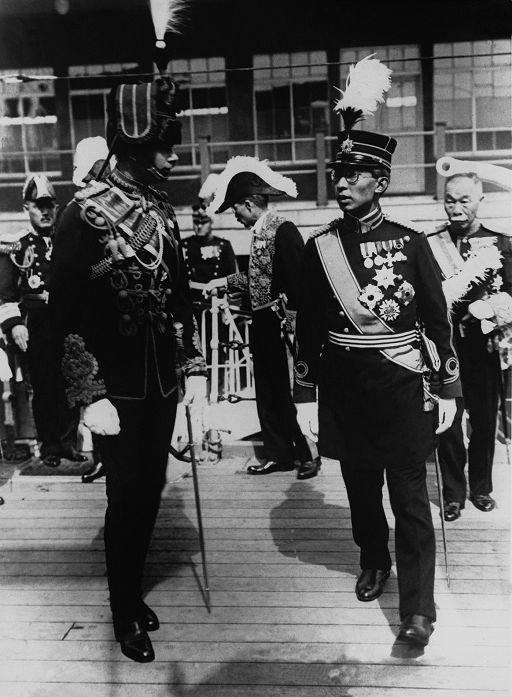
The early life of the nineteenth-century netsuke is not recorded but information held by the museum helps reconstruct the ‘consumption’ stage of the netsuke’s biography. The ‘Acquisition notes’ say it was acquired in Japan. It was probably given as a ‘ritual gift’ by the then emperor of Japan, Hirohito (1901–1989), to the Duke of Gloucester when the duke made a state visit to Japan in 1929 to confer the Order of the Garter on the emperor (Best, 2005; and see Figure 4). The visit was designed to improve Anglo-Japanese relations, and amid much exchange of ceremonial awards it seems likely that the netsuke was a gift rather than a private purchase. In these circumstances the netsuke was acting in a ceremonial role as a prestige gift rather than simply being an ordinary present of a belt toggle. Subsequently, the netsuke was transported around the world and became part of the collection of the Duke of Gloucester.
Consumption: the end
On 14 November 2005 the Daily Telegraph reported:
Royal heirlooms for sale to pay death duties
Death duties, often regarded as the curse of the middle classes, have hit the Royal Family.
Prince Richard, Duke of Gloucester, a cousin of the Queen, announced yesterday that he is having to sell a large selection of property to pay the inheritance tax bill on the estate of his father, Prince Henry, Duke of Gloucester. In what is tantamount to a Royal Household clearance sale, Christie’s will auction family heirlooms in January with prices ranging from £50 to more than £100,000.
The old duke’s backgammon set, his collection of sporrans and his ancient cine-camera may tempt souvenir hunters. Serious collectors will be more interested in Prince Henry’s rare books and paintings.
Prince Henry, the youngest brother of Edward VIII, who abdicated in 1936, and George VI, died in 1974, but the Inland Revenue deferred death duties until after the death of his widow, Princess Alice.
She died, the oldest royal in history, last October, aged 102. Their son, the present Duke of Gloucester, is hoping to raise £1 million from the sale.
The collection of 777 items referred to in the article above was sold at Christie’s auction house in London in 2006. The objects were sold as ‘alienable goods’ (things that can be exchanged for money, goods or services). However, some objects, including the netsuke, were not actually sold, they were exchanged with the government in lieu of paying inheritance tax. The netsuke performed a final function for the estate of the Duke by being effectively converted into cash.
6 Life cycle: afterlife
Transition from ‘consumption’ to ‘afterlife’
All these events relate to the biography of the netsuke as part of its transition from the phase of ‘consumption’ to the ‘afterlife’ stage in the object life cycle (Figure 1). In this case the UK government accepted ownership of the netsuke in lieu of inheritance tax and passed them into the care of the British Museum.
The British Museum’s Report and Accounts notes the arrival of related objects:
Japan featured prominently in the year’s acquisitions. A fine impression of Hokusai’s celebrated The Great Wave (1830–3) was acquired with support from The Art Fund. A group of 19th-century netsuke, accepted by HM Government in lieu of inheritance tax, was allocated to the [museum]. The 26 tiny carvings of ivory, horn or wood depict priests and devils, old women and babies, wolves and toads, and even two apes playing Go.
Afterlife: ‘museumisation’
Once in the museum, the objects were catalogued: each was given a unique accession number, described, and all known details recorded in the museum’s catalogue of accessions. This is the basis of the information that you have been studying in the Museum’s database.
The museum database also shows subsequent events in the netsuke’s life. It was lightly cleaned on 24 June 2009, displayed to the public from 1 July to 25 October as part of the exhibition ‘Japan from prehistory to the present’ at the British Museum, and then displayed again from October 2010 to 14 February 2011 in the same exhibition. Thousands of people must have seen it, a striking contrast to the time it was owned by Prince Henry, Duke of Gloucester, when there is no record of it being seen by anyone.
7 Writing an object biography
Towards an object biography
As the netsuke has moved through time it has changed location, visibility and ownership; it has also changed both its function (what it does or is) and its utility (what it is used for). The difference between the function of an object and its utility is subtle and reflects the difference between an object-centred approach and an object-driven approach. Essentially this is the difference between what an object was for (or what it was designed to do) and what it was actually used for by people (or what the artefact actually did itself).
Activity 8
Make a list of the various functions that our object has performed over its lifetime.
Discussion
Here’s my list, and I’ll try to surprise you with my starting point. The object has functioned as:
- a tusk for digging, etc. (while still raw material)
- a netsuke – a toggle on a kimono belt, for suspending objects
- a chattel – an object with a monetary value
- a museum object.
This varied list illustrates the changing functions that the same object may perform at different points in time.
Building an object biography
All of these observations that we have made about the netsuke could contribute to its object biography. Some parts of the biography are well documented, while others are derived from an interpretation of what we can see and deduce from the object itself. We have been focusing much more on object-centred approaches to the netsuke, but it would be possible to look further into the object-driven approaches and find out more about the makers, users, consumers or viewers of the object. We have already encountered some of the raw materials for an object-driven approach. The inscription in Japanese characters identifies the maker of the netsuke as Masanori; we could investigate him further and find other artefacts he made. We have encountered Emperor Hirohito and Prince Henry of Gloucester as users or consumers of the netsuke. What motivated them to become engaged with the artefact? Presumably the answer lies in its prestige value or aesthetic qualities. We could visit the British Museum to see it ourselves, or to observe other people encountering it and see what effect it has on them.
Does the netsuke have a meaning?
This question takes us beyond just studying the function and use of the netsuke. A more focused question to start from is ‘What does the form of the netsuke represent?’ The answer is straightforward enough: it is the same story told in the comic verse by John Godfrey Saxe, ‘The Blind Men and the Elephant’. Yet the story is not Saxe’s creation; it has ancient precedents in several non-European religions, appearing in the Buddhist scripture Udana, and also later in Sufi Muslim and Hindu mysticism. Saxe’s poem doesn’t explain the figures on the netsuke – it is a separate representation of the same story that inspired the carving of the netsuke. They differ in their details and emphasis: the poem reflects the arguments between the men, whereas the netsuke shows the activity of the crawling men. The poem helps to interpret the netsuke because it is a version of the same story that the netsuke represents. In these eastern religious traditions the story is taken to symbolise the idea that things may be looked at from different points of view, or that partial information leads to argument and dissent. If the netsuke also carries these ideas through its life cycle, this may add another dimension to its social life: perhaps the netsuke might be interpreted as symbolising a concept appropriate to a diplomatic gift given as Britain and Japan attempted to find common ground in their approach to China in the 1920s. It was certainly chosen to be studied in this OpenLearn course because it symbolises different ways of looking at the same problem.
Conclusion
The case study on the netsuke allowed you to work carefully through the ways in which descriptions can be created. Such descriptions, when systematically applied to a group of objects, can be used as the basis for systems of classification. You have already learned that the key to description is observing and then communicating your observations. You have also worked with a museum’s collections database and can apply your experience the next time you use a museum website that offers public access to their collection database. Description is also the basis for comparing objects and can be enhanced by exploring the context of an object. But that is a different topic to study.
Glossary
- inscription
- To follow
- object-centred approach
- An approach to the study of material culture that starts with close description of the object and works outwards.
- object-driven approach
- An approach to the study of material culture that starts with the broader context in which objects are located and then works towards greater understanding of the object
References
Further reading
Acknowledgements
Except for third party materials and otherwise stated (see terms and conditions), this content is made available under a Creative Commons Attribution-NonCommercial-ShareAlike 4.0 Licence.
The material acknowledged below is Proprietary and used under licence (not subject to Creative Commons Licence). Grateful acknowledgement is made to the following sources for permission to reproduce material in this free course:
Course image: Ardonik in Flickr made available under Creative Commons Attribution-ShareAlike 2.0 Licence.
Every effort has been made to contact copyright owners. If any have been inadvertently overlooked, the publishers will be pleased to make the necessary arrangements at the first opportunity.
Don't miss out
If reading this text has inspired you to learn more, you may be interested in joining the millions of people who discover our free learning resources and qualifications by visiting The Open University – www.open.edu/ openlearn/ free-courses.