The body in antiquity
Use 'Print preview' to check the number of pages and printer settings.
Print functionality varies between browsers.
Printable page generated Friday, 22 May 2026, 5:16 PM
The body in antiquity
Introduction
This free course will introduce you to the concept of the body in Greek and Roman civilisation. In recent years, the body has become a steadily growing field in historical scholarship, and classical studies is no exception. It is an aspect of the ancient world that can be explored through a whole host of different types of evidence: art, literature and archaeological artefacts to name but a few. The way that people fulfil their basic bodily needs and engage in their daily activities is embedded in the social world around them. The body is a subject that can reveal fascinating aspects of both Greek and Roman culture – it will help you to better understand the diversity of ancient civilisation.
This OpenLearn course is an adapted extract from the Open University course A864 MA Classical Studies Part 2.
Learning outcomes
After studying this course, you should be able to:
understand what makes the study of the ancient body important for our understanding of ancient society
understand the meaning and significance of key theoretical approaches to bodies (‘habitus’, ‘cultural scripts’)
understand the central role of specific cultural circumstances in the way human societies view and treat the body
display knowledge of some diverging ancient and modern approaches to the body.
1 Why the body?
In many ways, human history is a history of bodies. Bodies attend parliaments and move to different regions; it is in human brains that ideas are conceived and decisions are made; it is human limbs that embrace friends and fight enemies. Moreover, history is shaped by bodily experience: lives of important people have been cut short by illnesses; large groups of migrants have decided to stay in or leave regions based on their capacity to acquire food and cope with the climate; major political crises have resulted from the simple fact of sexual attraction between two key figures. These may seem obvious points to make, but starting from these considerations gives us a new approach to the past and a fascinating prism through which to explore ancient societies.
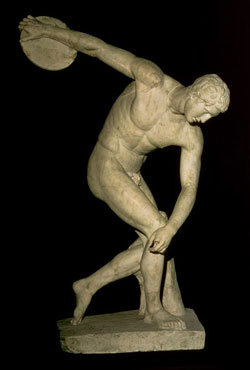
The centrality of the body to human cultures is something an increasing number of scholars have begun to explore and, in the past few decades especially, there has been an explosion in the number of studies that use the human body as a starting point for understanding various aspects of the ancient world. When we bring the dimension of the body into the way we view the past, we suddenly find that new questions and new ways of approaching old questions emerge. For example, in the field of architecture the study of ancient buildings is as old as the discipline of classical studies itself, but what did it feel like to walk through the streets of, say, a Greek or Roman city? What were the smells and sounds one might have experienced? How far could one see? How much light was there in a given area?
But why is the body so interesting? It doesn’t take much to consider that all humans throughout history have been born, have eaten, slept, fallen ill, experienced injuries and died. This is precisely where it gets interesting, because although all humans have done or will do these things, the way that they have gone about them has differed dramatically according to the society in which they lived. In other words, the way that people fulfil their basic bodily needs and engage in their daily activities is embedded in the social world around them.
2 ‘Habitus’
Activity 1
Write a list of things that you have done with your body since you got up this morning. Where did you sleep? Did you have a bath or shower? Did you eat breakfast? Where are you now? As you ponder these questions, I would also like you to write down all of the physical things around you that have played a part in those things: furniture, tools and infrastructure. Jot down some notes for each of these on how they relate to the culture in which you live. Think about how your environment has determined how you go about certain things, and even whether you go about them at all.
Discussion
Most of you will have woken up in a bed. While all humans sleep, their beds can look very different depending on their culture and climate. Your bed is a cultural construct. If you’re like me you were woken by an alarm clock. In the long view of human history, this is a very recent invention. Mine goes off at the same time every day, but even this is a characteristic of the society in which I live. Other people and people in other cultures wake at different times each day according to their needs, or respond to more natural impulses like daylight and birdsong, which fluctuate from season to season. Many people in the ancient world would have lived by this kind of clock. I had a bath this morning, finding it normal to wash every morning, but this is something that I was taught to do – in some societies a wash every morning would be considered excessive, in others it would be deemed insufficient. In many western countries I might have been expected to have a shower – baths, if existent at all, being the preserve of children or the elderly. In ancient Rome, bathing was generally done communally in a public bath. Even the fact that I have a bathroom in my flat is something that has a specific history in modern western culture relating to how we expect to live our lives. Referring to the post-war fashions for alfresco dining and indoor bathrooms, my grandfather once declared that the world had gone mad because people were going outside to eat, but coming inside to defecate!
Moving on with your day, did you have breakfast? I had muesli and orange juice; both things we readily associate with breakfast, but which are in fact arbitrary foodstuffs our society, for one reason or another, has assigned to the breakfast table. Even the idea of breakfast and the three-meal day are rituals our society has invented. In another society I might have had only one meal later on in the day, or be tucking into a communal bowl of hot rice or lentils. You probably put on some clothes and maybe did something with your hair. Again, the society in which you live will have had an effect on how you did your hair and what clothes you chose to wear. If you have left your home like I have, you will probably have put on a different set of clothes than if you were staying at home. Depending on your cultural background, going outside might also have meant covering up key parts of your body such as your hair. In ancient Greece, respectable women were expected to veil their heads whenever they were in public. This rule applied to Roman women too, but we do not have evidence that it was followed very often!
What this exercise has attempted to highlight is that some of the things associated with our bodies that we take entirely for granted are in fact deeply embedded in our cultural background. There is a specific cultural history behind when we wake, what we eat and whether or how we clean our teeth. This may seem simple – even banal – to you, but that is far from the truth. If, in 2,000 years’ time, archaeologists were to dig up the remains of our households or read written accounts of our bodily routines, they would, even if they had nothing else, already be able to say a great deal about us: the alarm clock would tell them that our society had the concept of the regular working day; our clothes would tell about which parts of our body we considered proper to cover, what it was acceptable to reveal, and how we constructed gender and other identities in appearance. Our plates, cutlery, tables and chairs would tell them we ate communally, but from separate vessels; they might guess that meals were social occasions over which we talked about our day or shared jokes. If they found written internal memos pertaining to the homes of important political figures, they might discover an important decision was negatively influenced because of the poor quality of the meal over which it was discussed. History and culture cannot be separated from the body.
All of this relates to what the French sociologist and anthropologist Pierre Bourdieu has called ‘habitus’ (1990, pp. 52–79). He was writing mainly about modern society, but his theories can be applied to human society in general, including the ancient world. In its essence, this concept denotes the way bodies interact with the world around them. It holds that all the everyday things that we do – and take for granted – and all the ways that we think about these things are actually determined by the structures and beliefs of the society in which we live. However ‘normal’ or ‘natural’ they may feel to us, in fact these are but learned processes. Through this view, human experience becomes ‘embodied’. But why does this matter? Surely it stands to reason that in, say, the history of food, someone is eating it, and in the history of dress someone is wearing it. Well, it’s not quite as simple as that. How we interpret the shreds of evidence from the ancient past that have come down to us depends very much on what framework we use to interpret them. When looking at artefacts in archaeology, for example, a key question here would be: “Are we interested in the object itself, or is it more important what was done with it?”. The following exercise will get you thinking about this, and demonstrate that even the most banal human activities could be done in a very different way in the ancient world.
Activity 2
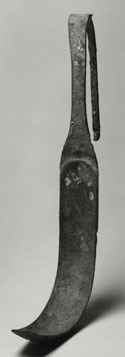
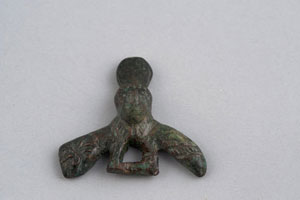
Consider the object in Figure 3. You may already know what it is, but if you don’t, take a good look at it, and try to think how it might be used: what are the different parts, what could they be used for? When you have finished looking at it, reveal the discussion for the solution.
Discussion
This item is called a strigilis. The Greeks and Romans used it to clean themselves. It is essentially a kind of scraper, used to scrape oil and sweat off the surface of the body, like the man in this grave stele from classical Athens demonstrates (Figure 4).
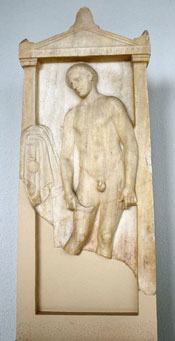
We take it for granted that when we wash ourselves in the shower or bath, we use some kind of soap that lifts grease and dirt which we rinse off, leaving our skin dry. But whilst soap was known in the ancient world, it was associated with the cultures of northern Europe. When Greeks and Romans went to the bath, they used an entirely different method of cleaning. They took with them a flask containing oils, a strigilis and a towel. They would immerse themselves in water – often of different temperatures including a hot bath in order to sweat – and then dry themselves off using the towel. After that, they would massage – or be massaged – using the oils from the flask, and then scrape the oils and sweat off their skin using the strigilis. In other words, this implement reveals a whole very peculiar world of habit in the ancient world – the culture of bathing. It also tells us about how differently the ancients viewed what it meant to be ‘clean’. It is hard for us to imagine getting up in the morning and scraping ourselves down with what looks for all the world like a bent butter knife! In the way that it is made the strigilis may look to us more like a kitchen implement or DIY tool, but in terms of habitus its modern equivalent would be more accurately found in the idea of the common flannel!
3 ‘Cultural scripts’
In many ways, the body is an unusual subject. We all have bodies, and biologically and physiologically they are more or less the same as the bodies of ancient Greeks and Romans, so anything to do with bodies is always going to be very familiar and personal to us. At the same time, the ancient world involved cultures that were in many ways different from our own. Engaging with ancient bodies draws into contrast something that is true of all studies of the ancient world: the constant tension between familiarity and distance. Historically, western culture has identified very strongly with the Graeco-Roman world. It is often seen as the ancestor of our own western culture, and has been appropriated as the origin of much that is familiar to us now, including science, philosophy, democracy, art and architecture, poetry and drama. But other aspects of the classical world have not been greeted with the same enthusiasm. From polytheism and animal sacrifice to gladiatorial combat, and from infanticide to slavery, some features of Greek and Roman society have come to be regarded as alien, and if we choose to focus on these then the Greeks and Romans may look to the modern viewer more like a dangerous ‘Other’ than our honoured ancestors (Cartledge, 1993).
It is important, then, to maintain an objective standpoint on all matters concerning the Graeco-Roman world. The societies of Greece and Rome must be seen as cultures in their own right, with their own systems of beliefs, values and ideas influencing the way they did things. In this way we can see the cultural beliefs and practices behind the things we do with our bodies as ‘cultural scripts’. This is a term that comes from linguistics and has a very specific meaning in that discipline, but here we mean something very similar to Bourdieu’s ‘habitus’. However, it is different in the sense that it can be conscious as opposed to simply an automatic way of doing things that we take for granted. It is important to be aware of habitus or cultural scripts when looking at the body, as beliefs and ideas have an especially profound effect on what humans do with their bodies. For example, in ancient Rome, mosaics of phalluses could sometimes be found at the entrance to Roman buildings and children often wore amulets in the shape of phalluses around their necks. The cultural script underlying this is that phallic symbols were thought to ward off evil. In a modern context this would be considered obscene in the case of the entrance decoration and inappropriate in the case of the children. This is not because we have more respectable house entrances or a more protective attitude to our children, but because we have a different cultural script underlying our use of the phallic symbol.
Finding out more
When we see the stately marble statues of Romans and Greeks, it is hard to imagine that obscenity in many ways played a more central and acceptable role in many forms of public life than it does for us today. For a humorous (and somewhat adult-themed – beware!) insight into this, listen to the audio ‘The art of insult’.
(please note that this audio contains language that some students may find offensive)
Transcript: The art of insult
‘The art of insult’ audio
4 Where does the body begin and end?
Even the way people think about bodies is determined by the cultural scripts of the culture in which they live. For example, some people may take it for granted that they possess a body on the one hand, and a mind or soul on the other, but this idea is in fact one that they have received from the culture in which they live, and other cultures have very different ways of perceiving the relationship between physicality, thoughts, physical drives and emotions. What we consider to be our body is also determined by our culture.
Activity 3
For an introduction to how wide-ranging perspectives and beliefs about the body can be in different parts of the world, read John Robb and Oliver Harris, ‘O brave new world, that has such people in it’ (2013). As you do so, think about the following questions:
- What do Robb and Harris list as key issues in the modern world that pertain to where the human body begins and ends?
- Why do these things matter so much to us?
- How is the body defined in the different case studies that are briefly mentioned by the authors?
- How universal is the idea of a ‘natural body’?
Discussion
Robb and Harris make the point that many of the controversial issues discussed in the media in the western world at the time of writing relate to the body: sexuality, genetics, bodily alteration and death. Some of the most divisive of these relate to the limits of the human body: is a foetus a human? Is a corpse still a human? Should biological material from other people, other species or even artificial substances be introduced to a human body? If yes, are they foreign to it or do they become part of it? The sheer quantity of debate surrounding issues such as these shows that we, as humans, are very concerned with what makes up our bodies and what we do with them. The human body is at the heart of key questions of our civilisation, and authors and philosophers have spent a lot of time mapping out what successive changes in how we deal with our bodies can mean for the way our society functions.
In the case studies Robb and Harris cite in the section on ‘natural bodies’, we are presented with three very different cultural scripts in terms of viewing the body in various parts of the world. For some groups in the Amazon, the human body can change in form depending on who – or what – is viewing it. In Trinidad, clothing is an essential part of the human body, not just a covering for it. What you wear doesn’t just express who you are, it determines it. And in the case of Siberian shamans, regardless of what we would see as biological sex, gender is something that is fluid and mutable, and relates not to what a person is, but what he or she does, and the powers they possess. As a result, there is no simple categorisation of ‘male/female’ but up to ten different categories of gender. In other words, what makes up the ‘natural body’ varies from culture to culture – it is dependent on habitus and cultural scripts.
5 Keeping body and soul together
In the ancient world, people asked themselves what the essence of the human body was, and how the physical side of it related to thoughts and feelings. It was philosophers especially who pondered this question, and they came up with a variety of answers. Take, for example, the account from the philosopher Plato’s work Phaedrus. Plato (c.428–c.348 BCE) often used dialogues – most often involving students talking to his former teacher Socrates – to present his views. In Phaedrus, Plato has Socrates engaged in a conversation with a man called Phaedrus. They are discussing the nature of love and how it affects the way people behave. In the course of this conversation Socrates explains his theory of the soul consisting of three parts. He uses the analogy of a charioteer, and two very different horses that are pulling the chariot.
Activity 4
Read Plato, Phaedrus, on the Perseus ancient text website: (Sections 246a–247c; 253c–254e). Make sure to click through to the relevant sections by using the arrows above the text or the orientation bar above that. As you are reading, think about the following questions:
- What is the nature of the three different parts of the soul: the charioteer and the two horses? How do they interact with each other?
- How does the nature of the soul affect the body? What is their relationship to each other? Socrates is talking here about how the soul makes one behave towards a person one loves: how do the different parts of the soul react to the lover? What is considered ‘good’ and ‘bad’?
- Are there similarities with the way the soul is viewed in many western cultures?
Discussion
For Plato, the soul consists of three parts that are like a charioteer with winged horses. The charioteer represents reason, the beautiful and noble horse represents positive impulse – what we might call spirit – and the ugly and bad horse represents base nature, appetite and irrational passion. Plato imagines the conscious, rational part of human beings struggling to control the two ‘horses’ pulling in opposite directions: the good horse will always want to fly up to heaven, and the bad horse will want to drag the whole chariot down to earth.
In terms of the body, this means that one part of our soul is always reaching for noble and good deeds and a higher understanding. In terms of love, this means appreciating the beauty of the one who is loved and respecting their wishes and their bodily sanctity. The other part of the soul is where base instincts and appetites live – it will make the lover want to satisfy their sexual or emotional needs without consideration for higher ideals.
Although we may view the notion that the soul is like a charioteer with two horses as strange, in the western world we may find Plato’s basic division of a human into a natural body and a soul that determines its behaviour much less foreign than other cultures might. This is in part because the writings of people like Plato have had a direct effect on our civilisation. Even the notion of lofty ideals as opposed to base instincts is one that we are perhaps familiar with, and one that was carried through – among other things – into Christian philosophy.
Conclusion
All of us have bodies, which makes the subject of the body something that we can all relate to. But this can be a trap, because it is easy to assume that the way we see our bodies and the things we do with them are somehow ‘natural’ and universally human. What this free course, The body in antiquity, has aimed to show you, however, is that these things are actually profoundly influenced by the period and place – in short, the culture – in which we live. As a result, it is important to keep your mind open and to view ancient bodies in an objective way.
References
Further reading
Acknowledgements
This course was written by Ursula Rothe.
Except for third party materials and otherwise stated in the acknowledgements section, this content is made available under a Creative Commons Attribution-NonCommercial-ShareAlike 4.0 Licence.
The material acknowledged below is Proprietary and used under licence (not subject to Creative Commons Licence). Grateful acknowledgement is made to the following sources for permission to reproduce material in this course:
Course image: Tilemahos Efthimiadis in Flickr made available under Creative Commons Attribution-ShareAlike 2.0 Licence.
Text
Activity 3: Extract from Robb, J. and Harris, O, J. T. (2013) The Body in History: Europe from the Palaeolithic to the Future, Cambridge, Cambridge University Press.
Images
Roman votive face, terracotta, 200BC-200AD. Science Museum, London. Photo: Science & Society Picture Library.
Figure 1: photo © Bridgeman Images.
Figure 2: photo © Bridgeman Images.
Figure 3: photo © Walters Art Museum, Maryland.
Figure 4: photo © Sites and Photos, Israel.
Figure 5: photo © Bridgeman Images.
Audio
From radio broadcast: ‘The Art of Insult’, 30.10.91, © BBC.
Websites
Classics Resources: http://classicsresources.info/
Every effort has been made to contact copyright owners. If any have been inadvertently overlooked, the publishers will be pleased to make the necessary arrangements at the first opportunity.
Don't miss out:
If reading this text has inspired you to learn more, you may be interested in joining the millions of people who discover our free learning resources and qualifications by visiting The Open University - www.open.edu/ openlearn/ free-courses