The moral equality of combatants
Use 'Print preview' to check the number of pages and printer settings.
Print functionality varies between browsers.
Printable page generated Sunday, 17 May 2026, 6:17 AM
The moral equality of combatants
Introduction
This OpenLearn free course introduces and explores the idea of the moral equality of combatants and discusses the question of the basis of liability to killing in war. It invites students to understand and assess the epistemological argument for the moral equality of combatants and other arguments for and against this idea.
This OpenLearn course is an adapted extract from the Open University course A333 Key questions in philosophy.
Learning outcomes
After studying this course, you should be able to:
understand the Jus ad Bellum / Jus in Bello distinction and be able to understand why it might need to be qualified
understand and take a view on the idea of the moral equality of combatants
understand and take a view on the question of the basis of liability to killing in war
understand and assess the ‘epistemological argument’ for the moral equality of combatants
understand and assess the ‘voluntariness argument’ for the moral equality of combatants.
1 Three components of the Just War Tradition
In this course we are going to be thinking about war, and the morality of war. To understand what philosophers have written in this area, we need to distinguish two things. The first is a tradition of thought, and the second an area of philosophical enquiry.
The first, known as ‘the Just War Tradition ’ is a long historical tradition which is difficult to summarise in a non-controversial manner. It is, more or less, the claim that there is a set of conditions which can act as a kind of checklist for whether a war is just or not. The Just War Tradition takes its form because it originated as a source of advice for princes and kings who were considering whether or not to wage war. In particular, the early modern just war theorists were advising Christian princes on whether their warfare was justified. They were advised that, if their actions met the conditions specified the Just War Tradition, then they were morally justified in waging war. One reason why the Just War Tradition is important today is that it has been encoded in the rules of war – the laws covering international conflict – at the Geneva Convention, the Hague Convention and so on. These conditions were conventionally divided into two groups, one concerned with when one may go to war and the other concerned with how one may fight. These two sets of conditions are standardly known by their Latin tags: Jus ad Bellum and Jus in Bello . The word ‘ jus’ refers to something like rightness, or justifiability, or justice; ‘ bellum’ and ‘ bello’ both mean war (the ending of the word changes in Latin, according to the role of the word in the sentence, just to make life difficult for schoolchildren); ‘ad ’ means ‘to’ or ‘towards’; and ‘in’ means ‘in’. ‘Jus’ is sometimes spelled with an ‘I’, but however it is spelled, the word is conventionally pronounced softly, with a ‘y’ sound at the start. For ease of reference I will shorten the Jus ad Bellum to JaB and the Jus in Bello to JiB . These conditions are summarised in the box below.
There are six conditions of Jus ad Bellum and two conditions of Jus in Bello . Here is the account given by a present-day just war theorist, Uwe Steinhoff.
The Jus ad Bellum ( JaB ) conditions:
- A legitimate authority (king, president, parliament and the like) decides on the entrance into war.
- One has a just cause for entering into war (for example, defence against an aggressor).
- One pursues the war with the right intention, namely for the purposes of a just cause (thus, for instance, one does not harbour the plan of not ceasing conflict once the aggressor has been thwarted or possibly even punished, and of getting further advantages for oneself, such as the increase of one’s own power or the acquisition of territories or resources).
- The war fulfils the condition of proportionality, that is, it is a proportionate means, which is to say that it does not create more mischief than it averts.
- The war also fulfils the condition of having prospects of success (in the sense of prospects of victory).
- The war is the last resort ( ultima ratio ), that is, there are no other promising alternatives available.
The Jus in Bello ( JiB ) conditions:
- The condition of proportionality must be fulfilled. That is, the violence used in the war must be proportional to the injury suffered. States are prohibited from using force not necessary to attain the limited objective of addressing the injury suffered. (One is not to bomb a country ‘into the Stone Age’ if victory may also be had less destructively.)
- The principle of non-combatant immunity must be observed, that is, some distinction must be made between combatants and non-combatants or, respectively, between legitimate and illegitimate human targets of a direct attack. That is, civilians are never permissible targets of war, and every effort must be taken to avoid killing them. The deaths of civilians are justified only if they are unavoidable victims of a deliberate attack on a military target.
Just war theory is a project, in philosophy, which considers the justifiability of war and killing in war, and concludes that there are occasions when it may be justified. Any theory that says that there can be a just war, even if only in theory, is a just war theory. Any sustained argument about the conditions of a just war is a contribution to just war theory. This is not a historical tradition, but (merely) an area of philosophy.
The moral equality of combatants
There is a third component in the arguments of many conventional just war theorists. This is the idea of the moral equality of combatants (MEC) . The exact status of this view is contentious. Arguably, the classical theorists of just war – Grotius and Vitoria – did not hold this view. But Michael Walzer, whose (1977) book Just and Unjust Wars set the parameters of the philosophical debate about war, does hold this view, and does so explicitly. What does ‘the moral equality of combatants’ mean, what are the implications of this claim, and how might it be justified?
The moral equality of combatants thesis states that:
Combatants on both sides of a war, regardless of the justice of their cause, are equally permitted to kill each other and equally liable to be killed. (In everyday language ‘liable to be killed’ means ‘likely to be killed’ but here the word has a different meaning: it establishes who, morally speaking, may be killed.)
We might think about this as follows: imagine two soldiers confronting each other. If they are morally equal, then they must have the same moral rights as each other. In war, this means the right to kill each other.
The idea is that we can abstract the individual soldiers from the overall justice or injustice of the cause that they are fighting for, and consider them as individuals confronting each other face to face. If we consider them as such, each threatens the other, so each is liable to be killed by the other, and each has a right to defend him- or herself from the threat of the other. Clearly, under some circumstances, the right to self-defence amounts to a permission to kill the person who threatens, because that is the only way in which I can defend myself. I hope that you can see the way that moral symmetry here seems to build up.
The idea of the moral equality of combatants can be put in a less analytical and abstract way. Walzer does so in the extract about Hitler’s generals, which I will ask you to read next. The extract starts by discussing the case of Erwin Rommel.
Can unjust wars be fought justly?
Activity 1
Now read Reading 1 ‘Walzer on the moral equality of soldiers’ at the end of this free course. This is an extract from Walzer’s book Just and Unjust Wars .
What, in brief, is Walzer’s view of the moral status of Erwin Rommel?
Discussion
Walzer thinks of Rommel as someone who fought justly but in an unjust cause. In particular, he cites Rommel’s burning of the ‘commando order’.
The ‘commando order’ was sent directly from Hitler and decreed that Allied commandos who were captured should be killed. Clearly, this order required that Rommel violate the rules of war concerning the treatment of prisoners (and the rules of war concerning the treatment of prisoners derive from the JiB condition of discrimination between those liable and those not liable to be killed in war). Walzer commends Rommel, then, for acting in accordance with the principles of JiB , even while he fought in a cause that Walzer takes to be wholly unjust. He uses this example to illustrate a claim about the moral equality of combatants.
Activity 2
Now listen to the audio recording ‘McMahan on Erwin Rommel’.
Transcript: ‘McMahan on Erwin Rommel’
What analogy does the philosopher Jeff McMahan use to explain his own analysis of Rommel?
Discussion
For McMahan, Rommel is like a burglar who refrains from torturing your pets. It is better that they do not torture your pets, but not really the point. Whether or not they torture your pets, they should not be burgling your house. Their actions are still impermissible – wrong. They act wrongly, not honourably.
The independence of the JaB and JiB conditions
The supposed moral equality of combatants is closely related to the idea that there is a clear distinction between the conditions under which one may justifiably resort to war and the conditions one must observe if one is to fight justly. Walzer himself claims that the JaB and JiB conditions are ‘logically independent. It is perfectly possible for a just war to be fought unjustly and for an unjust war to be fought in strict accordance with the rules’ (1977, p. 21). George Fletcher and Jens David Ohlin write that ‘the most basic … architectonic distinction that structure[s] the law of war is the radical separation of Jus ad Bellum and Jus in Bello . The lawfulness of war has no bearing on the proper conduct of war’ (2008, p. 20).
It is often suggested that the JaB and JiB conditions also apply most directly to different groups of people. Statesmen and politicians need to decide about the justice of going to war (the JaB conditions) while those who actually fight – combatants – need to think (only) about their conduct in war (the JiB conditions). So, a sharp distinction between the conditions of JaB and JiB is closely related to the moral equality of combatants. The moral equality of combatants means that both sides can fight well. Equally, it means that both sides can fight unjustly. The combatants on both sides have to conform to the same rules of war: they are morally equal. This is the dominant view in the Just War Tradition, both as an understanding of the morality of war and as an interpretation of the laws governing the conduct of war.
Activity 3
Part 1
Drawing on whatever general knowledge you have of warfare, or your imagination, give an example of just combatants fighting by just means.
Part 2
Now give an example of just combatants fighting by unjust means.
Part 3
Now give an example of unjust combatants fighting by just means.
Part 4
Finally, give an example of unjust combatants fighting by unjust means.
Discussion
Here are my examples.
Just combatants fighting by just means: most of the allied war effort of the Second World War.
Just combatants fighting by unjust means: the dropping of the atom bomb on Hiroshima by the Enola Gay .
Unjust combatants fighting by just means: Erwin Rommel (burning of the commando order).
Unjust combatants fighting by unjust means: most of the German war campaign of the Second World War, especially, for example, the London Blitz.
I do not wish to smuggle in the claim that the dropping of the atom bombs on Japan failed to meet the JiB conditions. I happen to think that it is a good example of when actions in a just cause did fail in this respect, but I am not going to argue that here. Note that this could be a different claim from the claim that the dropping of the atom bomb was justified . It might be argued that the bombing of Hiroshima and Nagasaki was a case in which the normal rules of war were justifiably suspended or that it was justified on a straight utilitarian basis, breaking with the Just War Tradition that we are examining. I am sceptical of such claims, but it is a possible move in the argument.
The important issue is whether it could be that a just cause justifies anything done in its name, so that anything done in accordance with the JaB conditions is as a result in accordance with the JiB conditions. This seems implausible. It seems open to us to look for examples of warfare that were in accordance with the JaB conditions but in breach of the JiB conditions. We can argue about examples, but the issue is that, in the Just War Tradition, there can be such examples: just combatants fighting by unjust means is a possibility. Importantly, too (on this line of argument), unjust combatants fighting by just means is a possibility: even though their cause is unjust, combatants who conform to the rules of war can fight justly, and the example here is Erwin Rommel.
So, the independence of the JiB and JaB conditions fits with the moral equality of combatants. Combatants are morally equal because they can act in an equally just manner: they are equally liable to be killed (i.e. within the JiB conditions) and equally permitted to kill (again, within the JiB conditions). The ‘moral equality’ is reflected in the fact that we can work our way through the examples, and fill up each of them: there is a kind of symmetry going on.
2 More on Walzer’s theory of self-defence
Walzer’s key point is that soldiers are ‘dangerous men’. On his line of argument, equal liability comes from equality of threat; what it is that makes it permissible for me to kill you is that you threaten me. Even if you threaten me through no decision, let alone fault, of your own, you still threaten me. Sometimes, in the literature, this is called ‘ material non-innocence ’. The idea is that I have a right to defend myself against a lethal threat; enemies at war pose a lethal threat to each other; consequently they have a right to kill each other. Walzer says:
He has joined the army because he thinks his country must be defended. … He can be personally attacked only because he already is a fighter. He has been made into a dangerous man, and though his options may have been few, it is nevertheless accurate to say that he has allowed himself to be made into a dangerous man.
A simple view might go as follows: in a war, there are two sides. On one side, one set of combatants pose a threat to their enemy or counterpart combatants. And this is reciprocated: their enemy combatants pose a threat back. Each side poses a threat to the other, because combatants on one side try to kill combatants on the other side. Because of this, combatants on one side are liable to be killed by combatants on the other side.
On this view, if you pose a lethal threat, then you are liable to be killed. Look at Figure 1; although this image does not concern war, it makes the case dramatically.
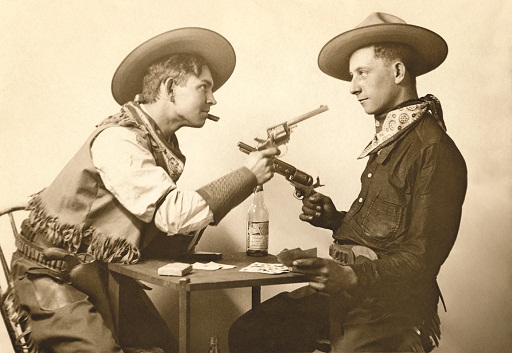
The two cowboys aim their guns at each other: each poses a lethal threat to the other. This situation is sometimes known as a ‘Mexican stand-off’. Does the fact that each poses a lethal threat to the other tell us all we need to know about the liability of each to defensive killing? Is it necessarily true that the people facing each other are, morally speaking, equal, and equally liable to defensive killing by virtue of the fact that they pose a lethal threat, or could it be that one is liable to killing and the other is not?
Activity 4
Take a moment to consider option A and option B below. Think through the reasons for adopting each option, and make a mental note about which you agree with.
- A. Both cowboys pose a lethal threat to the other. So each is liable to defensive killing.
- B. Both cowboys pose a lethal threat to the other. But whether each is liable to defensive killing depends on other facts about their situation.
Discussion
If you agree with option A, you are in line with Walzer’s position. If you agree with option B, you are not so clearly in line. Either way, you should think about the reasons for your view – either that posing a lethal threat makes you liable for killing, or that the link is not so strong.
3 McMahan’s criticism of Walzer
McMahan doubts option A. He generalises the point as follows:
Suppose a malicious person attacks you unjustly. Would you lose your right not to be attacked by him simply by trying to defend yourself? No. People don’t lose moral rights by justifiably defending themselves or other innocent people against unjust attack.
What matters here, McMahan is suggesting, is that the malicious person is in the wrong in the first place: that their attack on you is unjust and so impermissible. Suppose we find out the ‘back story’ to the photograph above: one of the gunmen has charged in, unprovoked, and attacked the other without good reason. Should this further information alter our judgement about the case?
One reason I called the view above the ‘simple view’ is that it says nothing about whether the sides are just or unjust. McMahan thinks we should add that in. Consider a situation in which an unjust combatant threatens a just combatant with lethal force. Does it follow that the unjust combatant is therefore liable to be killed? This seems to make sense. Now consider the counterpart: a just combatant threatens an unjust combatant with lethal force and the just combatant is therefore liable to be killed. This claim is not so obvious. McMahan thinks that it is false.
To see why he thinks it is false, we need to differentiate between ‘material non-innocence’ and ‘ moral non-innocence ’. A person is materially non-innocent if they pose a lethal force. A person is morally non-innocent if they are doing something that morally they should not be doing. Consider an example. In 1943, the Jews of Warsaw forcibly resisted attempts by the German army to round them up and send them to extermination camps. In such a case, it does not seem wrong to resist obvious injustice with lethal force. Indeed, it is easy to argue that one is morally obliged to defend one’s community against invasion, violation or extermination. And you cannot lose your right to life from doing what you are morally obliged to do. Jewish fighters in the Warsaw Ghetto did everything they could to present a lethal threat to the German army, which was seeking to destroy the Ghetto and kill its inhabitants. As they did pose a lethal threat they were materially non-innocent. They were not, however, morally non-innocent.
McMahan’s claim is that Walzer ignores the broader moral background. The morally non-innocent do not gain rights over the morally innocent but materially non-innocent by virtue of the latter’s attempts at resistance. The German army did not gain a moral right to kill the Ghetto resistors as a result of that resistance.
Building on this insight – if it is one – about the morality of self-defence, a number of recent philosophers have come up with a revisionist account of just war which says, more or less, that all the standard elements of the Just War Tradition as I have discussed it above are wrong . The view has important philosophical consequences, and significant real-world consequences. Let us see how it gets going.
Activity 5
Now read Reading 2 ‘McMahan on the moral equality of combatants’ at the end of this free course. This is an extract from McMahan’s article ‘On the moral equality of combatants’, which appeared in the Journal of Political Philosophy .
Once you have read the extract, answer the following questions:
- What two distinct uses of ‘innocent’ does McMahan distinguish?
- What two requirements of JiB does McMahan think unjust combatants cannot satisfy? (He argues for only one of his claims in the reading.)
- McMahan finds two arguments for Walzer’s position; only the first of these is covered in the reading. What is that argument?
- What three objections does McMahan have to that argument?
Discussion
- ‘Innocent’ meaning ‘civilian’ (or ‘non-combatant’) and ‘innocent’ meaning people who ‘have done nothing, and are doing nothing, that entails the loss of their rights’.
- He thinks they can satisfy neither the requirement of discrimination nor that of proportionality. (You might want to remind yourself of these by looking again at the start of the course.)
- ‘The boxing match model’: ‘combatants understand that they and their adversaries are all fulfilling their professional role and at least implicitly they consent to be done to by their adversaries as they are doing unto them.’
-
- (i) Combatants do not always consent to being attacked by their adversaries.
- (ii) Even if just combatants did consent, someone consenting to being killed does not always make it permissible to kill them.
- (iii) Even if Walzer’s arguments worked, that would show only that unjust combatants could kill just combatants. However, unjust combatants’ actions would still be wrong because they are in service of an unjust cause.
The revisionist view denies the moral equality of combatants and the independence of the JiB and JaB conditions. The standard view of the Just War Tradition is that combatants on the unjust side in a war can fight justly if they obey the JiB conditions. But the revisionists say: they cannot obey the JiB conditions.
4 Can unjust combatants fight justly?
If we can endorse the Just War Tradition’s distinction between JaB and JiB , then the second example in Activity 3 can be filled in. The point of this example is that it is possible to fight justly in an unjust cause. This is of great importance for serving soldiers, because it means their actions can be just even if their cause is not. But the distinction does not work if it is the case that it is not possible to fight justly in an unjust cause. And this is what McMahan suggests is the case (although with one qualification, which we will look at below).
The second JiB condition is that those who fight observe the principle of discrimination. Here is what McMahan says in Killing in War :
Those who fight solely to defend themselves and other innocent people from a wrongful threat of attack, and who threaten no one but the wrongful aggressors, do not make themselves morally liable to defensive attack. By engaging in morally justified self- and other-defense, they do nothing to forfeit their right not to be attacked or killed. This means that even though just combatants are ‘doing harm’ and ‘pose a danger to other people’ when they oppose the military action of unjust combatants, they do not thereby become legitimate targets of attack but retain their innocence in the generic sense.
But if this is right, then just combatants are not liable to attack. Here is McMahan again:
It is hard to see how just combatants could become legitimate targets simply by offering violent resistance to unjust attacks by unjust combatants. …to attack just combatants is to attack people who are innocent in the generic sense: people who have not forfeited their right against attack, and thus are not liable to attack. They are therefore illegitimate targets. To attack them is indiscriminate.
Indiscriminate killing is, of course, in breach of the JiB conditions. So, if you are fighting in an unjust cause, then you cannot target civilians, because they are civilians, and you cannot target just combatants, because they are not liable to be killed. You cannot target anyone. You cannot fight justly. The second example in Activity 3 has become a big problem.
Activity 6
Look back at Activity 3 . Consider how McMahan’s account might alter things, and see if you can decide how McMahan would deal with each of the examples.
Discussion
| Actions of combatants | Conform to JaB conditions | Fail to conform to JaB conditions |
|---|---|---|
| Conform to JiB conditions |
Combatants fight in a just cause and by just means Not liable to attack. Just combatants have not lost the right not to be killed, and killing them is impermissible |
Void: Unjust combatants cannot meet the condition of discrimination between those liable and those not liable to attack: they have no legitimate targets (and should stop fighting). If you fight in breach of the JaB conditions, you cannot meet the JiB conditions (Exceptionally, perhaps, unjust combatants may have legitimate targets. They may attack just combatants who fight unjustly: such as the crew of the Enola Gay ) |
| Fail to conform to JiB conditions |
Combatants fight in a just cause, but by unjust means Example: the bombing of Dresden, which failed to meet the JiB condition of discrimination. Just combatants who fight unjustly are liable to being killed in war – for example, the crew of the Enola Gay |
Combatants fight in an unjust cause and by unjust means Liable to attack; they should stop fighting. They may not permissibly defend themselves from defensive killing |
McMahan’s account differs radically from the account given by Walzer, and the standard account of the Just War Tradition which forms the background to most everyday thinking about killing in war. In general, on McMahan’s account, unjust combatants cannot fight justly. They cannot obey the JiB conditions. For sure, they can try to discriminate between soldiers and civilians. But the moral point of the discrimination between soldiers and civilians is to discriminate between those liable to be killed and those who are not liable to be killed. The moral property that makes a difference is the property of being liable, not the property of wearing a uniform. So, on McMahan’s account the second example is void – it cannot be filled.
What about the third example? That is, what about just combatants who fight by unjust means? Here the situation gets more complicated.
On the argument so far, unjust combatants are not permitted to attack just combatants. But what if the just combatants are violating the JiB principles? McMahan thinks it would have been morally justified for a Japanese fighter pilot to shoot down the Enola Gay ‘despite the fact that he was an unjust combatant while the crew of the Enola Gay were just combatants’ (2009, p. 16)
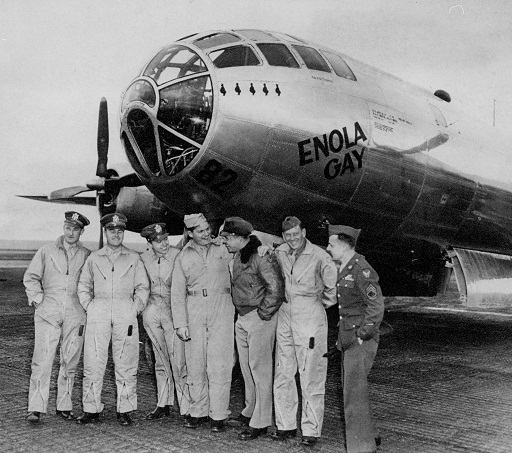
On this account, acts of war by unjust combatants can be morally justified – when they are directed at just combatants who are breaking the rules of war – but it is very hard and very rare for this to be the case.
Here is how McMahan puts it in Killing in War :
Unjust combatants can seldom satisfy the jus in bello requirement of discrimination, since just combatants seldom make themselves liable to attack and thus are in general illegitimate targets. If just combatants were always to fight according to the moral constraints that govern their conduct in war, they would never be liable to attack and thus unjust combatants would never be able to satisfy the requirements of discrimination.
5 The implications of McMahan’s account
The first time that you grasp McMahan’s account the implications should strike you as thunderous. In the blurb for his book, McMahan’s mentor Derek Parfit points out that McMahan’s account shows just how difficult it is to fight a just war. The consequences for the moral responsibilities of actual combatants are profound. McMahan is clear about the implications of his views in an interview he did for this course, which you should listen to next.
Activity 7
In order to consolidate your understanding of McMahan’s position you should listen to the audio recording ‘McMahan against the moral equality of combatants’.
Transcript: ‘McMahan against the moral equality of combatants’
6 Objections to McMahan’s account
McMahan’s account faces some important objections. We will spend the rest of this course considering two of them.
The epistemological argument
The epistemological argument is so called because it has to do with knowledge; ‘epistemology’ means ‘theory of knowledge’. The argument rests on what combatants know, and what they can reasonably be expected to know.
In general, combatants do not have a fully informed understanding either of morality or of international affairs, and so consequently they cannot know about the justness of their cause; it is simply too complicated. They cannot reasonably be expected to make moral judgements about the justice of their cause. This being the case, they are entitled to act as if they were fighting in a just cause. Ordinary combatants can legitimately defer to their leaders, on the basis that these people are better informed about the facts of the war and are in a better position to determine its justice.
Note that the argument applies equally to just and unjust combatants. The epistemological argument supports the moral equality of combatants. Both sides are justified in deferring to their leaders and so are justified in fighting if they are ordered to do so. If both are justified in fighting, then they are morally equal.
McMahan makes two replies to this. The first depends on distinguishing the blameworthiness of an action from the wrongness of an action. If I am not in a position to know that an action of mine is wrong, then generally I am not blameworthy for that action. Nonetheless, the action itself is wrong. If I did not know that a drink I gave someone was poisoned, then I cannot be blamed for poisoning them. Nevertheless, it is wrong to give someone a poisoned drink.
McMahan’s sharpest criticism of Walzer’s explanation of the moral equality of combatants is that Walzer slips between two different moral questions: whether we act in a way for which we are or are not blameworthy and whether we act in a way that is morally impermissible or morally permissible. Here is what McMahan says:
In various places Walzer also identifies the absence of criminality with the absence of blameworthiness. ‘It would be very odd,’ he claims, ‘to praise Rommel for not killing prisoners unless we simultaneously refused to blame him for Hitler’s aggressive wars. For otherwise he is simply a criminal, and all the fighting he does is murder or attempted murder.’ In short, Walzer claims that if an unjust combatant is blameless, he is not a criminal, that if he is not a criminal, he is the moral equal of a just combatant, and that he is therefore permitted to fight if the just combatant is.
The mistake here is to ignore the possibility that blamelessness implies nothing more than that the unjust combatant is excused. That a person is blameless does not entail that he or she has acted permissibly; for both those who act permissibly and those who act wrongly but with a full excuse are blameless.
That is, McMahan convicts Walzer of an unwarranted slippage , from excusability to justifiability. The excusability of unjust combatants does not entail the justifiability of their actions.
McMahan’s second reply questions whether unjust combatants even escape being blameworthy:
While it’s sometimes reasonable for unjust combatants to believe that their war is just, it isn’t always. But the doctrine of the moral equality of combatants doesn’t hold that participation in an unjust war can be permissible provided that one reasonably believes that the war is just; it holds, rather, that combatants aren’t responsible for whether their war is just and therefore don’t do wrong if they obey an order to fight even if they reasonably and correctly believe that the war is unjust.
In Killing in War , McMahan outlines a series of tests that a serving combatant can ask themselves about whether they are fighting in a just or unjust war. The stakes are much higher than in many other cases where one is obliged to come to a judgement about the justification of one’s actions. So a soldier should ask: is this war on my home territory? Am I fighting alongside a native army? What is said by Human Rights Watch, the UN and other agencies? These tests may strike you as a little rough and ready, but they certainly seem to indicate there are mechanisms that can be applied by combatants at an individual level to make a judgement about the justice of their cause.
The voluntariness argument
For the sake of argument, let us concede that there is a series of questions that combatants can ask, and accept also that they should ask themselves these questions. They ask themselves these questions, and then they make a judgement. They choose to join up, or, if they have joined up, they choose to remain in the military rather than desert. McMahan’s account suggests that joining up does not free me of moral responsibilities: if my cause is unjust, I act unjustly in attempting to further it. What, then, does change? What is it for me to enlist in the military? One way of describing what it is that I do when I join the military is to say that I consent to putting myself in the firing line. So, in a way, I consent to be targeted. If I do this, and the people I fight also do this, then are we not, in an important sense, morally equal?
The American philosopher Thomas Hurka has developed this point into an argument that defends the moral equality of combatants. The argument turns on our being free to give up our rights. For example, I have the right to lie in bed all day if I want to. However, if I voluntarily enter into a contract with you – say, I accept your offer of a job – then I lose that right. Indeed, you have the right to insist that I get out of bed and turn up for work.
Activity 8
Read Reading 3 ‘Hurka on the moral equality of soldiers’ at the end of this free course . This is an extract from Hurka’s article ‘Liability and just cause’, which appeared in the journal Ethics and International Affairs . Once you have read the extract, answer the questions below. (Hurka uses the word ‘inalienable’ in the extract. To claim that a right is ‘inalienable’ is to claim that it cannot be given up.)
- What exactly does Hurka think happens to your right not to be killed when you join the army?
- What two objections to this view does he consider?
Discussion
- Hurka’s view is that combatants waive, temporarily, their right not to be killed when they join the army.
-
The two objections that Hurka identifies are:
- i.That the right not to be killed is inalienable.
- ii. That just combatants can fight proportionally and unjust combatants cannot.
Hurka needs to find ways to overcome these objections if his argument is to succeed. First, let us consider his attempts to reply to the first objection (that the right not to be killed is inalienable). He begins by describing a case of a contract in which A offers B $100,000 per year for 10 years in return for the right to kill B after that time. Hurka claims that ‘many will say’ that A does not get the right to kill B; B cannot trade his life for money, as the right not to be killed is inalienable. Of course, if volunteering for the military is analogous to this case, then combatants too will not be able to forgo their right not to be killed, and Hurka’s argument will fail.
I shall list each of the replies Hurka makes. You will need to go back to the reading to ensure that you have grasped them.
- The right to be killed is alienable (so there is no objection anyway).
- The case of the military is not analogous to the contract case, because combatants only give up their liberty rights. To have a liberty right is to have a right to do something (that is, one is not obliged not to do it). To have a claim right is to have a liberty right and also to have a claim over someone else (perhaps a duty to help me exercise that right).
- The case of the military is not analogous to the contract case, because it is symmetrical and the contract case is not.
- The case of the military is not analogous to the contract case, because it is revocable and the contract case is not.
- The case of the military is not analogous to the contract case, because it is a waiving of a right and not an alienating of a right.
Hurka claims that, taken together, these make the military not analogous to the contract case (which would be problematic) but rather analogous to the boxing case (which is not problematic). You should consider each of these distinctions, and whether they make a morally relevant difference in the case of the contract.
Activity 9
What is Hurka’s response to the second objection?
Discussion
Broadly, he accepts it. In wars fought only between combatants there is moral equality. However, in most wars civilians will also be harmed. For just combatants this is sometimes proportionate, for unjust combatants it is never proportionate.
Hurka sums up his views as follows:
If soldiers on both sides have surrendered their right not to be killed to all enemy soldiers in all future wars, then with respect to each other they are moral equals, each permitted to kill their enemy and liable to be killed by them. The two sides are not completely morally equal, since in most wars just combatants can fight proportionally while unjust ones cannot. But insofar as they target each other, both act permissibly and neither’s acts are wrong. In that important respect they are moral equals.
So Hurka defends the idea of the moral equality of combatants, but with a different central argument from that of Walzer. Before any war has begun, combatants have voluntarily waived their right not to be killed: they have made themselves liable to attack by joining up.
How might McMahan respond? McMahan argued that material non-innocence was not enough to establish the moral equality of combatants, we also had to look at the broader picture. If someone assaults me, and I resist, that does not make us morally equal in the damage we inflict upon each other. We can try to fit Hurka’s argument into this analogy. Hurka argues that if I volunteer to get into a fight then I give up my right not to be hit (that is part of what volunteering to get into a fight is).
Is it always true that in volunteering to fight one gives up the right not to be harmed? This certainly seems true for the boxer. However, if I choose to defend my home against a hostile invading army, does that give the hostile army the right to kill me? What do you think?
Conclusion
In this course we have looked at the arguments for and against a doctrine known as the moral equality of combatants. The moral equality of combatants says that combatants on both sides of a war, regardless of the justice of their cause, are equally permitted to kill each other and equally liable to be killed. We looked at Walzer’s argument for moral equality from the right to self-defence, and then at McMahan’s arguments against this. Finally, we considered Hurka’s argument that the moral equality of combatants follows from the fact that, in joining up, they voluntarily surrender their rights.
The following table, which gives some of the arguments and locates some of the theorists in relation to those arguments, will help you to draw all this information together.
| Arguments for MEC | Accepts | Rejects |
|---|---|---|
| Material non-innocence | Walzer | McMahan, Hurka |
| Voluntariness | Walzer, Hurka | McMahan |
| Epistemological argument | Walzer | McMahan |
| Protection of non-combatants on the unjust side | McMahan |
Reading 1 Walzer on the moral equality of soldiers
Source: Walzer, M. (1977) Just and Unjust Wars: A Moral Argument with Historical Illustrations , New York, Basic Books, pp. 36–40 (this edition 2006). Footnotes omitted.
Soldiers cannot endure modern warfare for long without blaming someone for their pain and suffering. While it may be an example of what Marxists call ‘false consciousness’ that they do not blame the ruling class of their own or of the enemy country, the fact is that their condemnation focuses most immediately on the men with whom they are engaged. The level of hatred is high in the trenches. That is why enemy wounded are often left to die and prisoners are killed – like murderers lynched by vigilantes – as if the soldiers on the other side were personally responsible for the war. At the same time, however, we know that they are not responsible. Hatred is interrupted or overridden by a more reflective understanding, which one finds expressed again and again in letters and war memoirs. It is the sense that the enemy soldier, though his war may well be criminal, is nevertheless as blameless as oneself. Armed, he is an enemy; but he isn’t my enemy in any specific sense; the war itself isn’t a relation between persons but between political entities and their human instruments. These human instruments are not comrades-in-arms in the old style, members of the fellowship of warriors; they are ‘poor sods, just like me’, trapped in a war they didn’t make. I find in them my moral equals. That is not to say simply that I acknowledge their humanity, for it is not the recognition of fellow men that explains the rules of war; criminals are men too. It is precisely the recognition of men who are not criminals.
They can try to kill me, and I can try to kill them. But it is wrong to cut the throats of their wounded or to shoot them down when they are trying to surrender. These judgments are clear enough, I think, and they suggest that war is still, somehow, a rule-governed activity, a world of permissions and prohibitions – a moral world, therefore, in the midst of hell. Though there is no license for war-makers, there is a license for soldiers, and they hold it without regard to which side they are on; it is the first and most important of their war rights. They are entitled to kill, not anyone , but men whom we know to be victims. We could hardly understand such a title if we did not recognize that they are victims too. Hence the moral reality of war can be summed up in this way: when soldiers fight freely, choosing one another as enemies and designing their own battles, their war is not a crime; when they fight without freedom, their war is not their crime. In both cases, military conduct is governed by rules; but in the first the rules rest on mutuality and consent, in the second on a shared servitude. The first case raises no difficulties; the second is more problematic. We can best explore its problems, I think, if we turn from the trenches and the front lines to the general staff at the rear, and from the war against the Kaiser to the war against Hitler – for at that level and in that struggle, the recognition of ‘men who are not criminals’ is hard indeed.
The case of Hitler’s generals
[…]
Consider now the […] case of Erwin Rommel: […] one of Hitler’s generals, and it is hard to imagine that he could have escaped the moral infamy of the war he fought. Yet he was, so we are told by one biographer after another, an honorable man. ‘While many of his colleagues and peers in the German army surrendered their honor by collusion with the iniquities of Nazism, Rommel was never defiled.’ He concentrated, like the professional he was, on ‘the soldier’s task of fighting’. And when he fought, he maintained the rules of war. He fought a bad war well, not only militarily but also morally. ‘It was Rommel who burned the Commando Order issued by Hitler on 28 October 1942, which laid down that all enemy soldiers encountered behind the German line were to be killed at once …’ He was one of Hitler’s generals, but he did not shoot prisoners. Is such a man a comrade? Can one treat him with courtesy, can one shake his hand? These are the fine points of moral conduct; I do not know how they might be resolved […] But I am sure, nevertheless, that Rommel should be praised for burning the Commando Order, and everyone who writes about these matters seems equally sure, and that implies something very important about the nature of war.
It would be very odd to praise Rommel for not killing prisoners unless we simultaneously refused to blame him for Hitler’s aggressive wars. For otherwise he is simply a criminal, and all the fighting he does is murder or attempted murder, whether he aims at soldiers in battle or at prisoners or at civilians. The chief British prosecutor at Nuremberg put this argument into the language of international law when he said, ‘The killing of combatants is justifiable … only where the war itself is legal. But where the war is illegal … there is nothing to justify the killing and these murders are not to be distinguished from those of any other lawless robber bands.’ And then Rommel’s case would be exactly like that of a man who invades someone else’s home and kills only some of the inhabitants, sparing the children, say, or an aged grandmother: a murderer, no doubt, though not one without a drop of human kindness. But we don’t view Rommel that way: why not? The reason has to do with the distinction of jus ad bellum and jus in bello . We draw a line between the war itself, for which soldiers are not responsible, and the conduct of the war, for which they are responsible, at least within their own sphere of activity. Generals may well straddle the line, but that only suggests that we know pretty well where it should be drawn. We draw it by recognizing the nature of political obedience. Rommel was a servant, not a ruler, of the German state; he did not choose the wars he fought but, like Prince Andrey, served his ‘Tsar and country’. We still have misgivings in his case, and will continue to have them, for he was more than just unlucky in his ‘Tsar and country’. But by and large we don’t blame a soldier, even a general, who fights for his own government. He is not the member of a robber band, a willful wrongdoer, but a loyal and obedient subject and citizen, acting sometimes at great personal risk in a way he thinks is right. We allow him to say what an English soldier says in Shakespeare’s Henry V : ‘We know enough if we know we are the king’s men. Our obedience to the king wipes the crime of it out of us.’ Not that his obedience can never be criminal; for when he violates the rules of war, superior orders are no defence. The atrocities that he commits are his own; the war is not. It is conceived, both in international law and in ordinary moral judgment, as the king’s business – a matter of state policy, not of individual volition, except when the individual is the king.
It might, however, be thought a matter of individual volition whether particular men join the army and participate in the war. Catholic writers have long argued that they ought not to volunteer, ought not to serve at all, if they know the war to be unjust. But the knowledge required by Catholic doctrine is hard to come by; and in case of doubt, argues the best of the Schoolmen, Francisco de Vitoria, subjects must fight – the guilt falling, as in Henry V , on their leaders. Vitoria’s argument suggests how firmly political life is set, even in the pre-modern state, against the very idea of volition in time of war. ‘A prince is not able,’ he writes, ‘and ought not always to render reasons for the war to his subjects, and if the subjects cannot serve in the war except they are first satisfied of its justice, the state would fall into grave peril …’ Today, of course, most princes work hard to satisfy their subjects of the justice of their wars; they ‘render reasons’, though not always honest ones. It takes courage to doubt these reasons, or to doubt them in public; and so long as they are only doubted, most men will be persuaded (by arguments something like Vitoria’s) to fight. Their routine habits of law-abidingness, their fear, their patriotism, their moral investment in the state, all favor that course. Or, alternatively, they are so terribly young when the disciplinary system of the state catches them up and sends them into war that they can hardly be said to make a moral decision at all:
From my mother’s sleep I fell into the State.
And then how can we blame them for (what we perceive to be) the wrongful character of their war?
Soldiers are not, however, entirely without volition. Their will is independent and effective only within a limited sphere, and for most of them that sphere is narrow. But except in extreme cases, it never completely disappears. And at those moments in the course of the fighting when they must choose, like Rommel, to kill prisoners or let them live, they are not mere victims or servants bound to obedience; they are responsible for what they do. We shall have to qualify that responsibility when we come to consider it in detail, for war is still hell, and hell is a tyranny where soldiers are subject to all sorts of duress. But the judgments we actually make of their conduct demonstrate, I think, that within that tyranny we have carved out a constitutional regime: even the pawns of war have rights and obligations.
Reading 2 McMahan on the moral equality of combatants
Source: McMahan, J. (2006) ‘On the moral equality of combatants’, Journal of Political Philosophy , vol. 14, no. 4, pp. 377–82 [Online]. DOI: 10.1111/j.1467-9760.2006.00265.x (Accessed 17 October 2013). Copyright © John Wiley & Sons, Inc.
I The doctrine of the moral equality of combatants
There’s a well-known scene in Shakespeare’s Henry V in which the King, disguised as an ordinary soldier, is conversing with some of his soldiers on the eve of the battle of Agincourt. Hoping to find or inspire support among them, he remarks: ‘Methinks I could not die anywhere so contented as in the King’s company, his cause being just and his quarrel honorable.’ One soldier replies: ‘That’s more than we know,’ whereupon a second says: ‘Ay, or more than we should seek after; for we know enough if we know we are the King’s subjects: if his cause be wrong, our obedience to the King wipes the crime of it out of us.’ Footnote 1
I don’t know whether Shakespeare recognized the now familiar legal distinction between justification and excuse. But if he had meant for this soldier to be claiming only an excuse, he probably would have had him say that the King’s authority wipes the guilt from them. But instead he says that it clears them of the crime : that is, even if the cause for which they fight is wrong, they commit no crime, or do no wrong, in fighting for it.
This has been the dominant view about participation in an unjust war throughout history. And it’s central to the theory of the just war in its currently orthodox form. According to contemporary just war theory, the principles governing the conduct of war make no distinction between soldiers whose war is just and those whose war is unjust. These principles are held to be equally satisfiable by all those who fight. According to the theory, combatants do wrong if they violate these principles, though not if their war contravenes the principles that determine whether a war is just. For these latter principles apply only to those who have a role in deciding whether to resort to war, or to keep a war going.
Michael Walzer, the most distinguished proponent of the just war theory in its contemporary form, refers to the idea that combatants on all sides in a war have the same rights, immunities and liabilities as the ‘moral equality of soldiers’. I will refer to this as the ‘moral equality of combatants’, since the term ‘soldiers’ doesn’t obviously include air and naval personnel. All combatants, he says, have an ‘equal right to kill’. Although Walzer is asserting a moral claim, he might equally have been citing international law, which holds that it’s not a crime merely to participate in an unjust war. Combatants act illegally only if they violate the laws that regulate the conduct of war.
A war can be unjust for various reasons. It might, for example, be fought for a just cause but be unnecessary for the achievement of that cause, or disproportionately destructive relative to the importance of the cause. Usually, however, wars are unjust because they’re fought for a cause that’s unjust. I’ll refer to combatants who fight for an unjust cause as ‘unjust combatants’ and to combatants who fight in a just war as ‘just combatants.’ These categories are not exhaustive because they leave out combatants who fight in unjust wars which have just causes.
My remarks will focus on the more common cases in which war is unjust because the cause for which it’s fought is itself unjust. Though many of my subsequent claims will apply to combatants who fight in wars that are unjust for other reasons, I’m restricting the focus of my argument because it’s in cases in which a war’s goals are unjust that the doctrine of the moral equality of combatants is least plausible. If it can be shown that the doctrine is indefensible in these cases, that will be sufficient to refute it, since it’s supposed to be universal in scope and application. No one, to my knowledge, claims that it’s impermissible to fight in a war with an unjust cause yet permissible to fight in a war that has a just cause but is unnecessary or disproportionate, or in a war that has a good aim that doesn’t rise to the level of a just cause. Footnote 2
…
Although the doctrine of the moral equality of combatants has been the dominant view throughout history, it’s hard to see how it could be correct as a matter of basic morality. In part that’s because it’s hard to see how any means to the achievement of an unjust end could be anything other than wrongful – unless, perhaps, it were simultaneously an end in itself that was just, or a means to another end that was just, and achieving the just end would morally outweigh bringing about the unjust end.
But an equally important reason why participation in an unjust war seems wrong is that those against whom unjust combatants fight are innocent in the relevant sense. This may seem a strange claim. For in the context of war, ‘innocent’ is usually treated as synonymous with ‘civilian’. Yet ‘innocent’ has two distinct uses in discourse about war that are commonly assumed to coincide. My claim invokes the other sense, which is acknowledged by Walzer when he notes that ‘ innocent [is] a term of art’ that we apply to people when ‘they have done nothing, and are doing nothing, that entails the loss of their rights.’ Footnote 3 The reason that the two senses are generally thought to coincide is that civilians aren’t engaged in the activity of war and thus are assumed to have done nothing to lose their right not to be attacked.
But even if all civilians are innocent in this second sense, that doesn’t mean that only civilians have this status. Suppose that a malicious person attacks you unjustly. Would you lose your right not to be attacked by him simply by trying to defend yourself? No. People don’t lose moral rights by justifiably defending themselves or other innocent people against unjust attack; therefore, unless they lose rights for some reason other than acquiring combatant status, just combatants are innocent in the relevant sense. So, even when unjust combatants confine their attacks to military targets, they kill innocent people. Most of us believe that it’s normally wrong to kill innocent people even as a means of achieving a goal that’s just . How, then, could it be permissible to kill innocent people as a means of achieving goals that are unjust ?
In effect, what I’m asserting is that unjust combatants can’t satisfy the traditional requirement of discrimination in its generic formulation – that is, the requirement to attack only legitimate targets. I’ve argued elsewhere that they also can’t satisfy the other principal constraint on the conduct of war: the requirement of proportionality. Footnote 4 Acts of war by unjust combatants can’t in general satisfy this requirement because any good effects they might have can’t serve to justify, and therefore can’t weigh against, the killing or maiming of innocent people.
These objections seem obvious enough. I believe that they conclusively demonstrate the moral inequality of combatants at the level of basic morality. Yet even after considering them, most people remain convinced that unjust combatants do not act wrongly merely by fighting in an unjust war. So, rather than further developing the arguments against the doctrine of the moral equality of combatants, I propose to explore the reasons why people are reluctant to accept that unjust combatants act wrongly in fighting. My concern here is with normative rather than explanatory reasons, and in what follows I’ll examine the most cogent arguments that I’ve been able to find or to devise in support of the orthodox doctrine of the equality of combatants. Footnote 5
II The traditional criterion of liability to attack
I have noted that ‘innocent’ has two distinct meanings in discourse about war but that they are commonly assumed to coincide. The sense in which ‘innocent’ is virtually synonymous with ‘civilian’ is given by etymology. The Latin nocentes means ‘those who injure or are harmful’. The innocent are those who are not nocentes – those who aren’t threatening or harmful. Those who are not threatening will also be those who retain their right not to be attacked if one loses this right by posing a threat to others. This is precisely the traditional view. According to Walzer, ‘our right not to be attacked … is lost by those who bear arms ‘effectively’ because they pose a danger to other people. It is retained by those who don’t bear arms at all.’ Footnote 6 This is the foundation of the virtually unquestioned premise of contemporary just war theory that the distinction between legitimate and illegitimate targets coincides with that between combatants and noncombatants.
But, as I noted earlier, the idea that one loses the right not to be attacked merely by posing a threat to others has no plausibility outside the context of war. Many people think, however, that war is somehow different. They think that even unjust combatants have, at a minimum, the right to defend themselves on the battlefield. But if this is true, we need to know exactly what it is about the circumstances of war that causes people to lose their rights merely by justifiably defending themselves and others against an unprovoked attack – something that doesn’t happen outside the context of war. But to identify this special feature of war, if such a feature exists, would be to offer an argument that goes beyond the simple, traditional claim that combatants make themselves liable to attack merely by posing a threat to others. What might that argument be?
III Consent
A. The boxing match model of war
Two such arguments are suggested in the following passage from Walzer:
The moral reality of war can be summed up in this way: when soldiers fight freely, choosing one another as enemies and designing their own battles, their war is not a crime; when they fight without freedom, their war is not their crime. In both cases, military conduct is governed by rules; but in the first the rules rest on mutuality and consent, in the second on a shared servitude. Footnote 7
According to the first of these suggestions, war is analogous to a boxing match or a duel. Just as it’s part of the profession of boxing to consent to be hit by one’s opponents, so combatants understand that they and their adversaries are all fulfilling their professional role and at least implicitly they consent to be done to by their adversaries as they are doing unto them.
There are, however, three objections to this view, each of which seems decisive on its own. First, it’s just false to suppose that combatants universally, or even generally, consent to be attacked by their adversaries. This is particularly obvious in the case of people who’re forced to become combatants by unjust aggression against their homeland. It’s absurd to imagine such people consenting, even implicitly, to be killed by invaders.
Second, suppose they did consent. This alone wouldn’t make it permissible to kill them. Sometimes a person’s consent contributes to making it permissible to kill him – for example, when a person wishes to be killed because his life has ceased to be worth living or because he has some other good reason to wish to die (for example, to make his organs available to save his child). But it doesn’t seem that a person’s merely consenting to be attacked can, in the absence of a good reason for consenting, make it permissible for another to kill him. It is generally wrong, for example, to kill a person in a duel even if he has consented to participate.
Third, even if all combatants did consent and even if their consent would mean that they wouldn’t be wronged by being killed, it wouldn’t follow that unjust combatants do no wrong in fighting. For acts of war by unjust combatants aren’t wrong only because they kill and injure just combatants. Attacks by unjust combatants against just combatants are merely instrumental to the ultimate aim of the war: the achievement of the unjust cause, which would have other victims. So just combatants aren’t the only people who are threatened or wronged by those who fight for an unjust cause. Because of this, acts of war by unjust combatants couldn’t be rendered permissible by the consent of the just combatants against whom they fight.
Note that the same is true of the kind of war that would best fit Walzer’s description: a war between rival mercenary armies for control of some area. In the actual cases that are most like this, all the combatants on both sides are arguably unjust combatants. Perhaps none would be wronged by being killed. But in such cases, even a combatant who attacks only members of the opposing army and doesn’t wrong them in doing so is still acting wrongly because his action is instrumental to the achievement of an unjust cause.
Reading 3 Hurka on the moral equality of soldiers
Source: Hurka, T. (2007) ‘Liability and just cause’, Ethics and International Affairs , vol. 21, no. 2, pp. 210–13 [Online]. DOI: 10.1111/j.1747-7093.2007.00070.x (Accessed 17 October 2013). Copyright © John Wiley & Sons, Inc.
I find [McMahan’s] critique of the standard view decisive, but McMahan ignores a more persuasive justification of the moral equality of soldiers that is most clearly available given volunteer militaries on both sides of a war. It says that by voluntarily entering military service, soldiers on both sides freely took on the status of soldiers and thereby freely accepted that they may permissibly be killed in the course of war. More specifically, they accepted that they may permissibly be killed by specific people – enemy soldiers who have made a reciprocal surrender of rights – in specific circumstances – those of formally declared hostilities between their and another state. By volunteering, in other words, they freely gave up their right not to be killed in certain circumstances and so made their killing in those circumstances not unjust. And since they both did so without regard to the justice of either’s cause, their resulting status with respect to each other is the same. Their situation is like that of boxers who, in agreeing to a bout, permit each other to do in the ring what would be forbidden as assault outside it. And just as the boxers’ interaction is governed by formalized rules, so is the soldiers’: there are uniforms to distinguish the people who have surrendered and gained rights from those who have not, and formal declarations of war and cease-fires to indicate when the permissibility of killing begins and ends. There is, to be sure, an important difference between the two cases. Whereas a boxer agrees to each of his bouts individually, a soldier makes a more global surrender of rights to all enemy soldiers in all future wars. But in both cases there is a voluntary permitting of what would otherwise be a serious violation of rights.
…
Though less prominent in the literature than the material-noninnocence justification, this surrender-of-rights justification does occasionally appear. Walzer’s influential discussion mostly grounds the moral equality of soldiers in the fact that they threaten each other, but at one point he says that an enemy soldier is a legitimate target because ‘he has allowed himself to be made into a dangerous man.’ Footnote 1 While ‘dangerous man’ here points to material noninnocence, ‘allowed himself’ suggests a voluntary assumption of status like that central to the surrender view. Even more suggestively, Paul Christopher says that treating others as ends means treating them ‘according to the roles that they have freely chosen for themselves,’ where that means that ‘soldiers may be killed because that is treating them appropriately as soldiers.’ Footnote 2
Though it neatly supports the moral equality of soldiers, this surrender justification is open to several objections. The first argues that the right not to be killed cannot be given away, because it is inalienable. Imagine that A offers B $100,000 per year for ten years in return for the enforceable claim-right to kill B at the end of that time, and that B accepts both the offer and the money. Many will say that despite this, A is not morally permitted to kill B at the end of the ten years. Though other less weighty rights can be surrendered in contracts, the most important ones, including the right not to be killed, cannot. But if the right not to be killed is in this way inalienable, it cannot be surrendered by volunteering for military service.
The most direct reply to this objection insists that the right not to be killed is alienable, since all rights can be given away. Robert Nozick, Joel Feinberg, and others have taken this line, Footnote 3 but there are less radical replies that point to differences between the surrender involved in military service and that involved in the contract between A and B.
First, what the contract tries to give A is an enforceable claim-right to kill B, one whose exercise it would be wrong of B to try to block or prevent. But volunteering for military service gives enemy soldiers only a liberty right to kill; one’s own right to defensive force against them is absolutely retained. So the surrender of rights in the military case is considerably less far-reaching and therefore perhaps less problematic. Second, once B has accepted A’s money, the rights resulting from the contract are asymmetrical: A has the right to kill B but B has no similar right against A. But the rights in the military case are equal on both sides: soldiers on both sides are permitted to kill their enemy and liable to be killed by them. Finally, the transfer of rights in the contract case is irrevocable. Once B has accepted A’s money, he cannot say he has changed his mind and now wants not to be killed; he cannot do this even if he offers to return the money. But the assumption of military status is always revocable: a soldier always has the option of either deserting from the military or surrendering to the enemy. Of course neither of these options is cost-free: if he deserts and is caught he will be imprisoned by his own side, whereas if he surrenders he will be imprisoned by the enemy. But being imprisoned is a lesser infringement of rights than being killed, and I doubt many will say the right not to be imprisoned is inalienable.
In this connection it is vital to recognize the role of time in alienation. Those who believe the right to life is inalienable need not and often do not deny that a person can permit another to kill him – for example, in voluntary euthanasia. But that is because they distinguish between waiving and alienating a right. When one waives one’s right not to be killed, as in voluntary euthanasia, the waiver is simultaneous with the killing it allows; one now permits a doctor to give one a lethal injection at that moment. But the alienation of a right occurs across time. In the contract between A and B, B’s accepting the money now is supposed to permit A to kill B at some future time whether or not B then wants to permit that killing. So unlike a waiver, which involves just a present exercise of choice, alienating a right involves an attempt by present choice to limit one’s permissible choices in the future. That is why those who deny that a right is inalienable can find waiving it perfectly acceptable. Footnote 4
Because it is revocable by desertion or surrender, the assumption of military status is closer in this key respect to waiving than to alienating the right not to be killed. There remains an obvious difference, since a soldier does not positively want to be killed, whereas a patient who requests euthanasia does. But the possibility of revocation allows us to see the permission to kill a soldier at a time as grounded in his choice at that time to remain a soldier, which assimilates it to the less contentious case of waiving rather than the more problematic one of alienation.
These features of military surrender also assimilate it to the boxing case. There too each boxer grants his opponent only a liberty-right to assault him, retaining his own right to defend himself; the resulting distribution of rights is equal; and each boxer can always revoke his surrender of rights by conceding defeat. We can also construct a boxing analogue of the contract case, where A offers B, say, $1,000 a year for ten years in return for the claim-right to punch him into unconsciousness at the end of that time. Our verdict about this contract may not be as clear as it is about the one involving killing, but I suspect some will say the contract is not binding, so if A does punch B he is morally guilty of assault. If they do say that but continue to allow standard boxing matches, they will be granting moral significance to the very features I have highlighted in a soldier’s surrender of the right not to be killed.
I do not claim that these replies decisively answer the inalienability objection, but together they make a substantial case in defence of the surrender justification. …
…
[T]here is a final objection, raised by McMahan in some as-yet unpublished lectures, that points to a serious limitation in the surrender justification of moral equality. Footnote 5
This objection concerns the harm unjust combatants cause noncombatants, who have not surrendered their right not to be killed and are also not a threat. In most contemporary wars soldiers on both sides, even if they aim only at military targets, collaterally harm and even kill some civilians. Their doing so is not forbidden by the discrimination condition, but it is restricted by the proportionality condition, which allows collateral harm to civilians only when it is not out of proportion to the relevant good an act will do. And it is hard to see how ‘relevant good’ can be understood except in terms of a war’s just causes. Surely what counts as proportionate harm depends on the seriousness of the stakes in war. A level of civilian harm that would have been acceptable in World War II, fought against a genocidal enemy, might not have been acceptable in the Falklands War. But if unjust combatants have no just causes, then no acts in which they harm civilians can be proportionate, and all such acts are wrong. This creates a fundamental moral inequality between soldiers. Soldiers on a just side can fight entirely permissibly, if they target only enemy soldiers and cause only proportionate collateral harm. But except in a war fought entirely apart from civilians, such as perhaps a purely naval war, unjust combatants cannot fight permissibly. Whenever they harm civilians, even if only collaterally, their actions are disproportionate and therefore morally wrong. It does not follow that they should be prosecuted after the war; for the pragmatic reasons McMahan cites, it may be best to excuse them. But the moral reality is that in most wars unjust combatants cannot fight justly, whereas just combatants can.
…
McMahan claims that to be liable for targeting, a soldier must himself be responsible for some wrong, and since there is no wrong on the just side, just combatants are not permissible targets. In reply I have argued that if soldiers on both sides have surrendered their right not to be killed to all enemy soldiers in all future wars, then with respect to each other they are moral equals, each permitted to kill their enemy and liable to be killed by them. The two sides are not completely morally equal, since in most wars just combatants can fight proportionally while unjust ones cannot. But insofar as they target each other, both act permissibly and neither’s acts are wrong. In that important respect they are moral equals.
Glossary
- Jus ad Bellum
- The conditions that specify when it is morally permissible to go to war.
- Jus in Bello
- The conditions that specify what actions are morally permissible in war.
- Just War Tradition
- A long historical tradition, starting with St Augustine, which lays out a set of conditions that say when a war is just, and when killing in a war is permissible. Standardly the Just War Tradition presents Jus ad Bellum conditions and Jus in Bello conditions: if these are met, then the combatants are fighting justly; if not, then they are fighting unjustly.
- liability
- Someone is liable to a harm if they have no right not to be harmed. If they have a right not to be harmed, they are immune from that harm and they ought not to be harmed. If they are liable to be harmed, then they are not immune from that harm, and it may be permissible to harm them.
- material non-innocence
- The state of being a physical or material threat, contrasted with moral non-innocence and with material innocence.
- moral non-innocence and material innocence
- The term ‘innocence’ derives from the Latin word nocentes, which means people who are threatening or injurious. In the Just War Tradition but not in ordinary discourse, innocence tends to mean material innocence, and contrasts with harming, not with guilt or culpability.
- moral equality of combatants (MEC)
- Combatants on both sides of a war, regardless of the justice of their cause, are equally permitted to kill each other and equally liable to be killed (see liability).
- moral non-innocence
- The state of being morally culpable, contrasted with
- material non-innocence
- In ordinary discourse, but not in the Just War Tradition. The opposite of innocence is guilt, or culpability; that is, we tend to mean moral innocence and moral non-innocence.
References
Acknowledgements
Except for third party materials and otherwise stated (see terms and conditions), this content is made available under a Creative Commons Attribution-NonCommercial-ShareAlike 4.0 Licence.
The material acknowledged below is Proprietary and used under licence (not subject to Creative Commons Licence). Grateful acknowledgement is made to the following sources for permission to reproduce material in this free course:
Course image: 7th Army Joint Multinational Training Command in Flickr made available under Creative Commons Attribution 2.0 Licence.
Every effort has been made to contact copyright owners. If any have been inadvertently overlooked, the publishers will be pleased to make the necessary arrangements at the first opportunity.
Don't miss out
If reading this text has inspired you to learn more, you may be interested in joining the millions of people who discover our free learning resources and qualifications by visiting The Open University – www.open.edu/ openlearn/ free-courses.
Footnotes
- 1 IV.i.128–35.Back to main text
- 2 For the distinction between a good cause and a just cause, see Jeff McMahan, ‘Just cause for war’, Ethics and International Affairs , 19 (2005), 1–21. Back to main text
- 3 Michael Walzer, Just and Unjust Wars (Harmondsworth: Penguin, 1977), p. 146. Back to main text
- 4 Jeff McMahan, ‘The ethics of killing in war’, Ethics , 114 (2004), 693–733, especially pp. 708–18. Back to main text
- 5 In The Ethics of Killing in War I will identify some confusions that I believe motivate people’s commitment to the doctrine of the moral equality of combatants. Back to main text
Footnotes
- 6 Just and Unjust Wars , p. 145. On p. 136 he claims that ‘simply by fighting … [combatants] have lost their title to life and liberty.’ Back to main text
Footnotes
- 7 Just and Unjust Wars , p. 37. Back to main text
Footnotes
- 1 Michael Walzer, Just and Unjust Wars , 2nd ed. (New York: Basic Books, 1992), p. 145. Back to main text
- 2 Paul Christopher, The Ethics of War and Peace , 2nd ed. (Upper Saddle River, NJ: Prentice-Hall, 1998), p. 126, n. 23. Back to main text
- 3 Robert Nozick, Anarchy, State, and Utopia (New York: Basic Books, 1974), p. 331; and Joel Feinberg, ‘Voluntary Euthanasia and the Inalienable Right to Life’, Philosophy and Public Affairs 7 (Winter 1978), pp. 122–23. Back to main text
- 4 Feinberg, ‘Voluntary Euthanasia and the Inalienable Right to Life’, pp. 114–18; Feinberg emphasizes this distinction before expressing his skepticism about whether any rights are inalienable. Back to main text
- 5 Jeff McMahan, ‘The Ethics of Killing in War: The Uehiro Lectures 2006,’ Lecture 1, ‘Unjust Warfare’, p. 6 (forthcoming). Back to main text