Visions of protest: Graffiti
Use 'Print preview' to check the number of pages and printer settings.
Print functionality varies between browsers.
Printable page generated Sunday, 20 September 2026, 7:03 AM
Visions of protest: Graffiti
Introduction
What is graffiti? Is it art, vandalism or a form of popular protest? This course, which is based on materials from Y031, the Open University’s Arts and languages Access module, introduces you to contrasting understandings of graffiti. It draws on a wide range of different examples of graffiti, including mystery zebras in Hackney, fish graffiti in Morecambe, ‘tags’ in a Milton Keynes underpass, a McDonald’s advert and exhibits at a highly established art gallery, the Tate Modern. You will consider different arguments for and against the perception of graffiti as a form of art or as vandalism. You will furthermore explore how graffiti has been used as a form of communication and as an articulation of protest.
This OpenLearn course provides a sample of level 1 study in Arts & Humanities
Learning outcomes
After studying this course, you should be able to:
understand more clearly the complexity of the concept of ‘art’
explain the origins and meanings of the concept of ‘graffiti’ and distinguish between different forms of graffiti
have a clearer understanding of different attitudes to graffiti and different arguments used in debates related to graffiti
have a clearer understanding of the impact particular contexts and techniques can have on the effects and meaning of graffiti
have a clearer understanding of the use of graffiti as a form of communication, and in particular as a way of articulating protest.
1 What is graffiti?
Graffiti involves the often unauthorised spraying, painting or scratching of words and/or images on buildings, bridges, streets, trains, trams, subways, monuments or any other surfaces usually in public spaces. There are many different styles and types of graffiti.
Styles of graffiti range from relatively simple scribbles or ‘tags’ or signatures to rather complex, unique images. The creation of graffiti often involves the use of spray paint, marker pens and stencils, and sometimes acid solutions or sharp instruments, such as keys or knives, to mark surfaces. Whilst graffiti has become increasingly widespread, particularly in large cities like New York, Berlin or London, since the mid-1970s to 1980s, graffiti has a long history. The word ‘graffiti’ is based on the Italian word graffio (‘scratch’) and started being used in the English language in the mid nineteenth century to refer to informal engravings found on ancient vases, walls, flagstone paving and rocks from Ancient Greece and Rome. However, more recently ‘graffiti’ has been used to refer to both engravings and paintings (singular and plural). The term is now generally used to refer to ‘any form of unofficial, unsanctioned application of a medium onto a surface’ (Lewisohn, 2008, p. 15; see also Chilvers and Glaves-Smith, 2013; Cresswell, 2010; Langdon, 2010).
If you enter ‘graffiti’ as a search item into an internet search engine, such as Google, and explore only two or three of the links that come up, you will see that there are many different types of graffiti.
There is not only a wide range of different forms and styles of graffiti; perceptions of graffiti are also very varied. They can range from the celebration of graffiti as ‘street art’ to its condemnation as vandalism. This course will introduce you to different examples of graffiti and arguments for and against the perception of graffiti as a form of art or as vandalism. Futhermore, you will explore how graffiti has been used as a form of communication and as an articulation of protest.
2 What is art?
The question of whether or not graffiti can be considered as a form of art relates to wider debates around the question ‘What is art?’. This question has been the subject of hot debate by art historians for many years and is notoriously difficult to answer. However, in the next activity, you will take on the challenge and attempt to answer the question yourself.
Activity 1 What is art?
- a.Make a list of no more than three things that you consider to be ‘art’.
- b.Make a list of any common characteristics that these ‘artworks’ have. (For example, are they already exhibited in galleries, do they display technical skill, do they have the power to move you emotionally?)
- c.Try to write a one-sentence answer to the question ‘What is art?’
Discussion
Did you find this activity difficult? If so, you are in good company as thus far no universally agreed answer to the question ‘What is art?’ has been reached. In fact, there as many different definitions as there are people providing those definitions. Some of the characteristics that are often identified as making something ‘art’ include:
- being displayed in galleries
- being produced by a recognised artist
- showing evidence of technical skill
- expressing an emotion or a point of view
- being the result of a creative process by an artist
- being unique
- being labelled as ‘art’ by the person who created it.
You may have mentioned one or more of these characteristics in your own answer to question (b).
The Collins Paperback English Dictionary (1999) defines art as: ‘The creation of works of beauty or other special significance’ and ‘Human creativity as distinguished from nature’. How far does this reflect your own views?
Answers to the question ‘What is art?’ are not straightforward because images, objects or concepts can have very different effects on different people in different contexts and can be interpreted in many different ways. The question ‘What is art?’ is not only relevant in relation to decisions of what to formally exhibit in art galleries and museums, but can also be asked in the context of less formal, everyday settings. Coming back to the example of graffiti: let us now consider different arguments for and against the perception of graffiti as a form of art or as vandalism.
3 Vandalism or art?
There have been heated debates around the question of whether or not particular examples of unsolicited graffiti should be celebrated and preserved as ‘street art’ or whether they should be regarded as vandalism of public or private property and removed. In Britain – as in many other countries – creators of illicit graffiti can be fined, arrested and even jailed if caught.
Public campaigns, such as Keep Britain Tidy, have condemned graffiti as ‘offensive’, ‘juvenile scribbles’ (Keep Britain Tidy, n.d.). A survey undertaken in 2003 on behalf of the Department for Environment Food and Rural Affairs (DEFRA) came to the conclusion that after litter/rubbish and dog fouling, graffiti was considered to be one of the biggest problems affecting people’s quality of life in their local neighbourhoods (DEFRA, 2003). In the same year, ENCAMS (Environmental Campaigns Limited) launched an anti-graffiti campaign which resulted in 123 Members of Parliament signing a petition stating:
Graffiti is not art – it’s crime, making our neighbourhoods look squalid, damaging people’s property and when it’s racist or offensive, it causes fear and heartache. On behalf of constituents and all right-minded people, I back this campaign and will do all I can to rid our community of this problem.
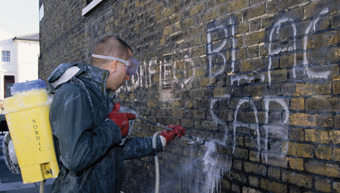
Similar concerns are raised in the following statement from British Transport Police:
Scrawling graffiti in public is criminal damage. It causes a variety of problems and we take it very seriously. If graffiti is not dealt with quickly, it can often lead to further undesirable activity taking place, and can create a climate of fear for those using and working on the railways. Graffiti also poses safety issues. Vandals often put their lives at risk in the act of spraying difficult surfaces, such as bridges or trains in sidings, putting themselves and others in danger. And the costs of cleaning up are enormous. Network Rail estimate that it costs at least £5 million per year to clean up graffiti, not including the loss of revenue or delays caused to the service. London Underground meanwhile says graffiti costs them a minimum of £10 million per year, and it would cost about £38 million to replace all of the graffiti-etched windows on every Tube train. Dealing with graffiti also diverts valuable police and staff resources. Hundreds of thousands of staff hours are taken up in cleaning, repairs and police time. London Underground devotes some 70,000 hours a year just to cleaning up graffiti.
Local councils often spend considerable time and money removing graffiti in response to public complaints, but they can also face difficult decisions as to which graffiti should be preserved or even protected. Some graffiti are much loved by local communities and can even become tourist attractions. One of the most famous British graffiti artists is known by the pseudonym ‘Banksy’. Banksy’s graffiti are internationally renowned and are now widely considered as valuable pieces of art. In February 2013, a Banksy graffiti known as Slave Labour vanished in unknown circumstances from a wall of a Poundland shop in north London and then appeared on an auction site in Miami. This provoked a public outcry among local residents and officials, who wanted to keep the graffiti and argued that it belonged to local residents and not to a wealthy private client. Amidst this controversy, the graffiti was withdrawn from sale shortly before the auction in Miami – without explanation – and was then sold at another auction at Covent Garden in London a few months later. Though the actual price was not known at the time of writing, the minimum auction price was set at £900,000 (Batty, 2013; BBC News, 2013).
Activity 2 When does graffiti become street art?
Click on the following link to read the article ‘London 2012: Banksy and street artists’ Olympic graffiti’ from the BBC News website (Cafe, 2012), which describes different reactions to the removal of graffiti in London in 2012. What do the comments cited in this article tell us about when graffiti can be considered to be street art worthy of preservation? Make some notes in the text box below.
Discussion
According to the article, artists claim that the council’s decision to remove graffiti is often based on the graffiti’s location, rather than their artistic value. In this particular instance, they claim that graffiti are being removed as part of an indiscriminate ‘clean up’ campaign in preparation for the London Olympics in 2012. However, the response from Hackney Council highlights the difficulties local authorities often face in deciding which graffiti can be considered to be art worthy of protection. Reference is made to levels of technical skills and originality involved in the production of specific graffiti, but also to the way specific graffiti have been received by local residents and tourists. The article mentions examples where local residents have expressed their wish to protect particular graffiti artwork by setting up petitions. It also becomes apparent that graffiti produced by respected, well-known artists, such as Banksy, are often instantly associated with high artistic value.
In 2008, ENCAMS published a research report entitled Good Graffiti, Bad Graffiti? A New Approach to an Old Problem, which summarises findings of research exploring public attitudes towards graffiti. This report noted that attitudes to graffiti were more nuanced than initially assumed in their 2003 anti-graffiti campaign and depended on a range of factors, such as the type, quality, message, location and personal impact of the graffiti:
Graffiti was more likely to be reported if it was low quality … racist or offensive; if it was on somebody’s property, a respected site in a valued location that people used frequently, or in more affluent or gentrified areas.
Public responses to graffiti are often linked to how aesthetically pleasing people find graffiti – how much they like the way it looks – especially if it is located in exposed public places that local residents have to live with. Context and location play a big role in public responses to graffiti.
4 Looking after public space
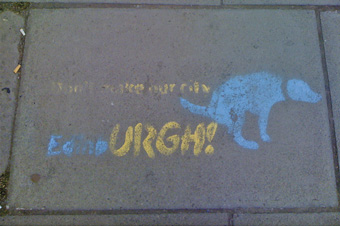
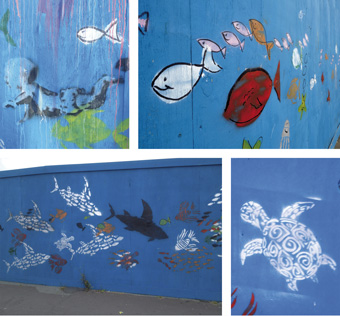
While graffiti is often perceived as an eyesore damaging public spaces, in some instances it has the opposite effect. Graffiti can be welcomed as a way of brightening up derelict buildings or neglected public space, or to remind companies, councils or citizens to look after public space. An example of this is Figure 2, a stencilled graffiti which reminds dog owners in Edinburgh to pick up their dog’s waste. Another example is graffiti that appeared in the summer of 2012 on several hundreds of metres of wooden boards fencing off a derelict former fairground site at the seafront in Morecambe (see Figure 3). Over a period of several months, mystery artists gradually added a growing number of painted fish and other sea creatures to the wooden boards at night. In a leaflet that was posted to local residents, the activists, who refer to themselves as ‘MorecambeUnity’, explain:
We live in Morecambe too and are very sad to see how our local council either ignore our area or allow it to look bad with giant blue walls and boarded up homes. … Life is tough for all of us right now, redundancies, welfare benefit cuts, and the destruction of our public services. So the way we see it, is that maybe we can make some of ‘their’ mess, look a little brighter at least.
So far, neither the local council nor the local supermarket that owns the site have taken steps to remove the graffiti or prosecute its creators. According to the local newspaper The Visitor, the graffiti sea creatures have been very positively received by the public as a way of brightening up a local eyesore (The Visitor, 2012). As a local resident argues in a blog on The Visitor’s website:
This wall and so called graffiti is a far less crime than that perpetrated by the multi national company of […name of supermarket chain…], who have left this eye sore on our seafront for far too many years.
5 Graffiti as a form of communication
Regardless of whether or not it is recognised as art, graffiti can be understood as a form of communication. Graffiti often involves the combination of different modes of visual communication, in particular images, symbols and written words. Graffiti can be used as form of territorial marking, personal branding, flirting, grieving, declaring love, expressing discontent or of showing support for or membership of a particular political group, football team, style of music or music subculture (most notably hip hop) and much more. People that associate themselves with particular groups or subcultures often use specific symbols, signatures or ‘tags’ in their graffiti or adopt a particular style of graffiti that can be easily recognised by members of the same group.
Activity 3 Reading graffiti
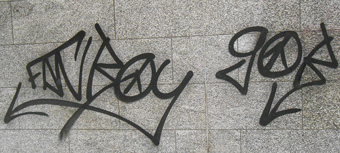
Figure 4 is a photograph of graffiti in an underpass near Milton Keynes Central train station. At the time, there were a number of copies of this particular graffiti in various locations around Milton Keynes Central (though not in this combination). Take a look at the photograph and consider what kind of message or messages these graffiti might be communicating. Make some notes in the text box below.
Discussion
Of course, the answer is personal to you. Here is what a member of the course team thought:
These are examples of stylised signatures (also known as ‘tags’), most likely written with black spray paint on a grey wall. They read as ‘FANBOY’ and ‘GOB’, which could be titles someone uses to describe themselves. They both are written in very similar style, which suggests they were written by the same person. The last letters of each word or name are extended into arrows and the Os have been turned into peace signs. (At least this is how I read this symbol, which has, for example, been adopted by the Campaign for Nuclear Disarmament (CND) as a symbol of peace. However, we do not know whether this is how this symbol is used in this context.) I have to admit that I have a fairly limited idea of message these ‘tags’ are communicating. It is likely that this combination of letters and the way they are arranged is a way of marking territory or a type of personal branding. From this picture it is not clear whether we are looking at two separate signatures or tags here, or whether both words are linked. As I mentioned above, they look like they have been written by the same person. However, I have no idea whose signature this is or what it stands for or refers to.
This form of graffiti writing ‘isn’t so much about connecting with the masses: it’s about connecting different crews, it’s an internal language, it’s a secret language. Most graffiti you can’t even read, so it’s really contained within the culture that understands it and does it.’ (Faile, artists’ collective, cited in Lewisohn, 2008, p. 15). So, in this case, unless you are a member of the group that uses this form of communication, you will be struggling to understand their ‘internal language’.
Street art, on the other hand, ‘is more about interacting with the audience on the street and the people, the masses’ (Faile, artists’ collective, cited in Lewisohn, 2008, p. 15). The wider popular appeal of some types of graffiti is often linked to how innovative, entertaining, surprising, acceptable or relevant the messages graffiti convey are perceived to be by a wider audience. Many of Banksy’s graffiti are, for example, very popular because of the dark humour they imply and the satirical, surprising, subversive messages they convey. Banksy’s work in Figure 5, sometimes referred to as Hackney Welcomes the Olympics, (mentioned in the BBC News article that you were asked to read as part of Activity 2 ‘When does graffiti become street art?’) subverts the stereotypical image of a javelin-throwing athlete by placing a missile in the athlete’s hand. This thought-provoking image could still be interpreted in a range of different ways, but it tries to engage, rather than exclude a wider audience.
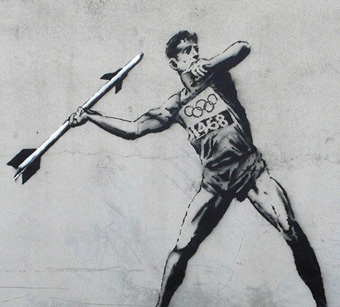
Its wider popular appeal often distinguishes street art or murals from other forms of graffiti, such as the ‘tags’ illustrated in Figure 4 from Activity 3. However, Peter Ferrari, who is known across the US city of Atlanta as the artist PLF, argues that the distinction between street art (or murals) and tags is not clear cut, and sees a paradox in public attitudes towards graffiti: ‘People hate the tags, but they want the murals. […] I think there is a misunderstanding, and people don’t realize that it is all connected and all related. You can’t have the mural without the tag’ (Ferrari cited in Imam, 2012).
6 Graffiti as a form of popular protest
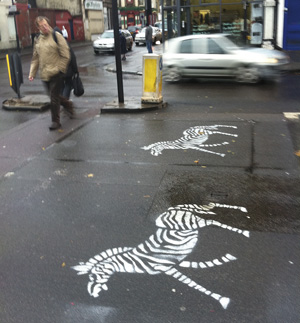
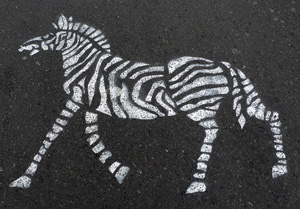
The following case study illustrates how graffiti has been used as an articulation of popular public protest. In 2010, anonymous activists sprayed stencilled zebras on the surface of a road in the London borough of Hackney to draw public attention to a previously unsuccessful seven year long campaign and online petition for a safe pedestrian crossing at a notoriously dangerous junction.
Activity 4 ‘Mystery zebras’
Question 1
Watch the following short film ‘Hackney’s mystery zebras uncovered’, which shows how the graffiti was made, what motivated activists to make these graffiti and how people responded to them. The activists’ voices are altered and their faces covered as they do not want to be identified. While watching this short film, bear in mind the following questions and note your responses in the text boxes below.
- What effects do the ‘Hackey Zebra’ graffiti have on:
- you
- the people shown in the video?
- How were the ‘Hackey Zebras’ made? What techniques are used in their production?
- What does the video say about the wider context within which the ‘Hackeney Zebra’ graffiti were made, and why they were made?
- What do the creators of the graffiti say about the intended meaning of the ‘Hackney Zebra’ graffiti?
Tip:
Making notes at the same time as you are watching or listening can be tricky as you are likely to miss something. Try watching the whole video first. Jot down very briefly what you noticed that you want to capture next time. Then watch any sections you want to focus on again
Transcript: Video: Hackney’s mystery zebras uncovered
[SIREN]
- What effects do the ‘Hackey Zebra’ graffiti have on:
- you
- the people shown in the video?
Discussion
The answer is personal to you and there are many different ways of approaching this task. Here is what a member of the course team thought:
The ‘Mystery zebras’ made me smile. I regard this graffiti as an example of an amusing and clever way of expressing protest, and I am also impressed by the courage of the protesters (feel free to disagree!).
The video also says something about the wider effects of this graffiti. It shows the artists being chased by the police with blue flashing lights and sirens. The video suggests that they were caught by the police, but it is not clear what the end result of this was (that is, whether they were arrested and/or fined). Even though the graffiti caused enough concern to the police to chase (and possibly arrest) the artists, it is also clear that the graffiti was widely welcomed by local residents (judging by the information provided in the video). The video captures a range of reactions by pedestrians, car drivers and cyclists who all respond very positively to the graffiti that mysteriously appeared overnight. The graffiti zebras draw attention to the junction and the badly-needed zebra crossing. People are also pleased with the visual effect of the graffiti and its implicit humour, given that the graffiti is in the shape of zebras, rather than the black and white stripes of an actual zebra crossing. They describe the graffiti as ‘amazing’, ‘brilliant’, ‘really cool’, ‘lovely’, ‘so nice’ and as ‘brighten[ing] up a rainy day’.
- How were the ‘Hackey Zebras’ made? What techniques are used in their production?
Discussion
The video shows the artists/activists drawing and cutting out a cardboard stencil of a zebra. At night, they put the stencil on the road and use white spray paint to spray several zebras onto the black road surface.
Question 2
- What does the video say about the wider context within which the ‘Hackeney Zebra’ graffiti were made, and why they were made?
Discussion
This particular example of graffiti was created in the context of a campaign to improve pedestrians’ safety in Hackney, which had previously not been successful. Campaigners were looking for a way to make ‘people’s voices heard’ and convince TfL (Transport for London) to install a safe pedestrian crossing at this particular junction.
Question 3
- What do the creators of the graffiti say about the intended meaning of the ‘Hackney Zebra’ graffiti?
Discussion
The artists/activists explain that they chose the zebra graffiti as they perceive it as an effective way of communication that does not ‘hurt … anyone’, is ‘immediately recognisable’ and ‘so simple’. They want to take charge and ‘reclaim the streets’ by making their ‘own zebra crossing’.
In response to the appearance of the mystery graffiti zebra on the road surface of this junction, Transport for London (TfL) was finally convinced to install an official zebra crossing there.
7 Why did the Hackney zebras work?
In the case of the Hackney zebras, illicit graffiti worked very well as an articulation of public protest and was successful in getting its message across and in achieving its aim. The next activity explores possible reasons behind the Hackney zebras’ success.
Activity 5 Why did the Hackney zebras work?
In the text box below, note down possible reasons that could explain why the Hackney zebra graffiti was successful in getting the activists’ message across. How might it have contributed to achieving the aims of the associated campaign? While you are thinking about possible explanations, consider what kind of evidence you have come across in your study of this section that could support your arguments.
Discussion
There are a range of possible explanations. Here is what a member of the course team came up with:
The message this graffiti was trying to get across was relatively simple and could be understood by a wide audience and appealed to many people’s sense of humour. As evidenced by the reactions of members of the public that are shown in the video, many people also approved of the message it was trying to get across. However, we do not know whether the views expressed by the people that are shown on the video are representative of all local residents. The fact that the zebra graffiti was linked to a long-standing public campaign and petition is likely to have been a big factor of its success. The zebras also appeared in a very prominent location which will have given the associated campaign a higher public profile. In the video, it becomes apparent that the graffiti drew many passing people’s attention to the issue at stake (the lack of a safe pedestrian crossing). The fact that the zebra graffiti was not authorised by the local council, suddenly appeared overnight and that its creators are unknown also adds a certain sense of mystery. It could also be argued that the fact that its creators stay anonymous means that the focus is shifted away from the artists/activists, which allows greater emphasis to be placed on the aim of the campaign.
The question of whether a ‘good’ cause can justify the breaking of laws (for example, by spraying illicit graffiti onto public road surfaces) and the potential damage graffiti can cause to public or private property cannot be answered here and is highly dependent on specific circumstances and contexts, and on the techniques used. It also raises a range of other questions: What qualifies as a ‘good’ cause? When does graffiti work effectively as a way of articulating popular protest? Also, do local residents (who have to live with the graffiti or bear the cost and/or effort of removing it) agree with this cause? Even if they do agree with the cause or message, do they approve of the way in which this message is communicated?
Given that graffiti artists/activists are keen to protect their anonymity, it is sometimes difficult for them to consult (other) local residents and ask them for their opinions. In the case of MorecambeUnity, the graffiti artists/activists posted leaflets through letterboxes to explain their motives to local residents. Social media and the internet have opened up new opportunities for local residents to express their opinions through websites such as Facebook, blogs or Twitter, or to offer their support by signing online petitions, or for graffiti artists/activists to promote their work or the cause they are campaigning for. Social media played an important role in relation to the ‘Mystery zebras’ in Hackney. The ‘Mystery zebras’ were not only linked to an online petition, but they were also commented on in blogs (for example, click the following link to read the article ‘Mystery zebras earning their stripes at Hackney’s killer crossing’ on East London Lines (Alderwick, 2010)), and the Video (which you watched in Activity 4) is widely available on the internet.
According to the Office for National Statistics (ONS), vandalism rates, including reported illicit graffiti, have been decreasing in England and Wales over recent years (ONS, 2013). Some explanations of this decrease have been linked to the impact of social media, which have offered people new opportunities to express themselves, or are simply keeping bored teenagers entertained and off the streets. The fall in vandalism does indeed correlate with a steep rise in the use of social media (Easton, 2013). Another explanation might be that graffiti has become more widely acceptable and is more frequently not regarded as vandalism, and not reported to the police as such.
8 Graffiti goes mainstream
Not all graffiti is unauthorised or illegal. There are many signs that graffiti is becoming increasingly socially acceptable within mainstream culture. Some local councils offer specifically designated spaces for graffiti, fund local community graffiti art projects and, in some instances, graffiti artists are commissioned to do particular pieces of graffiti art. Graffiti artists were, for example, recently hired to decorate the ceiling above the main altar of a church in l’Hospitalet, near Barcelona. Click on the following link to see a related article on the BBC News website with images of this church (Hadden, 2013).
In recent years, some prestigious mainstream galleries have dedicated entire exhibitions to graffiti art. For example, in 2008 Tate Modern art gallery in London offered its own external walls to graffiti artists to host an open-air graffiti exhibition (click the following link to see the exhibition information on the Tate website). However, what happens when graffiti crosses into the mainstream art world?
Activity 6 Tate Modern’s giant graffiti
Click on the following link to watch ‘Tate Modern‘s giant graffiti’, which is a short video of a BBC News report on Tate Modern’s graffiti exhibition in 2008.
When watching this film think about the following question and make notes in the text box below:
What is the difference between the creation and exhibition of graffiti art on the walls of Tate Modern in London and the creation of illicit graffiti art in the streets of London?
Discussion
The association with Tate Modern, a ‘refined British museum’ and modern art gallery, gives the exhibits a lot of official recognition. However, the display of street art is perceived as a bit of an ‘oddity’ by the reporter and by visitors and passers by interviewed in the film, not least because it is displayed on Tate Modern’s external walls, rather than inside the building. As opposed to the informal settings of illicit graffiti, the graffiti on the walls of Tate Modern are created in a very formal, controlled environment as ‘some of the world’s best graffiti artists’ were presumably approached and selected and assigned particular spaces on the building. Though the short film does not give us information about how the artists were selected, there is reference to hurdles the organisers had to deal with regard to building regulations. Although this is not specifically mentioned in the film, it is also likely that artists had to agree with the gallery on the designs beforehand. The film makes it clear that it had already been formally agreed that the graffiti are going to be removed after a three-month period. While creators of illicit graffiti risk being prosecuted, this is not a risk the artists who worked at Tate Modern had to worry about (even though some artists still preferred not to be filmed and covered their faces). This gave them more time to work on their graffiti, and meant that they did not have to be prepared to ‘spray and run’, that is, be ready to pack up their materials at short notice and run away from the police (like the creators of the Mystery zebras in Hackney). The artists were also given technical assistance by lorries and cranes that could lift them up to reach higher spaces. The walls of Tate Modern gave the artists a very large space to work on, so the graffiti were of unusually ‘colossal’, ‘massive’ dimensions.
Even Cedar Lewisohn, the curator of the ‘Street Art’ exhibition at Tate Modern in 2008, is convinced that ‘the best street art and graffiti are illegal’ (2008, p. 127). He argues that ‘graffiti and street art are essentially acts of rebellion’ (2008, p. 153) and believes that ‘illegal work have political and ethical connotations that are lost in sanctioned works’ (2008, p. 127). He claims that illegal graffiti transfers ‘the sense of danger the artist felt […] to the viewer’, and by contrast, ‘a work of graffiti or street art in a gallery or museum can feel safe as if its wings have been clipped’ (2008, p. 127).
9 Graffiti in advertising
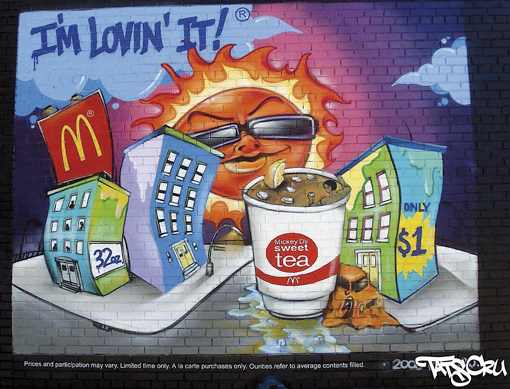
In addition to entering the realm of mainstream galleries and museums, graffiti art (sometimes also referred to as ‘aerosol art’) is also increasingly used commercially, for example to advertise products (Imam, 2012). In an article published in the academic journal Visual Communication Quarterly, the scholar Kara-Jane Lombard uses ‘Tats Cru’ as an example of the ‘commercial incorporation’ of hip hop graffiti. She explains:
One of the most successful aerosol art businesses, Tats Cru was once a graffiti crew that wrote illegally on subway trains. Now legitimate aerosol artists, the group incorporated in the early 1990s and has been commissioned to do work for a variety of companies such as small neighborhood businesses as well as bigger corporations such as Coca-Cola, Firestone, Reebok, the Bronx Museum of Arts, and Chivas Regal. They have also been featured in media outlets such as the New York Times, USA Today, CNN, and BBC.
Activity 7 Graffiti in advertising
Take a look at examples from Tats Cru’s portfolio on their website.
Alternatively, see whether you can find any other examples where graffiti has been used to advertise products, either in newspapers, on billboards or packaging, or on the internet (using search terms such as ‘Graffiti and advertising’).
In the text box below, note down your response to the following question:
Why do companies (like McDonald’s, Coca-Cola or Reebok) use graffiti for advertising?
Discussion
There are a range of possible reasons. Graffiti is associated with youth culture and with being young, rebellious, brave and ‘trendy’. Companies that use graffiti in adverts are possibly hoping that customers will associate these qualities with the purchase, use or consumption of the products that are being advertised.
Some critics have argued that the use of graffiti for mainstream commercial purposes, such as advertising, amounts to a sell-out. They feel it degrades this form of art or even renders it meaningless (Fuchs, 2008). However, others have pointed out that the use of graffiti in advertising is an increasingly complex process, where some companies are making real efforts to work together with artists (Lombard, 2013).
It is also important to bear in mind that graffiti artists are often involved in a range of different forms of graffiti. Banksy, for example, uses both illicit street art (including graffiti) and official exhibitions at public galleries and publications (such as books) to exhibit his work. In the video linked in Activity 6, it also became apparent that he is not alone in this approach and that many graffiti artists use both officially sanctioned and illicit forms of graffiti for different purposes and reasons. Some artist welcome the public recognition and financial rewards linked to the official exhibition of graffiti in prestigious art galleries and other aspects of mainstream culture, but still regard illicit graffiti as the ‘real thing’. As graffiti artists Cept and Stik explain:
Cept: ‘The fun of it is [...] painting where you shouldn’t be and that’s where the real graffiti works. It’s all good spending all day doing a piece and taking your time, but it is not half as fun as doing it illegally.’
Stik: ‘Its like being part of the biggest gallery in the world [...] because you are part of the street that is open 24 hours a day and 7 days a week and it is uncensored.’
Conclusion
In this course you have engaged with a range of debates around questions such as: Is graffiti a form of art or vandalism? Should it be penalised or celebrated? Who owns public space? Who owns graffiti in public spaces? Can graffiti only effectively articulate public protest when it is illegal?
You have looked at different arguments used in these debates and encountered a range of different types of evidence, including quotes by artists, activists, local residents, spokespeople for local councils and curators. You have worked with evidence published on the BBC News website, campaign websites, online petitions, blogs, newspapers, YouTube videos, surveys, academic journals, research reports, reference works and other literature discussing graffiti and street art.
This course has shown that the meanings and effects of graffiti can be very varied and are closely related to different techniques used and the contexts within which graffiti is presented and interpreted. The line between ‘art’ and ‘vandalism’ in interpretations of illicit graffiti can be very thin and very much depends on the background and point of view of the spectator and on the context within which it is displayed.
The formal display at prestigious venues such as Tate Modern gives the graffiti exhibits a great deal of official recognition as works of art. However, this formal, authorised, controlled setting stands in stark contrast to the thrill of the secrecy, subversiveness, risk, defiance, informality, freedom and mystery associated with the creation and display of unauthorised graffiti, like the ‘Mystery zebras’ in Hackney. It could be argued that these are important elements within the use of graffiti as an effective articulation of popular protest that might get lost when graffiti ‘goes official’. What do you think?
Reflective activity
Next time you come across an example of graffiti, for instance in your local neighbourhood or on a visit elsewhere, reflect on whether the study of this section might have affected your perception of this example of graffiti, and if so, how.
References
Acknowledgements
This course was written by Stefanie Sinclair.
Activity 1 written by Leigh-Anne Perryman, taken from the Y031 course ‘Making sense of art’.
Except for third party materials and otherwise stated (see terms and conditions), this content is made available under a Creative Commons Attribution-NonCommercial-ShareAlike 2.0 Licence.
Course image: Anders Lejczak in Flickr made available under Creative Commons Attribution-NonCommercial-ShareAlike 2.0 Licence.
The material acknowledged below is Proprietary and used under licence (not subject to Creative Commons Licence). Grateful acknowledgement is made to the following sources for permission to reproduce material in this course:
Figure 1: © Marion Bull/Alamy; Figure 2: © Stefanie Sinclair; Figure 3 image top right: © Lancaster & Morecambe Newspapers, other Figure 3 images, courtesy of Melody Treasure ; Figure 4: © Stefanie Sinclair; Figure 5: © Banksy; Figure 6: © Alan Boyles; Figure 7: © Emily Webber; Figure 8: © TATSCRU.NET.
Created by Lucio Casellato, Hasmik Gasparyan, Sithsatree Khot-Asa and Luisa Miller for EastLondonLines.co.uk http://www.youtube.com/ watch?v=86CQS192VUQ;
Every effort has been made to contact copyright owners. If any have been inadvertently overlooked, the publishers will be pleased to make the necessary arrangements at the first opportunity.
Don't miss out:
If reading this text has inspired you to learn more, you may be interested in joining the millions of people who discover our free learning resources and qualifications by visiting The Open University - www.open.edu/ openlearn/ free-courses