Beginners' German: Places and people
Use 'Print preview' to check the number of pages and printer settings.
Print functionality varies between browsers.
Printable page generated Saturday, 4 April 2026, 6:23 PM
Beginners' German: Places and people
Introduction
This free course focuses on planning and preparing for a journey through German-speaking countries. You will read and hear about a range of places and people.
You will learn the names of things you need to remember when travelling and, most importantly, you will find out what it’s like to read and listen to German in real contexts, and about developing strategies and studying useful phrases, which will help you to cope in a range of situations.
You will also find out how to order and pay for things in cafes and restaurants.
This OpenLearn course is an adapted extract from a previous edition of the Open University course L193 Rundblick: beginners' German.
Learning outcomes
After studying this course, you should be able to:
demonstrate knowledge of the singular forms of personal pronouns, singular forms of the regular verb kommen and generalisations using man
use improved vocabulary and pronunciation related to place names, numbers 0–10, countries, finding out what is available when ordering and paying for things, ordering and paying for food
understand the cultures of places and people in Germany, Switzerland and Austria, German-speaking minorities
address people, imitate German pronunciation, and read for gist
learned how to work out meanings from the contexts.
1 Talking about places and locations
In this section, you have a first look at places and people in Germany, Austria and Switzerland. You familiarise yourself with the pronunciation of place names in German, and you talk about the location of cities and towns in German-speaking countries. You also talk about where some people come from (some well-known and some not so well-known).
1.1 People and places
You will start this section by looking at the geography of some German-speaking countries.
Übung 1
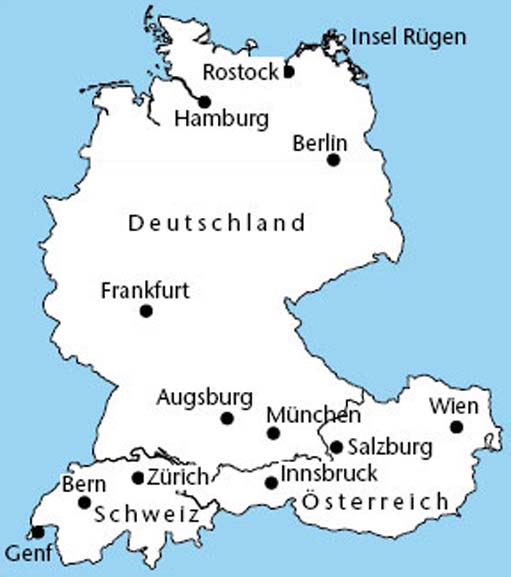
Here is a map showing places in Germany, Switzerland and Austria. To start with, listen to the audio extract beneath the map. Can you understand where the various people are from? Which of the labelled places do you hear mentioned in the clip?
Transcript: Übung 1
Discussion
The places mentioned were Frankfurt, München (Munich), Berlin, Innsbruck and Zürich.
Which of the places have you heard of before (or perhaps even visited)? Make a note of them. Do you know any other places in Germany, Austria and Switzerland? Where are they?
Discussion
What you've written depends entirely on your own experiences. The aim of this activity is to make you think about what you know already, and encourage you to have a look at a map to find out more about the location of places you have heard of.
Übung 2
Now listen to the pronunciation of the place names. Repeat each name as you hear it.
Hören Sie und sprechen Sie nach.
Transcript: Übung 2

1.2 Pronunciation
German uses the same letters as English, with some additions: ‘a’, ‘o’ and ‘u’ can sometimes be found with two dots over them (called Umlaut). They sound slightly different from ‘a’, ‘o’, and ‘u’ on their own. The letter ‘ß’ represents a double ‘s’ and is pronounced like an ‘s’.
At this stage, all the German you need to use is presented in the audio clips. Listen to the words and phrases and try to imitate the pronunciation of the speakers. You will find that German pronunciation becomes very easy to predict after a while. As the course progresses, you will be introduced to some of the rules and asked to practise individual sounds.
Übung 3
How are the following letters or groups of letters pronounced in German? Listen to this audio extract again and, if you like, make some personal notes on the pronunciation. Write down something that will help you remember how to say the word when you see it written down. The first one has been done as an example.
Bitte hören Sie und schreiben Sie.
Transcript: Übung 3
‘eu’ in Deutschland: sounds like ‘oy’ in ‘joy’
‘ü’ in München:sounds like …
‘ch’ in München: sounds like …
‘au’ in Augsburg: sounds like …
‘ö’ in Köln: sounds like …
‘a’ in Hamburg: sounds like …
‘ei’ in Österreich: sounds like …
‘w’ in Wien: sounds like …
‘ie’ in Wien: sounds like …
‘z’ in Zürich: sounds like …
Answer
The answer depends on what you find helpful and on your own mother tongue, accent and knowledge of other languages. Here are some suggestions:
‘eu’ in Deutschland sounds like ‘oy’ in ‘joy’;
‘ü’ in München sounds like nothing in English (it is pronounced right at the front of your mouth, halfway between ‘ee’ and ‘oo’);
‘ch' in München sounds a bit like ‘H’ in ‘Hugh’;
‘au’ in Augsburg sounds like ‘ou’ in ‘ouch’;
‘ö’ in Köln sounds a bit like ‘oeu’ in the French word ‘boeuf ’ (but your lips are more closed and pointed when you pronounce it);
‘a’ in Hamburg sounds like ‘u’ in ‘hum’ (in Standard English);
‘ei’ in Österreich sounds like ‘I’;
‘w' in Wien sounds like ‘v’ in ‘Vienna’;
‘ie’ in Wien sounds like ‘ee’ in ‘see’;
‘z’ in Zürich sounds like ‘tz’ in ‘Switzerland’.
1.3 Location
In the previous activities you have been looking at the location of places in Germany, Austria and Switzerland. If you had to give this information in German, this is the vocabulary you would need:
- Vokabeln
das ist … that is … / this is …
in Deutschland in Germany
in Norddeutschland in northern Germany
in Süddeutschland in southern Germany
in Österreich in Austria
in der Schweiz in Switzerland
Übung 4
Listen to the names of some places and say, in German, where they all are. Repeat this activity until you are happy with your pronunciation.
Bitte hören Sie und sprechen Sie. Hier ist ein Beispiel.
You hear: Hamburg
You say: Hamburg? Das ist in Norddeutschland.
You hear: Hamburg? Hm, das ist in Norddeutschland!
Transcript: Übung 4
Answer
As is the case in English, countries in German in general do not have articles (for example you would say ‘Germany’ not ‘the Germany’). There are a few exceptions though and Schweiz is one of them. That's why you had to say Das ist in der Schweiz.)
Übung 5
Now listen to people saying who they are and where they come from. Then, complete the sentences below.
Transcript: Übung 5
- 1. Claudia Grothe kommt aus …
- 2. Jasmin kommt aus …
- 4. Dieter Hoffmann kommt aus …
- 5. Bärbel Kleingarn kommt aus …
- 6. Peter Neißendorfer kommt aus …
Answer
This is where the people come from:
Claudia Grothe kommt aus Norddeutschland.
Jasmin kommt aus Innsbruck.
Ulf kommt aus Rostock.
Dieter Hoffmann kommt aus Köln.
Bärbel Kleingarn kommt aus Hamburg.
Peter Neißendorfer kommt aus München.
Apart from ich komme aus … (I come from …), people were also saying ich bin in … geboren (I was born in …).
So far you have been talking about places, but what about the people who come from these places? You already know Das ist … which you can use for introducing them. And then you could say:
er kommt aus … he comes from …
sie kommt aus … she comes from …
And you may also want to introduce yourself:
mein Name ist … my name is …
ich komme aus … I come from …
Übung 6
Click the following link and complete the activity. Then, move on to the question below.
Und Sie? (Introduce yourself. You can look up the name of your country in a dictionary, if you like.)
Answer
These are the answers to the activity, showing how each person should be introduced:
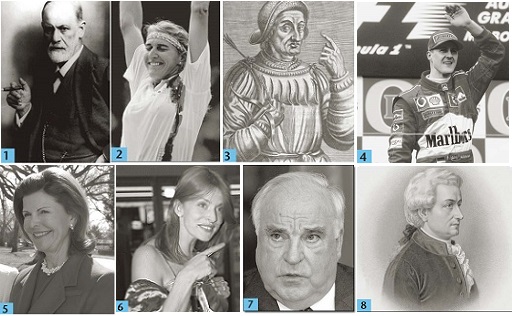
Das ist Sigmund Freud. Er kommt aus Österreich.
(The Austrian neurologist and founder of psychoanalysis lived from 1856 to 1939.)
Das ist Steffi Graf. Sie kommt aus Deutschland.
(Tennis player Steffi Graf was born in 1969.)
Das ist Wilhelm Tell. Er kommt aus der Schweiz.
(The semi-legendary Swiss patriot was first mentioned in a chronicle in 1470.)
Das ist Michael Schumacher. Er kommt aus Deutschland.
(The German racing driver was born in 1969.)
Das ist Königin Silvia. Sie kommt aus Deutschland.
(Silvia, Queen of Sweden, was born in Heidelberg in 1943 as Silvia Renate Sommerlath, the daughter of a West German businessman and his Brazilian wife.)
Das ist Nastassja Kinski. Sie kommt aus Deutschland.
(The actress – and daughter of actor Klaus Kinski – was born in 1960).
Das ist Helmut Kohl. Er kommt aus Deutschland.
(The former German chancellor was born in 1930.)
Das ist Wolfgang Amadeus Mozart. Er kommt aus Österreich.
(The Austrian composer lived from 1756 to 1791.)
This is how you could have introduced yourself:
Mein Name ist _____. Ich komme aus _____ (England, Schottland, Wales, Irland, usw.).
1.4 Numbers 0–10
Before you can complete the final activity in this section, you need to understand numbers up to ten. Here they are in writing:
| 0 | 1 | 2 | 3 | 4 | 5 | 6 | 7 | 8 | 9 | 10 |
| null | eins | zwei | drei | vier | fünf | sechs | sieben | acht | neun | zehn |
Übung 7
Listen to the audio extract and read the numbers, paying close attention to pronunciation. Then listen again and repeat out loud until you are happy with your own pronunciation.
Bitte hören Sie und sprechen Sie nach.
Transcript: Übung 7
Übung 8
Now listen to the audio and look at the pictures below for some more practice in presenting people and pronouncing names. Listen out for the numbers, and then name the relevant person. Here's an example.
Bitte hören Sie und sprechen Sie. Hier ist ein Beispiel.
You hear: Nummer eins
(picture number 1 shows Sigmund Freud)
You say: Das ist Sigmund Freud.
You hear: Das ist Sigmund Freud.
Transcript: Übung 8
2 Understanding information about countries and languages
In this section, you have a look at countries all over the world and meet some of the people who live there. You learn to recognise more names for countries, understand some information about the German language as well as basic personal information. You also learn to use regular verbs and pronouns such as ‘I’, ‘you’, ‘he’ and ‘she’.
2.1 Where is German spoken?
So far, this course has looked at places in Germany, Austria and Switzerland. In this activity, you'll learn about other countries around the world where you might hear German being spoken.
Übung 9
The countries listed below (among many others) have German minorities living within their borders who speak either standard German or a German dialect, or both. Before reading more about why this is the case, decide which continent they belong to by arranging the countries in the blank table below. One has been done as an example.
Bitte ordnen Sie.
Australian • Brasilien • Dänemark • Frankreich • Italien • Kanada • Kasachstan • Namibia • Polen • Rumänien • Russland • USA
| Afrika | Asien | Australian/Ozeanien | Europa | Südamerika | Nordamerika |
|---|---|---|---|---|---|
| Dänemark | |||||
Now listen to this audio clip, which will help you check your answers above. Listen out for the pronunciation of the different countries in German.
Bitte hören Sie.
Transcript: Übung 9
Answer
Here is a completed table for you to check.
| Afrika | Asien | Australian/Ozeanien | Europa | Südamerika | Nordamerika |
|---|---|---|---|---|---|
| Namibia | Kasachstan | Australien | Dänemark | Brasilien | Kanada |
| Russland | Frankreich | USA | |||
| Italien | |||||
| Polen | |||||
| Rumänien | |||||
| Russland |
2.2 Useful expressions
Here are some useful expressions for you to understand when reading about the German language.
- Vokabeln
Deutsch German
Hochdeutsch standard German
Deutsche Germans
Land, länder country, countries
Staat, staaten state, states
Sprache language
Muttersprache mother tongue
Minderheitensprache minority language
Landessprache national language
offizielle Sprache official language
sprechen, spricht speak, speaks
Übung 10
Look at the extracts below to learn more about places where German is spoken. You will probably not understand all of it yet, but keep a look out for the countries mentioned in each paragraph. You may like to make some notes.
Bitte markieren Sie.

Discussion
Translating some sentences, these are the countries mentioned in each text.
Germany, (the German part of) Switzerland, Austria, Luxembourg, Liechtenstein
more than 60 countries where German is a minority language
Germany, Austria, Denmark, Italy, France
Germany, Namibia
Poland, Russia, Romania
places in the USA, Canada, (Southern) Brazil
Australia
Übung 11
Now go through the extracts again. Even without understanding much German, can you guess what kind of information is given in each of them? Read the English summaries below and decide which one represents each of the German extracts.
Bitte ordnen Sie zu.
Two lists follow, match one item from the first with one item from the second. Each item can only be matched once. There are 7 items in each list.
Extract 1
Extract 2
Extract 5
Extract 6
Extract 7
Extract 4
Extract 3
Match each of the previous list items with an item from the following list:
a.Germans also went overseas. For example, you can find a large number of Mennonites in both North and South America.
b.Germany used to have some colonies, where German is still spoken today.
c.German emigration to Australia concentrated in the Barossa Valley, a famous wine-growing area which attracts many tourists.
d.Many Germans left their home, for example for religious reasons, and went to live in Eastern Europe.
e.German is also spoken by some of the people who live in regions that share a border with Germany.
f.German is the national language in a number of European countries.
g.There are also countries all over the world where German is spoken as a minority language.
- 1 = f,
- 2 = g,
- 3 = d,
- 4 = a,
- 5 = c,
- 6 = b,
- 7 = e
Discussion
If you found the correct English extracts for some or all of the texts, you will have understood the most important information given. When reading in a foreign language it's important not to be scared by the number of new words and structures that are being used, but to concentrate on what you can understand.
Übung 12
The following audio clip contains five short dialogues in which people talk about their origins. Listen and read the sentences below. They each contain one error. Rewrite the sentences correctly.
Hören Sie und korrigieren Sie die Sätze.
- Vokabeln
- Herr Mr
- Frau Mrs, Miss, Ms
- meine Familie my family
- meine Mutter my mother
Transcript: Übung 12
Dialog 1
Dialog 2
Dialog 3
Dialog 4
Dialog 5
1. Marcos Schneider kommt aus Deutschland.
2(a). Frau Lahn kommt aus Hahndorf. Das ist in Namibia.
2(b). Frau Lahns Familie kommt aus Österreich.
3. Frau Lengenfelder kommt aus der Schweiz.
4. Herr Söder kommt aus Norddeutschland.
5. Frau Schweigert kommt aus Kanada.
Answer
Here are the corrected versions of the sentences:
1. Marcos Schneider kommt aus Brasilien.
2(a). Frau Lahn kommt aus Hahndorf. Das ist in Australien.
2(b). Frau Lahns Familie kommt aus Deutschland.
3. Frau Lengenfelder kommt aus Russland.
4. Herr Söder kommt aus Dänemark.
5. Frau Schweigert kommt aus Kasachstan.
In the dialogues the question word woher was used several times. It means ‘where from’.
2.3 Personal pronouns
In order to talk about yourself and other people you need the German for ‘I’, ‘you’, ‘he’, ‘she’ and ‘it’ (personal pronouns).
ich – I
du – you (when talking to a close friend, a relative or a child)
er – he
sie – she
es – it
Sie – you (when talking to an adult who is not a very close friend or relative)
Note that sie with a small letter means ‘she’, whereas Siewith a capital letter means ‘you’.
Using kommen
While listening to the interviews you may have noticed the different forms of the verb kommen (to come). The form kommen – which is the one you will find in a dictionary – is called the infinitive. In the infinitive almost all German verbs end in –en, but when used in a sentence, –en is replaced by another ending depending on the person you are talking about. Here are the forms of kommen in the singular.
kommen
ich komme
du kommst
er, sie, es kommt
Sie kommen
Übung 13
Listen to this audio again:
Transcript: Übung 13
Dialog 1
Dialog 2
Dialog 3
Dialog 4
Dialog 5
Now fill in the gaps in the following quiz by dragging the different forms of kommen to their correct positions.
Answer
These are the forms of kommen which fit into the sentences:
Hallo, mein Name ist Marcos Schneider. – Hallo. Kommst du aus Deutschland?
Ich komme aus Hahndorf im Barossa-Tal. Meine Familie kommt aus Deutschland.
Woher kommen Sie? – Ich bin in Sibirien geboren, in Russland.
Guten Tag, Herr Söder. Kommen Sie aus Norddeutschland? – Nein, ich kommeaus Dänemark.
Woher kommen Sie? – Ich bin auch Deutscher, also Nationalität Deutsch.
Übung 14
Complete the sentences in this quiz with the grammatically correct personal pronouns.
Answer
Here are the sentences with the correct personal pronouns:
Hallo, mein Name ist Sam Schmidt – ich komme aus Namibia.
Dein Deutsch ist perfekt! Kommst du aus Deutschland?
Das ist Peter Neißendorfer – er kommt aus München.
Das ist Claudia Grothe – sie kommt aus Norddeutschland.
Frau Lengenfelder – kommen Sie hier aus München? Nein, ich komme aus Russland.
3 Giving and understanding personal information
In this section, you will get more practice in answering questions and giving basic personal information. You'll also learn to use more personal pronouns and regular verbs.
3.1 Where do you come from?
Start this section by listening to conversations about various countries. You may find this vocabulary useful:
- Vokabeln
- Entschuldigung excuse me
- Entschuldigung, woher kommen Sie? excuse me, where do you come from?
- bitte please
- wohnen to live
Übung 15
Listen to people being asked where they come from, paying particular attention to which countries are mentioned. After listening, complete the activity below, organising the countries in the order they were mentioned.
Transcript: Übung 15
Dialogue 1
Dialogue 2
Dialogue 3
Dialogue 4
Dialogue 5
Dialogue 6
Dialogue 7
Two lists follow, match one item from the first with one item from the second. Each item can only be matched once. There are 11 items in each list.
der Schweiz
Großbritannien
England
Schottland
Wales
Deutschland
Russland
Irland
Brasilien
Italien (Norditalien)
Frankreich
Match each of the previous list items with an item from the following list:
a.1
b.7
c.3
d.10
e.11
f.2
g.5
h.8
i.9
j.6
k.4
- 1 = a,
- 2 = f,
- 3 = c,
- 4 = k,
- 5 = g,
- 6 = j,
- 7 = b,
- 8 = h,
- 9 = i,
- 10 = d,
- 11 = e
Übung 16
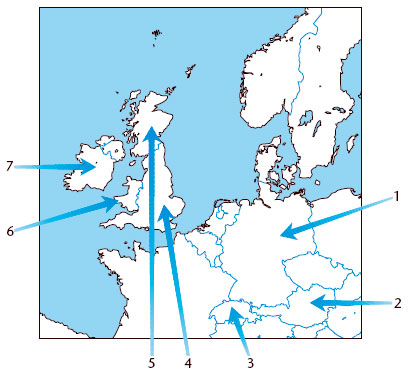
Below is a map with arrows pointing to different countries. Listen to the audio and look at the map at the same time. When asked where you come from, answer as indicated by the arrows.
Bitte hören Sie und sprechen Sie. Hier ist ein Beispiel.
Sie hören: Woher kommen Sie?
Sie sagen: Ich komme aus Deutschland.
(because arrow no. 1 is pointing to Germany)
Sie hören: Ich komme aus Deutschland.
Transcript: Übung 16
Abschnitt 10
Bitte hören Sie und sprechen Sie.
Dialogue 1
Dialogue 2
Dialogue 3
Dialogue 4
Dialogue 5
Dialogue 6
Dialogue 7
Übung 17
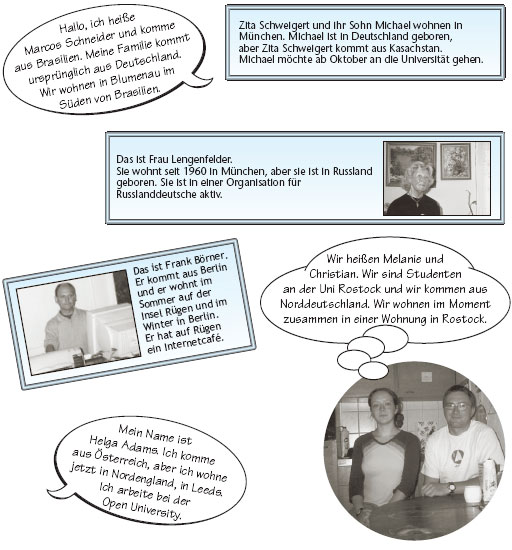
Below is some information about eight people who all have German as their mother tongue, but they come from and live in different countries. You were introduced to some of them in the previous sections. Fill in the gaps in the table below, noting where they live and which country they come from.
Bitte lesen Sie und schreiben Sie.
| Name | wohnt in | kommt aus |
|---|---|---|
| Marcos Schneider | ||
| Zita Schweigert | ||
| Michael Schweigert | ||
| Frau Lengenfelder | ||
| Frank Börner | ||
| Melanie | ||
| Christian | ||
| Helga Adams |
Answer
Here's the table correctly filled out:
| Name | wohnt in | kommt aus |
|---|---|---|
| Marcos Schneider | Blumenau (Brasilien) | Brasilien |
| Zita Schweigert | München | Kasachstan |
| Michael Schweigert | München | Deutschland |
| Frau Lengenfelder | München | Russland |
| Frank Börner | Rügen/Berlin | Berlin |
| Melanie | Rostock | Norddeutschland |
| Christian | Rostock | Norddeutschland |
| Helga Adams | Leeds (Nordengland) | Österreich |
3.2 Where do you live?
In the previous sections, you learned about personal pronouns when talking about one person or one thing only (the singular). Below is a list of all pronouns, singular and plural. You came across some of them in the audio extracts and when reading the introductions in Übung 17.
Personal pronouns
| Singular | Plural | Singular and plural |
|---|---|---|
|
ich – I du – you (when talking to a close friend, a relative or a child) er – he sie – she es – it |
wir – we ihr – you (when talking to two or more close friends, relatives or children) sie – they | Sie – (when talking to one or more adults who are not very close friends or relatives of yours) |
Note that sie with a small ‘s’ means ‘she’ and also ‘they’.
You will have noticed that there are different ways of saying ‘you’ in German. Sie is the most useful when you meet German-speaking people. You mainly use Sie throughout this course, but you also learn more about the different ways of addressing people later on.
Übung 18
You also need to know how to use verbs with pronouns in the plural. The table below shows all the forms for kommen. ‘komm-’ is the stem of the verb that is always the same. Endings are then added according to who you are talking about. Like kommen the verb wohnen is regular. They both work in the same way. Write down the forms for wohnen. The first one has been done for you.
Bitte schreiben Sie die Formen von „wohnen“ in die Tabelle.
| kommen | wohnen | ||
|---|---|---|---|
| singular | ich | komme | wohne |
| du | kommst | ||
| er/sie/es | kommt | ||
| plural | wir | kommen | |
| ihr | kommt | ||
| sie | kommen | ||
| singular and plural | Sie | kommen |
Answer
Here are the forms of wohnen:
| wohnen |
|---|
| ich wohne |
| du wohnst |
| er/sie/es wohnt |
| wir wohnen |
| ihr wohnt |
| sie wohnen |
| Sie wohnen |
Übung 19
Listen to the audio extracts and practise the different forms of wohnen.
Hören Sie und sprechen Sie. Hier ist ein Beispiel.
Sie hören: ich
Sie sagen: ich wohne
Sie hören: ich wohne
Transcript: Übung 19
Übung 20
Use the information from Übung 17 (repeated below), to match the answers with the questions in the following activity.
- Vokabeln
- Wo wohnen Sie? Where do you live?
- Wo wohnt er/sie? Where does he/she live?
Two lists follow, match one item from the first with one item from the second. Each item can only be matched once. There are 6 items in each list.
Er wohnt in Blumenau.
Sie kommen aus Norddeutschland.
Sie kommt aus Russland.
Er wohnt in Berlin und auf der Insel Rügen.
Sie wohnt in München.
Sie wohnt in Leeds.
Match each of the previous list items with an item from the following list:
a.Woher kommen Melanie und Christian?
b.Wo wohnt Frau Adams?
c.Wo wohnt Marcos Schneider?
d.Wo wohnt Herr Börner?
e.Wo wohnt Frau Schweigert?
f.Woher kommt Frau Lengenfelder?
- 1 = c,
- 2 = a,
- 3 = f,
- 4 = d,
- 5 = e,
- 6 = b
Übung 21
Match the questions and answers below. You will need to look closely at both the grammar and the content.
Two lists follow, match one item from the first with one item from the second. Each item can only be matched once. There are 8 items in each list.
Er kommt aus der Schweiz.
Er kommt aus Österreich.
Sie kommt aus Österreich.
Sie wohnen in Pennsylvania.
Sie wohnt in München.
Sie wohnen in Rostock.
Sie wohnen in München.
Er kommt aus Brasilien
Match each of the previous list items with an item from the following list:
a.Woher kommt Wilhelm Tell?
b.Woher kommt Wolfgang Amadeus Mozart?
c.Wo wohnt Frau Lengenfelder?
d.Wo wohnen Zita und Michael Schweigert?
e.Wo wohnen die Amish?
f.Woher kommt Marcos Schneider?
g.Woher kommt Frau Adams?
h.Wo wohnen Melanie und Christian?
- 1 = a,
- 2 = b,
- 3 = g,
- 4 = e,
- 5 = c,
- 6 = h,
- 7 = d,
- 8 = f
Übung 22
In this activity, listen to the audio to practise giving some personal information about the people you have come across in this section. Make sure you are familiar with the information given in the extracts in Übung 17, then answer the questions.
Bitte hören Sie und sprechen Sie. Hier ist ein Beispiel.
Sie hören: Entschuldigen Sie bitte, wie ist Ihr Name? (Lengenfelder)
Sie sagen: Mein Name ist Lengenfelder.
Sie hören: Wo wohnen Sie?
Sie sagen: Ich wohne in München.
Sie hören: Und woher kommen Sie?
Sie sagen: Ich komme aus Russland.
Transcript: Übung 22
Abschnitt 12
Bitte hören Sie und sprechen Sie.
Dialogue 1
Dialogue 2
Dialogue 3
Dialogue 4
4 Ordering and paying for things
You will now visit the island of Rügen, off Germany’s Baltic coast. You’ll learn to use the pronoun man to talk about the things you can do.
4.1 Using ‘man’
Making generalisations using ‘man’
When you are talking about people in general in English, you might say ‘you’, ‘they’ or ‘people’ rather than the formal-sounding ‘one’. But man doesn’t have the same formal ring to it in German. Man takes the same verb form as er/sie/es. Compare the following sentences, for example:
Was kann man hier essen? What can you eat here? (literally: What can one eat here?)
Was trinkt man hier? What do people drink here?
Man bekommt überall Wein You (can) get wine anywhere
Übung 23
You can buy food and drink in many different places. In the activity below, match the descriptions with the right picture numbers.
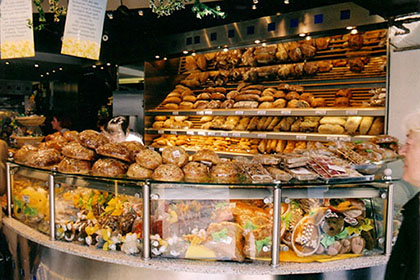
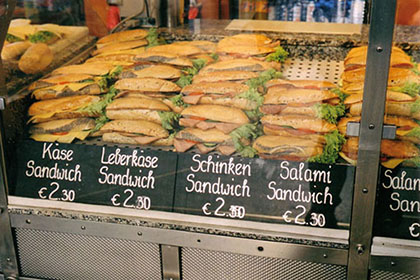

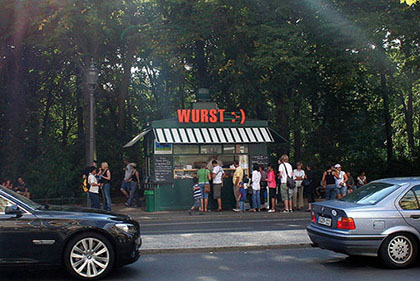
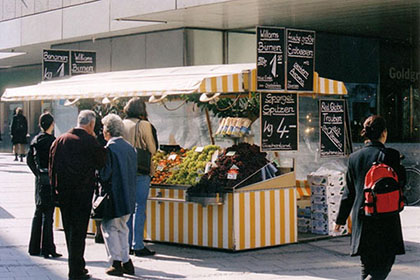
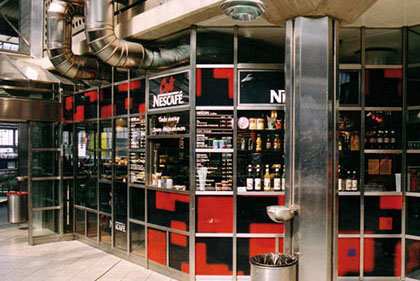
Two lists follow, match one item from the first with one item from the second. Each item can only be matched once. There are 6 items in each list.
Photo 3
Photo 6
Photo 4
Photo 2
Photo 5
Photo 1
Match each of the previous list items with an item from the following list:
a.Hier kann man Brot kaufen.
b.Hier kann man Bratwurst kaufen.
c.Hier kann man japanisch essen.
d.Hier kann man Kaffee trinken.
e.Hier kann man Obst und Gemüse kaufen.
f.Hier kann man ein Schinkenbrötchen kaufen.
- 1 = c,
- 2 = d,
- 3 = b,
- 4 = f,
- 5 = e,
- 6 = a
Übung 24
On the island of Rügen, you might hear someone asking about what you can eat and drink there. Listen for the key words and fill in the gaps in the following sentences. You don’t need to understand everything.
Hören Sie und schreiben Sie.
Transcript: Übung 24
Abschnitt 13
Hören Sie bitte.
- Vokabeln
- aus der Umgebung from the surrounding area
- wer Fisch mag, der ist hier genau richtig anyone who likes fish feels at home here
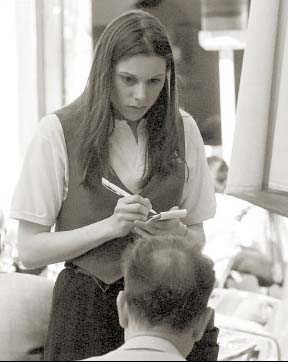
1. Was kann man auf Rügen essen?
Man kann _____ essen.
2. Was trinkt man?
Man trinkt _____.
3. Was bekommt man auch?
Man bekommt überall auch _____.
Answer
These were the key words.
Man kann Fisch essen.
Man trinkt Bier.
Man bekommt überall auch Wein.
4.2 Café conversations
Übung 25
Listen to this conversation in a café. Try to work out the meanings from the context without using a dictionary. Then do the quiz below.
Transcript: Übung 25
Abschnitt 14
Hören Sie bitte.
Two lists follow, match one item from the first with one item from the second. Each item can only be matched once. There are 12 items in each list.
stimmt so
sonst noch etwas
zwei Stück Apfelkuchen
ein Glas Tee
Ich möchte zahlen, bitte
das macht
mit Sahne
ein Kännchen Kaffee
mit Zitrone
zusammen oder getrennt
entschuldigung
wir möchten
Match each of the previous list items with an item from the following list:
a.a glass of tea
b.that comes to
c.anything else?
d.with lemon
e.two pieces of apple cake
f.keep the change
g.we'd like
h.excuse me
i.I'd like to pay, please
j.with cream
k.together or separately
l.a pot of coffee
- 1 = f,
- 2 = c,
- 3 = e,
- 4 = a,
- 5 = i,
- 6 = b,
- 7 = j,
- 8 = l,
- 9 = d,
- 10 = k,
- 11 = h,
- 12 = g
Übung 26
Listen to the audio again (and look at the transcript if you'd like). The waitress says bitte schön twice. Can you guess from the context what the phrase means in each case (two different meanings)? Write down what you think the different meanings are.
Lesen Sie und schreiben Sie.
Transcript: Übung 26
Answer
Bitte schön? – Yes, please? (How can I help you?)
Bitte schön. – Here you are. (When handing something over.)
There is a third situation where bitte schön commonly occurs – in response to danke schön it means ‘don’t mention it’ or ‘you’re welcome’.
Übung 27
Here are some extracts from everyday café conversations with a few key words missing.
Use some of the phrases you have learned to fill in the gaps.
Lesen Sie und schreiben Sie.
GAST: Entschuldigung! Die Speisekarte, bitte!
KELLNER: Ja, sofort. … Bitte _____.
(später)
KELLNER: Möchten _____ bestellen?
GAST: Ja, ich _____ einen Kaffee, bitte.
KELLNER: Eine Tasse oder ein _____ ?
GAST: Eine Tasse, bitte.
KELLNER: Sonst noch _____ ?
GAST: Nein, danke.
(später)
KELLNER: Bitte schön?
GAST: _____, bitte.
KELLNER: Das _____ €2,50, bitte.
GAST: €3,00 – _____ so.
KELLNER: Vielen _____. Auf Wiedersehen.
Answer
The full text is given below. Check that you used capital letters in the right places.
GAST: Entschuldigung! Die Speisekarte, bitte!
KELLNER: Ja, sofort. … Bitte schön.
(später)
KELLNER: Möchten Sie bestellen?
GAST: Ja, ich möchte einen Kaffee, bitte.
KELLNER: Eine Tasse oder ein Kännchen?
GAST: Eine Tasse, bitte.
KELLNER: Sonst noch etwas?
GAST: Nein, danke.
(später)
KELLNER: Bitte schön?
GAST: Zahlen, bitte.
KELLNER: Das macht €2,50, bitte.
GAST: €3,00 – stimmt so.
KELLNER: Vielen Dank. Auf Wiedersehen.
Having coffee and cakes with friends in a café or at home is a very popular way to take a late afternoon break in Germany.
Übung 28
Now it's your turn to play the customer's part, using your script from Übung 27. Speak aloud as you play the audio.
Hören Sie und sprechen Sie. Sie sind der Gast. Hier ist ein Beispiel.
Sie sagen: Entschuldigung! Die Speisekarte, bitte.
Sie hören: Entschuldigung! Die Speisekarte, bitte.
Transcript: Übung 28
Abschnitt 15
Hören Sie und sprechen Sie. Bitte beginnen Sie jetzt.
Answer
4.3 What the customer wants
Übung 29
Look at this drawing of a busy restaurant. The customers are trying to attract the waiter’s attention. What does each group want?
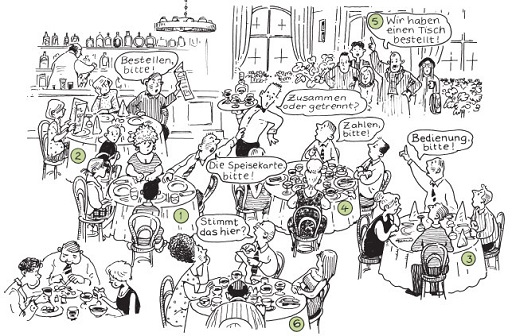
Two lists follow, match one item from the first with one item from the second. Each item can only be matched once. There are 6 items in each list.
Group 5
Group 3
Group 1
Group 2
Group 4
Group 6
Match each of the previous list items with an item from the following list:
a.This group wants a table they have reserved
b.This group wants to query the bill
c.This group wants the menu
d.This group wants to order
e.This group wants to attract the waiter's attention
f.This group wants to pay
- 1 = a,
- 2 = e,
- 3 = c,
- 4 = d,
- 5 = f,
- 6 = b
4.4 Your turn to order
Übung 30
Here is the menu at a restaurant:
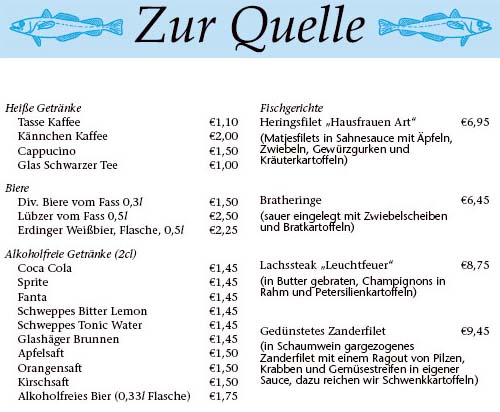
You decide to order fish at this restaurant. Begin by calling the waiter, then follow the cues in the audio extract.
Hören Sie und sprechen Sie. Hier ist ein Beispiel.
Sie hören: Rufen Sie den Kellner.
Sie sagen: Entschuldigung!
Transcript: Übung 30
Abschnitt 16
Bitte hören Sie und sprechen Sie.
(Rufen Sie den Kellner.)
Übung 31
Did you enjoy your meal? The waiter seems to have disappeared, so you ask the waitress (die Kellnerin) for your bill. You only hear the first cue in the audio, so use the notes below to guide you through the rest of the dialogue.
Hier ist ein Beispiel.
Sie hören: Rufen Sie die Kellnerin.
Sie sagen: Bedienung, bitte!
Transcript: Übung 31
Abschnitt 17
Bitte hören Sie und sprechen Sie.
(Rufen Sie die Kellnerin.)
I’d like to pay, please.
Excuse me, is this right?
But I had (ich hatte) fried herring!
OK, €10 – keep the change.
Conclusion
This free course provided an introduction to studying Languages. It took you through a series of exercises designed to develop your approach to study and learning at a distance and helped to improve your confidence as an independent learner.
This OpenLearn course is an adapted extract from a previous edition of the Open University course L193 Rundblick: beginners' German.
If you enjoyed this course, you might be interested in studying the Open University module L193 Rundblick: beginners' German. Or, if you are interested in other language short courses, rather than studying languages for a degree, you may want to have a look at what else is on offer here.
Take the next step

If you enjoyed this course, why not explore the subject further with our paid-for short course, Beginners German 1: fang an!?
Acknowledgements
Except for third party materials and otherwise stated (see terms and conditions), this content is made available under a Creative Commons Attribution-NonCommercial-ShareAlike 4.0 Licence.
The material acknowledged below is Proprietary and used under licence (not subject to Creative Commons Licence). Grateful acknowledgement is made to the following sources for permission to reproduce material in this course:
Course image: Jay Plemon in Flickr made available under Creative Commons Attribution-NonCommercial 2.0 Licence.
Figures
Übung 2 (top left) © Xeniel-Dia
Übung 2 (top right) Courtesy of German National Tourist Office
Übung 2 (middle): Geneve Tourisme/swiss-image.ch
Übung 2 (bottom left) Courtesy of the Austrian National Tourist Ofice
Übung 6 (clockwise) (1) © Mary Evans Picture Library; (2) Courtesy of Mary Evans Picture Library; (4) Courtesy of Shell; (5) © Mary Evans Picture Library; (6) © AP Photo/Roberto Pfeil; (7) © AP Photo/Rene Macura; (8) © AP Photo/Jacqueline Roggenbrodt
Übung 17 (top) Courtesy of Anna Lengenfelder.
Every effort has been made to contact copyright owners. If any have been inadvertently overlooked, the publishers will be pleased to make the necessary arrangements at the first opportunity.
Don't miss out
If reading this text has inspired you to learn more, you may be interested in joining the millions of people who discover our free learning resources and qualifications by visiting The Open University – www.open.edu/ openlearn/ free-courses.