Grammar matters
Use 'Print preview' to check the number of pages and printer settings.
Print functionality varies between browsers.
Printable page generated Friday, 3 April 2026, 1:25 PM
Grammar matters
Introduction
Many people believe that grammar matters hugely. For some, grammar matters principally because it is important to adhere to standards of accurate, clear and correct usage. Some people believe that the presence or absence of grammatical errors says a lot about the writer (for example, errors can signal ‘laziness’) and can provoke strong reactions. Another reason for considering grammar to be an important area of study is that, combined with vocabulary choice, it is our main way of making meaning. Linguists have studied the relationship between word and grammar choices on one hand and meaning or function on the other. This free course, Grammar matters, introduces you to one particular way of understanding how meanings relate systematically to different aspects of grammar – the functional approach of Michael Halliday and others, known as Systemic Functional Linguistics or SFL – and shows how this deeper understanding can be applied to make everyday communication more effective.
Halliday’s functional approach to the study of grammar is useful because it can enable us to better understand how written texts and spoken language work and how they relate to the context in which they are generated. In turn, this can enable us to develop our use of grammar to say what we mean more successfully, and so to make our speech, writing and other communication more effective. So, in this course you will see how studying grammar as a tool for meaning-making has numerous useful applications in the real world of professional practice and everyday communication.
This OpenLearn course is an adapted extract from the Open University course E304 Exploring English Grammar.
Brief definitions of words in bold can be found in the Glossary at the end of this course.
Learning outcomes
After studying this course, you should be able to:
understand that grammar can be seen as a flexible and useful tool for meaning making
understand how grammar and vocabulary choices together create a range of different meanings
see how an awareness of grammar as a tool for meaning-making can be applied to a range of real world situations in everyday life and professional practice.
1 Why does grammar matter?
In this introductory activity you will hear a short extract from an interview with Lise Fontaine, a Senior Lecturer in the School of English, Communication and Philosophy at the University of Cardiff. She is widely known for her work in Systemic Functional Linguistics, and is author of the book Analysing English Grammar: A Systemic Functional Introduction (Fontaine, 2013).
Activity 1: Why is grammar awareness important?
Listen to the interview with Lise Fontaine and then answer the following questions:
- What two reasons does Lise give for the importance of raising one’s knowledge about grammar?
- Do you agree with Lise? Can you think of any other reasons why it may be worth while studying grammar?

Transcript: Interview with Lise Fontaine
Discussion
- The first reason Lise gives for grammar being important is that success in almost anything means you need good communication skills, whether this is in your role as a parent, in your social relationships, when you negotiate a contract, or handle calls in a call centre. All these roles and tasks require flexibility and dexterity with language, and perhaps especially oral language. There is an implicit assumption in what Lise says that a dedicated study of grammar will provide someone with the understanding they need to develop such skills. The second reason given by Lise is that the age we live in – labelled by Lise as moving from the information into the digital age – puts communication in the hands of us all. Everyone has the possibility to use mobile technologies, Facebook, Twitter and to write blogs. This generates demand for a new kind of literacy – a digital literacy. And again, the assumption here is that a heightened awareness of what language can do is very useful in developing digital literacy skills.
- Lise argues persuasively for the value of grammar awareness particularly in the context of a world in which many more of us are text producers as well as readers. However, some would argue that, rather than focus on grammar per se, it is more helpful to think of language awareness, as the word ‘grammar’ can seem off-putting to some people. You may have come up with a number of other reasons why it may be worthwhile focusing on grammar – for example:
- the importance of giving a good impression of yourself as a writer
- enhanced ability to pass exams and succeed in job applications
- getting your message across clearly
- upholding proper standards of language use.
1.1 Different reasons why grammar matters
Why is grammar important? The next activity asks you to reflect further on different reasons for the importance of grammar.
Activity 2: A matter of life and death?
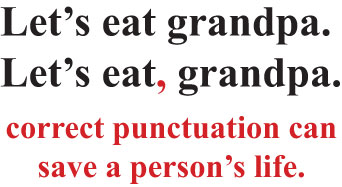
Consider the following piece of light-hearted punctuation advice, which popped up in numerous places on the internet when the author of this course searched for ‘grammar’ (19 January 2016). What message does it seek to convey about the importance of grammar?
Discussion
On one hand this grammatical joke is intended to suggest that grammar can be important because it is crucial to meaning, and that the meanings we convey in words have real consequences. The comma signals that Grandpa is the addressee of the imperative Let’s eat and so includes him as one of the ‘eaters’. Without it, Grandpa becomes the object of the verb eat: he is to be eaten. On the other hand, there is a strong element of tongue-in-cheek here which acknowledges that grammar is in fact rarely – if ever – a matter of life and death. In practice, unless these words were used following a fatal plane crash in a remote location, it is highly unlikely that the words Let’s eat grandpa – however punctuated – would be misinterpreted as an exhortation to cannibalise an older member of the family. In any case, these words are far more likely to be spoken, when intonation would take the place of punctuation in helping to make sure that listeners do not misinterpret.
We can use this example to illustrate that not all grammatical changes affect meaning. For example, if we left out the apostrophe in Let’s, which indicates that the u in us has been left out, there would be no loss or distortion of meaning. In this case, incorrect grammar would only be a superficial problem: it might make us question the attention to detail of the text producer, or even cause the reader to make negative social judgements about the writer, for instance, but it would have no significant impact on the substance of the message.
Another example of a superficial problem of incorrect grammar is the well-known extraneous ‘grocer’s apostrophe’. Although references to potatoe’s or pineapple’s may irritate some customers, it does not usually lead to misunderstanding.

Many of the debates about the significance of grammar and the importance of studying it involve some confusion between these two issues – a concern with ‘meaning’ on one hand and a concern with rules and standards on the other (though sometimes, of course, both concerns may be relevant at once). In this course we will be chiefly interested in the significance of grammar in making meaning, rather than with the formal rules of English for their own sake, or with the social connotations of ‘good’ and ‘bad’ grammar.
1.2 Meaning and consequences
The next activity asks you to look at a much more serious example of how grammar as a carrier of meaning can have serious consequences in the real world.
Activity 3: Grammar in the court room

Imagine you are observing a trial involving a child witness. A barrister is cross-examining the child. Consider these two alternative forms of questioning and use the blank text box to note answers the questions below.
Did you hit him first?
You hit him first, didn’t you?
- What differences in grammatical form do you notice between the two examples? (Don’t worry if you are not familiar with grammatical terminology, just note any differences in your own words.)
- What sort of response does each question call for?
- What potential problems can you foresee in the second example?
- Which do you think you are most likely to hear in a courtroom?
Discussion
- The first is a question or interrogative sentence. In the second sentence, the main clause of the sentence is an assertion, or declarative clause, followed by the question tag didn’t you?
- These utterances call for slightly different sorts of response. The first calls simply for an answer to the question, without proposing what that answer should be. The second makes a proposition and invites the other person to challenge the proposition.
- The second version potentially ‘leads’ the witness, who has to actively reject the barrister’s assertion if they wish to deny being the first to hit out. In the context of the courtroom the experienced adult barrister is in a very powerful position in relation to a young child in the witness box for the first time. By choosing this assertive wording in cross-examination, a barrister enacts their authority over the child and consequently there is a risk that the child will falsely agree to a proposition because they feel unable to challenge the ‘voice of authority’. This increases the risk of miscarriages of justice in such cases.
- It is difficult to be sure which question is most likely in a courtroom, and this will differ from one legal jurisdiction and culture to another. However, eminent members of the legal profession have argued that there is too much of the second type of wording in courtroom language where vulnerable witnesses are being cross-examined.
This example illustrates how different grammatical choices can have serious consequences. In 2013, Lord Judge, retired Lord Chief Justice of England and Wales, called for a major overhaul of the way in which children were cross-examined in court. In a BBC interview, he expressed profound concern for the 40,000 children a year who are called to give evidence in England and Wales in criminal proceedings, criticising the current system in strong terms (Today, 2013). One of the main reasons for Lord Judge’s objections hinged on the language that barristers acting for the defence were using to cross-examine child witnesses. In the example above, which was given by Lord Judge himself, the meaning of the declarative + negative question tag may be only subtly different to that of an interrogative clause. However, the difference is highly significant in terms of the social relationships in the exchange.
Activity 4: Grammar: form or function?
Think back to how you learned grammar at school, either in English or other languages you learned. What terms do you remember learning?
Discussion
Everyone will have their own recollections of grammar at school – not all of them positive! You may have made a note of learning such terms as noun, verb, pronoun, adverb and adjective. In some cases, you may have learned about past, present and future tense verbs. In some languages you may have learned about how to ensure agreement between verbs and nouns or pronouns, for example if they need to be plural or singular forms. In other languages you may have learned about word gender, i.e. whether a word is masculine, feminine or neuter, for example. Many of us would also have recollections of grammar as being about writing in complete sentences, using punctuation correctly, and so on. All of these terms are linked to an understanding of grammar as a question of form and structure rather than of function.
1.3 Functional grammar and its uses
Another way of understanding the importance of grammatical choice is to see it in terms of how language is functioning in any given text or interaction. For example, depending on the choices made in the courtroom case in Activity 3, language can function to intimidate and exercise power over a witness (or to reassure and empower them) as well as seeking information. This emphasis on function rather than form gives rise to the terms functional grammar and Systemic Functional Linguistics (known as SFL for short). A functional perspective holds that language looks the way it does because of the functions it fulfils, in other words, how we use it to make meaning. This perspective focuses on how forms perform a range of meaning functions, rather than on form in itself. The next activity explains further what this approach can offer.
Activity 5: The value of a functional perspective on grammar
In this activity you will listen to two brief extracts from an interview with the late Geoff Thompson, another well-known educator and researcher in the field of SFL. He is widely known and recognised for his work on functional grammar, and is author of the book Introducing Functional Grammar (Thompson, 2014).

As you listen, consider the associated questions.
1. What is formal grammar? What is functional grammar? How do they differ?
Transcript: Geoff Thompson interview (1)
2. In which other professional areas, apart from education, does Geoff suggest an increased knowledge of grammar might be put to use?
Transcript: Geoff Thompson interview (2)
Discussion
- To Geoff, formal grammar is the type of grammar that some people know about from school, which is often to do with being able to identity nouns and verbs, and breaking up a sentence into its parts. Functional grammar, by contrast, Geoff sees as having to do with understanding not just the constituent parts of the sentence but also what the sentence as a whole is doing.
- Geoff mentions the importance for advertisers, doctors and translators, among others, of increasing their understanding, not only of sentence-level grammar but also of meaning making through language as a whole. Advertisers, for instance, are able to manipulate language and persuade customers that they need a given product; doctors need not only to have medical knowledge but also to interact effectively and empathetically with the patients they are diagnosing; translators need to have an understanding of how different languages function in order to be able to translate between them. Geoff also relates how forensic linguists have used their linguistic knowledge to show how some historic alleged confessions from crime suspects were almost certainly tampered with by the police.
2 What do we mean by ‘meaning’?
The example from the law in the previous section shows that ‘meaning’ can be a more complex affair than we might normally assume. It’s not only about the dictionary meaning of the words used, for example, or about the logical function of an utterance. In the case of the cross-examining example, the second, more assertive style of questioning conveyed the speaker’s superior authority and so had an interpersonal element to it as well. This expanded view of meaning – as incorporating a range of functions, and involving more than just giving and receiving information – is a fundamental insight of functional linguistics, a field in which Michael Halliday was a major figure. Halliday proposed that language serves three overarching functions, which are always operating together.
Box 1 The three metafunctions
Ideational metafunction
We use language to talk about our experience of the world, including the worlds in our own minds, to describe events and states and the entities involved in them.
Interpersonal metafunction
We also use language to interact with other people, to establish and maintain relations with them, to influence their behaviour, to express our own viewpoint on things in the world, and to elicit or change theirs.
Textual metafunction
Finally, in using language, we organise our messages in ways that indicate how they fit in with the other messages around them and with the wider context in which we are talking or writing.
Language users will not normally be aware that the texts they produce and the interactions they engage in will perform all these three functions at one and the same time.
Activity 6: Three types of meaning

- In the brief utterance seen in the cartoon above, try to describe what is going on in terms of the three metafunctions. Write brief notes in the blank text box.
- How might these three different strands of meaning be altered with a change in the wording chosen by the speaker?
Discussion
- The speaker is reporting a specific experience of an event, which is that a vase has been broken (though as yet the speaker does not appear to know by whom, if we go by verbal clues alone) – this is the ideational metafunction. At the same time, the speaker is interacting with the child, by asking her a question to try to establish whether she was the person who broke the vase: this is the interpersonal metafunction. And finally, he is using language to organise his message so that it makes sense and fits into the wider context – for example, both speakers clearly know who the vase belongs to and so the word ‘her’ is used, reflecting the interlocutors’ shared knowledge. This is the textual metafunction.
The ideational meaning of the utterance could and would be changed if it were to reflect a different experience – for example, ‘her vase’ might become ‘my phone’ if the event were different. Or the speaker could focus on a completely different aspect of the same situation e.g. What a mess you’ve made. The interpersonal meaning could be subtly changed e.g. it could be more accusatory: You broke her vase, didn’t you? (Some might say that the visual image here fits better with that wording.) The textual meaning would change if, in the context, the father had instead written the daughter a note: ‘Amelia, I have just noticed the bits of vase lying on the floor. I want to know if that has anything to do with you. We shall talk when I get home. Dad’. This would be a more planned communication, and aspects of the situation (e.g. ‘on the floor’) would need to be put into words instead of being communicated non-verbally.
These three aspects of meaning are deeply intertwined and are not usually manipulated separately in this way: that is, we don’t normally change one metafunction without also changing the others. For example, in such a situation, the speaker could have chosen to focus on solving the problem (rather than finding out who did it) – which is predominantly an ideational dimension of the meaning and at the same time to emphasise solidarity, which is an aspect of interpersonal meaning, e.g. by saying We’d better clear this up before she notices.
Now that you have briefly been introduced to the three metafunctions, the next three sections of the course give you an opportunity to consider them in greater detail. In particular, you will get to see how they are related to the language choices people make in different contexts.
3 Ideational meaning – talking about what’s going on
In this section we focus on the language used to convey the speaker or writer’s perspective on and experience of ‘what is happening’: what is known in SFL as ‘ideational meaning’. Whenever we talk about events, we represent them in a certain way. There are almost always other choices we could make in our language which would result in a different representation of events.

Take, for example, the event represented in this image. This could be expressed verbally in different ways, for example:
- A young woman is photographing her brother.
- A young man is posing for a photograph.
Here we can see a difference in lexical choices (brother as against young man for example) and also a difference in the way the grammatical pattern represents the experience. In Example 1 we have a process in which two participants are involved: one that does the action (the agent – the young woman) and one that is affected by the action (her brother). In the clause in Example 2 we have a different process involving only one participant: the agent (A young man). The man is represented in Example 1 as the participant who is ‘acted on’ and in Example 2 as the agent.
Another contrast between the two representations concerns the action itself. In Example 1, is photographing has the central place grammatically as the verb. In Example 2, is posing is the verb that has the central place and the action of photographing is merely implied in the extra detail (for a photograph). The point is not that one version is better or truer than another, but that the two versions create slightly different meanings: they make subtly different interpretations of the same ‘reality’. Every time we say or write something that makes sense we are transforming experience into a particular pattern, and every time we do this we are making meaning – but not the only possible meaning. Just as our choice of words contributes to meaning, so does our choice of how we pattern those words. This is fundamental to understanding why our use of both vocabulary and grammar together (known as the lexicogrammatical system) is so important and also why a functional approach helps to focus on meaning.
3.1 Representing events
In the following activity you will explore a further illustration of the ideational metafunction: how different lexicogrammatical choices represent events in different ways.
Activity 7: ‘The Killing Time’

Read the following short text, which was part of an exhibition at the Australia Museum in Sydney. The text is about the arrival of white colonial settlers in Australia and its devastating consequences for the indigenous population. Make notes in the first text box about how the passage represents the Warlpiri people and the events which occurred.
When Europeans arrived, the way of life of the Warlpiri people was changed.
The best land was taken over by Europeans for cattle and sheep and the Aborigines had only the desert land to live in.
In 1928, a severe drought forced Warlpiri people from the desert. Some tried to get food and water on the better land and fights broke out. A large group of Warlpiri people were killed by Europeans. The Warlpiri refer to this as the Killing Time.
Those people who remained became dependent upon European society and were resettled at government controlled townships like Warrabri and Yuendumu. There, many people were alienated from their own country, their dreaming and their spiritual guardians.
Now look at the passage for a second time, paying particular attention to the verbs used to represent past events or processes. These have been highlighted using italics. Make a note of whether each verb form is active or passive, who is the agent and who is ‘acted on’ by the action represented by the verb in each case. In the second text box, make a note of whether this closer look has altered your interpretation of the passage.
When Europeans arrived, the way of life of the Warlpiri people was changed.
The best land was taken over by Europeans for cattle and sheep and the Aborigines had only the desert land to live in.
In 1928, a severe drought forced Warlpiri people from the desert. Some tried to get food and water on the better land and fights broke out. A large group of Warlpiri people were killed by Europeans. The Warlpiri refer to this as the Killing Time.
Those people who remained became dependent upon European society and were resettled at government controlled townships like Warrabri and Yuendumu. There, many people were alienated from their own country, their dreaming and their spiritual guardians.
Discussion
This passage was used by some Australian linguists and colleagues (Ferguson et al., 1995, p. 7) to explain to museum educators how their lexicogrammatical choices shaped the way they represented Australian history and culture to museum visitors.
They comment that the first impression given is that this is quite a progressive take on events. It acknowledges past violence by European settlers and appears to represent the Warlpiri point of view. There is no attempt to disguise who did the killing. On the other hand, closer analysis of the verb groups used in the passage provides a different perspective. The Warlpiri are often referred to as being affected by events rather than as agents (e.g. a severe drought forced [them] from the desert). Where the actions of the Warlpiri are referred to using active verb forms, the choices made convey a sense that their agency is limited (e.g. they tried to get food; [they] became dependent). Also, the most violent act referred to is written in the passive, lessening its impact: A large group … were killed by Europeans). The authors argue that the text unwittingly perpetuates a view of Australian history which subtly promotes cultural stereotypes and downplays the enormity of colonial violence. In doing so, they demonstrate that a detailed analysis helps to explain how ‘a particular orientation is constructed for readers’ (p. 7), even in a seemingly objective text. They show museum curators that they need to be highly conscious of their language choices in order to avoid giving unintentional messages.
Whether or not you agree with this particular interpretation or not is less important here than understanding how such choices matter when it comes to representing how the world is and what happens in it.
4 Interpersonal meaning – interacting with and relating to others
In this section we will look at interpersonal meanings by considering a communicative situation with which many of us are familiar: that between a teacher who marks a piece of written work and the student who has written it. As anyone who has received feedback on their writing will know, it’s not just the information that is conveyed – e.g. about the strengths and weaknesses of a piece of work – that is vital to the success of this interaction. How this information is conveyed is also very important, particularly because of the sort of relationship it sets up between the teacher and the student.
Activity 8: Communicating relationships in writing
Read the following lecturer feedback comment on an undergraduate essay then answer the following questions:
- What does this comment communicate about the social roles and relationship between student and teacher?
- Can you identify any aspects of the language that create this relationship?
- If you received this comment as a student, how do you think you might feel? Would you accept or resist such positioning?
You really have a problem with this essay, mainly for the reason that it is so incoherent. It has no beginning, middle and end, no structure, no argument … May I suggest very strongly that you go to the Study Centre and make more enquiries about essay-writing clinics.
Discussion
- This comment clearly constructs the lecturer (the feedback writer) as an expert, being in a position to judge the student’s work with little need for the polite language we often use when we wish to give advice or feedback to others. It also positions the student-reader as subordinate, and as someone with a ‘problem’ who needs to seek a cure at the ‘essay-writing clinic’.
- The language used here is very blunt. For example, the descriptive comment is made up of a series of plainly-worded statements (You really have a problem, it is so incoherent, It has no beginning … etc.) with no softening or hedging language. These bare assertions are presented confidently, with the assumption that the teacher’s evaluation of the text (and of the student) is beyond question – a matter of fact, rather than opinion. To help you see this point, imagine how different the effect of the comment might be if the teacher had written I think you may really have a problem… or I find the essay lacks structure. In these cases, the evaluative statements are preceded by the first person pronoun + a verb group which explicitly frames the teacher’s views as one possible opinion or response.
- I think most people would feel very deflated to receive this sort of comment on a piece of writing, though they might also feel a sense of resistance: I’m not sure this feedback would be guaranteed to get the student to pay a visit to the Study Centre. So the interpersonal meaning conveyed in this comment is likely to make it ineffective as well as disheartening.
This example illustrates how, even in a short text, the interpersonal metafunction can be a very significant element of meaning. It’s worth pointing out that the research on feedback comments from which this example was taken was conducted some time ago. In many institutions, including The Open University, this sort of interpersonally unhelpful feedback would no longer be considered acceptable, partly as a result of the work of researchers like Lea and Street, who collected this example.
5 Textual meaning – organising messages to make sense in context
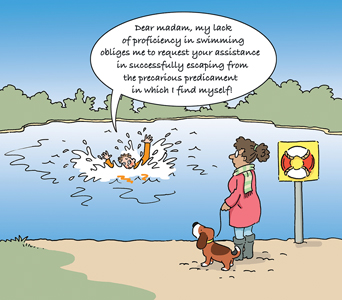
In this section we will look at how we organise our messages. This is an aspect of the textual metafunction. The lexicogrammatical choices we make not only construct a representation of experience (the ideational metafunction) and signal social roles and status (the interpersonal metafunction), but also provide a way of organising a message so as to make it accessible to the listener/reader, taking into account the context, channel and medium in which the text is produced. The first activity in this section is intended to show how language is packaged in order to help the reader make sense of what is being talked about. Three key questions can be asked about any act of communication which help to determine how it is or needs to be organised:
- Is it planned or spontaneous?
- Is it interactive or more of a monologue?
- Does the verbal message stand alone or does it work with other modes of meaning – e.g. images, pointing and gesture?
These three variables form a spectrum of possibilities which in SFL is called a mode continuum. At one end of this spectrum, face-to-face conversation would normally be spontaneous and interactive, and the verbal language used would normally be accompanied by physical gestures. In many cases, language might be taking second place, for example when it is mainly being used to accompany actions. At the other end, an academic article will be carefully planned, with no reader input, and with very few other modes of meaning (though in some cases, graphs, diagrams and charts may well be used alongside the words). This cartoon above plays on an apparent mismatch between the highly planned, wordy monologic mode of expression being used by the person in the pond and the apparent need for spontaneous, action-focused talk, given the situation.
However, there is no clear cut distinction between speech and writing. The mode continuum is the movement from more spontaneous spoken-like language to more formal, written-like language. Face-to-face informal conversation between friends may have characteristics similar to written communication between friends while a political speech may be organised in ways similar to newspaper reports. Communications via phones and the internet are useful in demonstrating the ways in which contextual variables, such as how well the interactants know each other, where they are, and the immediacy of response, can all work to blur the distinction between grammar in speech and in writing. For example, when exchanging text messages or chatting on social media, our language often reflects the relatively immediate timeframe and extent of contextual knowledge shared between participants, aspects which are often associated with conversation.
Take this brief exchange of texts:
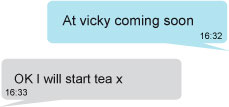
The second texter has responded knowing that in fact ‘vicky’ is the name of a nearby park (Victoria Park) and both participants are working on the basis that the communication will be almost instant, because the second person will be making a meal to suit the timing of the first person’s journey home ‘soon’. The way in which texts are nowadays represented on a screen, using speech bubbles, is an acknowledgement of their conversational nature, as is the tendency to omit any form of punctuation. Because of the way in which text messages automatically flag the sender’s name, there is no need for greeting or signing off, which is more like face-to-face conversation (where we know who is speaking because they are in front of us) than typical written contexts. On the other hand, there are features here that are associated with writing rather than speech – e.g. the first text message omits the personal pronoun ‘I’ and the verb ‘am’, which might be expected in speech abbreviated to I’m (though the pronoun is retained in the reply), and the second uses x to indicate affection (or a kiss).
5.1 It’s all in the packaging
In the next activity, you will look more closely at ways of organising messages, by analysing two different texts.
Activity 9: Comparing texts at different places on the mode continuum
Compare the two short texts below, paying particular attention to the noun groups that have been underlined for you. (Don’t worry about why some have not been underlined.)
- What differences do you notice in the way meaning is packaged?
- How do you account for these differences?
Text A: A storytelling text
(The speaker is describing a friend’s first skiing holiday. Dashes indicate hesitations or repetitions.)
He was coming down this – this track and he’s been a few times so he’s got some idea of it um so he said that he saw this slight rise so he said he headed up the rise and he found out it was a ski jump! he– he’d lost one ski at the top and eh apparently he was flying through the air with one leg up in the air with a ski on it and he landed head first in the snow but he caught his head his mate with him, he hit a tree on the way down came back all bruised and scraped …
Text B: An academic science text
The steady increase in life expectancy in human populations shows that longevity is a plastic phenomenon. Although lifespans are species-specific, they can be modified greatly by the environment as well as genes. For many human populations, the fixed three score years and ten allotted for human longevity are already but a distant memory. Much of this increase in lifespan has been achieved by improvements in public health, medical care and domestic circumstances. We are beginning to view ageing-related damage as a side-effect of other adaptive processes. This may allow us to reduce the impact of ageing-related diseases as the limits on human lifespan recede.
Discussion
A long, tightly structured unit at the start of the clause is not easily achieved in the dynamic context of speech, which allows no time for preparation and places a heavy information-processing load on the listener, so starting with an elaborate idea is not typical in speech. In Text A, therefore, the pronoun he is repeated throughout without any descriptive elements or elaboration about the person being referred to. A writer, however, has the opportunity to create such structures in a more considered way, free from the pressures of production in ‘real time’. Moreover, units in written text can be rapidly scanned by eye and so writers may compress more information into fewer words. Such units are described as ‘lexically dense’ as they have a high number of lexical words, words that carry the main content of a text. Lexically dense text is more easily understood when reading a written text than in the rapid processing necessary to understand spoken texts.
The frequent use of pronouns as participants in Text A reflects its subject matter – a story about a friend. On the other hand, Text B, as noted, has lengthy noun groups (e.g. the fixed three score years and ten allotted for human longevity, the impact of ageing-related diseases), which allows more information to be packed into these parts of the clause. Academic texts frequently have long noun groups as the readership is expected to be able to handle meanings compressed into such groups as a result of their familiarity with these types of texts and with the technical concepts of the field of study. The aim of the text is to move the argument forward as succinctly as possible. Information that can be taken for granted as understood therefore gets packaged up as long noun groups. The use of these abstract and often complex noun groups reflects the subject matter, while in Text A the nouns refer to the people and things that the story is about.
6 Summary of the types of meaning
In the last three sections of this course you have had an opportunity to consider the three different overarching types of meaning – or metafunctions – in turn. However, it is important to realise that these strands are always operating together in any text. For example, the scientific text you have just looked at is ‘packaged’ densely with information, and this is an aspect of the textual metafunction. At the same time, this sort of academic text, in which the focus is on relationships between phenomena, causes and effects and on evidence and logical arguments, also reflects a way of viewing the world in a scientific manner and so reflects typical ideational meanings of scientific texts. It also comes across as relatively impersonal, with only minimal use of personal pronouns, for example, and when they are used (‘we’, ‘us’); they have a rather generalised meaning. This is an aspect of the interpersonal metafunction. For definitions of these terms, see Box 1 in Section 2 ‘What do we mean by “meaning”?’
In the next section of the course, you’ll look more closely at this type of scientific text in the context of education, with a focus on the grammar of textual meaning.
7 Grammar in the real world
In previous sections of this course you have seen how a functional understanding of grammar can apply to a wide range of contexts. In this section, you will see how a functional approach, and particularly SFL, is being applied in a professional context, in this case secondary education. Shortly, you will learn about the work going on in an inner-city school in Birmingham, UK, to use functional grammar to improve student learning and achievement in their school subjects such as PE and Science.
First of all, however, it will be useful to introduce a particular aspect of grammar called ‘nominalisation’. This has been identified by functional linguists as an important feature of academic and scientific language, but one that can make scientific texts hard for learners to understand and produce scientific writing. The term will be explained as you work through the activity.
Activity 10: Raining cats and dogs

Compare these two short sentences and answer the following questions (note that the idiom ‘raining cats and dogs’ is used in British English to indicate heavy rainfall):
- What context might you expect each to have been produced in?
- What differences do you notice between the grammar patterns in each?
It got muggy really quickly and then it came down cats and dogs.
The rapid rise in humidity was followed by heavy precipitation.
Discussion
- You may have commented that the first sentence is more likely to have come up in spontaneous, informal, face-to-face conversation, where someone is telling a personal story to someone they know quite well. The second describes a similar event but seems to come from a weather report or some other scientific record of the event, and was probably written rather than spoken.
- There are a number of features you may have pointed out here. A key difference is in the way that information is packaged in each case. In the first sentence, a lot of the information is conveyed through the verb groups and adverb groups got muggy really quickly and came down cats and dogs, the noun groups are simple (e.g. made up of one pronoun) and there are two clauses linked by and. In the second, there is only one clause and one verb group was followed, which conveys information about the sequencing of events but not about what actually happened. Most information is instead conveyed through the noun groups A rapid rise in humidity and heavy precipitation. This can be shown as follows:
| Noun group | Verb group | Adverb group | Noun group | Verb group | Noun group | ||
|---|---|---|---|---|---|---|---|
| It | got muggy | really quickly | and | then | it | came down | cats and dogs. |
| Noun group | Verb group | Prepositional group |
|---|---|---|
| The rapid rise in humidity | was followed | by heavy precipitation. |
A compression of information has been enabled by the nominalisations humidity and precipitation.
This feature often seen in scientific and academic texts is called nominalisation. You saw a good example of it in Activity 9. Nouns and noun groups can be used to package meanings about entities in the real world – things or persons like mangoes, bluebottles, windowpanes, schoolgirls and clouds (often called concrete nouns). However, we can also use noun groups to talk about processes and qualities. If someone is leaving, for example, we can talk about their departure, and if they are feeling frustrated, we can talk about their frustration. Departure and frustration are both nouns, but they are not really ‘things’ in the way that a bluebottle or a windowpane is (they are often called abstract nouns). Nominalisation is the use of a noun to represent a process or quality. Through nominalisation, it becomes possible to pack into one noun group a number of meanings that might otherwise be expressed using verb groups and adverb groups.

This cartoon emphasises the fact that nominalisation can sometimes make language unnecessarily difficult and obscure. But in fact, without the ability to nominalise, i.e. to turn processes and qualities into nouns, it would be impossible to conceive of many common concepts such as ‘ownership’ or ‘movement’, or to measure abstract things such as ‘growth’, ‘birth rates’, etc. Below are some examples of processes in their verb form and their nominalised form.
| Verb form | Nominalised form |
|---|---|
| (to) evaporate | evaporation |
| (to) deliver | delivery |
| (to) arrive | arrival |
Nominalisation in scientific texts enables writers to describe the world and its phenomena in a particular way. It makes possible:
- the formation of technical terms that stand for complex but commonly occurring – and commonly understood – phenomena (e.g. reproduction, mutation, stability).
- the development of abstract concepts and properties.
When we use nominalisations, especially for abstract concepts and properties, we open up the possibility of precisely measuring and recording what was previously intangible. This makes nominalisation an important feature of the language of school subjects in which pupils need to learn how to understand the world of science, history, geography and so on in precise and more academic ways (for example, they need to be able to talk about the rise in humidity and heavy precipitation rather than about raining cats and dogs). In technical fields this is particularly useful, since so much activity revolves around measuring, comparing and ordering.
7.1 Subject learning in schools
In the next activity you will watch a video (which lasts 20 minutes). You’ll see two classes – physical education (PE) and science. The school where the action takes place is Hamstead Hall Academy, an inner-city school in Birmingham. Hamstead Hall is a secondary comprehensive school (pupils are aged 11 to 18 years) with a diverse school population. Fifty per cent of the pupils have an English as an Additional Language background and prior academic attainment on entry is, on average, significantly below the national average.
In the PE lesson, you will hear some terminology which comes from SFL and which has not been introduced in this course. The teachers are recapping a previous lesson and are using the concepts of ‘macro theme’ and ‘hyper theme’ to remind students of how to organise what they write at the whole text level as well as within individual paragraphs. You should not need an in-depth knowledge of these terms to make sense of what is going on here. This approach of giving students a metalanguage – that is language to talk about language – to help to scaffold their understanding of how language works is typical of the Hamstead Hall initiative. You may also have noticed that this is also the approach taken in this course!
In both classrooms you will also see examples of how students are being supported to use nominalisation to make their writing more scientific. The focus is partly on the lexical element – vocabulary – but also on the grammatical element of nominalisation and the way in which lexical choices and grammar patterns work alongside each other in technical and scientific writing. Aside from the classroom sequences, the video features the teachers talking about their experience of making language more central to their teaching and why and how the school developed a language and learning policy. The teachers you will hear from include Mark and Lee, two PE teachers who you will see co-teaching a lesson, and Alistair Clarke, a science teacher who you will also briefly observe. In addition, you will hear from Eileen Mawdsley, the assistant head, and Helen Handford, a literacy and language consultant to the school.
Activity 11: SFL in action: examples from the secondary school classroom
As you watch the video, make notes on any points that strike you in relation to the following questions:
- What in your view are the pros and cons of the approach being taken in this video?
- If you are familiar with an educational context, including your own schooling or that of your children, how could this approach be applied to that?
- How far does this example of grammar awareness in practice back up Lise Fontaine’s claim, which you heard at the beginning of this course, that grammar is at the centre of everything we do?

Transcript: SFL in the classroom
[Recap of previous lesson]
[Modelling and deconstruction]
[Joint construction]
[Independent construction]
Discussion
- There are certainly a number of very positive claims made in the video about this approach. In particular you may have noticed head teacher Eileen Mawdsley’s emphasis on how the approach has enabled students to take control of language for themselves and to be independent autonomous communicators who can judge how to use language in different contexts, both inside and outside school. Eileen was also particularly insistent that, by becoming more aware of how language works, rather than students losing their creativity or criticality, the inverse occurs. On the down side, it’s clear that this kind of approach requires teachers of different subjects to really take on board their responsibility for teaching children to write in their subject. This seems to involve a new mindset and considerable training, meaning that the whole approach may take a long time to fully embed in a school.
- You may be able to recollect experiences at school where you felt you understood some of the concepts being taught, but found it hard to express these in a scientific manner. Perhaps the technical vocabulary in some subjects put you off. The Hamstead Hall example provides evidence that difficult language issues across the entire school curriculum needn’t be such a barrier. The idea that PE teachers, for example, would be engaged in supporting students’ literacy, may seem radical but there is a lot of evidence that it is not helpful for schools to leave language learning and development only to the English department.
- This example is school-focused, but it does show that attention to grammar and language awareness can be of great use in a range of different areas of human activity and knowledge. If we extend this notion to the later stages of education and training – to university studies, professional and vocational training and beyond – it is not difficult to see how awareness of grammar can play a central part in our communicative lives at home, in the community and at work.
Conclusion
This free course, Grammar matters, has introduced you to a particular way of understanding grammar, focused on what language does, rather than on what it is. Because it is concerned with grammar as a way of making meaning (i.e. what it does), a functional approach to grammar can be particularly useful for understanding how language works in real-world contexts. Additionally, you’ve seen that the expanded view of meaning proposed by Halliday and other SFL scholars, which takes into account the ideational, interpersonal and the textual dimensions, enables a functional grammar approach to be used as a tool for intervening to address communicative issues in people’s lives. You’ve learned, for example, about how the insights of SFL can be applied to legal and educational contexts.
We hope this free course has given you more insight into the relevance of grammar to everyday and professional life, and has gone some way towards convincing you that grammar matters.
Glossary
- active
- An active clause contains an active verb group with a subject which is the agent of the main verb, i.e. carries out the action, e.g. The dog bites.
- adverb group
- A group of words used together with an adverb as its head, for example the italicised phrase here He was completely and utterly insensitive.
- clause
- A grammatical unit consisting of a verb phrase together with any associated elements such as subject, object or adverb group.
- context
- The situation in which an utterance is used.
- declarative clause
- A clause that most commonly functions as a statement, e.g. He read the book in a week.
- ideational metafunction
- One of the three metafunctions in SFL, this is the overarching function of language which expresses experience or ideas. It describes how we use language to talk about our experience of the world, including the worlds in our own minds, to describe events and states and the entities involved in them.
- imperative clause
- A clause with no subject, typically used for commands, e.g. Wake up! Put your clothes on!
- interpersonal metafunction
- One of the three metafunctions in SFL, this is the overarching function of language which enacts social relation. It describes how we use language to interact with other people, to establish and maintain relations with them, to influence their behaviour, to express our own viewpoint on things in the world, and to elicit or change theirs.
- interrogative clause
- A clause that most commonly functions as a question, e.g. Did he read the book in a week?
- lexical
- Relating to lexis, i.e. to the vocabulary of a language.
- lexical verb
- A ‘content’ verb, i.e. which carries informational content, such as walk, study, swim.
- lexicogrammatical choice
- The choices of wordings that people make to convey their meaning. This involves deploying lexis in particular grammatical patterns.
- mode continuum
- The spectrum of ways of communicating, ranging from more spontaneous spoken-like to more formal, written-like language.
- noun
- Nouns represent ‘things’ whether these be concrete objects, places and people or abstract ideas. They may be either countable (e.g. penny, egg, idea) or uncountable (e.g. money, sugar, information).
- noun group
- A group of one or more words which together function as a noun e.g. regulations, plenty of fresh orange juice, a long wait for the bus.
- object
- In a clause, the object is the participant that is affected by the action indicated by the verb. For example, in Everybody hates Chris, the object is Chris, and in Please bring some identification with you, the object is some identification. This is sometimes called the direct object, to distinguish it from the indirect object.
- passive
- A passive verb group typically consists of be followed by a past participle, e.g. is protected, has been repainted. A passive clause contains a passive verb group, and has a subject which instead of carrying out the action, is affected by it, e.g. Gandhi was assassinated.
- prepositional group
- A unit in which a noun group is linked into the clause by a preposition.
- pronoun
- Pronouns are one of the closed word classes, and typically stand for or replace a noun group. Common examples are: I, you, he, it, they, we, us, herself, these, another, somebody, anyone, nothing. ‘I’ ‘me’ ‘mine’ ‘we’ ‘us’ and ‘ours’ are first person pronouns because they relate to the speaker or writer when referring to themselves.
- question tag
- A question attached to the end of a statement; often a positive statement is followed by a negative question tag and vice versa, e.g. You hit him first, didn’t you?
- subject
- In a clause, the subject is the participant that carries out the action indicated by the verb. For example, in Everybody hates Chris, the subject is Everybody (Everybody does the hating).
- text
- In certain branches of linguistics, a text is any piece of language, whether spoken or written, which forms a unified whole (however short or brief). Texts can be written, spoken and multimodal e.g. email, greetings card, text message, transcription of a conversation, magazine article, screencast.
- textual metafunction
- One of the three metafunctions in SFL, this is the overarching function of language which relates meaning to context. It describes how we organise our messages in ways that indicate how they fit in with the other messages around them and with the wider context in which we are talking or writing.
- verb
- Verbs represent actions or states. They typically occur in finite and non-finite forms; e.g. She started to walk away, where started is a finite form and to walk non-finite. A verb is also a compulsory element in a clause, indicating what process is involved; this may be an action, event or situation, e.g. The referee blew the whistle; It was snowing last night; The soup tastes good.
- verb group
- A group of one or more words which together function as a verb, e.g. has been waiting, will vote, may be delivered.
References
Further reading
Acknowledgements
This course was written by Jackie Tuck.
Except for third party materials and otherwise stated (see terms and conditions), this content is made available under a Creative Commons Attribution-NonCommercial-ShareAlike 4.0 Licence.
The material acknowledged below is Proprietary and used under licence (not subject to Creative Commons Licence). Grateful acknowledgement is made to the following sources for permission to reproduce material in this free course:
Every effort has been made to contact copyright owners. If any have been inadvertently overlooked, the publishers will be pleased to make the necessary arrangements at the first opportunity.
Images
Course Image: courtesy Jackie Tuck.
Figure 1: © The Open University
Figure 2: © unknown
Figure 3: courtesy Jackie Tuck
Figure 4: ilbusca/Getty Images
Figure 5: © The Open University
Figure 8: © akg-images.
Figure 11: ©_Gearsolid/iStockphoto.com
AV
Video: Section 7.1: © The Open University
Don’t miss out
If reading this text has inspired you to learn more, you may be interested in joining the millions of people who discover our free learning resources and qualifications by visiting The Open University – www.open.edu/ openlearn/ free-courses.