Language and creativity
Use 'Print preview' to check the number of pages and printer settings.
Print functionality varies between browsers.
Printable page generated Tuesday, 17 March 2026, 3:56 AM
Language and creativity
Introduction
This free course, Language and creativity, looks at linguistic forms of creativity and at how creativity can be understood in different contexts of language use. We begin by asking what linguistic creativity is, how it can be defined and how it can be studied. It will also touch on why it might be important to know more about linguistic creativity in the first place.
This OpenLearn course is an adapted extract from the Open University course E302 Language and creativity.
Learning outcomes
After studying this course, you should be able to:
understand key issues in the relationship between language and creativity
understand some of the different ways that linguistic creativity can be studied
understand the importance of creativity in human communication.
1 Defining creativity
The terms ‘creativity’ and ‘creative’ are used in a variety of contexts. There are creative artists, thinkers, writers, designers and entrepreneurs; there can be creative talent, ideas, processes and minds. Creativity can be boundless and spontaneous, but it needs to be unleashed, fostered, stimulated and expressed, though sometimes it may be stifled. Creativity is also strongly associated with imagination, innovation, originality and genius. Similar lists and descriptions can be found in many discussions of the concept (e.g. Pope, 2005; Carter, 2011; Pope and Swann, 2011), and it is an area studied in a number of disciplines.
Psychologists and neuroscientists are investigating creativity to find out more about its relationship with the mind and the brain; ethnographic work is being done to explore its role in society; linguists are exploring creative language to understand more about how people communicate; and commercial organisations are constantly trying to find ways of making themselves and their employees more creative. Given this wide-ranging interest in the topic, it might be reasonable to assume that it is clear what ‘creativity’ means. But this is not necessarily the case: you will find that each field and discipline defines creativity slightly differently, and takes a different approach to investigating it.
Let us start by considering what we understand by creativity in relation to the use of language.
Activity 1
Look at the six examples given in Figure 1. On first reading, which ones do you think are creative? Which ones are not? Is it easy to put them into these two categories?
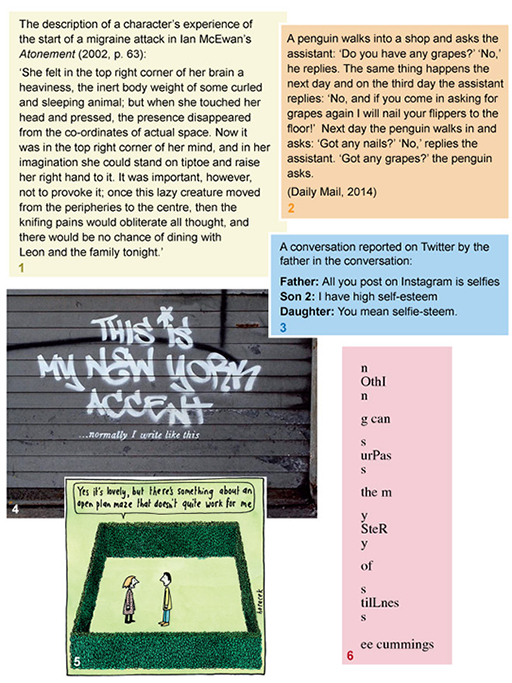
Look over them again and think about what made you decide that some of them are creative and others are not. What aspects of the examples suggest creativity?
Discussion
Your answers may differ from these, but we thought that the Atonement extract (example 1), the poem (example 6) and possibly even the cartoon (example 5) are creative. The joke (example 2), on the other hand, didn’t seem very creative. But how did you classify the tweet (example 3) and the graffiti (example 4)? Perhaps the binary distinction of ‘creative’ and ‘not creative’ feels too restrictive. We would say that examples 3 and 4 are perhaps less creative than the poem (example 6), but more creative than the joke (example 2).
There are several things that you could have considered when making your decisions. You might have asked yourself, ‘What kind of text is this?’, and decided that example 1 is creative because it is from a novel and that example 6 is creative because it is a poem. You might also have thought about what the examples look like and decided that example 6 is creative because of its unusual form (depending on what you’re comparing it to).
You might have looked in more detail at the language of the examples: perhaps you noticed metaphors in example 1 (e.g. ‘lazy creature’), the new word – or neologism – in example 3 (‘selfie-steem’) or repetition in example 2 (e.g. ‘Do you have any’, ‘Got any’). Maybe you noticed the humour in the apparent contradiction between ‘open plan’ and ‘maze’ in example 5. You might also say that the combination of words with images in example 5 – a mixture of different modes of communication – is also creative. Perhaps you thought about how long the examples took to produce, or how long lasting they might be. From this perspective, you might have decided that examples 3 and 4 are not creative: they probably didn’t take a lot of time to ‘invent’ and can be quickly forgotten, or example, 4 even painted over. But what if you looked at a caption and saw that example 4 is by Banksy – an award-winning graffiti artist? That might be enough to put it into the creative category. You could also say that there is creativity in Banksy’s use of two different fonts to represent two accents.
What about the effects of these examples on you? Did examples 2, 5, and perhaps 3, make you laugh? And would it matter if they only made you laugh but no one else? Did example 1 make you see pain differently and did you empathise with the character? Did you find the language beautiful? Perhaps these emotional effects on you could be considered to be instances of creativity.
Thinking about points such as these can reveal a surprising amount about how communication works, what it is for and how, as a society, we evaluate our world.
1.1 Questions to be addressed
In the discussion to Activity 1, I have intentionally raised a lot of questions and provided only tentative answers. At this stage, the important point to note is that linguistic creativity can be viewed in various ways. Later in the course we will look at three particular ‘lenses’ through which linguistic creativity can be explored: the textual, contextual and critical lenses. Each brings into focus different types and dimensions of linguistic creativity, and can be used simultaneously (or in succession) to view the same examples in different ways. With the help of these three lenses, I will consider the following questions:
How can linguistic creativity be identified?
What is it (definition)?
What are the important factors involved in its production and consumption?
2 What is linguistic creativity?
While this course takes language as the starting point for exploring creativity, it is useful to begin by considering a general definition of ‘creativity’. A currently dominant view in the fields of design, technology and the arts in the Western world is that something is creative if it is novel, of high quality and appropriate to the task at hand (Kaufman and Sternberg, 2010). In linguistic terms this could be a neologism or an uncommon metaphor used successfully to communicate a complex concept or idea – such as ‘lazy creature’ to talk about a migraine in example 1 in Figure 1 (see Activity 1 in Section 1).
While this definition represents a particular view of creativity – a view that perhaps encourages a focus on the creative product, rather than the process – it is important to note its (somewhat problematic) implications. First, novelty refers to the idea that the product of creativity has to be something ‘different, new, or innovative’ (Kaufman and Sternberg, 2010, p. xiii). Kaufman and Sternberg, however, do not make explicit on what basis one decides whether something satisfies those criteria. What should the frame of reference be – that is, different, new, innovative compared to what?
Second, high quality suggests that someone somewhere needs to evaluate this new ‘thing’ as good, but it doesn’t specify who is qualified to make such a judgement or how they are meant to do so. The frame of reference seems to be important here too. Finally, appropriacy also seems to be an entirely relative concept. The creative ‘thing’ has to make sense or be useful for a particular context. These qualifications are important to bear in mind throughout this book, but the Kaufman and Sternberg definition is still a good starting point for discussion. Although not everyone will (or should) subscribe to it, the issues it raises are useful ways of thinking in greater depth about the topic of creativity.
2.1 Creativity as ‘novel, high quality and appropriate’
How does this definition work with what we looked at in Section 1?
Activity 2
Look back at the six examples in Figure 1 in Activity 1. Does the Kaufman and Sternberg definition – ‘novel, high quality and appropriate’ – apply to the examples that you classed as creative? Are the three aspects of this definition easy to apply to these examples?
Discussion
You might have different views on this, but I can see novelty in the language of Atonement (example 1) and in the shape of the poem (example 6), but I find it harder to decide whether the joke (example 2), the graffiti (example 4) and the cartoon (example 5) are new – I don’t feel I know enough. The issue of quality is even fuzzier: I personally think that example 1 is good writing and I don’t particularly think that the joke (example 2) is a very good one. Yet the joke was classed as one of the UK’s top jokes by the Daily Mail (a British tabloid newspaper) in 2014, so clearly others disagree.
Who decides what is high quality and valuable? Appropriacy is also an interesting criterion: are the form and content of the poem (example 6) appropriate for poetry, for instance? When I presented this example to a class of students, they generally appreciated the interesting new form, but were unconvinced by the content, and actually came to the consensus that it didn’t qualify as poetry. So can we agree that it’s inappropriate and therefore not creative, or should we try to see whether it’s appropriate in a different way or in a different context?
Attempting to apply the Kaufman and Sternberg (2010) definition of creativity to a few linguistic examples still leaves quite a few questions unanswered. Generally speaking, examples of linguistic creativity that might satisfy the criteria of novelty, quality and appropriacy most easily tend to come from works of ‘literature’, such as example 1 (Atonement) in Figure 1. In fact, for some time the dominant view was that it was mostly the language of literature that could be creative. ‘Formalist’ scholars, for instance, believed that the language of literature was different from other uses of language, such as everyday conversation, and that it was possible to pinpoint what made the language of literature ‘literary’. ‘Literary’ and ‘creative’ in this sense could be considered synonymous. More recently, linguistic scholars, such as Tannen (1989), Crystal (1998), Cook (2000) and Carter (2004), have argued that the types of linguistic creativity (e.g. metaphor, neologism, repetition, puns) found in traditional literature are also abundant in everyday communication and worthy of academic study in that environment. At the same time, the relative natures of ‘novel’, ‘good’ and ‘appropriate’ suggest that the creativity of language will depend on context and the perspective from which one is ‘looking’. In fact, everyday uses of language can be creative in many more ways than just in specific lexical choices or patterns.
2.2 Creativity in everyday language
In this section you will listen to an interview with Professor Ronald Carter, in which he discusses creativity in everyday language use.
Activity 3
As you listen to the interview with Professor Ronald Carter, consider the following questions:
- What different types of linguistic creativity does Carter identify?
- How does Carter’s notion of linguistic creativity fit with Kaufmann and Sternberg’s definition?
- Why does Carter think it is important to study linguistic creativity?
- What does he suggest are the differences between everyday creativity and creativity in literature?
Transcript: Professor Ronald Carter on creativity in everyday language
Discussion
Carter highlights two main types of linguistic creativity, both related to patterning: repitition and breaks with pattern. He suggests that repetition can be found, for example, in the type of rhetorical communication used by politicians, but it can also be a way to build a relationship or show interest in what someone is saying.
As we have seen, Kaufmann and Sternberg (2010) suggest that something is creative if it is novel, of high quality and appropriate to the task in hand. Carter found examples of people being creative in everyday language to entertain, be playful, criticise, or make a point more forceful. His examples illustrate language use that is appropriate to the task and novel in the sense that the speaker has adapted the language for a particular purpose and context. However, it is debatable whether he would agree that all the examples of creativity in everyday language he has found would be considered of ‘high quality’.
Carter suggests that it is important to study creativity because it tells us something about how and why we communicate, showing that communication is more than just conveying information – it is also interactional and interpersonal, helping to build relationships. By studying language creativity we begin to understand the contexts where it is used. In this way we come to understand more about the relationship between playful language, context and people.
Carter seems to suggest that creativity in everyday language is brief and ‘spur of the moment’, whereas literary creativity grows ‘organically’ through a text, perhaps over several pages or chapters in a novel or in different stanzas of a poem. He does, however, warn that ‘literature’ means different things to different people and so there are different understandings of what counts as ‘literary creativity’.
3 Three lenses with which to explore linguistic creativity
This section introduces the three ‘lenses’ referred to in Section 1 as ways of exploring different dimensions of linguistic creativity in all types of text.
As mentioned above, traditionally, linguistic creativity was associated with canonical literature, where it was assumed that literary language was categorically different from language used in more everyday contexts. This assumption led to efforts by a group of scholars, known as the Russian Formalists, in the early twentieth century to try to identify the characteristics of literary language. Although the view that literary language and everyday language are fundamentally different is no longer the dominant view (Jeffries and McIntyre, 2010), these early investigations into the properties of literary language nonetheless resulted in influential ways of describing, comparing and analysing language itself as creative. This forms the basis of the first lens for exploring linguistic creativity: the textual lens.
Work from the latter half of the twentieth century onwards, in the fields of linguistic anthropology and sociolinguistics, highlighted the idea that human communication is more than just language itself. The social, cultural and historical context within which communication takes place interacts with how communication happens and what it is for. Communication is not just a simple transmission of information, but a way of achieving things: building and maintaining relationships, and constructing identities and the world (the context) around us. It is also fundamentally interactive. Such an appreciation of the inextricability of language from its context of use gives us the second lens with which to view linguistic creativity: the contextual lens.
The final lens also comes from an appreciation of context, but it questions the values and assumptions embedded in that context. This is the idea that concepts, definitions, the things around us and our reactions to them need to be ‘unpacked’ in order to be properly understood. Some of the questions in the previous discussions of examples fall into this tradition: Who decides what counts as good or appropriate? What are the broader societal effects of linguistic creativity, and how is it valued? This is the critical lens.
3.1 An animated look at creativity
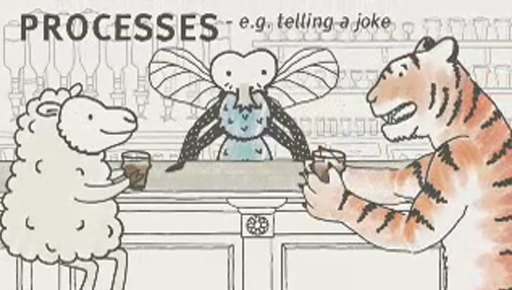
In the next activity you will watch a short animation, which summarises many of the points we have discussed so far, and gives a further explanation about the three lenses and how they can be used to look at acts and processes of creativity.
Activity 4
As you watch the animation below, pay particular attention to the notion of the three Ps: products of creativity, processes of creativity, and the purposes of creativity. Look out also for the Kaufmann and Sternberg definition of creativity, and its strengths and weaknesses as a means of understanding the concept.
Transcript: Language and creativity: a short introduction
4 Language and art
In the second half of this course we look at a particular context for linguistic creativity, which we can use as an example of some of the ideas we have discussed above. The context we focus on here is the ways in which language is used in – or sometimes alongside – works of fine art. We will look at what one might call ‘language art’ or ‘text-based art’ (works of art which involve language as a key part of their composition), and assesses how language operates in these contexts. One of the reasons for looking at this is that language art is, by definition, an explicitly ‘creative’ act or product. It is a forum where the way in which language is creatively used is purposefully to the fore and presented as something for the viewer to contemplate. To put it another way, one of the defining features of art is that it is presenting itself (or, more accurately, someone is presenting it) as art. It is understood as the product of a creative act, and thus its use of language becomes, by implication, an explicitly creative use of language. Consequently, examining how language is used in this context is a way of looking at a particularly creative type of language use. In our exploration of what is understood by ‘linguistic creativity’, language art presupposes from the outset that what is being done falls within this category.
4.1 The use of language in works of art
Let us now look at some of the key ways in which language can be used in works of art.
Activity 5
Have a look at the following three works and consider the different ways in which language is being used in them. What functions does it have in these pictures, and how does the relationship between text and visual image differ between the three of them?
Discussion
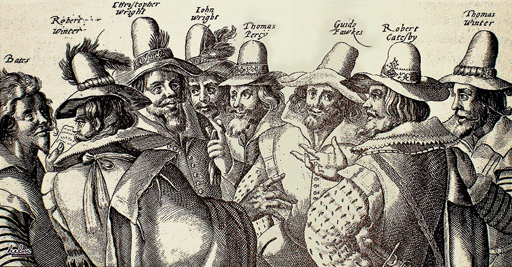
Figure 2 is an image of an engraving of the men responsible for the Gunpowder Plot – the failed attempt by a group of English Catholics to blow up the Houses of Parliament in 1605. It was made by the Dutch artist Crispijn van de Passe the Elder soon after the actual event, and is the only known contemporary representation of the conspirators. Guy Fawkes (the most famous member of the group) can be seen third from the right and next to him the group’s leader Robert Catesby. We know this because each member is identified by name. Text in this picture, then, is being used to enhance the visual image – it adds a further layer of meaning which the visual mode itself could not adequately provide.
Discussion
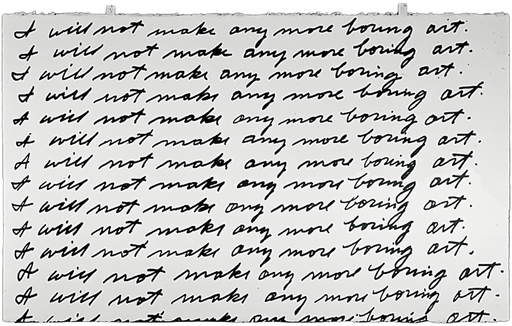
Figure 3 is quite different. Here text acts as the main element of the composition. The work is by the Californian artist John Baldessari, who has been one of the leading figures in the development of conceptual art since the mid 1960s. The painting consists entirely of the one sentence, ‘I will not make any more boring art’, written out in cursive handwriting, down the length of a piece of paper. The design clearly mimics a school punishment – the repetitive writing out of a commitment not to engage in a particular act of bad behaviour in the future – and in his notes about the origin of the work, Baldessari explicitly refers to it as a ‘punishment piece’ (Curator Chrissie Iles on John Baldessari’s I Will Not Make Any More Boring Art, 2010). The genre of the written text is thus very familiar. However, the fact that it is on display in a gallery, plus the way the content of the statement references the act of creating works of art (rather than, for example, failing to hand one’s homework in on time), combine to produce its creative effect. Here, then, in terms of both the content of what is written and, crucially, the form in which it is written (the cursive handwriting, the repetition, etc.), text is being used as the primary resource for the work of art.
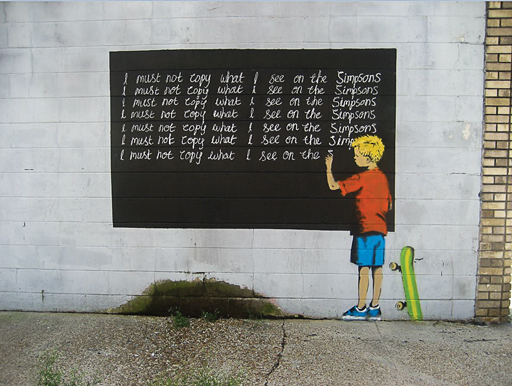
As a side note, the appropriation and recontextualisation (the uprooting of a sign or text from its original context and placing it in a new context) of a familiar genre of text, such as school lines, is an oft-used technique in art. Figure 4, for example, shows a work by the street artist Banksy which uses a similar conceit. Here, again, it is the juxtaposition of form, content and context that creates the effect. This work alludes to the opening sequence of the US animated series The Simpsons, in which the character Bart is found copying out a different sentence at the beginning of each episode. Banksy, here, uses the same composition and colour scheme as The Simpsons, simply replacing the cartoon-like image of Bart with a slightly more realistic representation of a child; and, just as Baldessari’s work acts as a commentary on the nature of contemporary art (especially within the context of the emergence of conceptual art in the 1960s), so Banksy’s piece is an ironic commentary on the influence of pop culture on street art, as well as the way in which ‘copying’ can itself be a creative act. In passing we might note that the contextual lens is of foremost value here in our interpretation of the effects of these works.
Discussion
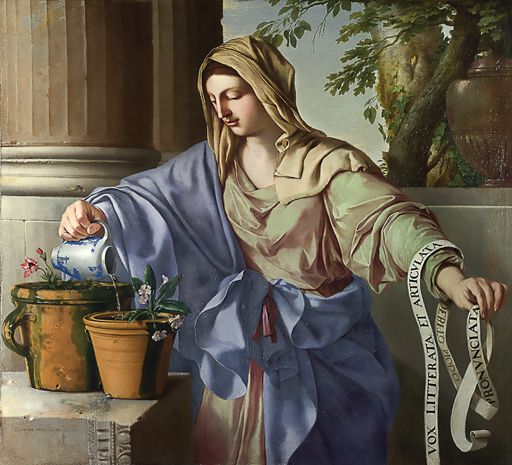
Figure 5 is different again in terms of the way in which language is used. Language is a feature of this painting in two specific ways. On the one hand, the picture includes a limited amount of text on the scroll draped over the woman’s arm. On the other hand, though, language – or at least a particular element of language – is also the subject of the painting, as the scene it depicts is an allegorical representation of the personification of grammar.
Along with logic and rhetoric, grammar was one of the three subjects that formed the basis of a medieval university education; their centrality for teaching and learning led to a tradition of allegorical representations of them. The three subjects were often depicted as women, in keeping with the feminine gender of the Latin nouns dialectica, rhetorica and grammatica. In this picture, painted around 1650 by the French artist Laurent de La Hyre, grammar is portrayed as a young woman tending a garden and cultivating the young blooms in her care. The idea here is of grammar as nurturer; an alternative tradition that was also popular had grammar as disciplinarian, wielding a rod or switch to help regulate her charges.
As noted, as well as an aspect of language comprising the subject of the painting, there is also a small use of text within the composition itself. Draped over the arm of the woman is a scroll which reads ‘Vox litterata et articulata debito modo pronunciata’ (‘A literate and articulate voice, pronounced in a correct manner’). This acts as a motto for the allegorical figure, defining the meaning of grammar as it is understood in this tradition. In other words, the text supplies additional meaning to the painting, though in a slightly different way from the names in Figure 2.
Adam Jaworski (2014), drawing on the work of Roland Barthes (1977), identifies two particular ways in which written text is often used in works of art. These are the concepts of ‘anchorage’ and ‘relay’, and they correspond well to the contrasting use of text in the two pictures in question. Anchorage is a process by which the meaning of the visual image is pinned down by the text: ‘the written text [is] used to “fix” the relatively indeterminate and polysemous meaning of the visual image’ (Jaworksi, 2014, p. 136). In Figure 2, the different members of the group are named and, as a result, each figure’s identity is tied down by the verbal caption. Relay, on the other hand, involves the text extending or elaborating on the meaning of the image. Thus, the scroll in The Allegorical Figure of Grammar offers a further gloss on the role that the figure plays – complementing, and also extending, the meaning depicted in the scene itself.
The three works of art you have looked at come from different eras and traditions, and in each of them language and text are used in slightly different ways. However, in all of these examples text is included within the frame of the composition itself. The art historian John Dixon Hunt categorises works of this sort as using language explicitly – that is, they are instances of pictures where ‘words, decipherable and meaningful by their own account outside the graphic medium, are included in or on the visual artwork’ (Hunt, 2010, p. 17).
5 Jeremy Deller: Juxtaposing genres
Having discussed different ways in which language is used in art, let us now concentrate on the work of one particular artist in order to examine in more detail some of these issues. The example I wish to focus on is the work of the British artists Jeremy Deller.
Deller has described his work as being a form of ‘social surrealism’, a way of foregrounding ‘how strange [the] everyday can be, and amazing, weird and odd’ (Deller, 2012). This term plays on the notion of ‘social realism’: the art movement highlighting and critiquing the everyday social conditions of the ordinary working person. Although Deller is not referencing it directly, it also parallels a movement from the USA in the 1930s, which drew on European surrealist techniques that were current at the time and applied them to social commentary and critique (Fort, 1982).
A technique that was favoured by artists in this earlier social surrealist movement was the juxtapositioning of incongruous images, something which Deller himself practices: ‘that is what art is often about … juxtaposition disrupting reality’ (Deller, 2012). Again, as we shall see, the contextual lens is key to our understanding and appreciation of the work, as much of its meaning and impact comes from the way it interacts with the context in which it is positioned.
5.1 Juxtaposing genres: Example 1
One of the ways in which Deller uses juxtaposition to disrupt reality, especially in his early work, is by merging two forms of communicative genre: placing the content of one within the form of another, to create playful but provocative social imaginings. Figure 6, for example, takes the form of a poster for an imaginary literary event at the British Museum dedicated to the work of the former frontman of The Smiths, Morrissey. By bringing two cultural worlds together – the high culture of the literary event and the popular culture of popular music – Deller highlights the relative value given to the two in society and the arbitrariness of how different cultural projects are framed by different discourses.
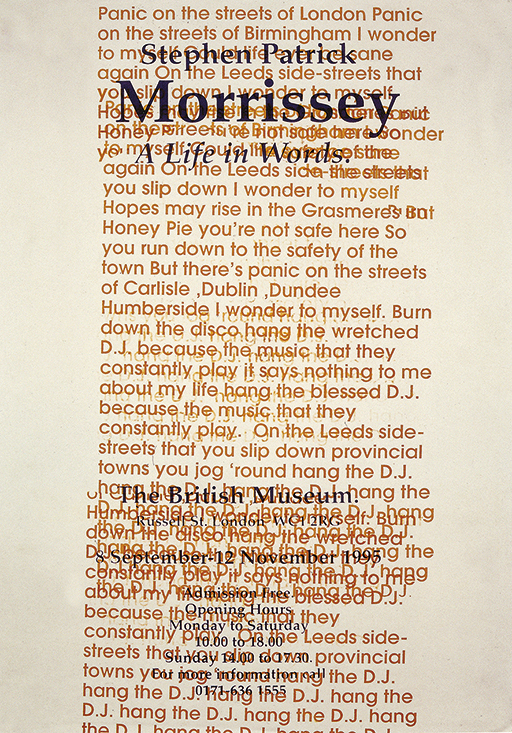
As a side note, at the time of creating the work, back in the mid 1990s, the incongruity encoded in the poster would have been more marked than it is now. In the intervening years this incongruity has lessened to the point where Morrissey’s autobiography was (albeit with a certain knowing irony) published as a Penguin Classic in 2013, alongside canonical figures such as Flaubert, Dostoyevsky and Wilde. As Deller says, ‘Exhibitions like this [i.e. dedicated to the work of Morrissey] are actually being staged now, but at the time it was just absurd to think they would ever happen’ (Deller, cited in Rugoff et al., 2012, p. 44).
5.2 Juxtaposing genres: Example 2
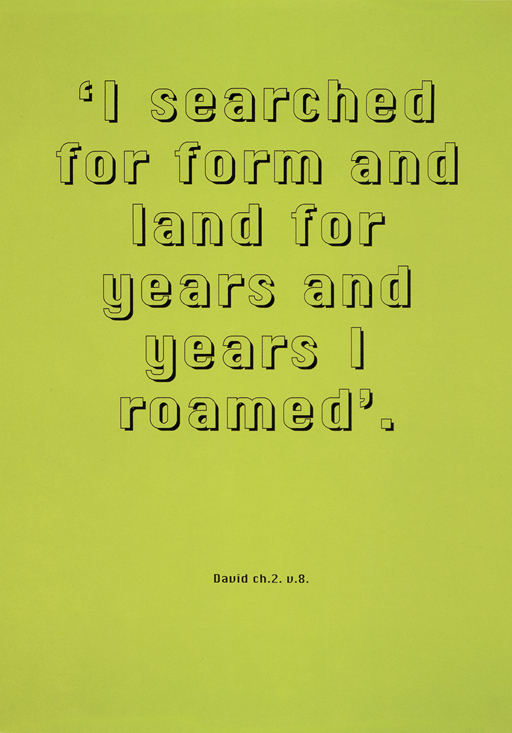
A similar mix of genres is at play in Figure 7. Here the layout of the text suggests a verse from the Bible, and the colour, size and formatting resembles the sort of posters which are often displayed on the outside of churches, with a slightly evangelical bent. The text of the quote, however, is once again from popular music – in this instance a song by David Bowie. The small print at the bottom ‘David ch[apter].2. v[erse].8’, which mirrors Biblical referencing, is actually here referring to the fact that the text is taken from Side 2, Track 8 of one Bowie’s albums. The combination of the two genres thus acts as a commentary on the way in which this form of popular music rivals the meaningfulness of spiritual quotations for many people today.
5.3 Juxtaposing genres: Example 3
The final example of juxtaposing genres, Figure 8, is in the form of a calling card or invitation which was traditionally used as part of the ritual when the aristocracy visited one another. However, the card purports to be from a group of football hooligans – rather than from members of the aristocracy – thus producing a clash of social cultures (while also possibly referencing the fact that football ‘firms’ in the 1980s often did leave ‘calling cards’ with their victims). Deller sent these cards out to 50 teenage peers selected from Debrett’s Peerage & Baronetage. As Rugoff writes, ‘More than clever gags, these works succinctly (and humorously) rais[e] questions about how different groups in society stage their allegiances and declare their status’ (Rugoff et al., 2012, p. 10).
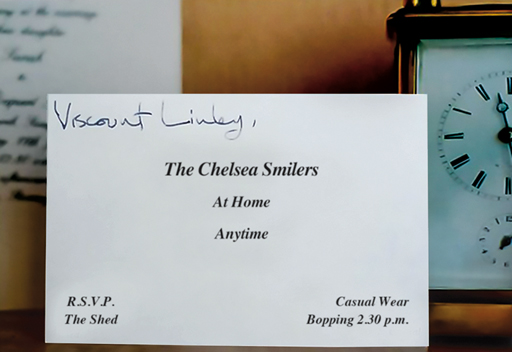
Fundamental to the way all these works operate is that domains have particular discourse and text genres, which are composed of elements such as text organisation, font, colour, etc. The conventions associated with communication in these genres cue us into expectations about the meaning and function of the texts; however, by putting a particular type of message into an unfamiliar genre of presentation, Deller brings about an unsettling, or at least thought-provoking, effect. This is, in a sense, a form of defamiliarisation, making the familiar unfamiliar pushing us to see the world around us afresh. All these imagine a different social reality and in this way make us re-evaluate (or see afresh) the social reality we do live in.
5.4 Interview with Jeremy Deller
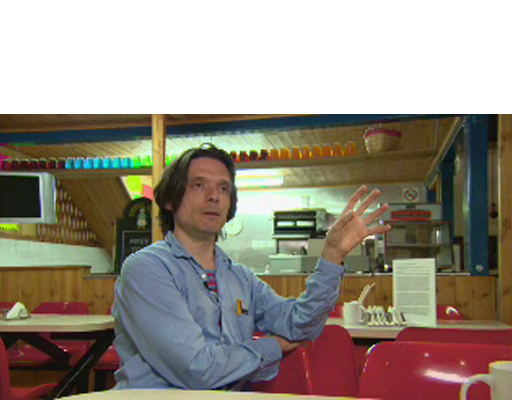
In the next activity Jeremy Deller discusses his interest in language and its use in his work.
Activity 6
As you watch the video below, consider the following questions:
- What does he mean when he says his work is ‘this + this = question mark’?
- In what ways is context important, in his view, for art?
- Why does he see art as being like a conversation?
Transcript: Jeremy Deller on the use of language in art
Discussion
In this video Deller explains how he sees his work as playing with different forms as a way of subverting expectations, and thus shifting one’s sense of reality. He approaches it as a sort of experiment: if I juxtapose this thing with that thing, what new effect will this achieve? Context – where something is staged or exhibited – and the meaning drawn from that context, is always therefore an important issue for him; however, as he says, context has been key throughout the history of art. For example, the fact that Renaissance paintings were exhibited in church settings is important for the function they had in cultural life.
He considers his work as operating as a conversation: first, because it’s a two-way process between artist and viewer; second, because it’s also a conversation with himself – a means of trying to work something out in his mind via a process of internal dialogue and negotiation.
Conclusion
In this free course, Language and creativity, we have discussed the definition of ‘creativity’, considered some of the main ways it relates to language use, and looked at approaches to analysing this use in society and culture. Although scholars disagree about many things when it comes to creativity, there seems to be some recognition that, in one form or another, it is something that is central to human activities (e.g. Carter, 2004; Pope, 2005; Richards, 2010). Language is not only something that everybody uses, but something that permeates all aspects of our lives. Using language, we discursively construct versions of our identities and the world around us, thereby shaping the reactions, views and behaviours of our audiences. Some texts make us laugh, cry or become angry, while others create, maintain or undermine relationships, social conventions and institutions. Linguistic creativity is a particularly salient way of achieving these effects, making it a lively and interesting focus for investigating communication. Therefore, the more we understand creativity, the more we understand ourselves and the contemporary world.
References
Acknowledgements
This free course was written by Philip Seargeant and Zsófia Demjén, with additional material by Penny Manford.
Except for third party materials and otherwise stated (see terms and conditions), this content is made available under a Creative Commons Attribution-NonCommercial-ShareAlike 4.0 Licence.
The material acknowledged below is Proprietary and used under licence (not subject to Creative Commons Licence). Grateful acknowledgement is made to the following sources for permission to reproduce material in this free course:
Every effort has been made to contact copyright owners. If any have been inadvertently overlooked, the publishers will be pleased to make the necessary arrangements at the first opportunity.
Images
Figure 1(1): from Ian McEwan's Atonement 2001, p. 63, published by Vintage.
Figure 1(2): Penguin joke, © unknown.
Figure 1(3): © unknown.
Figure 1(4): Banksy, courtesy of Banksy/New York 2013.
Figure 1(5): © Judy Horacek.
Figure 1(6): © 1963, 1991 by Trustees for E E Cummings Trust from Complete Poems 1904-1962, EE Cummings , edited by George J Firmage. Used by permission of Leveright Publishing Corporation.
Figure 2: from: http://commons.wikimedia.org/wiki/File:The_Gunpowder_Plot_Conspirators,_1605_by_Crispijn_van_de_Passe_the_Elder.jpg.
Figure 3: from http://whitney.org/Collection/JohnBaldessari/2007121.
Figure 4: © Banksy.
Figure 5: http://commons.wikimedia.org/wiki/File:Laurent_de_La_Hyre_-_Allegorical_Figure_of_Grammar_-_WGA12311.jpg.
Figure 6: from: Jeremy Deller, Morrissey: A Life In Words, 1995, p. 47 of Joy in People catalogue, written by Deller, J. (2012) Joy in People, London, Hayward Publishing.
Figure 7: Jeremy Deller, Quotations, 1995 (David Bowie) from p. 50 of Joy in People catalogue, written by Deller, J (2012) Joy in People, London, Hayward Publishing.
Figure 8: Jeremy Deller, Open Bedroom, 1993, The Chelsea Smilers mail-out, installed in the Deller family home, p. 10 of Joy in People London: Hayward Publishing.
AV
Video : Activity 6: © The Open University. Content in video Courtesy Jeremy Deller video.
Don't miss out
If reading this text has inspired you to learn more, you may be interested in joining the millions of people who discover our free learning resources and qualifications by visiting The Open University – www.open.edu/ openlearn/ free-courses.