Week 4: Introduction to social science
Use 'Print preview' to check the number of pages and printer settings.
Print functionality varies between browsers.
Printable page generated Saturday, 4 April 2026, 10:33 PM
Week 4: Introduction to social science
Introduction
Welcome to Week 4 of the course. The first week divided the range of subjects that it is possible to study at university into three broad areas:
- arts and humanities – these included the topic that this course explored in the last two weeks
- social science – your focus for this week and next
- science, technology, engineering and mathematics (STEM) subjects, which includes science and maths.
In the following video, Jonathan Hughes, the author of the social science parts of the course introduces Week 4:
Transcript
Social sciences until the early nineteenth century were really part of philosophy. However, as countries like the United States, France Germany and the UK moved from being agricultural to industrial societies there was a greater need to address the problems and issues that came about from this change. This led to a number of disciplines like sociology, economics and psychology separating out. To take sociology as an example, the Penguin Dictionary of Sociology (Abercrombie et al. 2000) points out that sociology literally means ‘the study of the processes of companionship’. Although people have always been interested in how their society worked the actual term ’sociology’ was first publicly used by Auguste Comte in 1838. According to Abercrombie et al. (2000),
Comte thought that sociology was a science employing observation, experimentation and comparison, which was specifically relevant to the new social order of Industrial Europe.
Many of these issues are very similar to those faced in the early twentieth century by countries like China and India as they become industrial nations.
This approach to social science is referred to as positivism and seeks to develop general laws to explain how societies work. This approach has been subject to different sorts of criticism. In particular there is a lot of debate within the social sciences as to whether it is possible to explain events or whether a more realistic goal is to try and arrive at a more rounded understanding. Another important criticism has been that positivism does not really take into account the intentions or motivations of individuals.
One really fascinating aspect of the social sciences is that we are all social scientists – we have to be to manage our everyday encounters with other people. Just walking down a busy street requires a high level of understanding of what people are likely to do.
This might sound like a rather grand claim. However, we all need to know how other people are likely to behave in different social situations if we want to get through each day without too many bumps and bruises.
We are also social scientists in everyday life because we have ways to deal with social encounters.
This week you will:
- start to identify the subjects grouped as social science
- begin to think about how social science can be used to think about everyday events
- understand and apply the concepts of identity and stereotyping
- explore aspects of cultural identity and group belonging
- understand how using a spider diagram can develop your study skills.
1 Social science and the everyday
I suggested in the introductory video that beginning to see the world as a social scientist adds another perspective – it makes the world an even more fascinating place. Please have a go at the activity that follows and which shows that social science thinking can even be applied to everyday encounters.
As you work through this week of Taking your first steps into higher education you will find that there is the same emphasis on doing activities as there was in the first three weeks of this course. All the authors share a conviction that learning at university level has to be active. The activities are a vital part of your work as they enable you to build on what you already know and to integrate new understanding.
Activity 1 Sometimes people do bump into each other
This activity is an opportunity to see how much you already know about everyday social encounters. The activity is also a chance to see how a distinctive social science approach can build on this understanding.
Watch this very short (11 second) video.
Then answer the following questions:
- Why do you think the two women bumped into each other?
- How do you think they felt about colliding?
- What did they do to ‘repair’ the situation?
- How else could they have reacted?
Discussion
My first thoughts were about how a topic like this is approached at university:
Did asking questions about this minor collision seem an odd thing to do? In some ways it probably is. Although there may often be times when we wonder about the meaning of things that happen, that’s not necessarily the same as posing questions about everything. The simple act of asking questions about what might be going on is an essential starting point in most academic disciplines, not least social science.
However, to get back to my thoughts about the questions I asked you, I think the woman the camera was following was walking quite slowly and the woman who came in from the left carrying the bottle did not seem to see her.
Of course, if the camera had been following the other woman we might have a different perspective on this. I also found myself building up a story. The woman we followed still had her coat on. Perhaps she was thinking about a meeting she was going to and didn’t spot the other woman until it was too late. It wasn’t so clear about the other woman who we only saw at the last minute. Perhaps she was taking the bottle of water to a meeting and was thinking that she needed to get back into her meeting. If this was the case perhaps she was thinking about other things and did not notice the other woman.
I think both women were a little embarrassed. The woman carrying the cup was surprised.
I thought that they attempted to resolve the embarrassment through apologies and by making a little joke about it. They also reached out to touch each other.
They could have been annoyed rather than embarrassed and tried to blame each other.
The other thing that surprised me was that I had to keep looking back at the video. To begin with I thought the woman in the coat was walking really fast and that the other woman was carrying a cup of coffee. When I checked back, neither was true.
The video clip lasted just 11 seconds. But just think how much went on in this small fragment of time.
To deal with the encounter in the corridor the two women drew on a huge amount of knowledge about what to do to deal with the situation. We apply this knowledge (sometimes called ‘implicit knowledge’ to our interactions with other people. Social scientists are interested in studying these same interactions but they draw on other ways of understanding apart from implicit knowledge. You will come across these as you work through this course.
1.1 Identity
Within these interactions we tend to have a very strong sense of ourselves as separate, even fixed, individuals. In social science terms we are fairly sure of our own identities. The same applies to fictional characters. To be believable they have to have identities we can understand.
A good example of this is provided by Popeye’s signature song. Popeye began life as a cartoon character in 1929. Popeye made his first animated appearance in Betty Boop Meets Popeye the Sailor in 1933. Popeye is clearly very sure of who he is, 'I yam what I yam'.
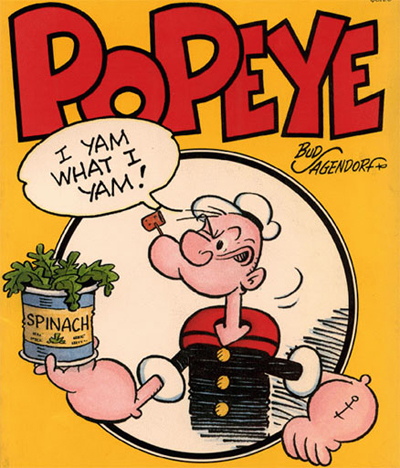
Read the words of Popeye’s song and then do the activity that follows.
Popeye’s Signature Song
I'm Popeye the Sailor Man, I'm Popeye the Sailor Man, I yam what's I yam,
And that's all what's I am, I'm Popeye the Sailor Man
I'm Popeye the Sailor Man, I'm Popeye the Sailor Man, I yam what's I yam,
And that's all what's I am, I'm Popeye the Sailor Man
I'm Popeye the Sailor Man, I'm Popeye the Sailor Man, I'm strong to the finich,
'Cause I eats me spinach, I'm Popeye the Sailor Man
I'm one tough gazookus, Which hates all palookas, What ain'ts on the up and square,
I biffs 'em and buffs 'em, An' always out-roughs 'em,
An' none of 'em gets no-where
If anyone dares to risk my 'fisk', It's 'boff' an' it's 'wham', Un'erstan',
So keep 'good behavior', That's your one life saver,
With Popeye the Sailor Man
Apparently ‘gazookus’ was an expression popular in the USA on the East Coast during the beginning of the 20th Century. Somebody could refer to another person as a lout or a fool by using it. During the 1920s, ‘the real gazookus’, could be translated as the real thing or the genuine article. ‘Palooka’ apparently means either an incompetent or easily defeated athlete, especially a prize-fighter or a stupid or clumsy person.
Activity 2 What makes up Popeye’s identity?
The activity is a fairly light-hearted way of helping you to think about the different things that can make up someone’s identity.
Read back through the lyrics and make a list of the different things that seem to make up Popeye’s identity as far as he is concerned.
Discussion
Again, starting with a focused question about aspects of identity has had the effect of getting me to think from a social science perspective. Once I started thinking in this way, I was surprised by how many different aspects there were. This is my list:
Popeye’s identity seems to be linked to:
- job (sailor)
- gender (he’s a sailor man)
- his body (which is strong) and how he uses it, particularly his ‘fisk’ (fist) to ‘biff’, ‘buff’ and ‘boff’
- his accent and use of language suggest quite a lot about his nationality (American) and even his class.
Popeye also identifies himself as a ‘real gazookus’ which meant that Popeye felt able to identify someone else as a palooka and if this palooka didn’t ‘keep “good behaviour”’ then his response would be ‘boff’ and ‘wham’.
1.2 How social science thinking works
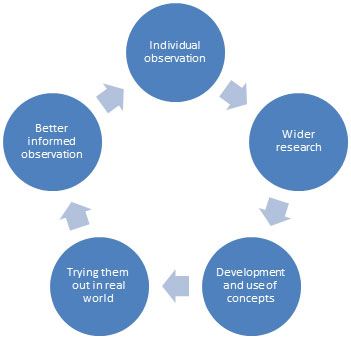
I’ve been using Popeye’s song lyrics and the short video of the two women bumping into each other to provide useful pointers about how social science thinking works. Basically it’s about starting with an observation about something and seeing if it’s possible to arrive at a better understanding than that provided by everyday knowledge.
This means that social science often starts with a particular observation or individual example but then sets out to explore what is often taken for granted. The concept of identity is a great example because it is widely discussed and debated in social science and we all have our own ideas about our own identity and the identities of other people – about who we are and who other people are.
Social science recognises that we all have identities but then poses questions like:
- How are identities created?
- Are we completely responsible for creating our own identities?
- What other factors might play a part in shaping identity?
This course looks at some of these factors so you see how a social science approach can help develop your understanding
Social science thinking differs from everyday thinking in another important way – it is generally part of a cycle of enquiry:
2 Social science: individuals and identity
We have already begun to make a start on exploring how social science approaches identity.
In social science, identity has two aspects:
- the sense of self you have (‘who I am’)
- the way that you are understood by others (‘who she/he is’).

The second of these highlights that social science does not treat individuals in isolation. It is more interested in how they belong to social groups, how these groups shape the identity of an individual, and how that identity is communicated between people. (This is, of course, why it is called ‘social’ science.)
So the next section is a chance to think about how individuals develop their identities through belonging to particular cultures and groups.
2.1 Cultural and group identities and belonging to groups
Society is made up of countless numbers of different social groups. The members of each social group share something that marks them out as a member of that group. This ‘something’ also highlights differences with other groups. ‘Culture’ is a frequently encountered word in social science and is used as a way to describing shared:
- behaviours
- attitudes
- values
- ways of understanding the world
- tastes in things such as food, entertainment and art.
Differences in ‘culture’ show themselves in all sorts of ways, including how people behave if they bump into each other.
It’s worth noticing how the word culture is being used in a social science way here. Culture has a huge range of often quite vague everyday meanings. But when social scientists use the word they will try to make it clear what they mean.
A nice example of cultural differences is how people greet one another.
Watch this short video in which these cultural differences are approached from an American perspective:
Getting the greeting culturally ‘wrong’ can cause embarrassment so people try to get them right and it is helpful to have some idea of what cultural norms are. These norms are sometimes formalised as etiquette which was originally a list of how people were supposed to behave in the French royal court of the eighteenth century.
From an American point of view when French (or even British) people meet, they often kiss acquaintances on the cheek. In contrast, Americans are more likely to shake hands. These different behaviours are considered appropriate depending on which group you belong to and the culture of that group. So some French person may not kiss anyone and some Americans may insist on hugging strangers, but you will probably agree that some behaviours are more common within a group or culture.
In social science terms this means that:
- belonging to a group will shape how we act, and even how we think
- but not everyone who belongs to a group is the same.
2.2 Group membership
If you are a member of a group, you share a connectedness or common culture with other members of that group and, in some way, you differ from those who are not members.
In some groups membership is quite formal, as when you are a member of a club and have a membership card. However, for most social groups membership is more informal and comes about because of where someone lives or as a result of something that has happened to them.
‘Mothers’ are a good example of this. There is no membership card required but someone who is a mother is more likely to share ways of seeing the world that differ from those who are not mothers. Mothers are also seen by society as a single group which can mean that they are assumed to share characteristics. For example most mother are assumed to care for their children, so only ‘bad’ mothers do not.
These ideas about mothers are the basis of the humorous take on mothers in this video:
Informal membership also connects people who use social networking websites and media such as Facebook. As members of this group, they share common behaviours such as ‘poking’ friends, sharing photos and writing on each other’s walls. They might also share ideas about the importance of virtual connectedness and may believe that having an online element to their social life is important. In these ways they share a common culture.
However, this does not mean that all Facebook users are the same or that they all use Facebook in the same way or with the same frequency. Another way in which Facebook users will differ is that different users will below to a range of other groups. For some, these other groups will be far more important than being on Facebook. So each individual will have their own personal combination that reflects their personal identity.
2.3 Spider diagrams
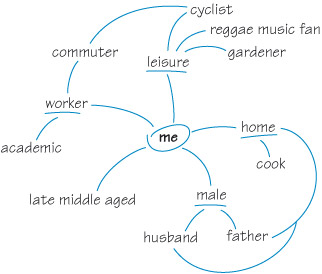
Spider diagrams are simple ways of displaying information and can be quickly created and easily adapted. The purpose of the spider diagram below is to display information about an individual’s group membership: the title is ‘Belonging to many groups’. What information can be understood from it? Three of the groups are ‘male’, ‘leisure’ and ‘worker’. Leisure is subdivided into groups which include gardening and cycling. There is a link between cycling as a leisure activity and cycling as a means of commuting to a place of work. From all the information given, it is possible to say that this spider diagram has been drawn by a ‘late middle aged’ family man, who cooks some meals at home when not gardening, cycling or playing reggae music. He works as an academic and he commutes to his place of work by bike.
Figure 3 is an example of a spider diagram.
Activity 3 Who am I?
This activity is designed so that you can apply the idea that individual identity is built up from membership of different groups. Think about the different groups you consider yourself to be part of. A useful starting point is family relationships, friendships, work, hobbies, interests.
Don’t forget being a learner on this Open University badged open course!
Then create a spider diagram in your notebook to illustrate how these connections work. Start, as in Figure 4, by putting yourself in the centre of the page using the word ‘me’. Then, for each group you belong to, begin a new branch from the centre and label it. If you want you can also have a further level of groups, linked to the main groups by more branches.
You may want to show a connection, a branch line, between groups as illustrated in Figure 4 between cycling for leisure and cycling as a means of commuting.
Comment
Were you surprised at the number of groups you were able to put into your diagram?
Do you belong to overlapping groups? For example if you identified yourself as a woman you may have put ‘sister’ as a group, but sister belongs too in a ‘family’ or ‘home’ group if you have one.
Whatever you included in your spider diagram, the experience of belonging to many groups, and the diverse cultures associated with them, will contribute in different ways to your sense of who you are, or, to put it another way, your identity.
You have been looking at how your identity is in part derived from the social groups you belong to. You have also briefly considered how behaviour or lifestyle can demonstrate membership of a group.
This raises an interesting question: if you can ‘see’ your own identity through the way you belong to different groups, then perhaps other people can see that identity too. You will consider this in more detail next.
3 Communicating connections
A key skill in the social sciences is to stop and look at everyday life, at what we might usually take for granted, and then try to explore it to find out more.
You will develop the skill of stopping and looking at what is taken for granted throughout the course and not just in the social science weeks.
Think back to the beginning of this section, which discussed the different ways that individuals greet one another. When you greet someone, you are communicating something about your identity and which groups or cultures you feel connected to. You are, in a sense, telling the rest of society where you feel you belong. It is very difficult, in fact, to do or say anything that does not give away clues to your cultural identity.
One form of behaviour which marks out how people belong to a culture is the way people stand (close or far away) with other individuals. Edward Hall (1966) recognised that the physical distance between people, known as interpersonal space, reveals a great deal about relationships. The better you know someone, the closer you stand to them.
Hall identified four types of interpersonal space which are illustrated in Figure 5. Intimate space is the tightest bubble around a person and only closest family and intimates can enter it. Other family members or close friends can enter personal space, and acquaintances or colleagues can enter social space. Public space would be occupied by those unknown or not known well to the individual.
Hall’s approach is very typical of social science. It probably came as no surprise that people ‘distance’ themselves from people they don’t know very well. But Hall then explored this notion with research and was able to suggest different sorts of ‘space’. These suggestions can then be tested out by further research.
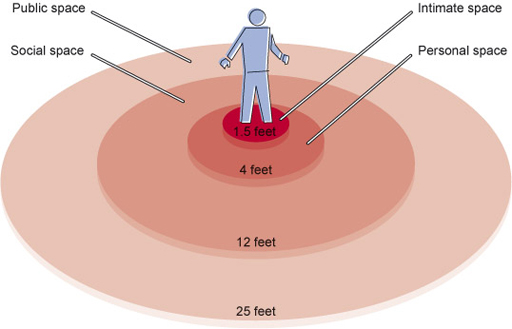
While carrying out his research, Hall further noticed that different cultures prefer different distances apart for personal space. This has been borne out by research which compared the distances adopted by couples from Japan, Venezuela and the USA. This research found that the Japanese couples tended to sit furthest apart, while Venezuelans tended be closest together. Americans were somewhere in the middle (Sussman and Rosenfeld, 1982).
3.1 Appropriate space
Knowledge of what is seen as the appropriate space between people is important in any culture. It helps avoid embarrassing mistakes such as standing too close to someone.
Our knowledge about appropriate interpersonal (between people) space is implicit or tacit – it is understood without being stated.
However, there are situations in which these rules are broken.

Apart from being crowded together, in life there are also times, for example in health and social care and when working with children, when it is important to be very aware of the interpersonal space they are supposed to maintain with others. Health care practitioners, for example, need consent before crossing the boundary into someone’s intimate space. In these circumstances knowledge has to be stated or explicit (rather than tacit).
Our behaviour gives out a constant stream of clues which can be ‘read’ by others. For example, if someone leans away from you, you may well move a step back yourself because you recognise their discomfort with being close. But it is also possible you may label them as being ‘oversensitive’ or ‘stuck up’. This is a judgement made on very little evidence and can lead to what is called stereotyping.
4 Stereotyping
Stereotyping is another idea (or concept) which is important in social science. It means having a fixed idea about an individual on the basis of knowing which group they belong to. Stereotyping can be harmful and lead to conflict because it depends on assumptions about, and simplifications of, an individual’s cultural beliefs and attitudes.
You have actually come across examples already in this course. For example, Popeye stereotypes ‘palookas’ and, more seriously, society has stereotypes about ‘good’ and ‘bad’ mothers.
Using stereotypes distorts how we think about situations. It leads to assumptions that are based on very limited information about a person, such as their age or gender (not just whether they are a palooka).
Stereotyping tends to overlook the fact that most people will feel connected to a collection of cultures and belong to a number of groups. These connections and memberships play a very big part in making up our identity. If you are aware of only one part of an individual’s identity, you will be missing out on crucial information about who they are and how they see themselves.
Sometimes the groups and cultures an individual feels connected to can appear in the first instance to be very diverse and lead to what appears to be a very complex identity. To illustrate this complexity, read the case study in the next section.
4.1 Piecing together an identity
As you read the case study, concentrate on the different social groups that an individual, known as Barry, seems to belong to, and the various cultures he has a connection through his family members. You should look out for places these family members have lived but also their education, class and ethnic origin. We have presented some of this information in the form of a spider diagram (Figure 7) which puts ‘Barry’ in the middle and then shows his family members around the outside.
Barry
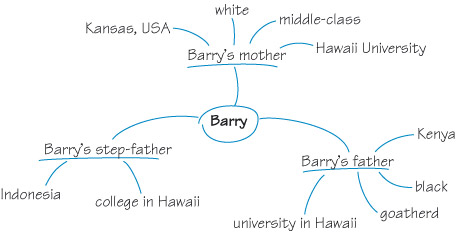
Barry’s father He was born in Kenya and for a time worked as a goatherd in his village. However, he showed ability in his schooling and with the support of his teacher and family he won an educational scholarship to the USA. He was the first black student at the University of Hawaii. He had little contact with Barry after the age of 2 as he returned to Kenya to be a senior government adviser.
Barry’s mother She was born in Kansas, USA, from a white middle-class background. She had a good education, a comfortable home and also went to university in Hawaii where she met her husband to be, Barry’s father. However the two were divorced when Barry was young and his mother later remarried.
Barry’s step-father He was from Indonesia but was also studying at college in Hawaii, which is where he met Barry’s mother. When Barry was 6, the family moved from Hawaii to Jakarta, Indonesia, to live.
What do we know so far? Barry has lots of different cultural influences from his parents. These include college or university education, Kenyan-African culture, Indonesian culture, a middle-class American background on his mother’s side at least, and more than one ethnic identity.
The activity coming up next gives you some more information about Barry and helps you to piece together a little more of his identity.
Activity 4 Piecing together an identity
Copy out the spider diagram in Figure 7.
Don’t worry about making an exact copy, but do leave some space around it so you can add more branches. Now read the following information and, based on it, add to the spider diagram, showing the main influences on Barry’s identity. As you will see the emphasis is shifting now from Barry’s parents to Barry himself.
Barry’s middle name is Hussein. He lived in Hawaii until he was 6 and then lived in Indonesia. His first school was a Catholic school but his first registered religion was Muslim after his father. He changed to Christianity later on. At 10 he moved back to Hawaii and was raised by his white grandmother, who paid for him to be privately educated. He went to Columbia University, then Harvard Law School. After college he became a civil-rights lawyer. He also married and became father to two children.
Comment
My Comment
So now you know more about Barry. In addition to a potential connectedness with a number of ethnic groups, he also has connections to different religions. His varied experiences of different types of education and his choice of career all served to expose him to cultural groups with different attitudes and beliefs.
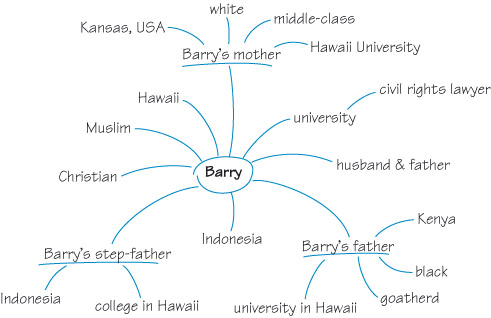
Figure 8 shows how we completed the identity diagram for Barry. You will probably have drawn yours differently, but we hope you have shown a few of the same influences. I also hope that you have found drawing spider diagrams useful. It can be an important part of taking notes from your reading and a powerful means of shaping what you have read on the page into information that is organised visually, in a way which makes sense to you. You can also use spider diagrams when planning essays or other written tasks. Some people find them a really helpful way of starting off a piece of writing. Often the spider diagram can assist you to structure your initial thoughts in a way that written notes on their own might not do.
Barry’s identity as you know it
You might be surprised to know that ‘Barry’ is in fact Barack Obama, the 44th President of the USA.
Does this change the identity that you had constructed of Barry? Perhaps you knew who we were describing already, or perhaps you didn’t know that President Obama has such a rich cultural background.
From considering the information in the spider diagram, you can see that Barack Obama is an individual with a very complex and diverse range of cultural connections, and different elements of his identity can and do mean different things to different people. This will depend on their cultural beliefs and attitudes.
So the point is that everyone can and often does belong to many different groups and feels connections to many different cultures. The extent to which an individual feels this connection is unique to them and makes up their own multifaceted identity. In an important way, then, someone like Barack Obama, with his connections to many different groups, provides living evidence of the limitations of stereotyping.
5 This week's quiz
Well done, you have just completed the last of the activities in this week’s study before the weekly quiz.
Go to:
Open the quiz in a new tab or window (by holding ctrl [or cmd on a Mac] when you click the link).
6 Summary
This week has introduced you to the social sciences. This would be a good moment to pause and reflect on your initial thoughts and reactions to the approach taken in Week 4, which aims to give you an idea about what it might be like to study these subjects at university. You might want to ask yourself if you have enjoyed the way social science explores everyday encounters and aspects of popular culture. Perhaps your reaction has been very different and you do not think you would be comfortable with the way in which social science tends to ask question rather than provide straightforward answers. These personal reactions are important as they should help guide your decision about what sort of subject might suit you best.
In Week 4 you have learned about:
- the subjects that can be grouped as social science
- how social science can be used to think about everyday events
- the concepts of identity and stereotyping
- aspects of cultural identity and group belonging
- using a spider diagram to develop your study skills.
You are now half way through the course. The Open University would really appreciate your feedback and suggestions for future improvement in our optional end-of-course survey, which you will also have an opportunity to complete at the end of Week 8. Participation will be completely confidential and we will not pass on your details to others.
You can now go to Week 5.
References
Abercrombie, N., Hill, S. and Turner, B.S. (2000) Dictionary of Sociology, 4th edn, London, Penguin Books.
Hall, E. T. (1966) The Hidden Dimension, Garden City, NY, Doubleday and Co.
Lerner, S. (1933) Popeye’s Signature Song, NY, Fleischer Studios.
Sussman, N. M. and Rosenfeld, H. M. (1982), 'Influence of culture, language, and sex on conversational distance', Journal of Personality and Social Psychology, vol. 42 (1), pp. 66-74.
Double Take – Mothers Group HD (2010) YouTube video, added by NothinG21halo [Online]. Available at www.youtube.com/watch?v=OsXuPFNZiw8 (Accessed 12 August 2014).
Sometimes people run into each other (2011) YouTube video, added by Michele Hans [Online]. Available at www.youtube.com/watch?v=CA6NeZayHrU (Accessed 12 August 2014).
The Etiquette of Social Kissing (2007) YouTube video, added by engclass0 [Online]. Available at www.youtube.com/watch?v=wXIAHhbdeQw (Accessed 12 August 2014).
Acknowledgements
This week was written by Jonathan Hughes.
Except for third party materials and otherwise stated in the acknowledgements section (see FAQs), this content is made available under a Creative Commons Attribution-NonCommercial-ShareAlike 4.0 Licence.
The material acknowledged below is Proprietary and used under licence (not subject to Creative Commons Licence). Grateful acknowledgement is made to the following sources for permission to reproduce material in this unit:
Images
Figure 1: Illustration of Popeye by Bud Agendorf; Figure 3: © Unknown; Figure 6: © Masterfile.
Every effort has been made to contact copyright owners. If any have been inadvertently overlooked, the publishers will be pleased to make the necessary arrangements at the first opportunity.
Lyrics
'Popeye’s Signature Song' lyrics by Sam Lerner.
Don't miss out:
1. Join over 200,000 students, currently studying with The Open University - http://www.open.ac.uk/ choose/ ou/ open-content
2. Enjoyed this? Find out more about this topic or browse all our free course materials on OpenLearn - http://www.open.edu/ openlearn/
3. Outside the UK? We have students in over a hundred countries studying online qualifications - http://www.openuniversity.edu/ - including an MBA at our triple accredited Business School.