Week 2: Introducing the arts and humanities through literature
Use 'Print preview' to check the number of pages and printer settings.
Print functionality varies between browsers.
Printable page generated Thursday, 23 April 2026, 2:55 PM
Week 2: Introducing the arts and humanities through literature
Introduction
Introduction
In the following video, Weeks 2 and 3 author, John Butcher introduces this week’s study. While watching, think about your experience of studying poetry at school, and of any preconceptions you may bring with you.
Transcript
You will now focus on what it’s like to learn in academic subjects that might broadly fit under the description of arts and humanities. If you already think you know you might choose to study in a different area from the arts and humanities, these two weeks will provide an interesting insight into some of the key academic skills vital to success across the disciplines – and we believe, from experience, it is worth knowing what the prevailing approaches to study in the arts are: all students might learn something new.
This week you will:
- identify the higher education subjects grouped as arts/humanities
- use personal response and critical reading as learning approaches in the arts
- discover a range of poetic techniques – rhyme, repetition, surprising language (e.g. imagery using metaphors and similes)
- explore some of the elements found in the sonnet form
- apply the study diamond to analyse effects, techniques, context and meaning in in poetry
- develop your study skills.
Remember that you will need your notebook to hand to record your response to the activities in this week of the course.
1 What is learning in the arts and humanities like?
So, what might learning in the arts and humanities in higher education (HE) involve?
The arts and humanities have proven popular and significant academic subjects over the centuries. Most UK universities currently offer degree studies in a wide range of arts and humanities subjects – although different universities will include their own combination of subjects. Within each subject the range of topics covered will vary, reflecting the interests of teachers. These subjects are likely to include:
- English Literature and Language (sometimes with Creative Writing)
- History (perhaps including History of Science/Technology)
- Music
- Art History
- Religious Studies
- Philosophy
- Classical Studies.
Some universities will also include creative disciplines like Fine Art or Dance, while others will include Modern Foreign Languages. For reasons of space we have not introduced the quite distinctive models of learning found in those subjects.
For students new to the arts in HE, some of these subjects may be quite familiar from school, while others may never have been encountered before. Years of research at The Open University tell us that students are likely to end up being excited and challenged by the new. Engaging with new ideas is, after all one of the key purposes of HE.
In HE two specific and important approaches can be found in the arts and humanities:
- personal response
- critical reading.
The following sections and activities will introduce the importance of reading critically, and of articulating a personal response to what you read. Because the course lasts only a few hours, I will focus on one subject this week – literature – and because I want to prompt you to think about learning in an area less familiar to most new students, you are going to look at poetry to see if you can get a feel of what it will be like to be a student in the arts.
2 What is poetry?
Are you one of the people who remembers enjoyment from learning a poem at primary school or perhaps the group reading of a nonsense poem? Or did you engage with a poem which really struck a chord emotionally during your teenage years?
Unfortunately, for too many, studying poetry for the purpose of passing exams puts people off for life. If this is you, it is worth remembering that the pleasure of poetic repetition in a Dr Seuss book for young children, or the evocative line about love or loss carried from a pop song heard in the teenage years, can provide insights into how poetry works. To take a first step into learning about poetry, let’s start by bringing in some of your current thoughts and preconceptions.
Activity 1 How do you feel about poetry?
I would like you to reflect for a few minutes on how you feel about poetry. In your notebook, jot down a few sentences, responding to the following prompts:
- How do you feel about studying poetry? Thinking back, did you enjoy poetry at school?
- Are you a reader of poetry?
- Do you approach poetry with trepidation because it appears ‘difficult’ or irrelevant?
Do you have a favourite poem, or song lyric that you can remember? Is there a short piece, such as an advertising jingle, that sticks in your mind?
Comment
Did you find that choosing a text and recording, whether you liked it or not, was easier than saying why the text is memorable?
If you thought immediately of a particular song lyric that is memorable for you, it is worth having a copy of the words in front of you as you work through week 2, and consider the extent to which lyrics might exhibit the kind of sophisticated language techniques which are worthy of study in HE.
It can sometimes be hard to say what makes you like or dislike something, and it can be harder still to spot what it is that makes you remember it. My favourite poems are probably from the 17th century, written by John Donne and Andrew Marvell, and the early 19th century, by John Keats. If I am honest, it is because they are so sensuous. By using words in startling juxtapositions they can evoke the headiest moments of romance (perhaps even desire) in a way that is utterly memorable. Other teachers will suggest markedly different favourites though – and for different reasons! Here are the answers that one student gave:
I remember the line, ‘Water, water, everywhere, nor any drop to drink’ – though I do not know where these words come from.
I like this line. It makes me think of being on a boat, in the middle of the sea.
It is harder to think about why this is memorable. It makes me think of a small boat in a vast sea, and this image has stuck in my mind. I learned it when I was very young. I do not really know why I remember it.
If you look at the sample answer above, you can see that it is the picture or image this student’s chosen text has produced in their head that has helped them to remember the line ‘Water, water, everywhere, nor any drop to drink’. (Incidentally, this line is from a poem called ‘The Rime of the Ancient Mariner’ by Samuel Taylor Coleridge.)
You may feel differently to other learners about this reflective activity. Your response might have included words like ‘excited’. Or perhaps you used words like ‘worried’; many students feel that poetry is the most difficult type of creative writing to understand, so do not be concerned if this is your initial response. It is good to make a record of your feelings at this stage as this will give you something to refer back to once you have begun to engage with the material that follows.
2.1 Feelings about poetry

Many adults claim to not be readers of poetry, but it is interesting that the web is awash with thriving poetry sites, and that at family or public moments of celebration (perhaps the father of the bride’s speech at a wedding) or condolence (a funeral oration) a poem is often quoted.
It is certainly true that some poetry can appear difficult, but also true that learners can acquire the skills to unlock the most challenging text – and it is undoubtedly true that much poetry is accessible. The fact that some poetry is centuries old, and written in what can appear archaic language, need not be a barrier. Just as many great paintings are centuries old – we just, as learners, have to work a little harder to understand the context in which they were produced.
2.2 Poetry is powerful
The purpose of Activity 1 was to get you to start thinking about why you react to a specific text in a particular way. In doing so, you are considering the effects the text has on you and trying to think about why the text affects you in that way. Any text you have chosen here is memorable to you for some reason and has created a response in you. That response, be it positive or negative, is produced by the effects of techniques used in the text.
Of course, different people will like different texts; we will not all respond in the same way to the same poem, song or advertising jingle. The techniques used will affect us all in different ways, otherwise we would all have the same opinions. What you are encouraged to think about when studying poetry is why you like or dislike a text. With practice, you will be able to give answers to this question in relation to any poem you study. You will be able to spot a particular poetic technique or a poetic use of language, whether or not you like the result it achieves. You will be analysing poetry.
Whatever your thoughts about poetry, there is no shortage of poetic writing around in everyday life. A glance inside many greetings cards will reveal a rhyming verse intended to capture feelings in a compressed way.
Often these can be funny or sentimental, but they are seeking to do what poetry aspires to – evoking an emotion through words organised into some kind of coherent structure. Take a look for yourself at some of the lyrics found in popular music.
Often simple images are being evoked, but the most memorable can capture a feeling which can stay with a listener for a lifetime. Poetry is powerful, often because it is concise, it can make us feel differently about something in a way in which a government report or even a piece of journalism cannot – which makes it an important topic of study in literature.
Activity 2 Impact of poetry
Here's a short clip from YouTube.
Listen to the poet Robert Frost reading his own short poem Fire and Ice recorded in the 1920s.
Having listened to the poem, what is your initial reaction? Jot down some thoughts addressing the following prompts:
- Consider the impact on you as a reader/listener – did you like it?
- What do you think the poem might mean?
- What effect did the poet's own readings have on you? Did it help you to understand the poem?
- Did you notice the tone change at any point?
- To what extent might the poet deliberately not be using language literally?
Comment
My response to those prompts might be:
- I think I like the poem, but I am intrigued and need to consider it a few times. This seems to be a deceptively simple nine line poem, written in plain, everyday language.
- The first four lines appear to discuss the end of the world, whether through a return of a Great Ice Age, or a fiery holocaust.
The speed at which the poem was delivered, and the different emphases put on certain words and phrases, does make me think slightly differently about the meaning. I find myself reflecting that the poet’s reading helps me make more sense of the poem – perhaps because his voice grabs my attention.
- But there is a subtle ‘turn’ in the middle – the word desire seems to shift the discussion to human emotions, in which passion (hot) is potentially destructive, but indifference (coldness) has an even greater destructive quality.
- So the language is not as simple as it first appears.
Already, I hope you are starting to find it exciting, forming your own personal response to literature, in this case a poem. This is a key aspect of learning across the arts. You will now be able to understand the challenge of engaging in critical reading when studying poetry – providing detailed analysis to justify your response.
2.3 The effects of poetry
Poetry can appear deceptive to many learners. It is often quite brief (certainly compared to, say, a novel), and it uses everyday language, but in a way that is somehow different, and the effect on a reader is also different. Sometimes, the poem’s brevity is the basis on which a poem’s message is conveyed particularly powerfully. At times, the words become more memorable because of the ‘shape’ of the poem. And often, the words in a poem can provoke a reaction, in a way in which the ‘everyday’ language of prose would not.
I think there are three specific uses of language which a learner in HE might want to look for when reading a poem for the first time.
- rhyme – by which the final sounds on lines are alike, maybe in a consistent pattern
- repetition – of words or sounds
playful or surprising language – puns, imagery as expressed through similes and metaphors.
It is important not to assume poetic language can be taken for granted. When studying literature, especially poetry, the use of puns, or of imagery expressed through similes and metaphors, is a bit like the ‘elephant in the room’, and it is important that you comment on such language, and not ignore any examples.

3 Learning to engage with a poem
Here is a poem to illustrate how it is possible to engage with the poetic techniques of rhyme, repetition and imagery. Many of you may already know it. Read it through two or three times, with a degree of concentration and remember, in HE, sometimes you just have to jump and challenge yourself!
Sonnet 18
Shall I compare thee to a summer’s day?
Thou art more lovely and more temperate.
Rough winds do shake the darling buds of May,
And summer’s lease hath all too short a date:
Sometime too hot the eye of heaven shines,
And often is his golden complexion dimmed;
And every fair from fair some time declines,
By chance, or nature’s changing course, untrimmed
But thy eternal summer shall not fade
Nor lose possession of that fair thou owest;
Nor shall Death brag thou wanderest in his shade,
When in eternal lines to time thou growest.
So long as men can breathe or eyes can see
So long lives this, and this gives life to thee.
Activity 3 Shall I compare thee … ?
Start by reading the poem out loud. Try it, and as you do so, think carefully about the punctuation and use it to help you with pauses/breaths as much as possible. Consider what your voice does at the question mark (line 1), and how to deal with the colon taking you from line 4 to 5. What is your voice doing in the final two lines? Now spend a couple of minutes concentrating on the written text – can you start to identify any poetic techniques such as rhyme, repetition, or use of language in which imaginative comparisons are made? Write some notes addressing these questions in this answer box (you don’t need to include these in your notebook, they are just for the purpose of this activity).
Comment
Rhyming is particularly noticeable if the rhymes occur at the ends of consecutive lines – termed a rhyming couplet (note the final two lines of the sonnet). In many poetic forms, the poem is divided into verses (also called stanzas) with a set number of lines. Often, the poem features the same rhyming pattern in each stanza, and when analysing poetry in degree study it is customary to ascribe a different letter for each new rhyme in a stanza to describe the pattern, or rhyme scheme. The first four lines of this sonnet could be described in a pattern of abab (a = ‘day’ at the end of the opening line, which rhymes with ‘May’ at the end of the third line. b = ‘temperate’ at the end of the second line, which rhymes with ‘date’ at the end of the fourth line).
Sometimes, you will spot a rhyme within a line – this is referred to as internal rhyme, and can be an effective way to draw attention to an image, particularly if there is not an end rhyme. Strong or obvious rhymes can draw attention to an idea, especially if the rhyming words oppose one another in meaning. Less obvious or ‘half-rhymes’ may be used sparingly by poets to suggest uncertainty (‘Sometime/shines’ line 4).
Repetition in poetry can be a powerful technique, because the repeating of words or sounds can draw attention to a specific section, and thus impact on the reader’s response and the meaning we ascribe to it. In this sonnet, the repetition of ‘fair’ within line 7, and again in line 10, emphasises the poet’s feelings about his beautiful lover. Analysing the deliberate repetitions can be part of interpreting the intended meaning.
Being alert to the deliberate use of playful/surprising language is an important element of engaging with poetry in HE. Sometimes this can be through imagery, by which the writer uses language to convey a visual picture or represent a sensory experience. It is a key element in poetry, as it can communicate in a vivid and innovative way, generating a precise picture rather than a vague suggestion. Imagery can be literal: describing through the senses; or figurative – calling to the reader’s mind real things representing an abstract idea. Poets use metaphors (associating two unalike things, one representing the other). In this poem, Shakespeare plays on the idea that the sun is ‘the eye of heaven’, bringing a ‘golden complexion’. The sun represents the perfect summer – but our emotional response is undermined because, unlike his lover, the sun can be excessively hot, and the impact of the sun fades with autumn. His lover is more lovely even than that perfect summer’s day. Poets also use similes (comparing two essentially unalike things using a comparative: like or as) to intensify significance and appeal to the readers’ senses or emotions.
Shortly, I will introduce a powerful tool through which to approach a poem (and indeed other works of art) – but first, a challenge.
Activity 4 A challenge
Listen to an actor reading the same sonnet. (It is David Tennant and I would encourage you to listen to this more than once!)
Reflect on the extent to which your initial personal response changed the more you thought about how the poem worked. If it helps, it might be worth thinking about some specific uses of language which might be less familiar to us in the 21st century:
Line 2 ‘temperate’ = moderate/mild
Line 4 ‘date’ = period of a lease
Line 10 ‘that fair thou owest’ = the beauty that you possess (own)
Line 12 ‘lines’ = the lines of this poem. ‘Growest’ = become part of.
Activity 5 Reflecting on a poem
Now, use your notebook to address the following prompts:
- What is the poem about – how would you sum up what it is trying to say?
- Does the rhyme scheme remain the same throughout? Write out the pattern (starting abab).
- Can you find examples of the repetition of words or sounds?
- What effect does the poem have on you?
Comment
The first response is likely to be to reflect on what the poem is about. Equally and inevitably your interpretation will differ from others’. This is a feature of learning in the arts, where, unlike learning in the sciences, there is no single ‘right way’ to read a poem – it is a matter of justifying your personal response, alongside a ‘critical’ interpretation through careful reading.
Shakespeare’s poem uses words in a more patterned way than prose, patterns which arise from rhyme, repetition and imagery. As readers, we are able to share in the experience described (which might be an event, or the poet’s inner thoughts, or feelings). I think poets make words work harder – by suggesting, in a concise manner, different layers of meaning. And crucially, as we will see shortly, what is said cannot be separated from the way it is said – so attention needs to be paid to the different ways words are used to create meaning. It is important to be conscious that a poet draws on the full potential of words and how they are placed in relation to one another, known technically as in juxtaposition. Poetic language can speak or refer back to itself, and learners need to become alert to the way that highly concentrated language amplifies and intensifies the effect of the poem.
This poem, is a lyric poem (a short poem expressing a poet’s feelings with particular intensity), written in the sonnet form. Sonnets almost always comprise of 14 lines, each line usually consisting of ten syllables (identifiable parts of pronunciation having a single vowel sound, for example ‘golden’ has two, ‘complexion’ has three) in a regular pattern of paired syllables termed iambic pentameters. The sonnet form originated in Italy in the 14th century, utilising a common rhyme scheme which we know as the Petrarchan (abbaabba cdcdcd). Shakespeare adapted the form to his own preferred structure, one closer to speech patterns in English: three quatrains (groupings of four lines within the single stanza) and a rhyming couplet (this is described as a rhyme scheme of abab bcbc cdcd ee, the different letters signify each new rhyme ending in the poem).
As you embark on your studies in HE, you will be challenged by many new words and technical terms (in the comment box above, I have already mentioned quatrains, couplets, lyric, iambic pentameter). Even if unfamiliar to you, these words can extend understanding and aid communication with others. You can utilise a good dictionary, some are available online(press ctrl and click on link to open in a new window), to build up a glossary of key terms in your journal.
Next I introduce an analytical framework which can be used across the arts. It enables learners to move from a position of personal response (I really like/don’t like that … ) to a more structured critical engagement with the text. In so doing it allows well-argued conclusions to be reached when interpreting particular works of art. It is called the study diamond.
4 The study diamond
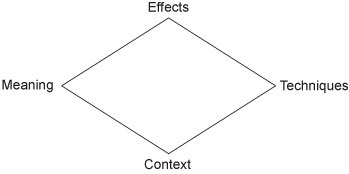
I now introduce an approach that is useful for analysing and interpreting written texts (like poems) as well as the visual images we move on to next week. This is the study diamond (see Figure 2). Using the study diamond will help you strike a good balance between, on the one hand dismissing your own views too readily as ‘unworthy’, and, on the other hand, concentrating on them too much as the ‘only’ reading.
When used methodically, it provides a reliable and reusable formula for arriving at well-argued conclusions when interpreting a particular work.
There are four points to the study diamond:
An excellent way of learning how to apply the study diamond is to first simply try it out.
Activity 6 Applying the study diamond
The study diamond is a four-step approach. Try to apply it to the next sonnet in the following way:
- What effects does the poem have on you? What does it make you feel or think about?
- Which techniques are used by the poet? In this case, think about any rhyme and any imagery used.
- Are there any aspects about the context that need to be considered? This could include who wrote the poem, where it was written, when and under what circumstances, as well as your relationship with its context (bearing in mind that you have been given hardly any contextual information at this stage).
- Ask yourself about the meaning of the poem – what you think the poem is about, and whether it might be trying to convey any messages.
Read Elizabeth Barrett Browning’s ‘Sonnets from the Portuguese XLIII’ (published 1850) two or three times and make notes for each of the concepts.
Sonnets from the Portuguese XLIII
How do I love thee? Let me count the ways.
I love thee to the depth and breadth and height
My soul can reach, when feeling out of sight
For the ends of Being and ideal Grace.
I love thee to the level of everyday’s
Most quiet need, by sun and candlelight.
I love thee freely, as men strive for Right;
I love thee purely, as they turn from Praise.
I love thee with the passion put to use
In my old griefs, and with my childhood’s faith.
I love thee with a love I seemed to lose
With my lost saints, – I love thee with the breath,
Smiles, tears, all of my life! – and if God choose,
I shall but love thee better after death.
Comment
There are a number of valid responses to most of the questions posed by the study diamond, but hopefully you recognised first of all that the poem is about the speaker’s total love for ‘someone’. As the previous extract about the development of the sonnet suggests, this is one of the main themes commonly found in this form of poetry. The poem also conforms to one of the most common rhyme schemes: the Petrarchan (abbaabba cdcdcd). In these respects, then, it can be described as a conventional sonnet. You may have noted it differs in rhyme scheme from Shakespeare's Sonnet 18. There are some lines of iambic pentameter (ten syllables): the final line, for example, seems to be regular in this respect. Lines 3 and 6, too, read as pure iambic pentameter, and you may have spotted others.
There will be some further explanation of what is meant by ‘effect’, ‘techniques’, ‘context’ or ‘meaning’ in the next section.
The analysis also does not stop here. Once you have thought about these four aspects of the poem and made some notes, think about each aspect again. By repeating these stages, your analysis of the poem can continue to build, until you think you have enough information about all four points of the study diamond.
Note that you might not always want to start with the ‘effects’ point. Sometimes, for example, a potential meaning might be more obvious. In such cases, make a note of this, and then go on to consider the other three points of the diamond. Also, having applied the study diamond once to a text, you may then want to look at the points again in a different order. However, as a general rule, start by noting the effects of a text, and see where this leads you.
The four points of the study diamond each represent specific tasks, which together form a useful approach when interpreting a work of literature or art. Next you’ll look at each of these in turn.
4.1 Effects
Most texts are intended to have some sort of effect on the reader, and the Barrett-Browning sonnet was intended to have a particular effect on you. Do not be tempted to concentrate only on what techniques are used in a text, or on what you think it might mean. Note, as accurately as you can, what your responses are. So, by looking carefully at how a text strikes you, you are trying to engage very directly with the author.
Here are three steps to help you to note as fully as possible the effects that a text has on you.
- Your initial response
Note the points that strike you after your first reading. For example, you might simply say things like:
- a. ‘I like some of it.’
- b.‘The language is old and so I find it difficult to understand.’
- c.‘The opening grabbed me.’
- Your second response
Use this list of six questions to try to probe your responses a little more. Try to apply each of these questions to the texts you study.
- a.Do you like the text?
- b.Describe your reaction to the text as fully as possible. Are there any parts that strike you more than others?
- c.Is there anything in the text that you feel is too obvious to mention?
- d.Do you have any feelings about the text which you are not clear about – for example, mixed feelings about whether you like it or not?
- e.Did your responses change as you analysed this text?
- f.Have you had similar responses to other poems (for example, the Shakespeare or the Frost)? If you have, looking at these other texts again might help you.
- Other responses
At this point, you might want to leave the poem for a little while, and then come back to it. Read it again, and consider for a moment, have any of your responses changed? Are there questions you find yourself asking without quite having a clear answer yet? Does the poem evoke a similar response to a lyric you know, or a film you have seen, or a scene in a novel you know?
In trying to consider as many aspects of the effects of a text as possible, one invaluable approach is to think how it might have different effects on other people. Think of three or four people whose feelings you could guess at, or who are likely to see things differently from you, in at least some ways. You could also ask people outright how they would respond to the text.
4.2 Techniques
You are encountering some of the specific techniques used in texts from poetry and the visual arts as you study this course. But the following general points should be considered:
It is important, as far as possible, to try to describe the effects that these techniques achieve as you identify them. For example, one technique commonly used in poetry is rhyme. In the sonnet, the rhyming of ‘height’ and ‘sight’ (line ends 2 and 3), seems significant – but why? In your study of poetry, other techniques will quickly become apparent to you. If you identify a technique such as rhyme, it may not be immediately clear what effects this technique can create. You can always come back to this point, so simply note the technique used and where in the text it is found, and move on. Can you see that one effect of the rhyming words is to draw attention to these words and thus emphasise them? One might argue that this use of rhyme makes the poem as a whole more striking, and perhaps more memorable.
As you read and reread a text, stay on the lookout for the techniques used in it. It will probably take several readings of a longer text for all the techniques to become apparent.
4.3 Context
While it is possible to reach some initial conclusions about what a text means without considering the context in which it was produced, and to which it might refer, this can result in a limited interpretation. Poems, songs, historical accounts and artworks are not produced in a vacuum; they are influenced by the circumstances in which they are created. For example, the sequence of sonnets from which this one came were written in the period leading up to the poet’s marriage to Robert Browning – a marriage which led to her disinheritance from her family’s vast riches (derived from West Indian slave plantations, although she herself was a very public abolitionist). She also suffered from a debilitating spinal disease, and died aged 55 in 1861.
To examine the context of a text, you need to ask the following questions; while not all of these may be relevant, it is worth asking them just to be sure.
- Who produced the text and what do you know about this person?
- Where and when was this text produced and what was happening in the wider world at that time?
- Do you know anything about why the text was produced?
Take care to ensure that any contextual information is relevant to your interpretation.
In brief, consider all available contextual information and stay alert for additional information. Think about how the contextual information can be used in conjunction with your consideration of effects and techniques in your analysis of the text.
4.4 Meaning
You now turn to the question of what messages might be in the text – what it might mean. In doing this you are, in effect, forming an interpretation of the text.
It is important to try to distinguish between what a text is about, and any messages it carries, as often these will be different. For example, this poem is about the poet’s reflection on the depth of her love. But the message of the poem could be said to lie in its comparison to aspects of a religious experience – the depth of expression that true love overcomes all, and is eternal. The word ‘could’ is used in both these instances, as commenting on the meaning of a text is a matter of interpretation. There can be many possible interpretations of a text, but do note that all your interpretations should always be supported using evidence from the text.
However much analysis you have done on a text, your first conclusions about its possible meaning are important. Nevertheless, you should also regard them as provisional. This is because it is possible that you will revise your interpretation in whole or in part a number of times. Be prepared, therefore, to change your mind regarding the meaning of a text. A good time to review the possible meaning of a text is after you have looked at some contextual information relating to it, for example the circumstances in which it was produced.
Finally, try to think of as many possible interpretations of a text as you can. Again, one useful method here is to consider what others might make of it. You could even ask other people for their opinions.
4.5 Studying works of literature and art
As previously said, the points of the study diamond need not be considered in any particular order. However, it is recommended that you start with ‘effects’, and move round the diamond in a clockwise direction, considering each point as you go.
The meaning of some texts and the messages they contain will be immediately apparent. If this is obvious to you at the outset, it would be artificial to begin with the ‘effects’ point of the study diamond and then move round in a clockwise direction considering ‘meaning’ last, when it was the first thing that struck you. The sensible approach would be to make notes about the meaning first, and then look at the other points of the study diamond. The same would apply if the rhyme in the poem stood out to begin with. You would start by noting your observations about techniques and then move on.
The most important thing about this approach is to consider all four points of the study diamond. This should help you to reach a balanced and well-argued interpretation.
In working through the four points of the study diamond, there is plenty of opportunity to think about the text in a number of different ways. You will have also made notes, which are valuable when explaining your interpretations. It is imperative that you give reasons for what you say, both for your interpretations of texts, and for the viewpoints and opinions which you express. Using the study diamond helps to ensure that you are clear about what your views on a text are, and how your examination of a text has informed your interpretation of it.
Another virtue of the study diamond is that it is recyclable. Once you have worked round each point, write up your notes and then start again.
Activity 7 Key features of the study diamond
Four ‘points’ are described in the study diamond: effects, techniques, context and meaning. Match each of these points to the correct definition.
Two lists follow, match one item from the first with one item from the second. Each item can only be matched once. There are 4 items in each list.
-
Effects
-
Techniques
-
Context
-
Meaning
Match each of the previous list items with an item from the following list:
a.Personal response by an individual reader to having read something
b.What elements of language use can be identified
c.What ‘message’ the reader is able to interpret from the text
d.In what circumstances was the text ‘made’
- 1 = a,
- 2 = b,
- 3 = d,
- 4 = c
Comment
The study diamond is designed to help you do four things, namely to:
- Look at the effects of the text
- Identify the techniques used in creating these effects
- Look for information about the context in which the text was produced
- Use your findings from the three points above to examine meaning.
In thinking about, and writing about, these four techniques of a poetic text, you are moving from what might be an overly personal and unstructured appreciation or dismissal, to the kind of critical engagement expected in HE. In addition, you might also have noted that the study diamond is designed to be used and re-used on the same or different subject matter.
5 This week's quiz
Well done, you’ve just completed the last of the activities in this week’s study before the weekly quiz.
Go to:
Open the quiz in a new tab or window (by holding ctrl [or cmd on a Mac] when you click the link).
6 Summary
Congratulations for reaching the end of the second week of the course. This week has focused on how the study diamond can provide a way into reading a wide range of poetry. The week also has outlined how a focused and organised approach makes it possible to go beyond personal responses to poetry in humorous verses or in greetings cards.
In Week 2, you have learned about:
- identifying the HE subjects grouped as arts and humanities
- the use of personal response and critical reading as learning approaches in the arts
- a range of poetic techniques: rhyme, repetition, surprising language (e.g. imagery using metaphors and similes)
- some of the elements found in the sonnet form
- applying the study diamond to analyse effects, techniques, context and meaning in in poetry
- developing your study skills.
For Week 3, you will further develop your understanding of learning in the arts and humanities by exploring some challenging contemporary art history, through the lens of the study diamond.
You can now go to Week 3.
References
Browning, E. B. (1806-1861) The Complete Works of Elizabeth Barrett Browning, Porter, C. E. & Clarke, H. A. (eds), (6 volumes), New York, Thomas Y. Cromwell & Co. (this edition 1900).
Coleridge, S. T. (1772-1834) Poetical Works, Mays, J.C.C. (ed.), Princeton, NJ, Princeton University Press (this editon 2001). Also available as an e-book for OU MA Literature through OU library: The rime of the ancient mariner in seven parts [Online] via LION.
Shakespeare, W. (1564-1616) The Complete Sonnets and Poems, Burrow, C. (ed.), Oxford, Oxford University Press (this edition 2002).
'Fire and Ice' Recited by the Poet himself! Robert Frost Poem Taught in SFHS's Literature Classes (2013) YouTube video, added by Tim Gracyk [Online]. Available at https://www.youtube.com/watch?v=rCbNOUeDQJM (Accessed 8 August 2014).
Robert Frost's 'Fire and Ice' read by Richard Burton (2011) YouTube video, added by Cakes in the Rain [Online]. Available at www.youtube.com/watch?v=Pjp1zdOaNCo (Accessed 8 August 2014).
Acknowledgements
This week was written by John Butcher.
Except for third party materials and otherwise stated in the acknowledgements section (see FAQs), this content is made available under a Creative Commons Attribution-NonCommercial-ShareAlike 4.0 Licence.
The material acknowledged below is Proprietary and used under licence (not subject to Creative Commons Licence). Grateful acknowledgement is made to the following sources for permission to reproduce material in this unit:
Images
Figure 1: © Yuriz/iStockphoto.com and Figure 2: © John Lund/ Getty Images.
Every effort has been made to contact copyright owners. If any have been inadvertently overlooked, the publishers will be pleased to make the necessary arrangements at the first opportunity.
Don't miss out:
1. Join over 200,000 students, currently studying with The Open University – http://www.open.ac.uk/ choose/ ou/ open-content
2. Enjoyed this? Find out more about this topic or browse all our free course materials on OpenLearn – http://www.open.edu/ openlearn/
3. Outside the UK? We have students in over a hundred countries studying online qualifications – http://www.openuniversity.edu/ – including an MBA at our triple accredited Business School.