Week 5: Linking ideas
Use 'Print preview' to check the number of pages and printer settings.
Print functionality varies between browsers.
Printable page generated Tuesday, 10 March 2026, 3:42 PM
Week 5: Linking ideas
Introduction
So far you have looked at the essay-writing process and at the structure of each part of a good essay. This week you will look at the essay as a whole and focus on ways to link its various parts so that readers will find it easy to read.
Anna introduces the week in the following video:
Transcript
Welcome to Week 5. And well done, you’re halfway through the course.
So what makes a successful essay and in general a successful text. Well essays and any other written documents are successful if they’re easy to read. That is, if they are clearly organised and all the parts are linked and work together to make a point.
This week you will concentrate on ways to link your ideas in writing. You will first look at how a student linked his introduction and his conclusion to the rest of his text. Then you will learn how to use information the reader is already familiar with to introduce new information.
Finally, you will look at ways to link ideas and information through linking words. In particular you will look at ways to add new information, compare and contrast ideas, and express cause and effect relationships.
Some of the activities this week are based on Fred’s essay from Week 4. I suggest you download the file that’s been provided and print it out, as you may find it helpful to be able to highlight, underline or annotate portions of the text.
By the end of this week you will be able to recognise ways to:
- link the introduction and the paragraphs to the essay question
- introduce new information by linking it to information already known to the reader
- link paragraphs and sentences through linking words and phrases.
1 Helping your reader to follow your text
An essay is easy to read if it is a cohesive text. In a cohesive essay all parts – the introduction, the paragraphs and the conclusion – are linked and work together to provide a relevant answer to the assignment question. These links need to be clear to the people who read the text. In this section you will see how this is achieved.
1.1 The house analogy
One way to look at an essay is to imagine that the writer is behaving in the same way as someone who is selling a house and showing the potential buyers around the different rooms. This analogy is used in the next activity.
Activity 1
Chris Lee, an Open University tutor, uses the house analogy when she helps students to understand essay structure and the importance of linking ideas. Read the advice she offers her students and then answer the questions that follow:
Try to pretend that you are somebody selling a house and showing the clients around it. You would start with an introduction to the house, possibly just before entering or while standing on the doorstep. In this introduction, you would mention the number of rooms and where these are located. This is just like the introduction to an essay.
Then you would move into the living room and say, ‘This is the living room’, which is just like a topic sentence, and you would describe what is in the living room – that is the rest of the paragraph. You would then move into the next room, which is the next paragraph, introduce that, give the detail and then move on again.
When using the house analogy, moving into a new room is like introducing a new topic. You need to give the introduction to the room first, for example say, ‘This is the dining room where we eat’, rather than saying the detail like, ‘Look at the knives and forks’. In the same way, when writing an essay you need to start with a clear topic sentence and then fill in the detail later, rather than the other way round.
The room analogy can help you deal with the logic of the argument, and linking paragraphs, which is one of the key difficulties, I think, for many students. You don’t just leap from one room to the other but you make a sort of transition. For example, if you were going up the stairs to the bedroom you would have to finish showing the downstairs and use the stairs to link to the bedroom.
In a similar way, you should not leap from one bit of the essay to the next. You have to link the paragraphs together logically for the reader so that there is a flow in the argument that makes the logic stand out.
- What is the mistake many students make?
Answer
Students have problems showing the logic of the main point they are making and linking their ideas. They leap from one part of the essay to another.
- Why is it important to link paragraphs?
Answer
The student’s logic must stand out and the essay should flow.
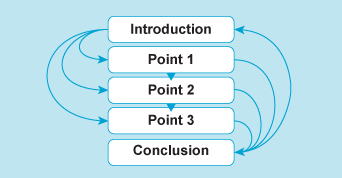
To ensure all the components of an essay are clearly linked and the text flows, it is important to use the first paragraph to tell the reader what the essay will be about. This can be done by introducing its topic, and then linking it to the assignment question by stating the main claim and outlining the rest of the text.
The body paragraphs also link to the assignment question. They follow the outline given by the introduction, develop the theme of the essay and support the writer’s main point.
The conclusion should link to the title and to the introduction by restating the writer’s main claim and by referring to the supporting points made in the paragraphs.
These links are illustrated in Figure 1.
1.2 Linking the introduction to the assignment question
A good introduction aims to show the reader that the essay will provide a relevant answer to the assignment question. To achieve this, the introduction should link back to the question. This is done by writing a paragraph that deals with all the key content mentioned in the assignment question. This is reinforced by the use of words (or their synonyms) mentioned in the question.
In the next activities you will look again at Fred’s essay, which you worked with in Week 4, to see how his paragraphs are linked and how they work together to answer the assignment question. If you haven’t done so already, I suggest you download the file that has been provided and print it out, as you may find it helpful to be able to highlight, underline or annotate portions of the text.
Activity 2
Reread the assignment question Fred had to answer. The key content words have been highlighted in bold italic and numbers have been added to link the words to a specific topic in Fred’s essay.
Assignment question
Why is it important for carers [1] to recognise the differences [2] between public [3] and private [4] spaces? Your answer should refer to care [1] provided in hospital [5], residential [6] and domestic [7] settings.
Now look at the introduction to Fred’s essay. Identify all the words Fred uses that relate to each specific theme. You can do this in any way you wish: by highlighting or underlining in different colours or otherwise adding numbers to a paper copy of the essay. Two numbers have already been placed for you. When you have finished compare your answer with mine.
Essay introduction
People consider their home their own private space [4] which they are able to control and keep separate from any public spaces [3] in which they live or work. However, should their circumstances change, and they find themselves in need of care, this private area may be encroached or they may have to spend time in a public space. This can be an uncomfortable experience whether care is delivered in public places such as hospitals or in residential and domestic environments. The ability to determine the differences between public and private spaces is therefore essential for those who wish to be skilled and effective carers as it affects the quality of their work in all care contexts. This essay will consider the differences between public and private spaces and how these can affect the behaviour of both carers and those receiving care in hospital, residential and private homes.
Answer
The word(s) in bold italic are the key words that link to each topic. The numbers indicate which topic the highlighted word(s) relates to.
Essay introduction
People consider their home their own private space [4] which they are able to control and keep separate from any public spaces [3] in which they live or work. However, should their circumstances change, and they find themselves in need of care [1], this private area [4] may be encroached or they may have to spend time in a public space [3]. This can be an uncomfortable experience whether care [1] is delivered in public places [3] such as hospitals [5] or in residential [6] and domestic environments [7]. The ability to determine the differences [2] between public [3] and private spaces [4] is therefore essential for those who wish to be skilled and effective carers [1] as it affects the quality of their work in all care [1] contexts. This essay will consider the differences [2] between public [3] and private spaces [4] and how these can affect the behaviour of both carers [1] and those receiving care [1] in hospital [5], residential [6] and private [4] homes [7].
If you chose to use colour to visualise this activity you can see the same information in this PDF: Week 5 Activity 2 answer.
Comment
It is important to use the first paragraph to introduce the key themes that will be covered in the essay. This helps readers to follow the student’s reasoning and reassures them that the answer is relevant to the assignment question.
1.3 Linking the main body paragraphs to the introduction
Having stated a claim and outlined the essay, it is important to show readers that the paragraphs follow the outline provided by the introduction and deal with the key ideas mentioned in the question. This is done by ensuring that each topic sentence links back to both the outline and the claim, as well as to the key ideas mentioned in the introduction.
Activity 3
Reread the last two sentences of Fred’s introduction, the topic sentences of each paragraph and the conclusion (all reproduced below). As you did in Activity 2, identify all the words that relate to the same specific topic. Some of these words are already highlighted, using the same system that was used in Activity 2 (bold italic and a topic number). If you prefer, you can highlight or underline words related to each topic using a different colour.
The ability to determine the differences [2] between public [3] and private [4] spaces is therefore essential for those who wish to be skilled and effective carers as it affects the quality of their work [1] in all care contexts. This essay will consider the differences between public and private spaces and how these can affect the behaviour of both carers and those receiving care in hospital [5], residential [6] and private homes [7].
Private and public spaces differ [2] greatly.
To provide good care in a mostly public space, such as the hospital environment, factors such as safety and the efficiency of the ward should be seen as paramount; however, it is also important to safeguard patients’ needs.
In the residential care setting too, it is important that staff recognise the differences [2] between public [3] and private [4] spaces.
In a good residential home, the staff will acknowledge the residents’ wishes to control their private space.
The story is very different in poorly run residential homes.
It would seem that those who receive care at home should be in a stronger position to maintain their autonomy, but even here carers must be aware that their behaviour can change this situation considerably.
A good home carer will always respect the wishes of the client and show them that their right to privacy is valued.
To conclude, whether they work in hospitals, residential homes or patients’ homes, carers must be sensitive to the different characteristics of private and public spaces. This sensitivity helps to carefully balance, on the one hand, patients’ need to privacy, dignity and control over their lives and, on the other, the carers’ need to guarantee safety and effective care. Evidence shows that this approach ultimately affects quality of care as patients will appreciate the security provided by the care context but at the same time benefit from having at least some autonomy and some control over their private spaces. This is likely to increase patients’ well-being and favour the recovery process.
Once again you can do this activity in any way you wish: by highlighting, underlining or otherwise annotating a paper copy of the essay or by making notes in the box provided below. When you have finished compare your answer with mine.
Answer
The words in bold italic are the key words that link to each topic. The numbers indicate which topic the highlighted words relate to.
The ability to determine the differences [2] between public [3] and private [4] spaces is therefore essential for those who wish to be skilled and effective carers [1] as it affects the quality of their work in all care [1] contexts. This essay will consider the differences [2] between public [3] and private [4] spaces and how these can affect the behaviour of both carers [1] and those receiving care in hospital [5], residential [6] and private homes [7].
Private [4]and public [3] spaces differ [2] greatly.
To provide good care [1] in a mostly public [3] space, such as the hospital environment [5], factors such as safety and the efficiency of the ward should be seen as paramount; however, it is also important that carers [1] safeguard patients’ needs.
In the residential care setting [6] too, it is important that staff [1] recognise the differences [2] between public [3] and private [4] spaces.
In a good [1] residential home [6], the staff [1] will acknowledge the residents’ wishes to control their private [4] space.
The story is very different in poorly run [1] residential homes [6].
It would seem that those who receive care [1] at home [7] should be in a stronger position to maintain their autonomy, but even here carers [1] must be aware that their behaviour [1] can change this situation considerably.
A good [1] home [7] carer [1] will always respect the wishes of the client and show them that their right to privacy [4] is valued.
To conclude, whether they work in hospitals [5], residential homes [6] or patients’ homes [7], carers must be sensitive to the different [2] characteristics of private [4] and public [3] spaces. This sensitivity helps to carefully balance, on the one hand, patients’ need to privacy [4], dignity and control over their lives and, on the other, the carers’ [1] need to guarantee safety and effective care. Evidence shows that this approach ultimately affects quality of care [1] as patients will appreciate the security provided by the care [1] context but at the same time benefit from having at least some autonomy and some control over their private [4] spaces. This is likely to increase patients’ well-being and favour the recovery process.
If you chose to use colour to visualise this activity you can see the same information in this PDF: Week 5 Activity 3 answer.
Comment
This activity has shown that Fred’s essay is indeed cohesive. This is because the key topics introduced in the introduction are discussed in the paragraphs. In particular, the differences between private and public spaces and the three care settings mentioned in the introduction are dealt with across all paragraphs in the essay.
All the topic sentences and the conclusion mention quality of care, which is the reason why, according to Fred, private and public spaces should be distinguished. If you read Fred’s essay, you will notice that the content of paragraphs 3–8 also support his claim. Therefore all the paragraphs work together to explain and support Fred’s claim.
Fred’s essay is easy to follow because both the introduction and the paragraphs are connected to the introduction, the conclusion and the assignment question. However, it is also important to ensure that paragraphs are linked to each other and that within them, sentences are also clearly connected. You will learn how to do this in the following sections.
2 Using familiar information to introduce new information
To help the reader follow the reasoning in the main body of the essay, the writer’s line of thinking should flow from paragraph to paragraph. This can be done by using information with which the reader is already familiar when introducing new ideas.
2.1 Linking paragraphs
One way to lead readers into the topic introduced in a new paragraph is to use the first sentence to mention something the reader already knows something about. This is usually a person, a concept or an event that has already been mentioned in the previous paragraph (Figure 2). This familiar information is used to introduce new information.
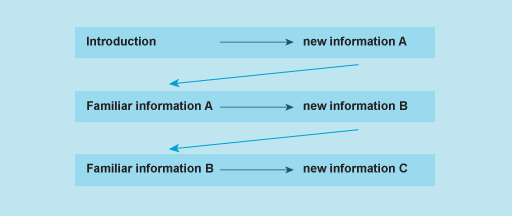
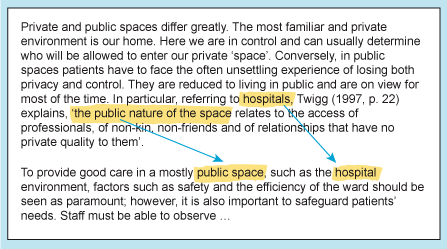
For example, the last two sentences of Fred’s second paragraph introduce the concepts of ‘hospitals’ and ‘public space’. These will be perceived as familiar information by readers when they are reused at the beginning of the following paragraph (Figure 3).
A similar way to help readers follow a writer’s reasoning is to mention the same familiar information in the topic sentences of two or more paragraphs. Therefore the topic sentence of each paragraph starts by mentioning the same familiar information. This is usually done when the writer needs two paragraphs to deal with the same topic. In this case, the writer can break each topic into two or more subtopics and deal with each in a separate paragraph (Figure 4).
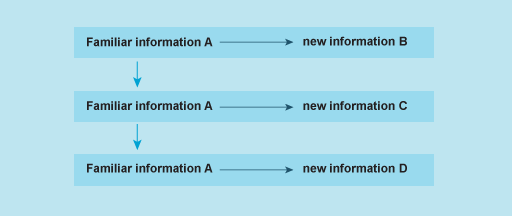
This is the approach Fred takes in paragraphs 4, 5 and 6. Each paragraph starts with a topic sentence that introduces an aspect of care in residential homes:
[P4] In the residential care setting too, it is important that staff recognise the differences between public and private spaces. …
[P5] In a good residential home, the staff will acknowledge the residents’ wishes to control their private space. …
[P6] The story is very different in poorly run residential homes. …
Activity 4
Reread the last two paragraphs of Fred’s essay (reproduced below). Which of the two methods listed below does Fred use to link these paragraphs to each other? Make some notes in the box before comparing them with the answer.
- The first sentence of a new paragraph mentions something the reader already knows something about.
- The topic sentences of two or more paragraphs mention the same familiar information.
It would seem that those who receive care at home should be in a stronger position to maintain their autonomy, but even here carers must be aware that their behaviour can change this situation considerably. Carers’ sensitivity to their clients’ private space and needs can therefore make an enormous difference. This is because people in need of care have less choice over who comes into their homes and what carers do once inside. Even areas such as bedrooms and bathrooms can be ‘under threat’. Though the reasons for this invasion of privacy may be fully understood and accepted, it is still difficult to lose control of the home environment. For example, when she was discharged from hospital, Esther Hurdle felt that she had limited control over her day-to-day life as her carer was more concerned with her own routines than with Esther’s needs and capabilities (Peace, 2005, p. 73). Esther felt, as suggested by Twigg (1997, p. 22), that ‘being and feeling at home means managing as you wish’ and not according to some professional ‘mode of coping’.
A good home carer will always respect the wishes of the client and show them that their right to privacy is valued. A person’s home is rightly regarded as the last bastion of privacy and safety. It is all too easy to feel that any remaining control over one’s own life is being taken away, if home care is not dealt with sensitively. Therefore, as Bell (1993, p. 40) advises, carers should treat the home care environment as their patients’ private space.
Answer
Fred uses the second method, as the topic sentences of both paragraph 7 and paragraph 8 mention care at home.
[P7] It would seem that those who receive care at home should be in a stronger position to maintain their autonomy, but even here carers must be aware that their behaviour can change this situation considerably …
[P8] A good home carer will always respect the wishes of the client and show them that their right to privacy is valued …
2.2 Linking sentences
Familiar information can be used to introduce new information within paragraphs too. For example, the information introduced at the end of the first sentence below (carers’ behaviour) is treated as familiar information at the beginning of the second sentence, which focuses on a specific type of carers’ behaviour: carers’ sensitivity to their clients.
It would seem that those who receive care at home should be in a stronger position to maintain their autonomy, but even here carers must be aware that their behaviour can change this situation considerably. Carers’ sensitivity to their clients’ private space and needs can therefore make an enormous difference.
Activity 5
Reread the following paragraph taken from Fred’s essay. In what way does new information build on information the reader is already familiar with? Identify all the words or phrases that are linked in this way.
For example, at Liberty of Earley House, the residents all have their own rooms and are able to keep many personal possessions (Peace, 2005, p. 71). This enables them to retain their sense of identity and gives them a degree of control over at least part of their lives. They are happy to allow the staff access to their ‘territory’ and are grateful for the sense of security which they get from knowing that help is always on hand if required. The residents have all had to come to terms with the fact that, for reasons such as age or infirmity, they can no longer lead fully independent lives, but can happily accept this compromise.
Once again you can do this activity in any way you wish: by highlighting, underlining or otherwise annotating a paper copy of the essay or by making notes in the box provided below. When you have finished compare your answer with mine.
Answer
As can be seen below, the first sentence introduces the new theme ‘residents’. This becomes familiar information, which is used to introduce each of the following sentences through the use of the words ‘the residents’, ‘them’ and ‘they’.
Another link is established by using the word ‘this’ in the second sentence to summarise the information at the end of the first sentence. Therefore, ‘this’ is treated as familiar information in the second sentence.
For example, at Liberty of Earley House, the residents all have their own rooms and are able to keep many personal possessions (Peace, 2005, p. 71). This enables them to retain their sense of identity and gives them a degree of control over at least part of their lives. They are happy to allow the staff access to their ‘territory’ and are grateful for the sense of security which they get from knowing that help is always on hand if required. The residents have all had to come to terms with the fact that, for reasons such as age or infirmity, they can no longer lead fully independent lives, but can happily accept this compromise.
If you chose to use colour to visualise this activity you can see the same information in this PDF: Week 5 Activity 5 answer.
3 Using connectives to link information
Another way to connect paragraphs and sentences is to use linking words or phrases. These linking words are also called connectives.
In the following paragraph, Fred uses four connectives:
The story is very different in poorly run residential homes. At Cedar Court Nursing Home, for example, residents’ rights to privacy and dignity are totally ignored by staff and residents are treated as objects of care (Peace, 2005, p. 75). As a result, the quality of life experienced by these residents appears to be very low. It is therefore clear that, in residential homes too, when carers fail to distinguish between private and public spaces and disregard residents’ wishes and needs, the quality of care suffers.
As you can see, in this example the connectives are used in the following ways:
for example: This connective helps the reader to understand that the situation explained in the second sentence is an example of the more general situation introduced in the topic sentence
as a result: this connective links the sentence describing the example to a sentence that describes its effect
therefore: this connective links the last sentence to the previous ones by introducing a consequence of the situation they describe
too: this connective links the situation referred to in the last sentence to situations described in previous sentences.
A range of connectives can be used in different ways to link the ideas contained in sentences and paragraphs. In the following sections you will look at connectives used to:
- add information and ideas
- add an example
- compare and contrast ideas
- express cause and effect relationships.
3.1 Adding information and ideas
It is often necessary to add new ideas and information to what has already been said. This can be signalled through a connective, as in these examples:
Furthermore, while the Earth’s temperature has been steadily rising over the last 200 years, there has also been a steady increase in the level of greenhouse gases in the atmosphere.
There are other types of uncertainty in measurements that may need considering too.
The most common words that writers use to add ideas or new information are:
- also
- too
- in addition
- furthermore
- moreover
The essay question may require a list of related points; for example, the student may have to list several reasons, causes or effects. To help the reader follow the text, one of the sets of linking words shown in Table 1 could be used to start each paragraph.
| Set 1 | Set 2 | Set 3 | Set 4 | Set 5 |
|---|---|---|---|---|
| Firstly, ... | One reason/cause/effect ... | The first reason/cause/ effect ... | Sometimes ... | The first point to note ... |
| Secondly, ... | Another reason/cause/effect ... | The second reason/cause/ effect ... | At other times ... | The next point ... |
| Lastly, ... | A further reason/cause/effect ... | The third reason/cause/ effect ... | ||
| Finally, ... |
If the list can be included in one paragraph, these linking words can be placed in each sentence to introduce an additional point, as in this example taken from the Open University course Understanding business behaviour:
Firms may decide to go multinational for a variety of reasons. Sometimes, the chief motivation is the reduction of costs, such as labour costs, costs of raw materials and components, and transport costs. At other times, the growth motive is more important: a firm may wish to exploit any advantages that it has over its rivals. Another reason may be the possibility to reduce costs of production due to a large number of items being produced. The desire to circumvent import restrictions may be another motivation for firms to become multinational.
As you can see, to add variety to their writing, this author used the words reason, motivation and motive when introducing each example of why firms may decide to go multinational.
3.2 Giving examples
In Week 4 you saw that to fully explain a point it is useful to illustrate it by adding an example. To help the reader notice the sentences containing examples and to distinguish them from sentences containing a point or an explanation, writers use a range of linking words and phrases, such as these:
- for example
- for instance
- is an example
- is a case in point
- one example is
- such as (Note that ‘such as’ can only be used to link information within and not between sentences.)
- is illustrated.
Activity 6
Fill the gaps in the sentences below by inserting one of the listed linking phrases. Sometimes more than one phrase can be used.
| for example | is illustrated |
| as an example | is a case in point |
| one example | such as |
Answer
- Technology often involves devices or tools, but it also includes social innovations. For example/for instance, a book can be thought of as a technology for sharing ideas, or a meeting between people as a technology for sharing experience to solve a problem.
- In this book, farming is used as an example of a technology that involves tools, knowledge and effective organisation of people in order to work.
- From a social science perspective migration provides an interesting example of how large-scale social forces impact upon individual lives. The experience of Barack Obama is a case in point. His parents, and also the young Obama, migrated across the world.
- This complexity is illustrated by the following case study.
- If migrants feel that their ancestral language negatively affects their life chances, they may encourage children to use only English. One example is that of a poor community of Yiddish-speaking immigrants in the early twentieth-century Cape Town.
- Some sciences, such as chemistry and physics, tend to be based within laboratories.
4 Comparing and contrasting ideas

University assignments often require students to link ideas by comparing or contrasting them.
When you compare things, the task is to explain how they are similar.
When you contrast them, you explain how they are different.
Whether it concerns a theory, an approach or a procedure, writing about similarities and differences is common to all academic fields.
This section focuses on the effective use of linking words to indicate similarities and differences between things and ideas in a text.
4.1 Becoming familiar with words and phrases that signal comparison and contrast
Compare and contrast can be signalled in many ways. The following activity introduces the words and phrases most commonly used in formal and academic texts.
Activity 7
Here are some words and phrases that are commonly used to signal comparison or contrast.
| but | instead | unlike | and |
| while | both | also | whereas |
| be different (from) | too | neither … nor | however |
| on the other hand | like | in contrast | be the same (as) |
Copy and paste, or type, those that you think signal comparison (similarity) into the first box below, and those that signal contrast (difference) into the second box.
Contrast
Answer
| Comparison (similarity) | Contrast (difference) |
|---|---|
|
|
Comment
You don’t need to memorise these words and phrases. By meeting them in your reading and incorporating them in your writing, you will gradually master their use.
4.2 Putting it into practice
Practice can help to express similarities and differences correctly. The following activity gives you an opportunity to use the compare and contrast connectives introduced in Activity 7.
Activity 8
The table below compares the job of a home carer employed by an agency with that of a personal assistant employed directly by the service user.
| Component | Home carer | Personal assistant |
|---|---|---|
| Terms and conditions of work | Involves unsocial hours, and the need to be flexible | Involves unsocial hours, and the need to be flexible |
| Training opportunities | Varies, but these ought to be available (in the way they are for staff at Somebody Cares) | Probably none in a formal sense |
| Career progression | Limited, but possibility of attaining supervisory or managerial | None |
| Choice of clients | Very limited | Considerable |
| Relationship with client | Will vary, but formally constrained by care plan, employer’s regulations and health and safety considerations | Personally negotiated, but there may well be issues associated with maintaining a boundary between work and friendship |
| Amount of personal risk associated with the job | Vulnerable as they work alone, often in the homes of people they do not know | Limited, although there may be some if the relationship with the employer goes wrong |
| Depends on the clients and the way the job is managed by the agency | Likely to be considerable if they get on with the person who employs them |
Some aspects of the two roles – such as their terms and conditions of work (first row of the table) – are considered to be much the same. Others, such as opportunities for training (second row of the table), differ.
In this activity you will practise various ways of expressing similarity on the one hand and difference on the other, with reference to the first two components of the table.
Choosing from the following connecting words, complete the gaps in the sentences below. Copy the word into the appropriate gap. Some of the words will need an initial capital letter at the start of the sentence.
| unlike | however | while/whereas | both |
| like | both | the same/similar | and |
- Expressing comparison (similarity)
Answer
- a.The terms and conditions of home carers and personal assistants are the same/similar in that they both involve unsociable hours and flexible schedules.
- b.Like home carers, personal assistants are required to work unsociable hours to flexible schedules.
- c.Both home carers and personal assistants are required to work unsociable hours to flexible schedules.
- Expressing contrast (difference)
Answer
- a.While/Whereas the training opportunities available to home carers vary, personal assistants have none in a formal sense.
- b.Unlike home carers, whose training opportunities vary, personal assistants have none in a formal sense.
- c.The training opportunities available to home carers vary. Personal assistants, however, have none in a formal sense.
Comment
These examples demonstrate that there are several ways of comparing or contrasting in any given text. Compare and contrast connectives can be used within a single sentence or over two or more sentences.
The structure used will both influence and be influenced by the kinds of connecting words that are used. Using a variety of connecting words to compare and contrast will add interest to an author’s writing.
5 Using linking words to express cause and effect relationships
In essay writing, as in everyday life, it often happens that something causes something else to happen. For example, if a person eats many fried or fatty foods this could mean that they put on weight or face some health problems. In this example, eating a lot of fried or fatty foods is the cause or influence that has resulted in weight gain or health problems (the effect or impact).
Sentences or longer texts expressing these relationships contain a cause and an effect, and a connective, as in this example:
Cause Many children eat unhealthily; |
as a result, | Effect they may experience health problems in adulthood |

The phrase as a result is a connective that links the cause and the effect in this sentence. Other words and phrases such as so, therefore, thus and consequently could be used in place of as a result.
Cause–effect relationships can also be expressed using verbs; that is, words that describe an action, as in this example:
Cause Unhealthy eating habits in childhood |
can lead | Effect to health problems in adulthood. |
It is also possible to mention the effect before the cause:
Effect Adults experience health problems |
because | Cause they ate unhealthily as children. |
5.1 Writing cause–effect sentences
In the next activity, you will practise combining causes and effects into sentences using connectives.
Activity 9
The following table shows some examples of the connectives that can be used to join cause and effect.
| Cause connectives | Effect connectives | Nouns for cause and effect | Verbs for cause and effect |
|---|---|---|---|
| due to | so | influence | influence |
| since | as a result (of) | effect | affect |
| because (of) | therefore | factor | cause |
| if | thus | consequence | lead to |
| hence | impact | resulted in | |
| consequently | |||
| accordingly |
The causes below contain information on how schools are intervening in the health of children. Alongside them are some of the effects that these interventions are having.
Combine each pair of cause and effect to make complete sentences, using some of the connectives given in the table to help you join them together. Type your combined sentences in the response boxes. Note, too, whether you choose to have the cause or the effect first in a sentence, and how this affects your choice of connective.
| 1. | Cause | Effect |
|---|---|---|
| Children in many schools have a greater variety of sports and exercise options than in the past | More healthy children |
Answer
Because children in many schools have a greater variety of sports and exercise options than in the past, there are now more healthy children.
| 2. | Cause | Effect |
|---|---|---|
| National Curriculum means less room for subjects like cookery and home economics | Less practical experience for children in nutrition, food handling and preparation – widely regarded as skills essential for healthy living |
Answer
The National Curriculum has meant less room for subjects like cookery and home economics, which has resulted in less practical experience for children in nutrition, food handling and preparation. These skills are widely regarded as essential for healthy living.
| 3. | Cause | Effect |
|---|---|---|
| The National Curriculum places a heavier workload on children | Less time available for play and exercise |
Answer
Due to the National Curriculum placing a heavier workload on children, they now have less time available for play and exercise.
| 4. | Cause | Effect |
|---|---|---|
| Education authorities given the right to sell off playing fields | More than 6000 sites have been sold |
Answer
Education authorities were given the right to sell off playing fields. Consequently, more than 6000 sites have been sold.
| 5. | Cause | Effect |
|---|---|---|
| Companies ‘donate’ equipment in exchange for vouchers that people collect by buying their products | Children eat more chocolate. An estimated 5440 chocolate bars, containing over 33 kg of fat and more than a million calories, would need to be eaten to get the most expensive item on offer |
Answer
The effect of companies ‘donating’ equipment in exchange for vouchers that people collect by buying their products is that children eat more chocolate. An estimated 5440 chocolate bars, containing over 33 kg of fat and more than a million calories, would need to be eaten to get the most expensive item on offer.
| 6. | Cause | Effect |
|---|---|---|
| Telephone companies put up phone masts on or near school premises | Fears that electromagnetic fields from the masts may pose a health risk |
Answer
There are fears that the electromagnetic fields caused by mobile phone masts that have been put up by telephone companies on or near school premises may pose a health risk.
| 7. | Cause | Effect |
|---|---|---|
| Vending machines selling ‘junk’ food installed in UK schools | Children consume more high-calorie drinks and junk food – reinforcing unhealthy eating patterns |
Answer
Since vending machines that sell ‘junk’ food have been installed in UK schools, children are consuming more high-calorie drinks and junk food. This is reinforcing unhealthy eating patterns.
Comment
Your answers may differ from the ones suggested above, as you may have chosen different connectives. In the answers given here, the cause comes first in sentences 1–4 and 7 and the effect comes first in sentences 5 and 6.
6 Referring to visual information
In essay and report writing, it may be necessary to include visuals such as a picture or a diagram. To help the reader see the relevance of these visuals, it is important to refer to them in the text.
To achieve this, it is necessary to give the visual a number (Figure 1, Table 1, etc.) and a title indicating its theme. This allows the writer to refer to the visual using one of these phrases:
- As can be seen in Figure 1 ...
- According to Figure 1, ...
- Figure 1 shows …
- Figure 1 indicates that …
- As shown in Figure 1 ...
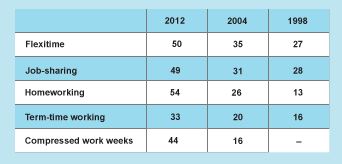
In the example text used in Activity 10, the figure has been given a number and a title, and the writer refers to it in the central part of their text by using the phrase ‘as can be seen in Figure 1’.
Activity 10
Look at the structure of the paragraph below and decide which of these functions each sentence performs:
- Introduction to the topic of the paragraph.
- Specific evidence contained in the table, which helps to develop the topic of the paragraph.
- Additional comments on the same topic.
- [1] In the last 15 years, employers have had to respond to an increased demand on the part of the employees for a better work/life balance. [2] As can be seen in Figure 1, this demand has generated a significant increase in flexible working practices offered by employers. [3] In particular, the provision of home-working and compressed work weeks has more than doubled over a period of fifteen years (CIPD, 2012). [4] This strategy tends to reduce absenteeism and lead to a more motivated and productive workforce (Bentley, 2014).
Note your answer in the box below before comparing it with mine.
Answer
Introduction to the topic of the paragraph: sentence 1
Specific evidence contained in the table, which helps to develop the topic of the paragraph: sentences 2 and 3
Additional comments on the same topic: sentence 4
Images and diagrams can be used to illustrate the points made in the text. However, readers will understand the relevance of these visuals if the text clearly refers to them.
7 This week's quiz
Well done! You have completed another week. Now it is time for the weekly quiz to see how you are getting on with what you’ve learned this week. This week’s quiz won’t count towards your badge so it has only five questions.
Go to:
Open the quiz in a new tab or window (by holding ctrl [or cmd on a Mac] when you click the link).
8 Summary
This week you have learned how to write a cohesive essay that readers will find easy to follow.
These are the key learning points:
- All parts of an essay can be connected so that they work together to answer the question.
- Paragraphs and sentences can be linked by using familiar information to introduce new information.
- Paragraphs and sentences can be connected by using linking words.
- Linking words can help the writer to add information, give examples, express cause–effect and compare–contrast relationships.
- A range of linking phrases can be used to refer to information contained in images and diagrams.
You can now go to Week 6.
References
Acknowledgements
This course was written by Anna Calvi.
Except for third party materials and otherwise stated (see FAQs), this content is made available under a Creative Commons Attribution-NonCommercial-ShareAlike 4.0 Licence.
The material acknowledged below is Proprietary and used under licence (not subject to Creative Commons Licence). Grateful acknowledgement is made to the following sources for permission to reproduce material in this unit:
Images
Figure 5: Hot and cold, © Oleg Prikhodko/iStock.
Text
Activity 10 extract: Figure 1 adapted from Figure 1, p. 30, Chartered Institute of Personnel and Development (CIPD) (2012) Flexible working provision and uptake, Survey Report May 2012, London, CIPD, https://www.cipd.co.uk/ binaries/ 5790%20Flexible%20Working%20SR%20(WEB2).pdf.
Every effort has been made to contact copyright owners. If any have been inadvertently overlooked, the publishers will be pleased to make the necessary arrangements at the first opportunity.
Don't miss out:
1. Join over 200,000 students, currently studying with The Open University – http://www.open.ac.uk/ choose/ ou/ open-content
2. Enjoyed this? Find out more about this topic or browse all our free course materials on OpenLearn – http://www.open.edu/ openlearn/
3. Outside the UK? We have students in over a hundred countries studying online qualifications – http://www.openuniversity.edu/ – including an MBA at our triple accredited Business School.