Week 4: Writing well-organised essays
Use 'Print preview' to check the number of pages and printer settings.
Print functionality varies between browsers.
Printable page generated Monday, 25 May 2026, 3:17 PM
Week 4: Writing well-organised essays
Introduction
This week you will continue working on assignment writing and focus in particular on ways to produce a text that answers the assignment question and can be easily followed and understood by tutors. In other words, you will look at ways in which students use essays to successfully communicate with their tutors.
Anna introduces the week in the following video:

Transcript
Welcome to Week 4.
Last week you learned how assignments and indeed any formal text should be approached through a step by step writing process and focus on the first steps of this process.
You may now wonder how to carry out the other steps and how to write the various components of an essay. So how should these be written?
This week you will focus on these steps in more detail. You will first look at what it means to communicate with other people and how this is done in everyday life. Then you will look at essays as a way in which students communicate with tutors in writing.
More specifically you will learn how to write introductions, paragraphs and conclusions. You will do this by looking in detail at an essay written by an Open University student and that the step by step process they followed when writing it.
By the end of this week, you will understand how to:
- communicate your ideas effectively
- communicate with a tutor through an essay
- use an essay plan to write an essay
- write an introduction
- write a paragraph
- write a conclusion.
1 How to successfully communicate with other people
The main reason for speaking or writing is to communicate with other people. This consists of giving them a written or spoken message they can understand and respond to. As illustrated by Figure 1, communication takes place when a sender, who could act as a speaker or a writer, sends a message to a receiver, who can be a listener or a reader. The receiver often responds to the sender by speaking or in writing.
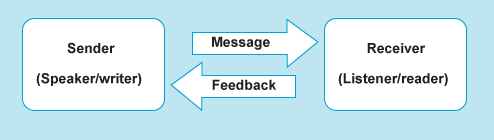
In this section you will look at the challenges of everyday communication and learn how essays can be a form of communication between students and tutors.
1.1 Communicating in everyday life
It is important that listeners and readers understand the message sent by a person and that they interpret it correctly. In the next activity you will focus on the importance of giving your listeners and readers a clear message.
Activity 1
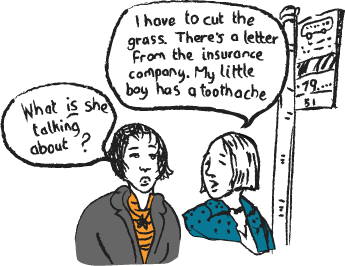
Figure 2 shows two colleagues who have just left the office and are queuing at the bus stop. Read their conversation and answer the following questions in the box below:
- Why doesn’t the woman on the left understand what the woman on the right is talking about?
- What could the woman on the left do to make sense of the other woman’s message?
- Could the same message be expressed more clearly? How?
Answer
- The three statements seem unrelated. The meaning of each statement is easy to see but the statements do not work together to provide a clear message. In particular, what is the topic of the woman’s message? Why is the woman mentioning information about her garden, her insurance company and her baby? The other woman only knows her as a colleague and may know very little about her situation at home, so they cannot use any background information to make sense of her words.
- The woman on the left would probably try to make a link between the letter from the insurance company and the baby’s toothache. Perhaps the toothache is an injury and the insurance company will pay for treatment. This interpretation, however, does not explain why the woman on the right also talks about cutting the grass. In addition, these are not issues one expects to hear about when queuing at the bus stop. The woman on the left could also look at the expression on the other woman’s face and consider the immediate context. Her worried expression and the fact that the bus is delayed could help her to make sense of her words. After trying to interpret the woman’s message, the woman on the left would probably conclude that her colleague does not know what she is talking about.
- Perhaps the woman on the right is worried because the bus is late and she needs to get home soon and deal with the three issues she mentions. To make this clear to her listener, she could have started by introducing the topic of her message: ‘I have got so much to do when I get home!’ This introductory statement helps to explain what the following statements are about, but the listener may also need more information. For example, they may wonder why the letter needs to be dealt with and why the woman is talking about her busy day at this time. A concluding sentence would help to clarify her message: ‘So I really hope the bus arrives soon!’
In everyday conversation, if what other people say is unclear to us, we can use the immediate context to clarify their message. We generally also have the possibility of asking them for an explanation and thus gaining some useful background information.
However, if communication takes place in writing, and the message is unclear or contains unexpected information, these options are not immediately available. This is because the writer is not usually present, and it may not be possible to communicate with them or gain information about the context unless they describe it. Therefore writers need to:
- clearly introduce the theme of their piece of writing
- explain and illustrate their ideas in detail
- clearly connect these ideas and information
- conclude.
As you can see, successful written communication proceeds from general to specific. It first introduces a theme in general terms and then it develops it in more detail through explanations, evidence and examples.
In the next sections you will learn how to communicate clearly through essays, a particular type of writing.
1.2 Communicating with tutors through essays
A university essay is a form of communication written by students for their tutors. The tutors respond by writing comments explaining what the student did well and how he or she can improve. This is called feedback (Figure 3).
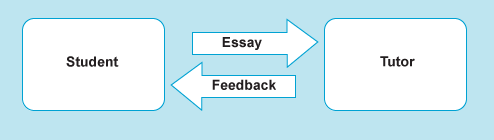
To communicate their knowledge successfully to their tutor, students must write in a clear and well-organised way. The next activity will help you to focus on what tutors expect.
Activity 2
Read what some Open University tutors say about the main characteristics they expect to find in a successful essay.
- a.I teach sociology. In this subject students have to write assignments of about 1,000 words in the first year. I expect an assignment to address the topics mentioned by the assignment question. A good assignment directly and clearly addresses that question and doesn’t deal with anything else.
- b.When I read an essay, I need to be able to follow what the student is saying. So ideas must be linked clearly. If the ideas are just presented as lists, I may have to stop and read certain sentences and paragraphs again to try to understand how they are related. I find it easier to read texts that flow.
- c.For me, to be successful, essays must be well organised. The first paragraph should introduce the theme of the essay and the main point the student wants to make, the next paragraphs must develop that theme by adding more information such as explanations and evidence which help to answer the question. It is also important to use the last paragraph to conclude.
- d.I tutor on a science module. For me a good assignment should demonstrate that the student has understood the course materials and is able to use them extensively and correctly.
- e.I expect students to show that they can explain but also illustrate the points they make. Their answer is stronger if they can give examples and if they can include evidence taken from the course materials. This evidence can be provided by using theories and information that support what they are saying.
- f.I tutor on a psychology module. I would say that a successful essay is easy to understand. The student must use grammar and vocabulary correctly. This means that sentences must be formed correctly and the student must have chosen the right vocabulary and in particular the correct academic and technical words.
Now match each of the characteristics below with the correct letter for the tutor statement.
Two lists follow, match one item from the first with one item from the second. Each item can only be matched once. There are 6 items in each list.
Well-connected ideas
Correct use of the course ideas and information
Relevant content that answers the assignment questions
Good use of examples and evidence
Clear structure
Clear use of language
Match each of the previous list items with an item from the following list:
a.f
b.c
c.b
d.e
e.a
f.d
- 1 = c,
- 2 = f,
- 3 = e,
- 4 = d,
- 5 = b,
- 6 = a
Comment
This activity has shown that, to successfully communicate with a university tutor, it is important to provide a clear answer (a–c) and support it with examples and evidence (d). It is also essential to produce what the tutor expects, that is, a text that is relevant to the question and makes correct use of the ideas and information contained in the course materials (e, f).
You have already started looking at ways to provide a relevant, clearly structured answer when you learned to read the assignment question and produce a draft plan of an essay. In the next sections you will further develop this skill and learn how to incorporate examples and evidence, and link ideas.
2 From outline to essay
You will now review the techniques that help to prepare a draft plan. You will then look at the subsequent steps that lead to writing a clearly structured essay that responds to the assignment question.
You will do this by looking in detail at an assignment written by Fred, an Open University student who is studying towards a degree in Health and Social Care. The first step is to look at the assignment question.
2.1 Analysing the assignment question and deciding what to read
As you know, the first steps to writing a successful assignment consist of analysing the assignment question and preparing a draft outline. In the next activity you will practise these steps again.
Activity 3
Read the assignment question and answer the questions that follow:
Why is it important for carers to recognise the differences between public and private spaces? Your answer should refer to care provided in hospital, residential and domestic care settings.
- What are the instruction words?
- What are the content words?
- What would be a suitable outline?
- If you had to write this essay, what information would you look for in your readings?
Make some notes in the box below and then compare your answers with mine.
Answer
Instruction words
- Why is it important?: The assignment question asks students to provide a reason.
- Your answer should refer to …: this instruction introduces the areas (specific care settings) on which the answer should focus.
Content words
Carers, public spaces, private spaces, differences, hospitals, residential and domestic care settings
Outline
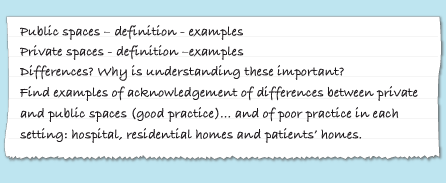
Figure 4 shows the draft outline that Fred produced:
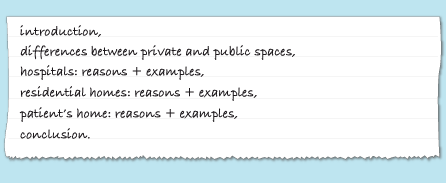
Information to look for in readings
Fred wrote the following notes and questions to guide his readings:
2.2 Using a mind map to identify key themes
Last week you learned that the next step in writing an essay is to use the questions identified when analysing the task to select and take notes from relevant readings.
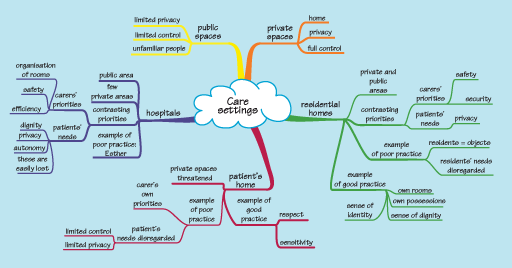
Fred read about the three care settings and found the answer to the essay question: carers should pay attention to the difference between public and private spaces because this ensures quality of care. This is the reason why private and public spaces should be recognised.
He also found that, due to different priorities, carers sometimes disregard patients’ private spaces and individual needs, and this is poor practice that negatively affects quality of care.
Fred jotted some notes in the margin of the course materials and then used the mind map below to reorganise them. The mind map identifies different spaces. It also shows how different priorities lead some carers to either respect or disregard patients’ private spaces and indicates where this leads to good or poor practice.
2.3 From mind map to revised outline
Drawing a mind map helped Fred to identify the key themes his essay would cover. It also helped to clarify his thinking and include an explanation of why, in each care setting, recognition of and respect for private spaces helps to provide good quality care.
In the next activity you will look at how the mind map helped Fred to choose the key themes of his essay but first look again at his mind map. It should help you to identify the themes and structure Fred decided to use for his final essay plan.
Each theme is linked to a coloured line. As you can see from Figure 7, each line relates one of the themes Fred included in his revised essay plan, as shown below.
Private and public places
differences (control/dignity – but presence of unfamiliar people/loss of control/dignity)
Residential homes
example of good practice (private space respected → acceptable level of control and privacy – residents accept compromise)
contrasting priorities – example of poor practice (private place not respected → residents = objects)
Care at home
example of poor practice (private place not respected → loss of control/privacy/dignity)
example of good practice (private space respected → control/privacy)
Hospitals as public spaces
contrasting priorities – limited private spaces → loss of dignity + control
contrasting priorities – mainly treated as public spaces → limited private spaces → loss of dignity + control
Activity 4
Match each theme Fred intends to use in his essay with the correct branch of his mind map.
Two lists follow, match one item from the first with one item from the second. Each item can only be matched once. There are 4 items in each list.
Private and public places
Hospitals
Residential homes
Care at home
Match each of the previous list items with an item from the following list:
a.Blue branch
b.Red branch
c.Orange and yellow branch
d.Green branch
- 1 = c,
- 2 = a,
- 3 = d,
- 4 = b
Fred used the structure themes you have just seen in his final essay outline. In the next activity you will see how he used this outline to write his essay.
2.4 Writing an essay based on an outline
After gathering information and revising the draft essay outline, it is time to write the essay. In the next activity you will see how Fred achieved this.
Activity 5
Read the essay to identify its main themes.
Fred’s essay
- People consider their home their own private space which they are able to control and keep separate from any public spaces in which they live or work. However, should their circumstances change, and they find themselves in need of care, this private area may be encroached or they may have to spend time in a public space. This can be an uncomfortable experience whether care is delivered in public places such as hospitals or in residential and domestic environments. The ability to determine the differences between public and private spaces is therefore essential for those who wish to be skilled and effective carers as it affects the quality of their work in all care contexts. This essay will consider the differences between public and private spaces and how these can affect the behaviour of both carers and those receiving care in hospital, residential and private homes.
- Private and public spaces differ greatly. The most familiar and private environment is our home. Here we are in control and can usually determine who will be allowed to enter our private ‘space’. Conversely, in public spaces patients have to face the often unsettling experience of losing both privacy and control. They are reduced to living in public and are on view for most of the time. In particular, referring to hospitals, Twigg (1997, p. 22) explains, ‘the public nature of the space relates to the access of professionals, of non-kin, non-friends and of relationships that have no private quality to them’.
- To provide good care in a mostly public space, such as the hospital environment, factors such as safety and the efficiency of the ward should be seen as paramount; however, it is also important to safeguard patients’ needs. Staff must be able to observe the patients, and have a certain degree of control over their activities, but this has the effect of reducing patients’ privacy and dignity. For example, Peace (2005) reports the experience of Esther Hurdle, who during her three years spent in hospital, enjoyed little privacy and felt that her needs had to be fitted in with staff routines. Indeed, Gann (1998) explains that ‘somehow, when patients enter hospital, it is all too easy for them to experience a loss of
autonomy and dignity’. The curtains around each bed offer some ‘token’ privacy, but in reality this is minimal as conversations can be easily overheard, and any discussions between staff, patients or visitors are effectively conducted in public.- In the residential care setting too, it is important that staff recognise the differences between public and private spaces. While it is vital to be able to observe the residents, primarily for reasons of safety (Peace, 2005, p. 23), it is equally important to safeguard residents’ private spaces. It is generally accepted that the public areas of these buildings are communal lounges, dining rooms and corridors, and the private areas are residents’ bedrooms and bathrooms. In some homes however, residents have to share bedrooms, which reduces the privacy level to that of the hospital ward. In homes where residents have little or no privacy, it has been observed that they create their own private spaces in public areas. For example, they will always choose the same chairs in the lounge, which are then unofficially regarded as their own. This illustrates the basic human need for some kind of private space, however small.
- In a good residential home, the staff will acknowledge the residents’ wishes to control their private space. In a carefully designed scheme, the needs of the residents are the prime consideration, although obviously the various fire and health and safety regulations have to be met. For example, at Liberty of Earley House, the residents all have their own rooms and are able to keep many personal possessions (Peace, 2005, p. 71). This enables them to retain their sense of identity and gives them a degree of control over at least part of their lives. They are happy to allow the staff access to their ‘territory’ and are grateful for the sense of security which they get from knowing that help is always on hand if required. The residents have all had to come to terms with the fact that, for reasons such as age or infirmity, they can no longer lead fully independent lives, but can happily accept this compromise.
- The story is very different in poorly run residential homes. At Cedar Court Nursing Home, for example, residents’ rights to privacy and dignity are totally ignored by staff and residents are treated as objects of care (Peace, 2005, p. 75). As a result, the quality of life experienced by these residents appears to be very low. It is therefore clear that, in residential homes too, when carers fail to distinguish between private and public spaces and disregard residents’ wishes and needs, the quality of care suffers.
- It would seem that those who receive care at home should be in a stronger position to maintain their autonomy, but even here carers must be aware that their behaviour can change this situation considerably. Carers’ sensitivity to their clients’ private space and needs can therefore make an enormous difference. This is because people in need of care have less choice over who comes into their homes and what carers do once inside. Even areas such as bedrooms and bathrooms can be ‘under threat’. Though the reasons for this invasion of privacy may be fully understood and accepted, it is still difficult to lose control of the home environment. For example, when she was discharged from hospital, Esther Hurdle felt that she had limited control over her day-to-day life as her carer was more concerned with her own routines than with Esther’s needs and capabilities (Peace, 2005, p. 73). Esther felt, as suggested by Twigg (1997, p. 22), that ‘being and feeling at home means managing as you wish’ and not according to some professional ‘mode of coping’.
- A good home carer will always respect the wishes of the client and show them that their right to privacy is valued. A person’s home is rightly regarded as the last bastion of privacy and safety. It is all too easy to feel that any remaining control over one’s own life is being taken away, if home care is not dealt with sensitively. Therefore, as Bell (1993, p. 40) advises, carers should treat the home care environment as their patients’ private space.
- Conclusion.
References
Bell, L. (1993) Carefully, Age Concern, London.
Gann, R. (1998) ‘What your patients may be reading’, British Medical Journal, vol. 296, pp. 493–5.
Peace, S. (2005) K101 Places for Care, Milton Keynes, The Open University.
Twigg, J. (1997) ‘Deconstructing the “social bath”: help with bathing at home for older and disabled people’, Journal of Social Policy, vol. 26, no. 2, pp. 211–32.
Having read Fred’s essay, now think about its content in relationship to the themes listed below.
Match each theme to the corresponding paragraph of Fred’s essay. Note that this essay lacks a conclusion. You will look at this later this week.
Two lists follow, match one item from the first with one item from the second. Each item can only be matched once. There are 8 items in each list.
Paragraph 2
Paragraph 1
Paragraph 6
Paragraph 4
Paragraph 8
Paragraph 5
Paragraph 7
Paragraph 3
Match each of the previous list items with an item from the following list:
a.a. Private and public places
b.b. Introduction
c.h. Hospitals
d.c. Residential homes: example of poor practice
e.g. Care at home: example of poor practice
f.f. Residential homes: example of good practice
g.d. Residential homes – contrasting priorities
h.e. Care at home: good practice
- 1 = a,
- 2 = b,
- 3 = d,
- 4 = g,
- 5 = h,
- 6 = f,
- 7 = e,
- 8 = c
Comment
Fred’s text follows his outline and draws on his mind map and readings. He used the typical essay structure consisting of three parts: the introduction, the main body and the conclusion (not included). The main body consists of several paragraphs that work together to answer the assignment question. In the next section you will learn how the first paragraph is used to introduce the essay.
3 Writing an introduction
In this section you will learn how to write a clear introduction. You will look at the purpose and structure of a good introduction.
As you have seen when looking at the bus stop conversation earlier, an introduction helps to give your text direction and introduce its content. The purpose of the introduction is therefore to provide readers with key information that will enable them to understand:
- what the essay will be about
- the main point (or claim) it will make
- how the main body will be organised.
This is essential information that attracts the readers’ attention, enables them to follow the remaining text easily, and helps them to see that the essay effectively answers the assignment question.
In the next activity you will see how this purpose is achieved by looking at the content and structure of Fred’s introduction.
Activity 6
Read Fred’s introduction and then answer the questions that follow. The numbers in brackets are the sentence numbers. Make your notes in the boxes before comparing your answers with mine.
[1] People consider their home their own private space which they are able to control and keep separate from any public spaces in which they live or work. [2] However, should their circumstances change, and they find themselves in need of care, this private area may be encroached or they may have to spend time in a public space. [3] This can be an uncomfortable experience whether care is delivered in public places such as hospitals or in residential and domestic environments. [4] The ability to determine the differences between public and private spaces is therefore essential for those who wish to be skilled and effective carers as it affects the quality of their work in all care contexts. [5] This essay will consider the differences between public and private spaces and how these can affect the behaviour of both carers and those receiving care in hospitals, residential and private homes.
1 Which sentence explains how the essay will be organised?
Answer
Sentence 5
2 Which sentences say what the essay will be about?
Answer
Sentences 1, 2 and 3
3 Which sentence states the main claim of the essay?
Answer
Sentence 4
Comment
Sentences 1–3 introduce the themes of the essay: the essay is about private and public spaces and the places where care is provided.
Sentence 4 is about the main point the writer will make. This sentence contains a rephrased version of the assignment question as well as Fred’s answer: carers’ understanding of the difference between private and public spaces will have an effect on the quality of the care they provide in each of the three care contexts. It is normal for this answer to be quite general at this stage as its content will be fully explained in the following paragraphs. Therefore a general statement, such as this, is sufficient.
Also note that the last sentence starts with the formal and impersonal expression, ‘This essay will’. This expression is normally used in academic essays and it is generally preferred to ‘I will’ or ‘We will’.
3.1 From general to specific
Readers can follow an introduction more easily if this first introduces the theme of the essay in general terms and then gradually narrows the focus. You will look at this progression from general to specific points in the next activity.
Activity 7
Listed below are five headings that summarise the first five sentences of Fred’s introduction.
- Carers’ understanding of differences between spaces.
- Normal situations: private and public spaces are clearly separated.
- Specific care contexts (e.g. hospitals, residential and care situations): difficulties due to reduced private spaces.
- Care situations: living in public spaces, invasion of private spaces.
- Effects of this understanding on quality of care.
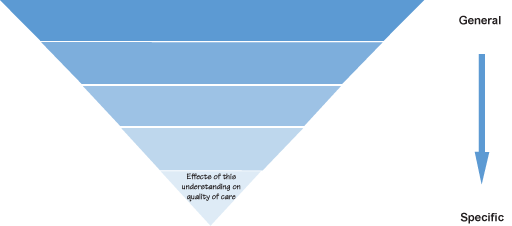
Think of them as forming an upside down pyramid (Figure 8) and sort them into the correct order so that they progress from general to specific. Make sure that the most general heading comes first and the rest occupy gradually narrower parts of the pyramid. As you can see, in Figure 8 the last heading has already been entered for you.
Copy and paste or type the headings into the box below in the correct order before looking at the answer.
Answer
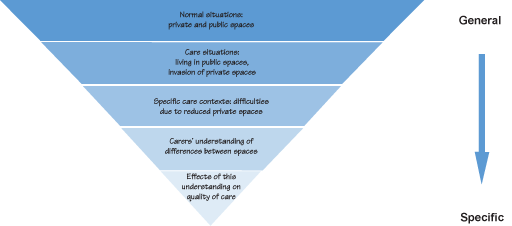
As you can see from the diagram, the correct order, reading from the top down (i.e. general to specific) is:
- Normal situations: private and public spaces
- Care situations: living in public spaces, invasion of private spaces
- Specific care contexts: difficulties due to reduced private spaces
- Carers' understanding of differences between spaces
- Effects of this understanding on quality of care
Comment
Fred’s introduction starts by considering all everyday situations, then narrows the focus to care situations before moving on to specific care contexts, e.g. hospitals, residential and private homes. For each situation, it focuses on spaces occupied by people. It starts by looking at private and public spaces in general, moves on to private spaces and the invasion of public spaces in care contexts, before saying that the level of understanding of spaces impacts quality of care.
3.2 Practice writing introductions
You will now look at another introduction, consider its structure and write its final sentence.
Activity 8
Read the following assignment question and the introduction written by Open University student Amina. Again the numbers in brackets refer to the sentence number.
Essay title
Discuss the extent to which a large corporation such as Nike might influence the economic health of a developing country.
Amina’s introduction
[1] Wherever a large corporation such as Nike operates, the scale of its activity will have an effect on the locality. [2] In a developing country, this activity will have a significant influence on the whole economy of the area. [3] Economists explain that there is a clear link between large corporations’ business activities in Asian countries and the subsequent rise in those countries’ standards of living (Sturges, 2000, p. 12). [4] Although multinational corporations’ investment can benefit developing countries, there may also be negative impacts.
Now complete the tasks below. Note your answers in the boxes before comparing them with mine.
Task 1
Answer the following questions:
- Which content words are contained in the title?
- Which instruction words are contained in the title?
- Which sentence states the claim that will be demonstrated by the essay?
Answer
- Content words: large corporation; influence; economic health; developing country.
- Instruction word: discuss.
- The claim is stated in sentence 4.
Task 2
Write what you think could be the last sentence of this introduction. This sentence needs to briefly outline Amina’s essay. Her essay plan contains the following headings:
- Definition of economy
- Definition of investment
- Effect of large organisations (e.g. Nike) on four areas of economic activity
Answer
Amina’s introduction ended with this sentence:
This essay will first define the terms ‘economy’ and ‘investment’ and then explain how much, and in what way, four areas of economic activity may be affected by the business activities of a large corporation.
Task 3
How does Amina’s introduction progress from general points to specific ones?
Answer
Amina’s introduction starts by mentioning the effects of large corporations on local areas in general. It then narrows down by considering developing countries and Asian developing countries. Finally, it states that the essay will focus only on four areas of activity in these developing countries (Figure 10).
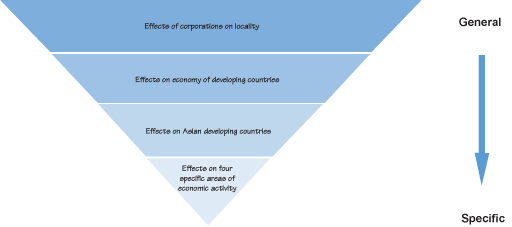
4 Organising paragraphs
The purpose of paragraphs is to answer the assignment question by developing the topic and supporting the claim mentioned by the introduction. Each paragraph achieves this by dealing with one key idea or making one point. In Fred’s essay, paragraphs are used to develop his main point: carers’ sensitivity to differences between private and public spaces in three contexts affects the quality of care.
In this section you will look at the way writers organise their paragraphs so that their readers will find them relevant and easy to read.
4.1 From general to specific
Activity 9
Reread the second paragraph of Fred’s essay, where he has moved from the introduction into the main body of the essay.
[1] Private and public spaces differ greatly. [2] The most familiar and private environment is our home. [3] Here we are in control and can usually determine who will be allowed to enter our private ‘space’. [4] Conversely, in public spaces, patients have to face the often unsettling experience of losing both privacy and control. [5] They are reduced to living in public and are on view for most of the time. [6] In particular, referring to hospitals, Twigg (1997, p. 22) explains, ‘the public nature of the space relates to the access of professionals, of non-kin, non-friends and of relationships that have no private quality to them’.
Now identify the purpose of each sentence by matching it to one of the following headings. Each heading could be linked to one or two sentences. Make your notes in the boxes before comparing your answers with mine.
1 Introducing differences between private and public spaces
Answer
Sentence 1
2 Private spaces: home, control and privacy
Answer
Sentence 2 and 3
3 Public spaces: loss of control and privacy
Answer
Sentence 4 and 5
4 Details about a public space where care is delivered
Answer
Sentence 6
Comment
An analysis of this paragraph shows that the paragraph starts with a general sentence that introduces its theme; in other words, it explains what the paragraph is about. The supporting sentences develop this theme by providing specific explanations and details.
In this case, the paragraph uses the topic sentence to introduce private and public spaces in care contexts and then deals with each of these spaces in detail. Finally some details about public care spaces are provided.
Readers find paragraphs easy to read if they start with a clear topic sentence. The next activity gives you an opportunity to focus on this.
4.2 Sequencing sentences within a paragraph
In order to be able to order information from general to specific, you need to practise the skills of sequencing sentences and writing a topic sentence. You will practise these skills through the following two activities.
Activity 10
The sentences below come from a paragraph taken from an essay on poverty. These sentences have been mixed up. Reorder the sentences so that they form a paragraph that progresses from general to specific. A good place to start is to find the topic sentence, which is the most general sentence, and then look for any supporting statements.
This context could then impact on the health of the individual and, in turn, affect their ability to work or attend college.
As a result of poverty, an individual may live within an area characterised by poor housing as well as high levels of crime.
Poverty can have a negative effect on people’s lives.
Therefore, governments are committed to reducing poverty so that people can live well.
Their income or ambitions will be affected.
Type or copy and paste the sentences in the correct order into the box below. Then compare your answer with mine.
Answer
Poverty can have a negative effect on people’s lives. As a result of poverty, an individual may live within an area characterised by poor housing as well as high levels of crime. This could then impact on the health of the individual and, in turn, affect their ability to work or attend college. Their income or ambitions will be affected. Therefore, governments are committed to reducing poverty so that people can live well.
Comment
The topic sentence introduces the theme of the paragraph. The supporting sentences develop this theme by explaining the various effects poverty has on people’s lives. This paragraph also includes a concluding sentence.
Activity 11
Read this paragraph from an essay on financial accounting.
Financial accounting, which is required by law, is primarily concerned with providing information to shareholders, creditors, and others who are outside an organization Financial accountants prepare three financial statements which are used internally by managers: the profit/loss account, the balance sheet and the cash flow statement. Management accounting, on the other hand, is not required by law and is concerned with providing information to managers – that is, people inside an organization who direct and control its operation (Shepherd, 2003, p. 23).
Now choose the most effective topic sentence from those listed below. Remember that this sentence should tell the reader in general terms what the paragraph will be about.
- Accountants spend a considerable amount of time preparing financial accounts.
- There are two types of accounting: financial accounting and management accounting.
- The accounting department employs 30 people.
Type or copy and paste the most effective sentence into the box below. Then compare your answer with mine.
Answer
The correct answer is 2. This topic sentence introduces the two types of accounting that are described in the paragraph.
Answer 1 is an ineffective topic sentence because it introduces only the first of the two types of accounting that are described in the paragraph.
Answer 3 is ineffective because it deals with a topic that is unrelated to the sentences that follow.
4.3 Using a paragraph to make a point
The paragraphs you have considered so far are descriptive as they simply provide details about a particular situation. However, paragraphs are also often used to make a point. In other words, they state and support a particular view convincingly. In the next activity you will look at how Fred makes a point in paragraph 7 of his essay.
Activity 12
Reread this paragraph from Fred’s essay.
[1] It would seem that those who receive care at home should be in a stronger position to maintain their autonomy, but even here carers must be aware that their behaviour can change this situation considerably. [2] Carers’ sensitivity to their clients’ private space and needs can therefore make an enormous difference.[3] This is because people in need of care have less choice over who comes into their homes and what carers do once inside. [4] Even areas such as bedrooms and bathrooms can be ‘under threat’. [5] Though the reasons for this invasion of privacy may be fully understood and accepted, it is still difficult to lose control of the home environment. [6] For example, when she was discharged from hospital, Esther Hurdle felt that she had limited control over her day-to-day life as her carer was more concerned with her own routines than with Esther’s needs and capabilities (Peace, 2005, p. 73). [7] Esther felt, as suggested by Twigg (1997, p. 22), that ‘being and feeling at home means managing as you wish’ and not according to some professional ‘mode of coping’.
Now identify the sentences that are used for the following purposes:
- sentence(s) that make a point
- sentence(s) that provide examples or evidence to support the point made
- sentence(s) that provide explanations of the point made.
Note the sentence numbers in the box below before comparing your answers with mine.
Answer
- Sentence(s) that make a point: 1, 2
- Sentence(s) that provide examples and/or evidence to support the point made: 6, 7
- Sentence(s) that provide explanations of the point made: 3, 4, 5
Comment
This paragraph shows that to make a convincing point, it is necessary to state this point and explain it (This is because…). It should also be illustrated through examples (e.g. Esther’s experience) and, where possible, with evidence (research conducted by Twigg).
As you can see, both examples and evidence have been taken from academic sources whose authors have been acknowledged through a reference.
Explanations and examples and/or evidence are both necessary if a convincing point is to be made; however, the order in which they appear in the paragraph may be different. This is illustrated by the next activity.
Activity 13
Reread the following paragraph and identify the:
- point
- explanation
- example.
[1] The story is very different in poorly run residential homes. [2] At Cedar Court Nursing Home, for example, residents’ rights to privacy and dignity are totally ignored by staff and they are treated as objects of care (Peace, 2005, p. 75). [3] As a result, the quality of life experienced by these residents appears to be very low. [4] It is therefore clear that, in residential homes too, when carers fail to distinguish between private and public spaces and disregard residents’ wishes and needs, the quality of care suffers.
Note the appropriate sentence numbers in the box below before comparing your answers with mine.
Answer
- Point: Sentence 1
- Explanation: Sentence 4
- Example: Sentence 2
Comment
This paragraph starts with a point, illustrates it with an example and ends with a concluding sentence that provides an explanation.
4.4 Presenting your paragraphs
As you have seen so far, when writing an essay a main concern should be clarity. This is achieved by clearly introducing and structuring the paragraphs, moving from general information to specific details and dealing with only one point at a time.
In the next activity you will learn that presentation also helps to produce a clear answer that tutors can easily follow.
Activity 14
Figure 11 contains visual representations of three possible ways to present an essay (A, B, C). Match each one to the tutor feedback below.
- This is a well-presented essay. Each paragraph develops one point and is clearly separate from the others.
- This essay is difficult to follow. It develops many points but these are not easy to identify as the essay is presented as one unbroken chunk of text.
- This essay deals with several issues but only one or two sentences are used to develop each point. In some cases explanations are provided in a separate short paragraph. This makes the text difficult to read.
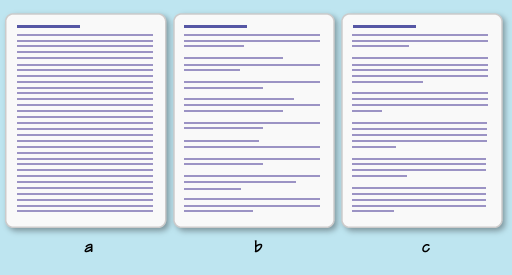
Note the appropriate numbers in the box below before comparing your answers with mine.
Answer
A: 2
B: 3
C: 1
Comment
The way in which an essay is presented can help readers to clearly see its organisation and identify each point easily. If all points are merged into one long paragraph or if the supporting sentences are presented separately, readers will find it very difficult to follow.
5 Using the last paragraph to conclude the essay
An essay should always have a concluding paragraph. An effective concluding paragraph should:
- refer to the assignment question and its key content words
- refer to the claim made in the introduction
- refer to and draw together the points made in the main body of the essay
- provide a clear answer to the question
- provide a brief comment (optional).
Activity 15
Read these two conclusions and then answer the questions that follow.
Conclusion 1
To conclude, in each of the settings described there can always be valid reasons for an individual’s private space to be entered. Aspects of safety cannot be ignored and regulations must be adhered to, particularly in non-domestic settings. There are always the problems of staff routines, and the greater good of all patients must be balanced against an individual’s needs. However, care should be taken when handling all these situations. Care staff should always remember that they are dealing with individual people. It must be difficult enough to cope with the loss of physical or mental capabilities, and to have to come to terms with the impossibility of ever leading a healthy independent life again without the added indignity of being treated as an object. Everyone is entitled to respect and to be given at least some control and freedom. This is a basic human right.
Conclusion 2
To conclude, whether they work in hospitals, residential homes or patients’ homes, carers must be sensitive to the different characteristics of private and public spaces. This sensitivity helps to carefully balance, on the one hand, patients’ need to privacy, dignity and control over their lives and, on the other, the carers’ need to guarantee safety and effective care. Evidence shows that this approach ultimately affects quality of care as patients will appreciate the security provided by the care context but at the same time benefit from having at least some autonomy and some control over their private spaces. This is likely to increase patients’ well-being and favour the recovery process.
- Which conclusion more closely follows the main characteristics of the concluding paragraph described above?
- Why do you think this?
- Why is the other conclusion less effective?
Make some notes in the box before comparing them with mine.
Answer
Conclusion 2 is the most effective because it very clearly answers the question asked, which was ‘Why is it important for carers to recognise the differences between public and private spaces?’ It does this by referring to the point, made in the introduction, that an understanding and sensitivity to these differences affects quality of care and is therefore good practice.
In providing this answer, Conclusion 2 summarises the main points made by the main body of the essay. This is done by mentioning ‘patients’ need to privacy, dignity and control over their lives’ and ‘the carers’ need to guarantee safety and effective care’.
Conclusion 1 is less good because it does not clearly answer the question. It summarises many points made by the main body and provides recommendations and comments. Recommendations were not required and it was therefore not necessary to include them.
6 This week's quiz
Now it’s time to complete the Week 4 badge quiz. This is in a similar format to the previous weeks’ quizzes but this time, instead of having five questions to answer, there will be 15. You will still have three tries at answering each question, with hints to help. This quiz will look at the topics from this week as well as the previous three weeks.
This quiz is the first of the two quizzes that count towards your badge. You need to do this quiz and the Week 8 quiz to get your badge for this course. You do need to achieve 50% on both.
Doing the quizzes is a great way for you to check your own learning – and it is always good to find out that you are on the right track.
Go to:
Remember, this quiz counts towards your badge. If you're not successful the first time you can attempt the quiz again in 24 hours.
Open the quiz in a new tab or window (by holding ctrl [or cmd on a Mac] when you click the link).
7 Summary
This week you have learned how to use notes and an outline to write an essay. You have also looked at the structure of introductions, body paragraphs and conclusions, and at the way in which these contribute to produce a relevant essay.
These are this week’s most important learning points:
- Communication takes place between a sender (a writer or speaker) and a receiver (a reader or a listener).
- One way in which students and tutors communicate is through assignments and tutor feedback on assignments.
- When writing, it is important to keep the reader in mind as this helps to produce clearer, more relevant texts.
- The essay and each of its paragraphs should proceed from general information to specific details.
- Introductions often contain an introductory sentence and background information.
- Introductions should contain the author’s main claim and an outline of the essay.
- Each paragraph should start with a general sentence that introduces its theme.
- The supporting sentences should gradually narrow the focus by including explanations, examples and evidence.
- The layout of an essay should help to identify each paragraph and the point it makes.
- The conclusion should be used to draw together the points made in the main body of the essay, and to refer back to the assignment question and the claim made in the introduction.
You are now half way through the course. The Open University would really appreciate your feedback and suggestions for future improvement in our optional end-of-course survey, which you will also have an opportunity to complete at the end of Week 8. Participation will be completely confidential and we will not pass on your details to others.
You can now go to Week 5.
Acknowledgements
This course was written by Anna Calvi.
Except for third party materials and otherwise stated (see FAQs), this content is made available under a Creative Commons Attribution-NonCommercial-ShareAlike 4.0 Licence.
The material acknowledged below is Proprietary and used under licence (not subject to Creative Commons Licence). Grateful acknowledgement is made to the following sources for permission to reproduce material in this unit:
Every effort has been made to contact copyright owners. If any have been inadvertently overlooked, the publishers will be pleased to make the necessary arrangements at the first opportunity.
Don't miss out:
1. Join over 200,000 students, currently studying with The Open University – http://www.open.ac.uk/ choose/ ou/ open-content
2. Enjoyed this? Find out more about this topic or browse all our free course materials on OpenLearn – http://www.open.edu/ openlearn/
3. Outside the UK? We have students in over a hundred countries studying online qualifications – http://www.openuniversity.edu/ – including an MBA at our triple accredited Business School.