Week 2: Using ideas and information from your readings in your writing
Use 'Print preview' to check the number of pages and printer settings.
Print functionality varies between browsers.
Printable page generated Wednesday, 19 August 2026, 5:41 AM
Week 2: Using ideas and information from your readings in your writing
Introduction
During Week 1 you learned a range of reading strategies and practised recording the ideas and information taken from your reading. This week you will consider ways to critically read source texts and appropriately use the information they contain in your writing.
Transcript
Welcome to Week 2. In Week 1 you looked at the different kinds of materials that are used at university and practice an active reading method. You may now ask: what do students do with these theories they have learned from their readings?
Well, the answer is, they use them to make sense of the world in a different and more informed way and that’s what can really be gained from a university education.
Students aim to demonstrate this new skill through their assignments. Assignment questions ask students to carry out written tasks using the insights from their readings. In other words assignments ask students to apply what they have learned and use it to support their discussions, justify the conclusions and of course display their knowledge.
So the next step consists of including in an assignment, information and ideas taken from readings. In order to achieve this it is important to develop two skills. First of all the ability to look critically at a reading and to select the most appropriate information, ideas and data. And secondly, to include these in an assignment correctly. So this week is about critical reading and techniques such as writing summaries, quotations, and acknowledging sources.
By the end of this week, you will be able to:
- start to critically process what you read
- recognise how to reproduce information from sources
- understand the importance of acknowledging your sources.
1 Critically processing what you read
In Week 1 you learned that it is important to read actively. As part of this strategy you learned that it is useful to ask yourself some questions about the text (Figure 1). This section will help you to look at these questions in detail in order to learn how to critically process information from anything you read.

Processing information is a very important skill for university students to develop. They should not read simply to ‘find out facts’ and absorb the ideas and theories in books. They need to think for themselves and question what they read, as well as weigh up ideas and viewpoints as they read them.
1.1 How to read critically
Reading critically consists of constantly asking yourself questions.
You may consider your own reactions to the content of the text and its
relevance to you personally. Analyse the way in which you plan to use the text and ask yourself:- Do I agree with this viewpoint?
- How does it relate to what I already know?
- Is this text relevant to my needs? Does it help to answer my questions?
You may also wonder how far the content of the text can be trusted, in other words if it is
reliable , and ask:- Does this text provide facts or opinions?
- If the text contains facts, has any data been obtained from research? How has the data been gathered?
- If the text contains opinions, are these supported with evidence and relevant reasons?
- Is the argument convincing or is it unclear and not completely logical?
The issue of objectivity is also important:
- Could the author be influenced by personal feelings or the context in which he or she writes? In other words, is the author objective?
- Has the author considered other contrasting viewpoints?
- What other perspectives or points of view could there be?
Finally, it is also very important to find out when the text was written:
- When was this information produced?
- Is the data still useful or are more current statistics available?
- Are the theories in the text still valid or have researchers moved on?
Activity 1
Below is a paragraph taken from Richard Layard’s article, ‘The secrets of happiness’. This article was first published in 2003 in the magazine New Statesman. If you did the Week 1 quiz you will already have read an extract from this article.
To see how critical reading skills are useful at university, imagine you have to write an essay about the causes of happiness and that you have found Layard’s article in the course materials. Read the paragraph below and critically look at some of the information it contains. Ask yourself the four sets of questions listed above.
It is true that, within any particular society at any particular moment, rich people are on average happier than poorer ones. For example, 41 per cent of people in the top quarter of incomes are ‘very happy’, compared with only 26 per cent of those in the bottom quarter of incomes. The problem is that, over the years, the proportions in each group who are very happy have not changed at all although the real incomes in each group have risen hugely. This is true of all the main western countries.
Make your notes in the box below before comparing your answers with mine.
Answer
Part of this answer is personal to you, but you might like to read the answer given by Jade, a university student who read Layard’s text when preparing for an essay about the causes of happiness:
This paragraph is definitely relevant to the essay as it looks at income as a cause of happiness.
The content partially related to my experience as I know some wealthy people who are also happy. On the other hand I have also met people who have very little but are extremely happy and I have read of very wealthy cinema and pop stars who are or have been very unhappy.
On a closer look, the text uses the phrase ‘on average’, therefore the author acknowledges that there may be unhappy rich people and happy poor people. The first sentence doesn’t say that all rich people are happy but that they are on average happier than poorer people.
The author’s main point is supported by evidence and this makes it stronger. However, the text does not say which groups of people and which societies were surveyed and who carried out the survey. Would rich people in any society feel happier than poor people? And would all the interviewees define happiness in the same way? The final point seems to relate only to western countries. How about other countries?
Despite these reservations, I think it would be interesting to read the rest of the article, but also think I also need to look for texts reporting different viewpoints. I wonder if happiness could be brought about by other factors because this is what my experience suggests. I have also noticed that Layard wrote this article in 2003 so I would like to read texts reporting more up-to-date research and theories. The course materials are very likely to provide them.
2 Using information from source texts
In this section you will consider ways in which you and other people use information and ideas from sources in day-to-day activities and then look at why and how this is done at university.
2.1 Your current use of information from sources
People often share the information they have read or heard. For example, today I looked at the train timetables on the National Rail website and used this information to let my friend know about my travel plans.
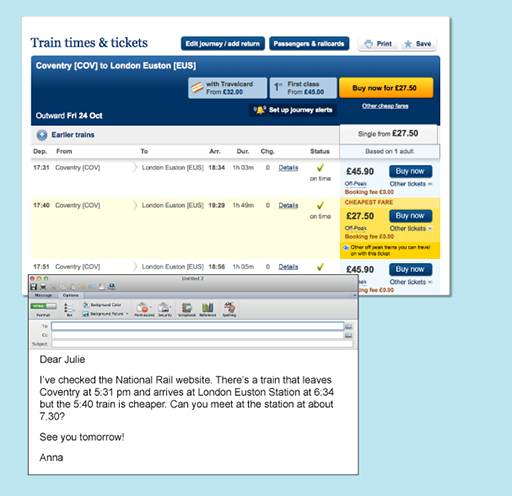
In order to pass on information, the choice is between repeating the exact words used by a source and rephrasing the content using your own words. You might, for example, summarise the information if you were telling someone about the content of a conversation. Information from other sources is often used to justify a decision or to support or illustrate a key point, in which case you may want to use the exact words.
Activity 2
How do you, and other people you know, use information and ideas you have read or heard? Spend a few minutes making a short list in the box below before comparing your answer with mine.
Answer
Your answer is personal to you, but it is useful to compare it to mine. Today I told my husband what my friends and colleagues had told me during the day. We also exchanged and commented on information we had read in the newspaper. Since we both read several newspapers, it’s interesting to compare notes. My daughter told me about an attraction near her home in Cornwall and used information from the internet to explain what can be done there and to quote the entry fee.
2.2 Reasons for using sources at university
Students, just like everybody else, share information they have read. They share it with other students during tutorials or in the course of online discussions, and they share it with their tutors by including it in their assignments.
Understanding why and how sources are used in assignments will help you gain an understanding of the type of work done by university students.
When they write their assignments, students use information and ideas from their readings to:
- demonstrate their knowledge and understanding of the subject
evaluate or compare ideas and information from readings- show how ideas from other writers have helped them develop their own views
- support the points they make and justify their decisions.
However, in order to achieve these purposes, students do not simply transfer information from a source to an assignment. They process this information and reproduce it by paraphrasing, quoting or summarising it. You will learn about this in the next section.
2.3 Distinguishing between summaries, paraphrases and quotations
In an assignment, it may be necessary to:
- include a summary of a text you have read
- include the paraphrased version of a sentence taken from a text
- quote a word or a sentence taken from a text.
The next activity helps to distinguish between these three ways in which information from sources is normally presented in a written assignment.
Activity 3
Match the following definitions to the three ways in which texts can be used in an assignment:
Two lists follow, match one item from the first with one item from the second. Each item can only be matched once. There are 3 items in each list.
-
A very concise and reworded version of a source text that reproduces all the key concepts but leaves out details and examples.
-
One word, or a group of words, taken directly from a source text and included, within inverted commas, in the assignment.
-
The reworded version of a short section of the source text.
Match each of the previous list items with an item from the following list:
a.Summary
b.Paraphrase
c.Quotation
- 1 = a,
- 2 = c,
- 3 = b
In the next activity you will look at some examples of summaries, paraphrasing and quotations.
Activity 4
Read this short text taken from the Open University Access course.
Musical connections are particularly significant for migrants. The music they bring with them provides an important way of remembering home culture. But it can also be a form of connection to the culture they are coming to. For instance in Britain people arriving from the Caribbean between the 1940s and the 1960s brought music, notably reggae, which was enthusiastically taken up by young people already living in the UK. Today the descendants of these migrants maintain links with the Caribbean, and this continues to have a major impact on British musical culture.
Now decide which of the following pieces of text is a summary, a quotation or a paraphrased sentence of the original text. Type the letter corresponding to the piece of text that matches the headings in the answer box below. Then compare your answers with mine.
- a.To migrants, music can ‘be a form of connection to the culture they are coming to’ (The Open University, 2014).
- b.Music is of fundamental importance to migrants as it allows them to retain and extend connections to their country of origin while at the same time culturally influencing their new country (The Open University, 2014).
- c.Reggae, a type of Caribbean music which was brought to the UK by immigrants in the period from the 1940s to the 1960s, became very popular among the British youth (The Open University, 2014).
Answer
1. Paraphrase of one sentence
c. Reggae, a type of Caribbean music which was brought to the UK by immigrants in the period from the 1940s to the 1960s, became very popular among the British youth (The Open University, 2014).
2. Summary of the whole paragraph
b. Music is of fundamental importance to migrants as it allows them to retain connections to their country of origin while at the same time culturally influencing their new country (The Open University, 2014).
3. Quotation
a. To migrants, music can ‘be a form of connection to the culture they are coming to’ (The Open University, 2014).
3 Reproducing information from sources
In the previous activity you practised identifying a summary, a paraphrase and a quotation. In particular, you have seen how they can transform the original text into different texts.
The diagram below (Figure 3) illustrates this transformation process:

In the following activity you will look at this transformation process in more detail.
Activity 5
Read the original text, the summary, the paraphrase and the quoted phrase again and then answer the questions that follow.
Original text
Musical connections are particularly significant for migrants. The music they bring with them provides an important way of remembering home culture. But it can also be a form of connection to the culture they are coming to. For instance in Britain people arriving from the Caribbean between the 1940s and the 1960s brought music, notably reggae, which was enthusiastically taken up by young people already living in the UK. Today the descendants of these migrants maintain links with the Caribbean, and this continues to have a major impact on British musical culture.
(The Open University, 2014, p. 82).
Paraphrase
Reggae, a type of Caribbean music which was brought to the UK by immigrants in the period from the 1940s to the 1960s, became very popular among the British youth (The Open University, 2014).
Summary
Music is of fundamental importance to migrants as it allows them to retain connections to their country of origin while at the same time culturally influencing their new country (The Open University, 2014).
Quotation
To migrants, music can ‘be a form of connection to the culture they are coming to’ (The Open University, 2014).
- In what ways has the writer transformed the original text in each case?
- How much content has been taken from the original text?
- What type of language has the author used?
- How has each text been structured? Do they differ from the original? If yes, in what ways?
- Does each text acknowledge the author of the original text?
Make some notes in the box before comparing your answers with mine.
Answer
Paraphrase
The writer has chosen to use only the example. This text conveys the same meaning as the original but has been reworded and structured differently. They have placed the name of the author of the original text in brackets at the end of the summary.
Summary
The summary is shorter than the original text. It contains the key points but not the examples. The writer has organised the text differently and chosen different words. They have placed the name of the author of the original text in brackets at the end of the summary.
Quotation
The writer has extracted just part of one sentence from the original text and included it in their own sentence without making any changes and within inverted commas. They have acknowledged the name of the author by placing it in brackets at the end of the quotation.
The transformation process normally involves choosing the amount of the original text that will be reused. The content (the ideas, theories and data) is never changed but it is usually reported in the writer’s own words. The only exception is the quotation but, in this case, the writer uses the inverted commas to indicate that the quoted word or sentence has been written by somebody else. The name of the person or organisation who wrote the original text is always acknowledged in brackets in the written text, together with the date when the original text was published.
The next three sections explain in more detail how to paraphrase, summarise and quote texts.
4 Paraphrasing text
In this section you will look at the paraphrasing process in more detail and practise paraphrasing strategies.
In order to paraphrase a sentence it is necessary to express its content in your own words. This is done by:
- replacing the words in the original text with synonyms
- reorganising the text.
4.1 Using synonyms
A synonym is a word that has a very similar meaning to another word. For example, the words intelligent and smart are synonyms. In order to paraphrase a sentence, it is necessary to replace most of its words with synonyms.
The only words that should not be replaced are the technical terms contained in the text. For example, in a text about the environment, the words species and biological diversity are considered technical terms.
In the next activity you will practise choosing synonyms using the following text taken from the Open University course Introducing environment.
As Fortey (2008) notes, the species is the fundamental unit of biological diversity.
Scientists use two approaches to identify a species:
- Members of the same species normally resemble each other.
- Male and female members of the same species can produce offspring that are also able to reproduce.
Activity 6
a.
feels
b.
reveals
c.
states
The correct answer is c.
Answer
states
Another way to express the same meaning is: ‘According to Fortey (2008), …’
a.
basic
b.
serious
c.
natural
The correct answer is a.
Answer
basic
a.
piece
b.
department
c.
element
The correct answer is c.
Answer
element
a.
methods
b.
means
c.
systems
The correct answer is a.
Answer
methods
a.
traditionally
b.
generally
c.
regularly
The correct answer is b.
Answer
generally
a.
echo
b.
look similar
c.
correspond
The correct answer is b.
Answer
look similar
a.
generate
b.
make
c.
create
The correct answer is a.
Answer
generate
a.
breed
b.
copy
c.
duplicate
The correct answer is a.
Answer
breed
Here you can see the complete text with the correct synonyms inserted.
As Fortey (2008) states, the species is the basic element of biological diversity. Scientists use two methods to identify a species:
- Members of the same species generally look similar.
- Male and female members of the same species can generate offspring that are also able to breed.
When you look up a word to find a synonym, you will be given a choice of possible words. In order to choose the most appropriate one, you need to look at its definition and make sure the word fits the specific context in which you want to use it.
Replacing some words of the original text is a useful strategy. However, it is not sufficient on its own as following only this strategy leads to writing a paraphrase that is very similar to the original text. If students change only a few words they will miss the opportunity to show that they have fully understood the original text and may also be accused of plagiarising – in other words, presenting other people’s work as their own.
4.2 Using another word of the same word family
In some cases, it is possible to paraphrase a text by replacing the original word with a word that is part of the same word family. Words are members of the same family if their form is very similar and their meanings are related.
If you look up the word able in the dictionary, for example in Dictionary.com, you will find that the following words are part of the family of the word able:
- able, ability, enable, unable
An important difference between these words is the role they play in a sentence. For example, ability describes a thing and enable describes an action. Able can be used to describe something or somebody (an able student) while unable is mostly used to describe a person or a thing that cannot do something (unable to move).
Knowing all the words that are part of the word family of able allows you to replace the phrase:
- are able to reproduce
with:
ability to reproduce
Similarly, resemble can be replaced with resemblance, identify with identification and reproduce with reproduction.
When you use a word of the same family, you will need to reorganise the original text.
4.3 Reorganising the original text
To correctly paraphrase a text it is necessary to replace as many words as possible with your own words and also to reorganise the information in the sentences while still keeping the original meaning.
Activity 7
Reread the original text and compare it with the paraphrase below. How does the organisation of the two texts differ? Make your notes in the box before comparing your answer with mine.
Original text
As Fortey (2008) notes, the species is the fundamental unit of biological diversity. Scientists use two approaches to identify a species:
- Members of the same species normally resemble each other.
- Male and female members of the same species can produce offspring that are also able to reproduce.
Paraphrase
Fortey (2008) defines the species as the basic element of biological diversity. In identifying a species, scientists follow two methods. They consider the resemblance between members of the same species and the ability of males and females of this species to generate offspring that can also breed (Peasgood and Goodwin, 2011, p. 38).
Answer
- The paraphrase has eliminated the bullet points. It uses a sentence to introduce two methods and places these two methods in the following sentence.
- The structure of the definition has been changed. It is useful to know different ways in which to define a technical term. Therefore the definition, ‘As Fortey (2008) notes, the species is the fundamental unit of biological diversity’, can also be rephrased in the following ways:
As Fortey (2008) states, the species is defined as the basic element of biological diversity.
According to Fortey (2008), the basic element of biological diversity is the species. Fortey (2008) defines the species as the basic element of biological diversity.
The paraphrase uses the words resemblance and ability instead of resemble and are able. For this reason the writer has had to change the organisation of the sentence. In order to do this it has been necessary to include the word consider.
Changing the organisation of a sentence while keeping the meaning of the original text can be difficult at first and most people learn to do this with practice and over a period of time. University students tend to start by simply using synonyms and, with practice and the help of their tutors, gradually develop the ability to also reorganise the original text.
5 Summarising text
In this section you will practise writing a summary. Summarising is part of writing assignments. Sometimes in an assignment students are specifically asked to write a summary of something they have read. However, they will need to include summaries of information taken from their readings in most assignments. Therefore, summarising is a very important skill to develop if you are thinking of enrolling on a university course.
5.1 What is a summary?
A summary can be a few words or many pages long. One of the main reasons for summarising is to give a reader your understanding of what you have read. In the next activity you are asked to think about what a summary is.
Activity 8
a.
Make the summary shorter than the original.
b.
Miss out some of the details contained in the original text.
c.
Write in your own words.
d.
Express the original writer’s facts and opinions accurately.
e.
Give an opinion about the original writer’s views.
f.
Compress the same meaning into fewer words.
The correct answers are a, b, c, d and f.
a.
You reduce the length.
b.
You reject information in the original: you include key points but reject some of the detail.
c.
You reword to show that you have understood, and to avoid plagiarism.
d.
You reproduce the original writer’s facts and opinions.
f.
You repackage the information into a lower number of words.
5.2 The 5Rs of summarising: reduce, reject, reword, reproduce, repackage
In this section, you will practise recognising the 5Rs in a summary.
Activity 9
Read the following example summary which uses all of the 5Rs. Then look at each of the four summaries below and select which of the 5Rs you can see in them.
Original text: Many non-governmental organisations (NGOs) tackle health issues around the world, for example the Red Cross and Red Crescent, which often step in following earthquakes and other disasters.
Summary: The involvement of NGOs in health problems
The 5Rs
- Reduce: the summary is shorter.
- Reject: it misses out the example.
- Reword: it uses problems instead of issues.
- Reproduce: it is accurate.
- Repackage: it compresses Many non-governmental organisations (NGOs) tackle health issues into The involvement of NGOs in health problems.
a.
reduce
b.
reject
c.
reword
d.
reproduce
e.
repackage
The correct answers are a, b, d and e.
Answer
Reduce, reject, reproduce, repackage.
a.
reduce
b.
reject
c.
reword
d.
reproduce
e.
repackage
The correct answers are a, b, d and e.
Answer
Reduce, reject, reproduce, repackage.
a.
reduce
b.
reject
c.
reword
d.
reproduce
e.
repackage
The correct answers are a, b, d and e.
Answer
Reduce, reject, reproduce, repackage.
a.
reduce
b.
reject
c.
reword
d.
reproduce
e.
repackage
The correct answers are a, b, d and e.
Answer
Reduce, reject, reproduce, repackage.
Discussion
None of the four summaries reword the original text enough yet. However, they do use the other four Rs. Too little rewording in a longer summary is regarded as plagiarism.
5.3 Writing a longer summary
When writing a longer summary, it is still necessary to use the 5Rs. However, because the summary is longer, it is also important to change the organisation. Academic texts are usually well organised, but when you write a summary you have to decide whether your summary will have the same organisation as the original text or not. This depends on your purpose.
While focusing on the way the summary is written, there is a risk of missing out or misinterpreting key information. When summarising a text, it is therefore important to follow the following process:
- Read the original.
- Make some notes.
- Summarise following the 5Rs.
The notes must correctly report the content of the original text as, if they contain errors, the summary will be incorrect too.
Activity 10
Look at the text below about HIV/AIDS, the two sets of notes on it and the two summaries. Compare the summaries with the original text. Which summary is the better one? Say why, bearing in mind the 5Rs and summary organisation.
Original paragraph
The HIV/AIDS epidemic threatens people in every part of the world. For example, it destroys the health, and lives, of millions of people. It also shatters families and communities and leaves millions of children orphaned. It undermines whole countries by robbing them of the young, able-bodied people needed to work in industry and agriculture. It ravages entire continents. While sub-Saharan Africa (the area of Africa south of the Sahara desert) has about ten per cent of the world’s population, it has almost two-thirds of all people living with HIV (UNAIDS, 2004). (91 words)
Notes 1
- HIV/AIDS threat to people everywhere
- health and life destroyed
- families and communities destroyed
- children orphaned
- countries robbed of young workers for industry and agriculture
- continents ravaged, e.g. sub-Saharan Africa, where the population is more heavily affected by HIV/AIDS
Summary 1
The HIV/AIDS epidemic is a threat to people everywhere, destroying the lives of families and communities. Young children lose their parents, and there is a lack of healthy young workers for industry and agriculture, which affects economies. In some parts of the world, such as sub-Saharan Africa, a higher proportion of the population is affected by HIV/AIDS. (58 words)
Notes 2
- HIV/AIDS tragedy
- young people are robbed
- two-thirds of African people have AIDS
Summary 2
The HIV/AIDS virus is causing terrible tragedies throughout Africa where two-thirds of the population are suffering from this dreadful disease. Young people are being robbed of their futures, and it is up to the rest of the world to help them. (42 words)
Answer
Summary 1 is the better summary because:
- it reproduces all the main points of the original text, without leaving out any of the key points;
- it rewords the original text in the student’s own words, e.g. a higher proportion of the population rather than two-thirds;
- it is well organised.
Summary 2 is a poor summary because:
- it does not reject the right information from the original – it mentions only Africa, not the rest of the world – and fails to make the relevant point about young people, i.e. their connection to the labour market;
- it does not reproduce the original text but gives the student’s own opinion – it is up to the rest of the world to help them.
Comment
There is a connection between good note making and good summary writing. If your notes are clear, brief and accurate, your summary is likely to be well organised.
5.4 Organising a summary: order of information
Sometimes, a summary writer changes the order of the original material to make it fit with their own text. This is acceptable, provided that the meaning of the original text is kept the same.
Activity 11
Read the following two texts and compare the original with the summary.
How has the student changed the order in the summary? Does the summary still make sense, and does it include all the relevant points made in the original text?
Type your answers in the box below before comparing your answer with mine.
Original text
The global nature of the HIV/AIDS crisis means that it needs to be tackled at a global level. In other words, international action is required. A key organisation at the international level is the United Nations (UN). This is a form of global government. It is funded by contributions from governments around the world and has its own parliament, the General Assembly, in which practically every country in the world has a seat. The General Assembly meets regularly to discuss and vote on important issues.
Summary
The United Nations (UN) is a key organisation in the fight against AIDS because of its international nature. The UN is funded by several countries and has a General Assembly at which most nations are represented, so it is in an ideal position to tackle global issues.
Answer
The numbers and bold text below show how the information in the original paragraph has been reordered in the summary. The parts which have been omitted from the summary are not in bold. Nevertheless, the summary flows logically and still contains the key points.
Original text
[1]The global nature of the HIV/AIDS crisis means that it needs to be tackled at a global level. [2] In other words, international action is required. [3]A key organisation at the international level is the United Nations (UN). [4]This is a form of global government. [5] It is funded by contributions from governments around the world and has its own parliament, the General Assembly, in which practically every country in the world has a seat. [6] The General Assembly meets regularly to discuss and vote on important issues.
Summary
[3]The United Nations (UN) is a key organisation in the fight against AIDS because of its international nature. [5] The UN is funded by several countries and [6] has a General Assembly at which most nations are represented, so [1] it is in an ideal position to tackle global issues.
6 Quoting
Quoting another author’s exact words is particularly appropriate when they express an idea or give a description in a particularly powerful and unique way. Quotations can be used to:
- provide evidence that supports your point
- add an important detail to your text
- help highlight a point you have made
- give authority to your point.
However, it is inappropriate to include a large number of quotations in assignments. This is because tutors are mainly interested in seeing how students talk about the things they have learned and how they apply theories and interpret information. If students do so by mainly using somebody else’s words, they will not be able to display their understanding very effectively.
When writing quotations, make sure you follow these guidelines:
- the quotation contains the exact words used by the author
- the quoted text is placed within inverted commas
- the quoted text fits grammatically in the text
- the meanings expressed by the original author are not changed
- the author of the quoted text is acknowledged.
Activity 12
Read the following short text.
It is true that, within any particular society at any particular moment, rich people are on average happier than poorer ones.
Now decide which of the following sentences quotes the text correctly and why this is so. You may also find it helpful to make some notes about why you think the other sentences are incorrect. Then compare your answers with mine.
- It is well known that ‘rich people are on average happier than poorer ones’.
- In the western world, rich people are happier than poorer ones (Layard, 2005).
- Layard (2005) states that ‘rich people are normally happier than poorer ones’.
- Layard (2005) argues that ‘rich people are on average happier than poorer ones’.
- According to Layard (2005) in some countries ‘rich people are on average happier than poorer ones’.
- Another important point ‘rich people are on average happier than poorer ones’(Layard, 2005).
Answer
The correct answer is:
4 Layard (2005) argues that ‘rich people are on average happier than poorer ones’. This quotation is correct because it follows the guidelines outlined above.
Incorrect answers
The author has not been acknowledged.
The author has been correctly acknowledged but, as there are no inverted commas, the reader cannot tell if these are all Layard’s own words or a paraphrase. Another problem is that the sentence changes the point made in the original text by adding the words ‘in the western world’.
The quoted phrase is different from the original as it uses ‘normally’ instead of ‘on average’.
The original text is correctly quoted, but the sentence that contains it changes the point made by Layard. Layard stated that rich people are happier in any society while this sentence states that this happens only in some countries.
The quotation does not fit grammatically into the sentence. The sentence should start like this: Another important point is that …
7 Referencing
Referencing is a way to acknowledge the authors of the ideas and words you use in your own writing. Therefore you need to include a reference every time you:
- summarise other people’s ideas, theories or works
- paraphrase their work
- quote their words.
In this section you will learn why referencing is important and how it is done.
7.1 Referencing in everyday life
Referencing is not simply an academic convention: people often acknowledge their sources when they report information. For example, when I reminded my son to take the umbrella this morning, I also said that I had listened to the BBC weather report, which forecast heavy showers.
If you read newspapers, listen to the radio or watch the news on TV, you will know that journalists regularly report information they have gathered from their sources and normally acknowledge these sources. They do this to justify and add authority to the points they make and to allow readers to locate their sources should they wish to find out more.
Activity 13
Read the extract below in which Guardian journalist Andrew Sparrow uses information from his sources to discuss child poverty in the UK. Identify the ways in which he acknowledges his sources and note them in the box before comparing your answer with mine.
The Social Mobility and Child Poverty Commission said the absolute child poverty goal was ‘simply unattainable’ and that this was on course to be the first decade since records began in 1961 not to see a fall in absolute child poverty.[…]
Iain Duncan Smith, the work and pensions secretary, argues that addressing poverty by just increasing benefits is flawed and the root causes must be addressed by getting more parents into jobs. But the commission says ‘ending poverty mainly through the labour market does not look remotely realistic by 2020’. In too many cases it simply moves children from low income workless households to low income working households.
Answer
Andrew Sparrow acknowledges both the Social Mobility and Child Poverty Commission and Iain Duncan Smith. He explains the current situation by reporting the Commission’s findings through a quotation and a paraphrase. He goes on to discuss a possible strategy by summarising the view expressed by the work and pensions secretary Iain Duncan Smith. He then reports the exact words used by the Social Mobility and Child Poverty Commission. Sparrow finishes by paraphrasing a point made by the Commission.
Comment
As you can see, journalists use their sources of information all the time. They sometimes simply report this information, but they often compare and contrast it or use it to make a specific point. They normally acknowledge their sources or inform readers of serious reasons why this cannot be done. The acknowledgement in this case would allow interested readers to look for the Commission’s report and read it in full. Referencing in newspapers, however, is not as precise as the referencing required in university assignments. For example, in this extract there is no date of publication.
7.2 Why should sources be cited in students’ assignments?
When producing an assignment, any other assessed piece of work or something that is going to be viewed and/or used by others, it is important to include complete and accurate references because:
- references show the student has read around the subject
- the points the student makes will appear stronger to their reader if it is clear that the points are supported by evidence from other people’s research
- others will be able to find and use the same sources that informed the student’s work, which in turn allows them to check the validity and authenticity of the student’s work, as well as develop and enhance their own understanding of the subject
- by doing so the student acknowledges the author or authors of the ideas and words they used in their text.
If the student uses other people’s work to construct their answers and does not include references, then it will look as if they are passing off other people’s work as their own, and they will be guilty of
To avoid plagiarism, it is therefore necessary for a student to:
- acknowledge the authors whose ideas and words are used in their text
- report these ideas either by using their own words (paraphrase) or by including a quotation.
There are several styles in which references can be presented in an assignment and they vary depending on the subject area. One suggested convention for citing references is the Harvard referencing system. This is the system used by The Open University.
The Harvard referencing system requires students to acknowledge their sources by including:
- an in-text citation in the body of their texts – this provides the author’s name and the date the work was published
- an end-of-text reference at the end of their assignment – this is detailed information not only about the author and their work but also about the publisher.
In-text citations provide the reader with very concise information regarding the source being used in the text. This is because a longer reference placed in the text would make reading difficult. Should the reader wish to know more about the source or where to find it, complete information is available at the end of the assignment.
7.3 In-text citation
An in-text citation of a book consists of:
- the surname of the author
- the date when the work was published
- the page number where the information and ideas can be found.
This information should be placed within brackets at an appropriate place within a sentence that contains information taken from the book. It can be included in different ways, as shown in the following examples:
According to Vygotsky (1978, p. 96) ‘the influence of play on a child’s development is enormous’.
The same point made by Vygotsky could be conveyed by paraphrasing his words:
Vygotsky (1978, p. 96) argued that the way children develop is significantly affected by play.
Alternatively, the acknowledgement can be added after paraphrased or quoted text:
‘The influence of play on a child’s development is enormous’ (Vygotsky, 1978, p. 96).
The way children develop is significantly affected by play (Vygotsky, 1978, p. 96).
7.4 End-of-text-referencing
Having placed an in-text citation in the body of the text, at the end of the text it is necessary to provide all the information readers will need if they wish to find the book. This information should be presented in the following order:
Surname of the author, initial. (date of publication) title (in italics and using initial capital letters), place of publication, publisher.
The Vygotsky example would be presented as:
Vygotsky, L.S. (1978) Mind in Society, Cambridge, MA, Harvard University Press.
Activity 14
Write an end-of-text reference using the following information:
- Title: Advanced grammar in use
- Year of publication: 2005
- Publisher: Cambridge University Press
- Place of publication: Cambridge
- Author: Martin Hewings
When you finish compare your answer with mine.
Answer
Hewings, M. (2005) Advanced Grammar in Use, Cambridge, Cambridge University Press.
The references list
End-of-text references should be included in a references list. According to the Harvard system, the references list should be placed at the end of the assignment under the heading ‘References’. The authors’ names should be listed in alphabetical order. If an author appears twice in the list, the references should be ordered according to the date of publication, as in the example below.
References
Crystal, D. (2003) English as a Global Language (2nd edn), Cambridge, Cambridge University Press.
Crystal, D. (2004) Stories of English, London, Penguin.
Swan, M. and Walker, C. (2007) How Grammar Works, Oxford, Oxford University Press.
Willis, J. (1996) A Framework for Task-based Learning, Harlow, Longman.
8 This week's quiz
Well done, you’ve just completed the last of the activities for this week's study before the weekly quiz.
Go to:
Open the quiz in a new tab or window (by holding ctrl [or cmd on a Mac] when you click the link).
9 Summary
This week you have looked at critical reading and have been introduced to ways in which students can use the ideas and the information they found in their readings when writing essays.
These are the key learning points:
Reading critically consists in asking yourself questions about the content of the text, its reliability and objectivity.
In everyday life, it is common to report information from various sources.
University students use information and ideas from their readings in their assignments.
Information from sources can be summarised, paraphrased and quoted.
Referencing is a way to acknowledge the authors of the ideas and words students use in their own text.
Plagiarism is passing off other people’s work as your own.
To avoid plagiarism it is necessary to reword the original text and to acknowledge its author with an in-text citation and an end-of-text reference.
You can now go to Week 3.
References
Layard, R. (2003) ‘The secrets of happiness’, New Statesman, 3 March 2003.
Peasgood, A. and Goodwin, M. (2011) Introducing Environment, Milton Keynes, The Open University.
Sparrow, A. (2014) ‘UK’s child poverty goals unattainable, says report’, The Guardian [Online]. Available at http://www.theguardian.com/ society/ 2014/ jun/ 09/ child-poverty-goals-unattainable-report (Accessed 13 October 2014).
The Open University (2014a) Y032 People, work and society, Milton Keynes, The Open University.
The Open University (2014b) Y032 Unit 4: Social Science: Individuals and Identity, Milton Keynes, The Open University.
Acknowledgements
This course was written by Anna Calvi.
Except for third party materials and otherwise stated (see FAQs), this content is made available under a Creative Commons Attribution-NonCommercial-ShareAlike 4.0 Licence.
The material acknowledged below is Proprietary and used under licence (not subject to Creative Commons Licence). Grateful acknowledgement is made to the following sources for permission to reproduce material in this unit:
Text
Layard extract from Activity 1: The Secrets of Happiness, extract from an article which first appeared in the New Statesman, 3rd March 2003. Permission from Professor Lord Layard. Copyright © Professor Lord Layard.
Every effort has been made to contact copyright owners. If any have been inadvertently overlooked, the publishers will be pleased to make the necessary arrangements at the first opportunity.
Don't miss out:
1. Join over 200,000 students, currently studying with The Open University – http://www.open.ac.uk/ choose/ ou/ open-content
2. Enjoyed this? Find out more about this topic or browse all our free course materials on OpenLearn – http://www.open.edu/ openlearn/
3. Outside the UK? We have students in over a hundred countries studying online qualifications – http://www.openuniversity.edu/ – including an MBA at our triple accredited Business School.