Week 8: Planning your next steps
Use 'Print preview' to check the number of pages and printer settings.
Print functionality varies between browsers.
Printable page generated Sunday, 20 September 2026, 7:27 PM
Week 8: Planning your next steps
Introduction
Hopefully, your engagement with this course has left you feeling that everyone, including you, is entitled to think that they have a career and to define ‘that career’ in a way that makes sense to you. This week you prepare for life after this course and how you will apply what you have learned. The activities are designed to help you ask ‘what next?’ and to create your own personal development plan.
Instead of introducing you to a lot of new material this week, the focus is on helping you to make sense of the learning experience this course has offered and to plan ahead. The week begins with a reminder of the career planning process, and explains how personal development planning helps. You will review your prior work on the course, fill in any gaps, and use this as the basis for planning what you will do when the course ends.
Finally, you will take the second of the two assessed quizzes, which must be successfully completed if you want to gain a badge for the course.
Watch Wendy introduce Week 8:
Transcript
By the end of this week, you will be able to:
- summarise what you have learned from the course
- use SWOT and SMART to assess your wish list and action plan
- produce an action plan for the next six months
- understand the need to review and update your action plan.
1 Your career planning process
In Week 1 you were introduced to the four main steps in a career planning process shown in Figure 1. As you probably realise, the course has been following this cycle.
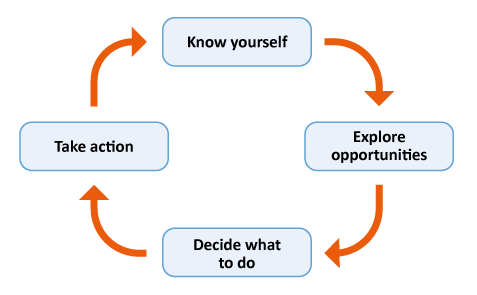
In the early weeks you undertook activities designed to help you to ‘know yourself’ in new ways. This enabled you to decide which opportunities you might want to explore. As you explored opportunities, you were encouraged to make decisions about what might be right for you. All that remains now is to decide what action to take.
Of course, the process does not work as neatly as the diagram suggests. Each time you explore an opportunity you may learn something new about yourself. As you learn more about your abilities, your horizons extend and you may be prepared to consider opportunities that you might previously have dismissed as ‘not for the likes of me’. You may have revised your ideas on what options would be fit for you, and some of your decisions about what kind of work to pursue, or about the working patterns that might suit you, may have changed. See the cycle as a dynamic, interactive set of activities to which you can return, at any stage.
At this stage in the course though, you are asked to focus on two things:
- deciding what you will do
- writing a personal development plan.
First, though, let’s consider what is meant by personal development plans.
2 Personal development planning

As the career planning diagram suggests, there are different steps you need to take at different stages of managing your career. A personal development plan is simply a structure you put around your activities, to make sure that they tie back to your thinking about the direction you want to go in.
A key idea in personal development planning is that learning is something which is life-long and encompasses all aspects of our life. A career is one aspect of our life, but as you have seen, it connects to many personal goals so it is easier to think of them together.
So, a good personal development plan helps you to:
- understand the skills you already have and to identify those you need to acquire or to develop further
- work out what you want to do in your career and how you will go about achieving this
- make choices between study and other development options, which might be important for your career and for your personal growth
- gather together the kind of information that you need in order to:
- write a good CV or job application
- present yourself positively in recruitment or appraisal interviews
- show that you are ready to take on more responsibilities, apply for a promotion or apply for development opportunities that will stretch you.
By completing the course activities in your notebook you have been identifying what you are learning from new ideas and experiences. This is a core skill, which not only helps you to plan your own personal, study or work-based development, but is central to some educational programmes and many forms of employment (QAA, 2009).
2.1 The next steps in your plan
The process you have been following over the last seven weeks has been part of your personal development planning. It just needs completing by considering your next steps.
This first activity helps you to understand the process and what it might offer you personally.
Activity 1 Personal development plan process
Watch the following short video, which explains the personal development plan process.
Transcript
What is Personal Development Planning?
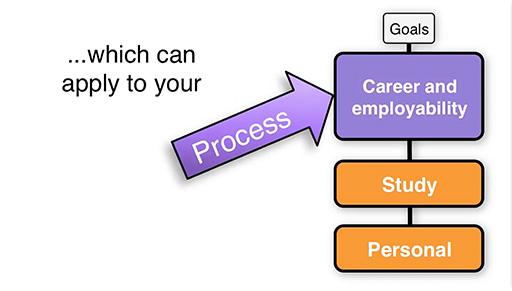
Personal development planning is a process which can help you to achieve your goals in three key areas: your career and employability, your study, and your personal development. The time and effort you invest in planning around these areas will enable you to continue developing effectively throughout your life.
So, what does Personal Development Planning involve?
There are five stages.
Identify – First identify your strengths, the skills you wish to develop and then set yourself realistic goals for each area you wish to focus on: careers and employability, study, or personal development. Are there smaller, short-term goals that will lead to your larger goals?
Plan – Plan what resources you need and when you intend to work on the goals that you’ve set. Think about how much time you have available each week. Be realistic to ensure your plans are achievable.
Action – Carry out the tasks you’ve set yourself for each goal, and be aware of any new skills that you’re picking up along the way.
Record – Record how the process is going: the progress you’ve made and the skills that you’re gaining. Where might you need to develop further? Recording your insights will help to inform your CVs, job applications and developmental reviews. It may also reveal other aspects involved in achieving your goals.
Review – Take a step back, collate everything that you’ve recorded and review what you’ve learnt. You should be more aware of your skills, and also be able to identify the next area or skill for development.
Remember that this process is flexible. You may identify new areas for development at any time, or realise that you’ve gained a new skill through your work or day-to-day activities. It’s important to record what you’ve achieved and use each stage of the process to help you develop further.
Take a few moments to reflect on what you heard. What were the main points being made? Write down your answer in your notebook.
Then, check you answer.
Answer
Some of the points which you might have written down include:
- Personal development plans can encompass career, study or personal aspirations.
- You need to assess your skills and strengths.
- You need to set realistic goals.
- You need a plan with timescales.
- You need to plan the actions you will take to progress each goal.
- You need to constantly record you achievements and new skills.
- You need to step back now and then and review how you have done against the plan, what you have learned and what the next phase of the plan needs to be.
Discussion
Which of these might be most important to you personally, at this stage?
Again, write down you answer in your notebook. Choose no more than three. You can always revise and add to them later. For now, focus on the things which will be most important immediately after the course finishes. It will serve as a reminder for you to go back to, when you have more time.
This sounds easier than personal development planning is in practice, as those of you who may have been asked to write one before may know. Of course, all the work you have done over the previous seven weeks has been a foundation for yours, so it makes sense to pause in the next section to review that work, and to fill in any gaps.
3 Reviewing and strengthening

Before writing your action plan, you need to give yourself space to review what you have done on the course, and to revisit any aspects that you need to complete, or about which you want to think more deeply.
Activity 2 Filling in the gaps
Table 1 is provided to remind you of the kinds of activity you covered in each week. Use your thoughts in your notebook, to decide which activities you might need to devote some time to this week before moving on. Identify those activities you need to:
- revisit (in order to cover an area in more depth or to do a bit more thinking or work on)
- do for the first time.
Make further notes in your notebook or in the ‘My note’ column of Table 1 in the Resource pack.
| Week | Key topics/activities | My note |
|---|---|---|
| 1 | ‘Wants’ from work Workline – influences on you so far Beliefs and values Interests and passions Constraints and limitations |
|
| 2 | Knowledge and skills Roles in life Skills acquired in work, learning and life |
|
| 3 | Work you want to do Market for work and matching it Finding out about types of work Working patterns and options |
|
| 4 | Work experience placement Finding work experience Benefiting from work experience Voluntary work and how to find it Learning review of the course so far |
|
| 5 | Networking What it is and why to do it Types of networking Mapping out your own network Using networks to obtain work Social networks and registering online |
|
| 6 | Analysing job advertisements Matching skills to job advertisements STAR and RAPPAS techniques Completing application forms CVs – and the different types LinkedIn profile creation |
|
| 7 | Interviews and how to approach them Types of interviews Types of interview question Preparing for interviews Performing in interviews Following up from interviews |
Now identify three priority areas you want to review this week. You can always go back to the lesser priorities later. For now, focus on the things that will help you to decide where to focus your energy once the course ends.
Write down your priorities in your notebook.
Try to make your ideas about what you need to do quite specific. So, instead of writing ‘look again at interviews’, for example, write something like ‘practise answers to competency-based questions’ or ‘practise (with a friend) giving my answers in a confident voice’.
Copy this table into your notebook or you can complete it in your Resource pack.
| Priority Area | Why | What do I need to do? |
|---|---|---|
|
|
|
|
|
|
|
|
|
Once you have your priorities, you are in a good position to decide how best to use your time this week. The activity in the next section is one which you construct (in part) yourself, as it focuses on your priorities.
3.1 Your priorities and decisions so far

This is an activity that you partly design yourself because time has been allowed this week for you to:
- complete or revise work from previous weeks that is on your priority list
- review all your thoughts in your notebook and to draw out any key decisions you have made along the way.
Activity 3 Revisions and decisions time
For activities that you wish to complete or revise (which you identified in Activity 2), you should return to the relevant section of your notebook and do the work there.
Once you are ready to review your notes and draw out your decisions, list them in your notebook under the heading ‘My decisions so far …’
Decisions might sound a strong word, and you may not yet feel wholly committed to some of the ideas you have had so far. This is fine. You are looking for the areas in which your thinking is pretty clear. For example, you want to work part time, or you wish to stay in your current career but perhaps move employer, or your next step is to find voluntary work that allows you to develop your interests in some way.
When you are ready to review your notes and draw out your ‘decisions’, make sure you record them in your notebook.
The following topics might prompt your thoughts, but do not feel constrained by them.
You may have made decisions about:
- yourself and what motivates you
- how you might be holding yourself back
- what changes you might need to make to pursue your aspirations
- the type of work you want to do – and where
- the kind of career you want
- the working pattern that best suits you
- the skills or knowledge you might need to acquire
- personal contacts you want to talk to
- jobs or work you want to actively seek soon
- new contacts you want to build.
Comment
You may well be surprised by the amount of ground you have covered over the last seven weeks, and also the number of decisions you have made already. That is just great! You should feel a real sense of achievement, however long your list is in answer to this activity. After all, making a decision to rule something out is just as important as identifying a potential new career path.
Having reviewed what you have done over the past few weeks, and taken a bit of time to sharpen your ideas where needed, you are now in a good position to think about what you want to take forward into an action plan. The next section takes you through this in a structured way.
4 Moving forward
You have just done a ‘stock take’ of where you are and now can think about how you want to move forward.
The first thing to do is to construct a ‘wish list’ of what you would like to achieve in both the short term and the long term. Below is an example of Jon’s wish list, presented as a spray diagram (sometimes known as a ‘mind map’). You encountered mind mapping as a technique in Week 5 when you mapped out your personal contacts network.
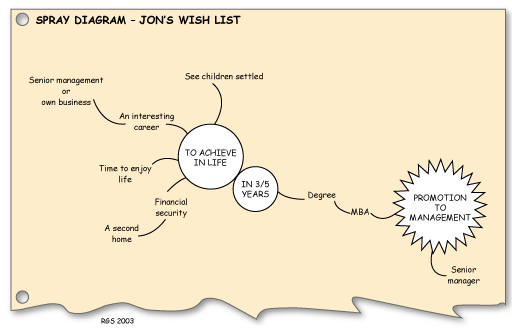
You might feel that Jon has aspirations that are way beyond what feels achievable for you and feel slightly demotivated. Or, perhaps you identify with Jon, and see him as someone who might be in a similar position to you. It is an ambitious set of wishes, and you might wonder whether they are even achievable. For instance, doing both a degree and a Masters in Business Administration within three to five years is certainly challenging, and could probably only be done if he studied on a full-time basis.
Without more knowledge of Jon’s personal circumstances, it is tricky to judge how realistic he might have been in creating his wish list. In a way, it is not too much of a problem if he has been unrealistic. They are only ‘wishes’, not a plan. But notice that Jon’s wishes are not all about work. They are wishes for his life. Work seems to be important in its own right because Jon wants an ‘interesting’ career. It is also something that makes other things possible. For instance, work may provide the income to buy the second home he wants.
Now it’s your turn to create your own wish list.
Activity 4 My personal wish list
This activity encourages you to create your own list of wishes, but in a structured way.
Throughout the course you have written down lots of your wishes and wants and, in the previous section, you wrote down any ‘decisions’ you made along the way. Now is the time to pull them together.
Produce your own wish list of what you would like to achieve in the short term (next 6–12 months) and the longer term (3–5 years). If you like the mind mapping technique you may want to follow Jon’s example. Otherwise, use a table similar to the example below in your notebook or you can complete this in your Resource pack.
| What would I like to achieve in the long term? | What would I like to achieve in the short term? |
|---|---|
|
|
|
|
|
|
Having worked out what you would like to happen in your life over the next few years, it now makes sense to briefly consider where you are starting from. The next step is to create what is called a ‘SWOT’ analysis of yourself and your situation. SWOT stands for:
- Strengths
- Weaknesses
- Opportunities
- Threats.
You’ll do this analysis in the next section.
4.1 SWOT analysis
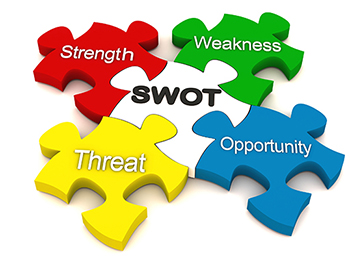
The purpose of a SWOT analysis is to help you to move from your wish list to a specific and achievable goal.
When you complete it, you will be again pulling together some of the questions you have already asked yourself over the last seven weeks.
Let’s look at Jon’s SWOT analysis to get a feel for this and as an example of how it can help you to take a balanced view.
| Strengths | Weaknesses |
|---|---|
|
|
| Opportunities | Threats |
|
|
Now you need to do your own analysis to help you move forward with confidence.
Activity 5 My personal SWOT analysis
This activity helps you to shape your thoughts from the last seven weeks, and to highlight where to focus your energy.
Carry out your own SWOT analysis by copying this example grid into your notebook or you can complete this in your Resource pack.
The following table of questions is to help you get started, but remember to use the thinking you have already developed in your notebook.
| Strengths | Weaknesses |
|---|---|
What do I do well in life? What do other people see as the things I am good at? What skills do I tend to rely on most? Which skills are the ones I’ve developed furthest so far? What personal qualities are strengths for me? |
What do I do less well in life? What do other people suggest I need to get better at doing? What skills do I tend to avoid using? What personal qualities might I wish I had – but don’t? |
| Opportunities | Threats |
What possibilities are open to me? What works in my favour at the moment? What resources do I have? What/who can help me? What is changing in my life and may open new options for me? |
What might cause me difficulties? What restrictions are there on me? What is changing in my life and may close options for me? Where are there gaps in my resources or sources of help? |
Be honest about your weaknesses – there is no point deceiving yourself and, as you know, you can take steps to develop those areas. Keep the responses simple. Once you have identified what is feasible, you can start to prioritise and decide what you want to achieve first.
Comment
Your wish list is an expression of your aspirations, of what you want for yourself at some point in the future. If they are ‘wishes’, they are likely to be things you do not have now, or feel you do not have enough of currently. The SWOT analysis describes where you are right now. Obviously, there will be a gap between the two, so you are likely to want to make some change. That’s a good result, as it means you are on the way to planning for the future and taking action.
You need to work actively towards any changes you have identified in your wish list. The SWOT analysis will help you identify what actions you need to take and issues you need to watch out for.
4.2 Reflecting on your wish list and SWOT analysis
You might have concluded that trying to improve your current situation is your best option. For instance, if you are employed and not doing the work that most interests you, or feel that you are struggling to get right the balance between work and the rest of your life, you may already have thought about how you might seek some changes within your existing job.
Some of your future-based aspirations, however, may not fit at all with your current situation. Perhaps you are not in work at all and are struggling to find a job. Perhaps you like your job but do not seem to be able to get promoted. You might not be able to take on work at the moment, but want to prepare yourself for doing that in the future; however, making time for study or work experience is difficult. Whatever the change you want to make, you might need to consider one or more of the following approaches:
- Change yourself. Examine your own attitudes, behaviour, ambitions, skills and lifestyle, and consider how, if you changed any of these, your situation might improve.
- Live with it. Devise a strategy to minimise the aspects of the situation you do not like and maximise those you do.
- Leave. Find a constructive way to move away from the situation that causes you difficulties.
In the next section you will be writing an action plan for the next six months. Bear these potential changes in mind as you think about the actions that might best serve you.
5 Action planning

Some changes happen in life without planning, or without you taking action. Others need your focus, attention and energy, if they are to take place. If you want changes in a specific direction, then you need to take charge of that process and plan what you are going to do to make it happen.
A good action plan breaks down your goals into smaller, more specific steps in order to make them more achievable. One of Jon’s goals is to gain a degree within four years. He asks himself four questions:
- What do I need to do to realise the goal?
- How I can do this?
- What resources might I need to help me?
- When do I need to take action to secure these resources?
The table below shows how Jon collated his answers and acted. It is an example of the kind of action plan you might want to create.
| My goal | |
|---|---|
| A degree within four years | |
| What? | How? |
Need to do 90 credits per year Allocate realistic time for study, i.e. 24 hours per week |
Do breakdown of typical week Note best and worst times of day for study Timetable in 24 hours using as much ‘best time’ as possible Think about which study tasks I might tackle during ‘difficult’ times, e.g. watching course videos |
| Resources to help | When? |
Tom, my line manager – to negotiate some study leave and/or flexible working hours Clare – to add key family commitments to timetable, e.g. parents’ evenings Parents – to ask for help with children and garden |
Talk to Tom during my appraisal on 10 November Talk to Clare next weekend while children are at swimming lessons and do timetable Ask Mum and Dad over for a meal next week |
5.1 SMART
After you’ve constructed an action plan you need to think about how good it is. Fortunately, there is a tool called SMART to help you do this.
This means the best action plans are:
- Specific – they state the goal, ideally as an outcome. For instance, saying that you will weigh 10 stones is more specific than saying that you will weigh less than you do now.
- Measurable – you will know whether or not you have achieved something. If you know you want to end up at 10 stones, you know how many pounds you need to lose, and can measure your progress.
- Achievable – it is within reasonable reach for you. Assessing this, for instance, might involve checking what percentage weight loss this would represent and how long it might take you to do it.
- Realistic – it takes circumstances into account. For instance, if your weight loss plan involves a 20% loss over three months, and you worked out how many pounds weight loss per week that would mean, you would be better able to judge whether or not it is practical.
- Time-bound – it has a target within which you will have done something. If three months is not realistic for your weight loss, what would be?
You can use the SMART tool to help you to create goals and action plans, as well as to review how good your plan is.
See how you get on using SMART in the next activity.
Activity 6 Using SMART criteria
Look back at Jon’s action plan and review it against the SMART criteria. Would you say that it meets them?
Look for the evidence against each of the criteria. An example has been given to start you off. You may have to make some assumptions about what is realistic or achievable, but look for indicators of whether or not Jon has tried to test these things. Carry out your own SMART analysis by copying this example grid into your notebook or you can complete it in your Resource pack.
| Criterion | Evidence |
|---|---|
| Specific | |
| Measurable | |
| Achievable | |
| Realistic | |
| Time-bound | Example – Jon gives himself four years in which to do a degree. |
Comment
You probably found that some of Jon’s ideas were ‘SMARTer’ than others. This should have given you some clues on what you might imitate or do differently in your own planning.
In the next section you will devise your own action plan and test it using SMART.
5.2 Building your own action plan

The next activity gives you the chance to complete the third part of the career planning process (decide what to do) and move on to ‘take action’.
Activity 7 My action plan
Now put what you have learned into practice by creating your own action plan.
First of all, choose your priority goal for the next six months. For example, you might decide that finding a paid job is your priority, or that you want to apply for promotion at work, or that you need to take a qualification related to the work you are doing or want to do. If your focus is not on work right now, you might want goals related to your relationship with your family, a role you want to play in your local community, or a sport or a craft you want to master.
When you have chosen the goal you want to work on, follow Jon’s example and create your own action plan by drawing Table 8 in your notebook or you can complete it in your Resource pack.
Don’t forget to check your plan against the SMART criteria.
| My goal: | |
|---|---|
|
|
| What? | How? |
|
|
| Resources to help | When? |
|
|
Comment
The real test is how clear you are about what you are going to do in the first few months after the course ends. Of course, you have long-term goals too, so you need to keep your plan under review to make sure you keep those in your sight.
The next section covers how to review your development plan.
6 Planning to ‘stay on track’

It is one thing to write a plan, but it is quite another to follow it through. Thinking about your achievements and recording them helps you stay on track once you get started. You have invested time on this course in establishing what skills and abilities you have to offer, and where they might best be offered. You have also acquired new skills and knowledge. It is important not only to keep a record of what you can do, but also to keep it current and up to date. No one else is going to have as clear a view of your abilities and your development as you are, so if you don’t keep your record up to date, you will always be selling yourself short in some way.
As you follow your action plan, paying attention to this becomes part of your routine. The following guidelines are designed to act as a checklist for you:
- Make sure you add to your record of achievements at regular intervals, perhaps every month, or every three months. Have a diary date to remind you.
- Don’t forget to continue to collect evidence and examples of the new skills you acquire.
- If you uncover a gap in your knowledge, or struggle to do something because of a lack of skill in particular area, make a note in your plan and put an action to address it. (Then make sure to do Step 2 when you have completed the development.)
- As your achievements build, look at your goals again and decide which have been met, which still remain relevant and whether or not you can add any new goals.
It is possible that plans will not work out exactly as you intended, so it is always useful to stand back from them now and then and review the situation as it has unfolded. It is not necessarily a bad thing if plans do not go as we expected. Sometimes opportunities or alternatives open up that you had not originally anticipated.
When you decide to review your plans then the questions below might help:
- Was I being realistic in my plans – in terms of how much time I could give to something, how long it might take me, how much it asked of me?
- Did anything affect my plan that I could not influence? Could I have anticipated any of this?
- Did my plans change because of something I did or did not do? Was this helpful or unhelpful?
- Has the plan taken me in an unexpected direction but one I am happy with following? Or have I gone off track altogether?
- Do I need to re-plan? If so, what are the next natural one or two things for me to do – either to get back on track or to move forward?
You may have questions of your own to add. As you have learned through practice each week, questions are a good way of prompting reflection. So, use the questions to reflect on any changes you might want to make to your goals and plans, and how to make them achievable.
In the last section of the course you’ll look at the importance of reflection, before finishing by reflecting on your own learning throughout the course.
7 The importance of reflection

You have had a lot of practice in reflecting on what you have done over the course of the last eight weeks, and this is an important skill in its own right. Before your final learning review of the course, watch a short video in which Stephen McGann discusses his own experience of learning how to reflect in practice, and why he now understands it to be so important.
Activity 8 Learning from reflection
In this video, actor and OU graduate Stephen McGann discusses how learning to reflect on what he did was an integral part of his degree course. He introduces the term ‘reflective practice’ – which is the same skill you have been encouraged to use on this short course, although you may not have always been aware of it. Listen to his views on what he gained from reflective practice and why it has become such an important skill that he continues to use it. Make a few notes.
Transcript
Comment
Hopefully Stephen inspired you to want to continue to use your reflective skills. You may want to jot down in your notebook any thoughts about how and when you might do this.
For now, at least, put your reflective skills into practice in the final section of this week, which invites you to look back over the course and record your main learning points.
7.1 Learning review
No doubt you have discovered for yourself that you can spend as little or as long as you like on reflective activity. The more time you give to it, the deeper your reflections will be, but the important thing is to write down your thoughts so that you can revisit them in the future and add to them if you wish to.
Activity 9 Final learning review
Use these questions to prompt your reflections on your learning over the last eight weeks, but do not limit yourself to these. Aim to think of three questions of your own and write your answers to them too. Write your thoughts in your notebook.
Reflective questions
- What motivated you to begin this course?
- Has your motivation changed at all during the course?
- What have you decided about the kind of work you want to do?
- Has this decision changed over time? If so, why?
- What areas of the course have you found most interesting and useful to you?
- How do you plan to use the areas you found most interesting and useful?
- Which areas of the course did you find least interesting or least useful to you?
- Might any of the less interesting or less useful areas become more valuable to you in the future?
- What are you most proud of having done or achieved over the last seven weeks?
Imagine it is now six months since you completed the course and you are talking to someone who might be able to offer you work. They ask you what you learned from this course. What would you say? (Remember the ‘lift activity’, and the need to make clear the value of your learning to the other person in a short time.)
Comment
This activity should have helped you to see how far you have come since the beginning of the course. It may have raised more questions for you but see this as a positive. That means you have more options to explore and work on.
And that’s it – you’ve finished all the activities for the course and should have a notebook full of ideas and thoughts to help you move forward. Well done, you should feel proud of what you've achieved. Remember you can always revisit your notebook at any time to add more thoughts that occur to you. Reflection and learning never stop.
8 Week 8 quiz
You are now ready to take the final quiz for your badge. This quiz is another 15-question quiz, like Week 4, but as with all the other quizzes, you still have three chances to answer each question.
Remember to take your time reading the questions, and answer options if given, to give yourself the best chance to show your full knowledge and understanding. Good luck!
Go to:
Remember, this quiz counts towards your badge. If you’re not successful the first time you can attempt the quiz again in 24 hours.
Open the quiz in a new tab or window (by holding ctrl [or cmd on a Mac] when you click the link).
9 Summary
During the past eight weeks you have been drawing out your thoughts on:
- who you are
- what you want for yourself going forward
- how to find out what kind of opportunities might be available
- how to develop a network of contacts who can help you with your aspirations
- how to put together a convincing written presentation of your abilities
- how to put those abilities across in situations where you are trying to secure a job or access the work you want
- your action plan going forwards.
Alongside the ideas and arguments you have encountered, you have been encouraged to apply the ideas to your own situation, and to reflect on your experiences. Your notebook is now your ‘resource bank’ of ideas about what matters to you, where you might want to take your interests, and what you need to do to achieve them.
It is a great achievement to complete the course, so remember to add the new skills to your CV, but you have also taken the first steps that may enable you to achieve your goals. Always keep these in mind now you have identified them, and good luck with fulfilling your career aspirations.
You should now feel that you can:
- summarise what you have learned from the course
- use SWOT and SMART to assess your wish list and action plan
- produce an action plan for the next six months
- understand the need to review and update your action plan.
If you’ve gained your badge you’ll receive an email to notify you. You can view and manage your badges in My OpenLearn within 24 hours of completing all the criteria to gain a badge.
Now you’ve completed the course we would again appreciate a few minutes of your time to tell us a bit about your experience of studying it and what you plan to do next. We will use this information to provide better online experiences for all our learners and to share our findings with others. If you’d like to help, please fill in this optional survey.
You can now return to the course progress page.
Tell us what you think
Now you've come to the end of the course, we would appreciate a few minutes of your time to complete this short end-of-course survey (you may have already completed this survey at the end of Week 4). We’d like to find out a bit about your experience of studying the course and what you plan to do next. We will use this information to provide better online experiences for all our learners and to share our findings with others. Participation will be completely confidential and we will not pass on your details to others.
References
Acknowledgements
This course was written by Maria Townsend and Gill Gustar.
Some of the material in this course is based on material originally available on the Open University Careers Advisory Service website.
Except for third party materials and otherwise stated in the acknowledgements section, this content is made available under a Creative Commons Attribution-NonCommercial-ShareAlike 4.0 Licence.
The material acknowledged below is Proprietary and used under licence (not subject to Creative Commons Licence). Grateful acknowledgement is made to the following sources for permission to reproduce material in this unit:
Images
Figure 2: Shutterstock © Joe Gough; Figure 3: Shutterstock © Nevenova; Figure 4: Shutterstock © Andy Dean; Figure 6: © ArtistashMita/Dreamstime; Figure 7: from: http://www.teachingideas.co.uk; Figure 8: from: http://onstartups.com; Figure 9: © Gregor Bister/iStockphoto.com; Figure 10: © unknown.
Every effort has been made to contact copyright owners. If any have been inadvertently overlooked, the publishers will be pleased to make the necessary arrangements at the first opportunity.
Don't miss out:
1. Join over 200,000 students, currently studying with The Open University – http://www.open.ac.uk/ choose/ ou/ open-content
2. Enjoyed this? Find out more about this topic or browse all our free course materials on OpenLearn – http://www.open.edu/ openlearn/
3. Outside the UK? We have students in over a hundred countries studying online qualifications – http://www.openuniversity.edu/ – including an MBA at our triple accredited Business School.