Teaching secondary geography
Use 'Print preview' to check the number of pages and printer settings.
Print functionality varies between browsers.
Printable page generated Tuesday, 20 October 2026, 12:18 PM
Teaching secondary geography
Introduction
Introduction
This free course, Teaching secondary geography, is designed for people who are learning to be a teacher, are in their first few years of teaching, or who are working in an educational setting. It identifies and explores some of the key issues around teaching geography in secondary schools. Engaging with these issues and debates will help you to reflect upon and develop your practice as a geography teacher. You will also develop a greater awareness of the wider context of geography education and how this affects geography in the secondary school curriculum.
Section 1 examines how students learn geography, discussing the role of concepts and ‘thinking geographically’. The second section explores how students can be engaged in geography, focusing on the use of enquiry and young people’s geographies to support learning. Section 3 discusses creativity in geography. The final section explores opportunities and challenges related to teaching controversial issues.
This course is based on a learner-centred approach to teaching, which is underpinned by a constructivist view of learning – that learners construct knowledge and understanding for themselves through activities and experiences.
Now listen to an introduction to this course by Gary Spruce:
Transcript
Introduction to Teaching secondary geography by Gary Spruce.
As you work through the activities you will be encouraged to record your thoughts on an idea, an issue or a reading, and how they relate to your practice. Hopefully you will have the opportunity to discuss your ideas with colleagues. We therefore suggest that you use a notebook – either physical or electronic – to record your thoughts in a way in which they can easily be retrieved and re-visited. If you prefer, however, you can record your ideas in response boxes in the course – in this case, in order to retrieve your responses you will need to log on to the course.
This OpenLearn course is part of a collection of Open University short courses for teachers and student teachers.
Learning outcomes
After studying this course, you should be able to:
outline the nature of geographical concepts and the enquiry approach, and explain their significance in geographical learning
explain modes of creativity and the stages of the ‘creative’ process in geographical teaching and learning
define controversial issues and explain their significance in geographical education
relate personal views of teaching and learning to those presented
use different resources and approaches to support students’ learning.
1 How do young people learn about geography?
If you asked a selection of adults or young people to tell you what ‘learning geography’ involves what do you think they would say?
Many people see geography as a subject concerned with remembering the names of places and landforms, and learning about human and physical processes responsible for the world around us. There is a common perception that geographers learn ‘the facts’, present them in maps, hydrographs, pie charts and ‘do fieldwork’. Many will restrict their comments to what is taught in school. Think for a moment of all the ‘out-of-school geography’ that students will have encountered over the last few weeks.
Activity 1 Views of geography
- Ask young people and some adults what they think learning geography involves.
- Ask adults about their views of geography now, as well as when they were learning it at school. What has led to their views?
- What are the most common responses?
- Were you surprised by any of the responses? Why?
Within the geography community there has long been a lively debate about the nature of geographical knowledge with views including, for example, those of:
- positivists (reality exists independently of what anyone knows, thinks or believes, fitting with many stereotypes of what learning geography involves)
- social constructivists (all geographical knowledge is constructed)
- social realists (some objective ‘facts’ about the world exist and some knowledge is constructed).
Positivists argue for a ‘traditional’ content-driven, socially conservative curriculum in which knowledge is fixed and the objective is to induct the learner into the dominant knowledge traditions (Firth, 2013, p. 64). By contrast, what vexes constructivists and realists is how best to help learners to develop structures and processes so that they can effectively make sense of the massive amount of geographical information available to them, pose questions, investigate issues, generate their own data and formulate and articulate their own opinions. Your view of geography matters in terms of what and how you teach. Furthermore the opinions of students will affect what and how they learn.
Teaching approaches such as conceptual learning and thinking through geography, geographical enquiry, supporting creativity and classroom talk are influenced by learning theories. If you are unfamiliar with learning theories, a brief explanation of four learning theories can be found within this OpenLearn course, Exploring children’s learning , and a longer exploration in this OpenLearn course, Secondary learning . Reflecting upon how students learn geography and how they can ‘think geographically’ will help you to plan your teaching and to support their learning.
1.1 Concepts in geography
Learning geography requires students to achieve ‘an understanding of geographical concepts and ideas. It is also about developing the intellectual structures which young people need to understand and process geographical information and progress in their learning’ (Geographical Association, 2014).
What is a geographical concept?
Geographers observe places, processes and objects and look for common features. The classification of these common features generates concepts that help us to structure our knowledge and understanding and to communicate these with others (Lambert and Balderstone, 2010, p. 46). If you think about geographical concepts, you can probably produce a long list of examples. They may be:
- abstract (e.g., erosion)
- concrete (e.g., beach)
- organisational (a way of linking the everyday to higher-level geographical ideas, such as interdependence)
- or belong to another category entirely (Brooks, 2013, pp. 76–80).
Like you, students will possess their own understanding of geographical concepts and their own lists. There is no one definitive list of concepts and no correct categorisation of concepts. However, thinking about the world we inhabit in terms of geographical concepts is how we learn in geography. This is explored in Activity 2, which outlines the thoughts of the Geographical Association (GA) about the nature of geographical concepts and their significance in promoting geographical learning.
Activity 2 Thinking geographically
Part 1
Read ‘Thinking geographically’ (2012), a paper prepared by the Geographical Association.
Consider how the responses you had to the questions in Activity 1 relate to the ‘vocabulary’ and ‘grammar’ of the subject and other ideas presented in the paper.
Note the importance given to ‘context’ and ‘authenticity’.
- What does the reference on page 5 to ‘a curriculum … of “engagement” rather than one of “compliance”’ mean to you?
- How far do you agree that thinking geographically involves more than thinking about concepts in isolation?
- Do geographers need to adopt relational thinking as proposed by Jackson (p. 5) and Hanson (p. 6) in the Thinking Geographically paper? Justify your answer.
You will return to some of these issues in Sections 2 and 4.
Part 2
Explore the Geographical Association Think Piece, ‘Concepts in geography’. Pay particular attention to the sections:
- Which are the big concepts in geography?
- Is a division between substantive and second order concepts helpful?
Comment
Your ‘big concepts’ will differ from those of colleagues and students and may change over time. Distinguishing between substantive and second order concepts can help you to plan in the medium and long term and to generate enquiry questions as illustrated in Resource One of the Think Piece.
Lambert (2011) has suggested that geography teachers can usefully distinguish between:
- core knowledge (world knowledge or vocabulary of geography)
- content knowledge (key concepts or grammar of geography)
- procedural knowledge (thinking geographically and distinctly geographical approaches to learning such as enquiry).
Core knowledge or context is important but where ‘thinking geographically’ (using and linking concepts) is a learning outcome, students develop the structures and skills to progress their own learning. Rather than ‘covering’ the subject, teachers support young people to develop conceptual understanding to organise, link, interpret and question geographical content. Students can link everyday experience with higher-level geographical thinking, develop explanations and think abstractly. Their own experiences and out-of-school or informal learning can be valued and integrated into their formal, school-based learning. In these ways the ‘curriculum becomes one of “engagement” rather than one of “compliance”’ (Geographical Association, 2012). More on this in Section 2.
1.2 Contested concepts in geography
Lambert and Morgan (2010, p. xi) issue some health warnings with regard to concepts: they ‘see concepts as sites of contestation’, observing that they are likely to have ‘multiple meanings that cannot be reduced to a single straightforward definition’. They observe that ‘Geography is a discipline that involves creating concepts in response to changes in the natural world’. Equally in a dynamic subject some concepts, such as regional geography, fall out of favour only to re-emerge again.
Activity 3 Contested concepts
Part 1
Spend 10 minutes using a search engine to research the history of the following concepts that are commonly used in geography:
- biodiversity
- globalisation
- sustainable development.
Are there other concepts you can think of that have emerged or significantly changed recently?
Comment
There will be a long list of possible answers but you could have answered something like this:
Biodiversity provides an example of the recent ‘creation’ or construction of a concept. This term was coined in the mid-1980s by a group of conservation ecologists. It links the variety of genes, species and ecosystems in a way that had not been done before.
Conceptualisations of climate change, development and regional geography have all changed through time and vary between different actors. This is explored in more depth in Part 2.
Part 2
Listen to Doreen Massey’s (2006) lecture, ‘Is the world really shrinking?’ (from 2 minutes 30 seconds to 23 minutes 15 seconds). (Alternatively, you can read a transcript.)
As you listen, note examples of the complexity of concepts and how they can change through time and between different people.
Part 3
For each of the concepts listed in Part 1 above, identify two different people who would attach very different meanings to them. Think of how they would define or frame these concepts and the reasons for their differences. For example, these could include social (age, experience, values), economic or political factors.
Comment
For example, ecosystem scientists might define biodiversity to include genetic, species and ecosystem diversity and view ‘nature’ as having intrinsic value. A multi-national company might define biodiversity in relation to ecosystem services that benefit humans (timber, pollination, medicinal plants) and some economists quantify the economic value of these in terms of dollars or pounds.
It is important to be aware of the contested nature of concepts. Be alert to alternative ways of thinking as you research topics and as you teach. Encourage students to develop, explain and question their own geographical conceptualisations and those of others. Have strategies to elicit and address misconceptions.
Reflection point
Are you clear about the differences between an alternative view and a misconception?
1.3 Summary
Many teachers and teacher educators have sought to explore and extend conceptual development in school geography. Brooks (2013, p. 86) argues that progress may be undermined by shifts in curricula and examination specifications from a conceptual approach to one that prioritises core knowledge. She argues that how teachers see the relationship between content (vocabulary) and concepts (grammar) will determine how they teach. Like Lambert (2011), Brooks advocates an approach that distinguishes between but integrates world knowledge, key concepts and procedural knowledge. You will have to determine which geographical concepts you wish to focus on, how best to help students to understand these concepts and how to support them as they develop their own conceptual frameworks.
2 How can young people be engaged in geography?
Acknowledging and valuing what young people bring to the curriculum is one way of ensuring that the geography they learn is both meaningful and connected to their everyday lives; it is also the means by which we can build a bridge between young people and the mandated curriculum to ensure that the subject discipline, the geography that they learn, is a vehicle through which they make sense of their own lives as well as those beyond their immediate horizon.
A ‘curriculum of engagement’ and a mix of teaching strategies that cater for diverse needs can motivate students. This section explores opportunities and challenges related to enquiry learning and Young People’s Geographies. These approaches can demonstrate the relevance of geography, thereby helping to engage students. Creativity and teaching controversial issues will also help to motivate and engage students and are discussed in Sections 3 and 4, respectively.
2.1 Using an enquiry approach
In geography, there are a range of opinions about what an enquiry approach to learning means. Roberts (2003, p. 37) states that ‘an enquiry approach to learning recognises that knowledge is not something “out there” ready to be learnt; it is generated in the process of answering questions’.
Activity 4 allows you to look at geographical enquiry in more depth.
Activity 4 Geographical enquiry
Part 1
Listen to the teacher explaining his experience of enquiry-based learning.
Transcript
Enquiry-based learning
Part 2
Read through Geographical enquiry (Roberts, 2010). On page 6 she says:
how people understand geographical enquiry is influenced by their own personal biographies, the ways they have encountered enquiry through their study of geography.
Reflect upon how your ‘biography’ has influenced your understanding of the objectives, operation and outcomes of enquiry-based learning.
Make three lists or a mindmap to identify the following:
- examples of how your own educational experience was similar to the approach advocated by Margaret Roberts
- examples from your own teaching or teaching you have observed
- the features of the enquiry approach to learning that will promote engagement.
If your own experiences do not seem to match up with an enquiry approach, consider ways in which the learning and teaching could be adapted to focus and build on students’ curiosity and questions. Provide some examples.
Part 3
Roberts (2010, p. 7) states:
I think of geographical enquiry as an approach to learning that accepts that knowledge has been constructed and prioritises the need for students to make sense of things for themselves – an approach which could include individual projects. I do not see it as an optional approach, to be used occasionally.
What challenges have you experienced, or do you foresee, in embedding the enquiry approach to learning rather than using it only occasionally?
How might you overcome these?
Part 4
There are many examples of resources made by teachers. Web-based enquiries can be seen at Staffordshire Learning Net (SLN). These aim to develop ‘critical literacy’ by encouraging students to question the validity of the information they retrieve. They are written to encourage students to ask the following:
- What is the source of information?
- What is the purpose of that information?
- What is the motivation?
- Who is represented? Who isn’t represented?
- How does the website persuade us?
- Are there alternative views?
Spend some time reviewing the SLN resources.
- How far and in what ways do they fit with your ideas and those of Roberts (2010) about an enquiry approach to learning?
- How could you use and adapt them?
- If you were to design a web-based enquiry, would you use the same questions? What topic would you choose?
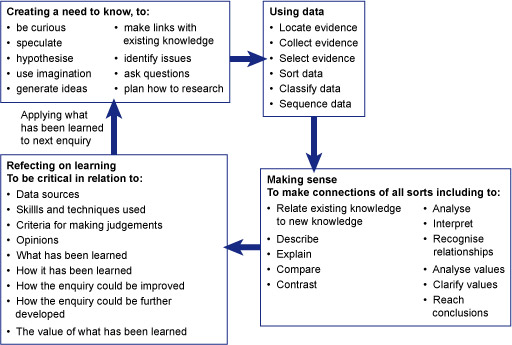
An enquiry approach, as understood by Roberts, includes four important aspects:
- creating a need to know
- using data
- making sense
- reflecting on learning (Figure 2).
It fits with a constructivist understanding of learning. Learners build on ideas they already have in order to question, understand and internalise new information (Ferretti, 2013, p. 105), interrelating, reinterpreting and trying to understand new experiences and ideas.
Ferretti (2013, p. 102) observes that enquiry learning has long been advocated as an important approach but its use in secondary teaching and learning is limited. This may in part be due to the skills and confidence of both teachers and students. Other challenges include a drive in many schools to have a standard approach to lesson planning, often including narrowly defined, differentiated outcomes and three-part lessons. An assessment culture that focuses on ‘coverage of the subject’ and progress can also be seen to be at odds with an enquiry approach. These and other concerns are discussed by Ferretti (2013, pp. 109–112).
2.2 Young people’s geographies
Students will be engaged by topics that they see as relevant. How would you define relevance? It could mean that knowledge is relevant to one or more of the following:
- the location or country students live in
- students’ experiences of these locations and issues affecting their lives
- current world issues
- student interests.
(Roberts, 2014, p. 203)
Several initiatives by the Geographical Association have aimed to help teachers make geography more relevant to young people. Many of these build on an enquiry approach. The Young People’s Geographies Project (YPG) recognised that students have different experiences and interpretations of their environments, which result in ‘personal geographies’.
Reflection point
Can you apply this concept to a young person living in a UK inner city estate?
How would their ‘personal geography’ of the city differ from that of an affluent commuter?
Experiences of an urban area will differ within and between peer groups in terms of transport and recreational choices, social interactions, identity, issues of personal safety and much more. Furthermore, young people are part of the geography of any place. Biddulph (2010, p. 45) states that ‘young people’s daily lives shape and are shaped by a multitude of social, economic and cultural changes’.
By helping students to make more sense of their immediate surroundings, the Making My Place in the World project addresses Roberts’ ‘relevance criteria’. Local fieldwork and classroom resources, such as starters and games, were piloted in 2011 and 2012. Students formulated their own enquiry questions and decided upon the evidence they wished to collect and methods of data collection and presentation.
Making geography relevant to students supports the development of conceptual understanding and builds on students’ existing knowledge.
Activity 5 Young People’s Geographies
Visit Young People’s Geographies. Start by watching the video at the bottom of the page, in which students answered the question ‘Have you learned anything about geography?’
Look through one or more of the case studies under the ‘Resources & Ideas’ tab:
- Comparing Areas
- ITE Case Study
- My Place
- The ‘What If’ Project
- Maps of Experience.
You might also have personal experience of similar approaches in your own teaching and learning ‘biography’. If so, include this as you consider the following:
- How far can the approaches and philosophy demonstrated in the examples you are considering be embedded through the curriculum?
- What do you see as the greatest opportunities?
- What do you see as the biggest constraints? How can you address these?
2.3 Summary
Research shows that shifting the focus from teaching to learning will produce better student outcomes (MacGilchrist et al., 2004) and that student motivation aids progress (Hattie, 2012). Learner-centred approaches such as an enquiry approach or YPG are characterised by:
- students actively engaged in activities that may involve problem solving
- students having the opportunity to discuss their work with each other
- students deciding how to approach a task, with support and encouragement from you
- self and peer assessment
- you providing encouragement and feedback.
Enquiry and YPG approaches to learning value what young people bring in terms of personal geographies and questions, and they encourage students to investigate their own questions and environments. Students construct knowledge and understanding for themselves. In this way, geography can be meaningful and connected to their lives, and young people develop the conceptual understanding and skills to extend and update their own learning.
3 What can creativity look like in geography?
This section explores the potential breadth of creativity within geography. Many geography lessons involve aspects of creative teaching and learning activities. You may be familiar with starter and plenary generators, mysteries and games, and a multitude of suggestions for ‘creative approaches’ to geography teaching can be found on the web and in teacher resources.
Creativity is included in the criteria for outstanding achievement of geography students (Ofsted, 2011). However, at the same time commentators like Renshaw (2011, p. 106) decry the possibility of an examination culture in schools eroding the innate creative abilities of students and ‘systematically teaching students out of their creative capacities’.
A distinction is often made between ‘ C reativity’ (a by-product or characteristic of ‘genius’, for example Einstein) and ‘ c reativity (something of which all are capable as a normal cognitive function). This section will concentrate on the latter definition. The following activity allows you to consider what creativity is and the modes and importance of creativity.
Reflection point
What do you understand by ‘creativity in geography’?
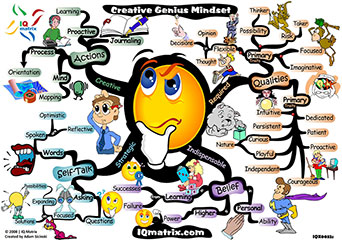
Creativity in geography can involve acts that demonstrate ingenuity, originality (in describing and presenting ideas) and thinking in a wider context to make links and connections (Bridge, 2003). It is a broad definition and, as Burnard (2011) observes, creativity has meant different things at different times as it is affected by the social, political and cultural context in which it is used and in which it is manifested. She notes that creativity is demonstrated not only by individuals but also through collaboration.
According to Scoffman (2013, p. 379), a pedagogy that puts creativity ‘at the heart’ of geographical learning will have benefits that include:
- respecting the autonomy and agency of the child
- facilitating personalised learning
- recognising ‘the complexity and messiness’ involved in generating new ideas and concepts
- valuing ‘emotional and existential knowing alongside more visible cognitive achievements’
- helping students to become more resilient, resourceful, flexible and independent.
Activity 6 Creativity in geography
Think back to your own educational experiences and lessons you have observed or taught.
Part 1 Creative learning
Spend a few minutes thinking about each of Scoffman’s suggestions (listed above) and how ‘creative learning’ can result in these benefits.
Part 2 Creative teaching
Make a list of any teaching that you considered to be ‘creative teaching’.
Look at your list and consider why this was creative.
- What was it about the teaching that made it creative?
- How might you introduce creative teaching approaches to more of your teaching?
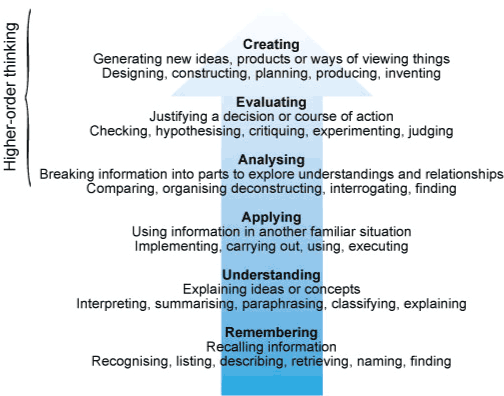
Creativity is integral to ‘intelligence’ and allows higher-order thinking. Bloom’s Revised Taxonomy (Figure 4) is a system for classifying levels of learning behaviour. ‘Creating’ is at the top of the classification. The intentional use of verbs in the classification highlights our understanding of learning as being an active process (Tarlinton, 2003). Creativity is a process and you can’t be creative if you don’t do something. Creativity involves the use of higher-order thinking skills, resulting in original and innovative understandings of geographical phenomena, often including ‘thinking outside the box’.
3.1 Creativity in a wider context
Creativity can interact with education in the classroom in a number of ways. Sir Ken Robinson is a creativity expert. In an interview with Amy Azzam (2009), he summarises key points about creativity in teaching and learning. You will explore these and different modes of creativity in Activity 7.
Activity 7 Modes and importance of creativity
Part 1
Scroll down to the bottom of the article, ‘Why creativity now? A conversation with Sir Ken Robinson’ , and click on the video. Listen to Sir Ken Robinson’s conversation with Amy Azzam and make notes under the following headings:
- Misconceptions about creativity
- The importance of creativity in the modern world
- The problem of creativity and standardised testing
- The social dimension to creativity
- Whether creativity can be taught
- Creativity and assessment.
(Alternatively, you can read a transcript.)
Part 2
Rework your notes into Table 1 or a mindmap, under the most appropriate headings.
Creativity (as in behaving creatively) |
Creative teaching (as in teaching to support creative development) |
Teaching creatively (as in using your own creativity to develop lessons that interest and motivate pupils) |
Creative learning (as in learning to be creative and learning in creative ways) |
3.2 Creativity in practice
You will now consider creativity in practice and think about how it can be used to structure your teaching to engage children in the process of being creative and to support their creative development.
Keep at the forefront of your mind the ways in which ‘creativity’ (Table 1 in Activity 7) can interact with education in the classroom:
- behaving creatively
- teaching to support creative development
- using your own creativity to develop lessons
- learning to be creative
- learning in creative ways.
Remember creativity is a process and a way of thinking rather than an activity or an event. Models of creativity summarised by Philpott (2007, p. 123) suggest that the creative process involves four stages (though these are not necessarily linear).
- Having an intention (an idea of what the outcome might be): exploring the problem or playing with ideas.
- Getting inside the problem : thinking around, and outside the ideas, identifying and playing with the concepts and materials that form the substance of the problem.
- Mastering the materials and the skills of the creative process and identifying the parameters and constraints within which creative thinking needs to take place.
- Gathering the problem into a satisfying whole : outcome or understanding of the problem and its ‘solution’.
Teaching creatively is not easy; it requires you to think, plan and prepare. You have to be prepared to take risks in your teaching, for example by giving greater autonomy to students or working in ways unfamiliar to them.
You have to create an environment in which students feel able to take risks, and risk failure. However, the benefits are that teaching creatively will not only motivate students but also encourage their own creativity and keep you stimulated as a teacher. Creative teaching strategies can also help to promote positive student behaviour through increased motivation and by involving students in the activity.
When considering the use of creative strategies in your teaching you will need to pay particular attention to:
- the level of structured versus independent learning activities
- the environment (do you need to change the layout of the classroom or move outside the classroom environment?)
- how to use resources creatively
- how to support the students
- how to manage timings
- how you will ensure that the overall aims of the learning sequence are achieved.
Remember, even ‘creative’ approaches can become stale if used repetitively, and you will still need to adopt a variety of approaches appropriate to the students, topic and context, giving due consideration to any organisational/management issues.
Activity 8 Dos and don’ts of creativity
Part 1
As you watch The secondary a to z of … creativity, make a list of suggestions for promoting creativity (including things to avoid). Are there any tips you plan to adopt or any ‘creativity killers’ that you feel you need to address?
Part 2
Stopsley School in Luton included a unit of work called ‘School of the Air’, which focused on the Australian outback in their year 7 curriculum. It is described and evaluated on the Geographical Association website.
Watch the School of the Air – Introduction PowerPoint presentation (the link is towards the bottom of the page). Then scroll down this page (Australian Outback - Students' Work) and click on the link to watch the PowerPoint on ‘Student Tasks’.
- How does this approach relate to the ideas about creativity discussed thus far?
- Could it be more creative?
Comment
Compared with most units of work, this is very creative. Lessons have been creatively planned, the teaching supports creative development and the students learn in creative ways. It also encourages students to get inside the problem, master the materials and to gather the problem into a satisfying whole (Philpott, 2007). However, while it allows students to choose a way to present their findings, the questions and the initial intention are still those of staff.
3.3 Summary
It is easy to think about creativity in geography in terms of students making papier mâché models, performing role plays or writing a song or poem. However, too often questions, approaches and outcomes are tightly defined by teachers. Creativity in geography can be so much more: it is a process that may take place within a single lesson or over a sequence of lessons. As Scoffham concludes, students value subjects that:
spark their curiosity and encourage them to explore. Geography is in a prime position to harness this energy. Exploring different ways to promote creative geographical learning brings fun and enjoyment to geography teaching for both pupils and teachers alike.
(Scoffham, 2013, p. 379)
You should plan to manage students and activities throughout this process. Creativity can contribute to students’ learning by increasing their motivation and supporting them in their development as independent learners. However, since time, effort and risk are required to adopt creative teaching strategies, you also need to know how and when to be creative (Beghetto and Kaufman, 2013).
4 What challenges are posed by teaching controversial issues?
Geography is a discipline laden with attitudes and values. There are many topics you will teach where you will have to explore a range of viewpoints and encourage students to appreciate others’ opinions. Getting young people actively involved in debating current issues, particularly those which are important to them, is a great way to build motivation and encourage students to see the relevance and importance of geography. Many current issues can be framed as being controversial but what does this mean?
According to the Royal Geographical Society (n.d.) controversial issues will:
- create differences of opinion
- have a political, social, environmental or personal impact
- have no straightforward or easy answer
- deal with questions of value or belief.
4.1 Controversial issues in geography
Many topics in geography have an element of controversy within them. This means that there is likely to be a variety of stances that different people can take. Some issues may provoke very strong feelings. As a geography teacher you must be well prepared to handle such topics, and you need to consider how to introduce and manage activities in a classroom to encourage everyone to take part and be listened to.
The next two activities require you to consider which issues may be defined as being controversial in geography and some general approaches you might adopt as you teach them.
Activity 9 Considering controversial issues in geography
What do you consider to be the most controversial issues in geography? Quickly write down your first thoughts before reading on.
Comment
You might have mentioned ‘high profile’ issues like global climate change, migration, population policy or genetically modified (GM) crops.
What would your students view as controversial? Would their opinions be the same?
Comment
It may be that river flood defence policy, building on the green belt, parking outside the school gates or wind farms are issues of more immediate relevance to you or your students.
In reality, most geography topics will have related controversial issues. Even ‘hard physical’ geography, such as studying coastal environments, includes controversial issues.
Identify a range of issues in a coastal topic that could be controversial.
Comment
In a coastal study unit, policies like managed retreat and the location and design of coastal defences and tourism development could all be controversial, raising issues such as:
- Who has the power to define the problem?
- What evidence has been used? Is it valid, accurate, reliable?
- Are there alternative ways of ‘seeing’ the issues?
- Whose views are taken into account?
- Whose views are ignored?
- Who or what is responsible for the problem?
- How are ecological and economic costs and benefits evaluated and compared?
- How will a solution be found?
4.2 Teaching approaches to controversial issues
Almost any topic can become controversial if individual groups offer differing explanations about events, what should happen next and how issues should be resolved, or if one side of an issue is presented in a way that raises the emotional response of those who might disagree.
(Oxfam, 2006, p. 2)
While you might decide to teach whole lessons or units focusing on a controversial issue, they are so embedded within geographical learning it is worth including ‘values and attitudes’ as you plan any lesson. This will help you to identify relevant issues, plan to support students’ learning and to anticipate a range of possible reactions from students.
Reflection point
How will you feel if some students say they ‘don’t care’?
How will you tackle feelings of helplessness among students to instead engender a sense of empowerment?
Activity 10 Approaches to teaching controversial issues in geography
Table 2 lists four teaching approaches that could be adopted when covering moral or controversial issues.
Choose a potentially controversial issue that you might have to teach in geography. Then, using Table 2 or a mindmap, note down the reasons why you might adopt each approach and the dangers to be aware of. Note: you could use different approaches at different times within the same lesson.
| Approach | Reasons to adopt this approach | Dangers to be aware of when adopting this approach |
| Neutral | ||
| Committed | ||
| Devil’s advocate | ||
| Balanced |
Comment
Remember that as a teacher you may have considerable power when discussing controversial issues. Also, think about stereotypes related to teachers and geography teachers in particular. How might these affect how students’ respond to your stance? Be careful not to preach to students but help them to explore their own values and choices.
Reflection point
Can you identify instances when your own values might affect your ability to be neutral?
It may be that you unwittingly promote a ‘green agenda’ or take a stand on social justice issues through your selection of topics, learning activities, resources and teaching. Are there times when neutrality is inappropriate?
You cannot remain neutral in cases of racism. In England, for example, the Race Relations Amendment Act of 2000 states that schools must ‘eliminate unlawful racial discrimination’. The Education Act of 2002 requires schools to ‘promote spiritual, moral, cultural, mental and physical development’. In addition, since 2007, English schools have been responsible for promoting ‘community cohesion’, which should be seen as a common vision and sense of belonging; a society in which the diversity of people’s backgrounds and circumstances is appreciated and valued.
In other cases, try to balance issues so that students can form their own opinions. However, if discussing a subject such as child labour, ‘you have a moral responsibility to highlight that child labour is considered to violate human rights’ (Royal Geographical Society, n.d.).
If you wish to consider these issues at greater length, you may find the resources at Controversial issues: guidance for schools from the Citizenship Foundation useful and Mitchell (2013) has a concise but in-depth discussion of teaching controversial issues.
4.3 Why teach controversial issues?
According to Oxfam, exploring controversial issues encourages learners to:
explore, develop and express their own values and opinions, whilst listening to, and respecting, other people’s points of view. This is an important step towards children and young people making informed choices as to how they exercise their own rights and their responsibilities to others.
By connecting with real life situations and contexts, learning about controversial issues helps students to ‘unpack’ mixed media messages they encounter. It provides context and authenticity to learning experiences and it supports enquiry and analytical thinking. By helping learners to clarify their own opinions it can raise self-esteem. Aspects of spiritual, moral, social and cultural education can be addressed through teaching about controversial issues. However, it is important to be clear about your aims as you select teaching content and approaches:
the geography curriculum is always controversial. It is ideological and linked to the social, economic and political agendas of the powerful. The ‘morally careful’ geography teacher must choose what and how to teach with critical consideration of underlying purposes. They must ask: what is this geography for ?
4.4 Teaching controversial issues
The Royal Geographical Society, the Geographical Association and NGOs like Oxfam have a range of resources to support the teaching of controversial issues. The next activity will allow you some time to explore some of these.
Activity 11 Exploring support materials related to controversial issues in geography
Part 1
Watch Teaching controversial issues, a Royal Geographical Society (RGS) webcast for teachers. As you watch, make notes or create a mindmap to outline tips for preparing to teach a controversial issue of your choice. Include your thoughts as to why you need to do the following and how you might do this:
- a.Provide a safe environment
- b.Class dynamics
- c.Research the topic well
- d.Provide resources that give a balanced view
- e.Adopt a flexible approach.
Comment
Read the RGS Teacher Notes. On page 2 there is a diagram summarising general tips in relation to the task above. Compare it with your notes or mindmap.
Part 2
Browse other resources for students and teachers.
RGS Student Handbook : this has a general introduction to controversial issues, as well as text to support learners in relation to the topics on the last few slides of the online tutorial (conflict, uneven distribution of wealth, consumerism and identity).
While much of the RGS website focuses on examples for 11 to 14-year-olds, Andreotti and Warwick (2007) focus on one particular teaching approach in post-16 contexts: Engaging Students with Controversial Issues through a Dialogue based Approach (see under ‘Engaging Post 16 students with controversial issues’).
Oxfam resources include:
a guide for teachers on teaching controversial issues
resources related to presenting positive images through a range of stimuli
the more or less equal (MOLE) materials – these explore how inequality and poverty affect the lives of young people in Ethiopia, India, Peru, Viet Nam and the UK. Qualitative and quantitative data and maps are presented. The aims of the MOLE project include the encouragement of critical thinking about issues and values. Review the resources and consider how you might adapt and use them.
Further resources
If you have time, you may like to review these Geographical Association resources and consider how you might adapt and use them.
- The Geographical Association has a Thinkpiece for mentors and trainee teachers entitled Values and controversial issues.
- Within the Online CPD section of the website, teaching controversial issues is discussed in the context of many specific topics such as migration.
Conclusion
To use the approaches explored in this course effectively, you must consistently adopt a learner-centred approach and support learners throughout processes such as conducting an enquiry or learning creatively. Occasional use of these approaches will have limited benefits in terms of learning outcomes. You and the students you work with need time to develop and master the conceptual understanding and skills involved.
Acknowledgements
This free course was written by Paula Addison-Pettit.
Except for third party materials and otherwise stated (see terms and conditions), this content is made available under a Creative Commons Attribution-NonCommercial-ShareAlike 4.0 Licence .
The material acknowledged below is Proprietary and used under licence (not subject to Creative Commons Licence). Grateful acknowledgement is made to the following sources for permission to reproduce material in this course:
The full URLs if required should the hyperlinks above break are as follows:
Terms and conditions link http://www.open.ac.uk/ conditions
Creative Commons link: http://creativecommons.org/ licenses/ by-nc-sa/ 4.0/ deed.en_GB
Course image:
Chris Lofquist; https://creativecommons.org/ licenses/ by-nc-nd/ 2.0/
‘Geographical enquiry’, Roberts, M., Teaching Geography, Spring 2010
Figure 1: (c) Janine Wiedel/Alamy
Figure 2: Roberts, M. (2003) Learning through Geographical Enquiry: Making Sense of the Key Stage 3 Classroom , Sheffield, The Geographical Association
Figure 3: courtesy of Adam Sicinski
Figure 4: Bloom, B., Blooms’ Revised Taxonomy, taken from http://www.slideshare.not/ castanlucy/ blooms-taxonomy-457128
Every effort has been made to contact copyright owners. If any have been inadvertently overlooked, the publishers will be pleased to make the necessary arrangements at the first opportunity.
Don’t miss out
If reading this text has inspired you to learn more, you may be interested in joining the millions of people who discover our free learning resources and qualifications by visiting The Open University – www.open.edu/ openlearn/ free-courses.
References
Andreotti, V. and Warwick, P. (2007) Engaging Students with Controversial Issues through a Dialogue Based Approach [online]. Available at http://www.citized.info/ pdf/ commarticles/ Post-16 Paul Warwick.doc (Accessed 10 February 2016).
Azzam, A. (2009) ‘Why creativity now? A conversation with Sir Ken Robinson’, Teaching for the 21st Century, vol. 67, no. 1, pp. 22–6.
Beghetto, R.A. and Kaufman, J.C. (2013) ‘Fundamentals of creativity’, Educational Leadership, vol. 70, no. 5, pp. 10–5.
Biddulph, M. (2010) ‘Valuing young people’s geographies’, Teaching Geography, vol. 35, no. 2, p. 45.
Bridge, C. (2003) ‘Creating the space to think’, Primary Geographer, January, pp. 19–21.
Brooks, C. (2013) ‘How do we understand conceptual development in school geography?’ in Lambert, D. and Jones, M. (eds) Debates in Geography Education, London, Routledge, pp. 75–88.
Burnard, P. (2011) SoundEd Programme: Creativity, London and Milton Keynes, Trinity College/The Open University.
Ferretti, J. (2013) ‘Whatever happened to the enquiry approach in geography?’ in Lambert, D. and Jones, M. (eds) Debates in Geography Education, London, Routledge, pp. 103–15.
Firth, R. (2013) ‘What constitutes knowledge in Geography?’ in Lambert, D. and Jones, M. (eds) Debates in Geography Education, London, Routledge, pp. 59–74.
Geographical Association (2012) Thinking Geographically [online]. Available at http://geography.org.uk/ gtip/ mentoring/ geography/ learning/ conceptsandthinkinggeographically/ (Accessed 25 February 2016).
Geographical Association (2014) How Do Pupils Learn Geography? [online]. Available at http://geography.org.uk/ gtip/ mentoring/ geography/ learning/ #theories (Accessed 25 February 2016).
Hattie, J. (2012) Visible Learning for Teachers: Maximising Impact on Learning , Abingdon, Routledge.
Humphreys, D. and Fall, J. (2014) ‘An idea of nature: biodiversity and protected areas’ in Brown, W., Aradau, C. and Budds, J. (eds) Environmental Issues and Responsibilities, 2nd edn, Milton Keynes, The Open University.
Lambert, D. (2011) The Geography National Curriculum: GA Curriculum Proposals and Rationale , Sheffield, Geographical Association; also available online at http://www.geography.org.uk/ getinvolved/ geographycurriculumconsultation2011/ (Accessed 16 March 2016).
Lambert, D. and Balderstone, D. (2010) Learning to Teach Geography: A Companion to School Experience , 2nd edn, Abingdon, Routledge.
MacGilchrist, B., Myers, K. and Reed, J. (2004) The Intelligent School, London, Sage.
Massey D. (2006) Is the World Really Shrinking?, OU Radio Lecture [online]. Available at http://www.open.edu/ openlearn/ society/ politics-policy-people/ geography/ ou-radio-lecture-2006-the-world-really-shrinking (Accessed 25 February 2016).
Mitchell, D. (2013) ‘How do we deal with controversial issues in a “relevant” school geography?’ in Lambert, D. and Jones, M. (eds) Debates in Geography Education, Ch. 17, London, Routledge.
Ofsted (2011) Geography: Learning to Make a World of Difference, London, Ofsted. Also available online at https://www.gov.uk/ government/ uploads/ system/ uploads/ attachment_data/ file/ 413723/ Geography_-_learning_to_make_a_world_of_difference.pdf (Accessed 25 February 2016).
Oxfam (2006) Teaching Controversial Issues [online]. Available at http://www.oxfam.org.uk/ education/ teacher-support/ tools-and-guides/ controversial-issues (Accessed 25 February 2016).
Philpott, C. (2007) ‘Creativity in music education’ in Philpott, C. and Spruce, G. (eds) Learning to Teach Music in the Secondary School, 2nd edn, Abingdon, Routledge, pp. 119–34.
Renshaw, S. (2011) ‘Creative thinking: assessing students’ learning’, Teaching Geography, vol. 36, no. 3, pp. 106–7.
Roberts, M. (2003) Learning through Geographical Enquiry: Making Sense of the Key Stage 3 Classroom , Sheffield, The Geographical Association.
Roberts, M. (2010) ‘Geographical enquiry’, Teaching Geography, vol. 35, no. 1, pp. 6–9.
Roberts, M. (2014) ‘Powerful knowledge and geographical education’, The Curriculum Journal, vol. 25, no. 2, pp. 187–209. Also available online at DOI: 10.1080/ 09585176.2014.894481 (Accessed 17 March 2016).
Royal Geographical Society (n.d.) Teaching Controversial Issues [online]. Available at http://www.rgs.org/ webcasts/ activities/ tutorials/ controversial_issues/ controversial_issues.html (Accessed 25 February 2016).
Scoffman, S. (2013) ‘Geography and creativity: developing joyful and imaginative learners’, Education 3–13: International Journal of Primary, Elementary and Early Years Education , vol. 41, no. 4, pp. 368 – 81. Also available online at DOI: 10.1080/ 03004279.2013.819625 (Accessed 17 March 2016).
Tarlinton, D. (2003) ‘Bloom’s Revised Taxonomy’, SlideShare, uploaded 9 June 2008 by L. Castanon [online]. Available at http://www.slideshare.net/ castanlucy/ blooms-taxonomy-457128 (Accessed 25 February 2016).