Developing high trust work relationships
Use 'Print preview' to check the number of pages and printer settings.
Print functionality varies between browsers.
Printable page generated Thursday, 21 May 2026, 5:55 PM
Developing high trust work relationships
Introduction
Trust has become an important topic in today’s business environment. Understanding trust from both an organisational and individual perspective will help you to develop as a leader within your organisation and can impact on the bottom line.
Improving levels of trust in the workplace has become increasingly recognised as key to long-term organisational effectiveness and success. In this free course, Developing high trust work relationships, you will start to explore the phenomenon of trust and investigate why it is seen as a fundamental aspect of the culture of flourishing and sustainable organisations. You will examine the changes in organisational dynamics, which have led to a focus on trust within modern economies, and investigate the specific consequences of a lack of trust within organisations.
This OpenLearn course provides a sample of level 2 study in Business and Management.
Learning outcomes
After studying this course, you should be able to:
understand the broad roles of trust in modern economics
explain the changes in organisational dynamics that have led to a focus on trust within organisations
understand and discuss the consequences of trust within organisations.
1 The concept of trust
In this section, you will be introduced to the concept of trust in organisations.
Activity 1 Introduction to trust
Start by watching the video featuring Dr Graham Dietz, one of the leading academics in the research on trust. Graham gives an overview of the multitude of ways that trust is important in organisations. As you watch the video note down your own thoughts about what ‘trust’ within the organisational setting means for you. Consider how something so individual can be meaningful for organisations.

Transcript
DR. GRAHAM DIETZ: My name is Dr. Graham Dietz, and I work at Durham University Business School, and I'm also one of the partners at Crucial Connexions. And the research that I do and the consultancy that I do is all about what inspires trust inside the organisation. And it's about helping HR functions to understand more the dynamics of trust and how the dynamics of trust can help performance and employee well being.
There are multiple relationships that are going on inside organisations, but also outside organisations. All of them rely on trust. Trust is crucial for HRM, because everything that HR does is about building that trusting relationship between the employee and the employer. The way in which you appraise people the way in which you pay people, the way in which you train people, the job design, even recruitment and selection.
All of this is about building a trusting relationship between the employee and the employer. And so HR has a vital role to play in enhancing trust levels inside the organisation. And if the employees feel that they are trusted and they in turn trust their managers, they can reciprocate in kind with superior customer service, sales, innovation. There are a number of key metrics that have been proven to have a decisive link with employee trust.
Trust suffuses all of these commercial relationships. And if we can understand better how trust is built and how trust is maintained, we can manage those relationships better and that will help business to thrive. If you trust somebody, you have confident reliance in them in conditions of risk and uncertainty. Several studies have shown now that if people trust their leaders, they reciprocate in kind with demonstrating superior customer service, which translates into better sales, which translates into better performance.
We worked with a leading housing agency in London and we trained the entire workforce, from the senior executive team down to the maintenance staff, in what trust is and how trust is so important for their working relationships and their working performance. And within three months of that training, staff satisfaction had gone up, customer satisfaction had gone up. And when they looked at the key performance indicators for maintenance and for dealing with customer complaints, for example, they found that the organisation had become more efficient, more effective, and also understood much more about the customer needs and was much more responsive.
There was a tangible impact within three months of the Trust Training Programme, and that's some of the things that we can offer. I think trust is absolutely crucial to the way in which all organisations function. All organisations thrive and rely on the relationships that they have internally and the relationships that they have externally. Without trust, you have no business.
Feedback
The interest in the concept of trust within organisations has not occurred in a vacuum. A number of specific contextual factors have led to the almost ‘holy grail’ status of the concept and in turn each of the contextual factors changed organisational dynamics, which have served to further highlight the importance of organisational trust.
Underpinning the value of trust is the importance of effective cooperation in organisational life. In the simplest of terms, trust is key because it enables cooperation (Tyler, 2003). While cooperation has always been important in organisations, emerging trends in organisational dynamics have pushed this to the foreground. Changes in the nature of work have made ‘old’ styles of securing cooperation more difficult to maintain. Additionally, the nature of cooperation has changed; there is now a greater emphasis on more ‘voluntary forms of cooperation’, which can be more difficult to achieve (Tyler, 2003, p. 557). Old-style ‘command and control’ strategies for securing motivation are no longer considered sufficient against the backdrop of organisational changes.
Processes of globalisation, flexibilisation of labour relations, continuous change and the virtualisation of organisational forms mean that the relations between people have become looser and behaviours are less easy to monitor. Within firms, hierarchical relationships are being replaced by lateral relationships (e.g. matrix structures and teamwork), further emphasising a growing need for the voluntary cooperation and ‘extra-role behaviours’ (Bijlsma and Koopman, 2003, p. 543) associated with trustful relations.
The dynamics of contemporary organisational trends and the resultant implications for trust are the focus of exploration throughout this course.
By the end of this course, we want you to be able to fully answer the following questions: ‘What do we mean when we talk about “trust” within organisations’?; ‘Why is trust important in organisations?’ and ‘What are the consequences of trust in organisations?’, moreover, ‘What are some of the likely consequences of a lack of trust within organisations?’.
2 What is trust?
While a great deal of interest in trust has been generated by academics and practitioners alike, it is a concept that has attracted different definitions and interpretation.
Before we examine why trust is important, we need to establish the phenomenon of trust or, in other words, ‘what trust is’. In this course we will start by examining some ‘working’ definitions of trust to enable our analysis and discussion of the role and importance of trust within organisations.
Activity 2 What does ‘trust’ mean to you?
Reflect on your own views, thoughts, beliefs about trust, and what trust means to you. Make notes on this in the box below.
Some definitions of trust are provided below:
Definitions of trust
… when we say we trust someone or that someone is trustworthy, we implicitly mean that the probability that he [sic] will perform an action that is beneficial or at least not detrimental to us is high enough for us to consider engaging in some form of cooperation with him.
The willingness to be vulnerable to the actions of another party based on the expectation that the other will perform a particular action important to the trustor, irrespective of the ability to monitor or control that other party.
…trust is both the specific expectation that another’s actions will be beneficial rather than detrimental and the generalized ability to take for granted, to take under trust, a vast array of features of the social order.
From these definitions of trust we can see a number of different issues emerge.
Each definition of trust above involves two specific parties: a trusting party (trustor) and a party to be trusted (trustee).
Also, there are two related concepts raised in the definitions. These are the notions of ‘risk’ and ‘vulnerability’.
For now, it is useful to assume that trust is associated with the related notions of risk (the specific expectation that another’s actions will be beneficial rather than detrimental) and vulnerability (the implication that there is something of importance to be lost).
Making oneself vulnerable is taking risk. Hence ‘trust is not taking risk per se, but rather it is a willingness to take risk’ (Mayer et al., 1995, p. 712).
Activity 3: Reflection on what trust in the organisational setting means
Refer back to the definitions of trust provided in Activity 2 and the emergent themes of risk and vulnerability.
While reflecting on the definitions and themes, think of two people you work with; one that you trust and one that you don’t (or one that you trust less than the other). For the purpose of this exercise they can be from any level of the organisation you are in. Then, answer the following questions:
- How well do the definitions and themes above account for the reasons you trust or distrust your chosen co-workers? What did you find most useful about each of the definitions or themes?
- Can you think of specific incidents that have impacted on your level of trust in each person? If so, what were they?
Feedback
The aim of this activity is to start to get you thinking and analysing the reasons why you would choose (or not choose) to trust a work colleague, particularly in terms of the concepts of risk and vulnerability.

3 Trust as a belief
In order to further our understanding of trust as a phenomenon, it is useful at this stage to consider why we may trust or distrust another person. Within the context of the organisation, why do we choose to trust a co-worker or line manager or senior manager?
According to one theoretical perspective, trust can be seen as a belief. In other words, we trust someone if we believe that certain ‘properties’ or ‘actions’ are associated with that person.
A description of ‘trust as belief’ is provided by Cummings and Bromiley (1996, pp. 303–5) in the extract below.
Trust as a threefold belief
‘Trust [is] defined as an individual’s belief or a common belief among a group of individuals that another individual or group (a) makes good-faith efforts to behave in accordance with any commitments both explicit or implicit, (b) is honest in whatever negotiations preceded such commitments, and (c) does not take excessive advantage of another even when the opportunity is available. The rationale for this definition of trust rests on the socially embedded, subjective, and optimistic nature of most interactions within and between organizations that involve trust. Much of organizational interaction rests strongly on these three characteristics and thus makes trust so centrally important.
The contrasting position, dominant in many economic formulations of organizational action, depicts individuals acting alone in a strictly self-interested objective fashion and driven by pessimistic assumptions about other individual actors. …That is, in transaction cost economics, actors lie in negotiations, cheat on any deals if it is profitable to do so, and exploit opportunities for renegotiation to their utmost.
We assert that in many important situations, such a depiction is both inaccurate and inadequate. …Our definition of trust rests on a view of organizational action based largely on good-faith effort, honesty in exchange, and limited opportunism.’

The idea of trust as a belief can be usefully explored by testing your own trust ‘belief’ system in a test instrument called the ‘Organisational Trust Inventory’. This is the topic of the next activity.
Activity 4: The Organisational Trust Inventory
The Organisational Trust Inventory was developed in 1995 by Philip Bromiley and Larry Cummings as a means of analysing the levels of trust both within and between organisations. For the purposes of this activity we have adjusted the inventory slightly to ask you to assess your view of both your line manager and senior management more broadly within your organisations (we recognise that your line manager may or may not fall into this second group).
Click on the ‘view’ link below to complete the questionnaire. When you have done so, look at the bar chart and examine where you have different scores between senior management and your line manager. Consider why that might be and write some notes in the box below. If you have difficulty differentiating the different bars on the bar chart, please see the further description below. .
Further description
The figure comprises a set of statements numbered from 1 to 12. You are required to provide an answer for each statement for your view of both your ‘line manager’ and ‘senior management’ by choosing one of the following options from a drop down box: Strongly disagree, disagree, slightly disagree, neither agree nor disagree, slightly agree, agree, strongly agree.
The answers you select will generate bars at the bottom of the diagram in the form of a bar chart. The size of the bar rangers from the shortest denoting strongly disagree to the tallest denoting strongly agree. The bars relating to the line manager options have dashes on, and the bars relating to the senior management answers are in solid colour.
Feedback
It is not uncommon to find you have a higher level of trust in your line manager than in senior management more generally. This may be the reflection of more distance or more control, or other factors. You may want to consider whether a greater or lesser degree of trust is reasonable and whether you are more likely to trust someone when you work more closely with them.
4 The challenge of trust in organisations
There is no doubt that trust is an appealing concept and one that is highly valued. In our daily lives it is an important feature of our relationships and social adjustment. But in the context of organisational life, trust does not necessarily sit easily.
As mentioned in the introductory section, the nature of work has undergone significant changes, leading to a need to reconsider old command and control modes of management. Contemporary organisations are increasingly placing a greater emphasis on voluntary forms of cooperation such as employee engagement. Underpinning the heightened need for cooperation and engagement, however, is the fundamental issue of trust.
The main changes that have led to the focus on developing trust within organisations are highlighted below:
- Changed work organisation – people are increasingly working in widely dispersed groups and in flexible working arrangements, including homeworking, remote working, virtual working, and working different types of work schedules. This spatial and temporal dispersion of work renders traditional control and monitoring unviable and implies the need for a new type of both interdependence and cooperation between workers and managers.
- Diversity – people are also working within a diverse workforce across different geographical locations both nationally and internationally. As with the point above, a dispersed workforce requires a new type of interdependence and cooperation between workers and managers. Moreover, the increased diversity within the workforce leads to the need for people to be able and willing to trust people with very different backgrounds.
- The design and content of work – rather than routinised and simple tasks, jobs are increasingly focused around a strong customer service orientation, as well as ‘knowledge work’ and intellectual labour. Each of these types of work depends heavily on high levels of engagement and voluntary cooperation in work, again leading to a focus on cooperation and trust.
- Structural change within organisations – hierarchies within organisations are increasingly being replaced by lateral alliances and social relations (Sheppard and Tuchinsky, 1996). Flatter hierarchical structures mean that people are working in teams, with responsibilities shared across group members, and within matrix structures with different managers for different tasks. Against this backdrop, formal controls and sanctions are minimal and relationships between co-workers and management can be complex; trust becomes paramount.
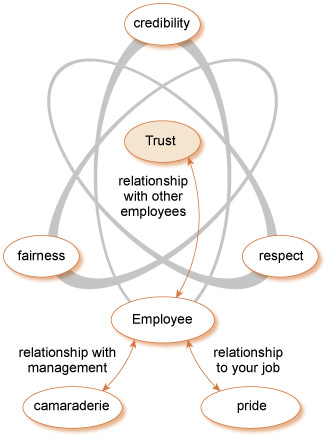
In the next activity you will explore some of the work that has taken place to study trust and effectiveness within one structural component of organisations: teams.
Activity 5: ‘Work team trust and effectiveness’
Think about your own work team(s) or one in which you have worked. Reflect on your experience of working in the team(s) and the level of trust with the team(s). Do you think the level of trust has affected the effectiveness of the team, its performance or the commitment to the organisation? Record your thoughts below.
5 The consequences of trust in organisations
In any discussion of ‘why does trust matter?’ we need to go beyond the theory (as much as we can) and get an understanding of the practical consequences of the concept of trust. So far we have examined what trust in organisations consists of as a phenomenon in terms of risk and vulnerability, and we have examined the context in which the concept of trust has emerged.
But what does trust actually do in organisations? How does it work and why is it needed? Consider the following quote by Bijlsma and van de Bunt:
‘… trust works as a lubricant in economic transactions by smoothing relations between actors and reducing transaction costs related to control’
The idea of ‘smoothing relations between actors’ deserves more attention here, as does the notion of ‘reducing transaction costs related to control’. Let’s take each one of these ideas in turn.
When we talk about organisational actors and trust, it would be prudent to consider that not all organisational actors will attract the same amount or type of trust. Research has shown that different organisational actors at different levels within an organisation are indeed likely to be considered more or less trustworthy (Chartered Institute of Personnel and Development (CIPD), 2012; CIPD, 2013). One particular finding is that senior managers are considered less trustworthy if they have more control. The relationship of trust and control is one that has sparked some debate in the literature. However, most researchers agree that trust works as a substitute to control because it reduces transaction costs. Essentially, the higher the trust in a relationship, the lower the costs of monitoring, checks and other control mechanisms will be.
A related issue here is the role of leadership and the leadership culture within organisations. This is not just since it is managers and leaders who often instigate monitoring and control measures. Leadership culture cascades throughout an organisation and creates strong messages, both real and symbolic, as to the nature of trust within organisations.
Put simply, leadership has been found to be a highly important factor in the level of trust within organisations. Two recent reports published by the CIPD (CIPD, 2012, CIPD, 2014) ) have led to the strong conclusion that senior leaders play a pivotal role in trust relations throughout an organisation and that the cultivation of ‘trustworthy’ senior leaders underpins the challenge of creating cultures of organisational trust throughout the entire organisation.
So, what does ‘smoothing relations’ between actors mean? If we return back to our previous discussion on trust involving both risk and vulnerability then this becomes clearer. The process of taking a risk and ‘the willingness to be vulnerable’ is arguably related to the acceptance of actions and decisions of others with whom we come into contact in organisations. In other words, if we choose to accept the risk of accepting the actions and decisions of others (and our resultant vulnerability) then resistance is lessened and the relationships within organisations are potentially ‘smoothed’ or ironed out. This in turn has the potential to lead to a number of outcomes, in particular a number of behavioural and attitudinal outcomes. These consequences or outcomes are explored in the next section.
6 Behavioural consequences: increased performance
Trust has been found to be positively associated with increased levels of performance (Dirks and Ferrin, 2002). Research has found that individuals who feel that their leader has demonstrated, or will, demonstrate care and consideration will reciprocate this sentiment in the form of desired behaviours. A high trust social exchange relationship encourages people to spend more time on required tasks and be willing to go above and beyond their job role. High trust relationships have thus been found to result in higher performance and organisational citizenship behaviours (OCBs).
This includes higher performance in teams, resulting in more effective teamwork (Costa, 2003), as noted in the earlier reading for this course.
Empirical research has also found that behavioural innovativeness is positively linked with trust within organisations (Ellonen et al. 2008, p. 176).
Behavioural innovativeness is defined as ‘the overall internal receptivity to new ideas and innovation that is demonstrated through individuals, teams and management, and that enable the formation of an innovative culture’.
7 Attitudinal consequences: commitment, job satisfaction, intent to stay
Trust is also linked to a number of attitudinal outcomes, particularly organisational commitment and job satisfaction.
It is widely recognised that managers are responsible for many duties that have a major effect on employees’ job satisfaction, such as performance evaluations, guidance and assistance with job responsibilities, and training.

People are likely to feel safer and more positive about a manager making these decisions when they believe the leader is trustworthy.
In contrast, having a low level of trust in a leader is likely to be psychologically distressing when the leader has power over important aspects of one’s job and this distress is likely to affect one’s attitudes about the workplace.
The implication of this idea is that trust in leadership should be associated with higher levels of job satisfaction, higher organisational commitment and lower intention of quitting.
For instance, when individuals do not trust their leaders, they are more likely to quit or consider quitting, because they may be concerned about decisions that the leaders might make (owing to perceptions of lack of integrity, fairness, honesty, or competence) and not want to put themselves at risk to the leader. Either way, quitting has all the obvious costs associated with turnover, while intention to leave is empirically associated with low levels of engagement and organisational citizenship behaviours.
Conclusion
In this free course you have done the following:
- explored the broad phenomenon of trust within organisations, focusing on why trust is important in the contemporary economic environment
- started to examine what trust means within the organisational setting, highlighting notions of both ‘risk’ and ‘vulnerability’
- begun to investigate the consequences or outcomes of organisational trust in terms of the attitudes and behaviour that are potentially impacted by trust.
References
Acknowledgements
This free course was written by Diannah Lowry, Hugh Palmer and Jacky Hinton.
Except for third party materials and otherwise stated (see terms and conditions), this content is made available under a Creative Commons Attribution-NonCommercial-ShareAlike 4.0 Licence.
The material acknowledged below is Proprietary and used under licence (not subject to Creative Commons Licence). Grateful acknowledgement is made to the following sources for permission to reproduce material in this free course:
Every effort has been made to contact copyright owners. If any have been inadvertently overlooked, the publishers will be pleased to make the necessary arrangements at the first opportunity.
Images
Course image: Adapted from http://accocladecommunications.wordpress.com
Figure 1: © Meriel Jane Waissman/iStockphoto.com
Video
Activity 1: Video: © Crucial Connexions http://www.crucialconnexions.com/
Text
3 Trust as a belief: Adapted from Bromiley, P. and Cummings, L. (1996) Trust in organisations, Sage Publications.
Don't miss out
If reading this text has inspired you to learn more, you may be interested in joining the millions of people who discover our free learning resources and qualifications by visiting The Open University – www.open.edu/ openlearn/ free-courses.