Workplace learning with coaching and mentoring
Use 'Print preview' to check the number of pages and printer settings.
Print functionality varies between browsers.
Printable page generated Wednesday, 16 September 2026, 12:22 AM
Workplace learning with coaching and mentoring
Introduction
This free course, Workplace learning with coaching and mentoring, will help you consider some of the theoretical and practical issues involved in planning and managing learning and talent development programmes for people in your organisation. You will also explore ideas about coaching and mentoring, as these have become prevalent learning and development tools in contemporary organisations.
During the course, you will learn about the transition from training to learning, and how learning theories become concrete in the practical issues and decisions you will make about learning and talent development. The course is designed to encourage critical and personal reflection on these practices with the aim both of enhancing your own learning experiences and of providing effective learning interventions for others.
This OpenLearn course is an adapted extract from the Open University course B867 Workplace learning with coaching and mentoring.
Learning outcomes
After studying this course, you should be able to:
describe the generic components of the traditional training lifecycle of the training needs analysis, or TNA (sometimes called a training needs assessment), design and development, delivery and evaluation
critically evaluate the strengths and limitations of the traditional training-based approach, and the main implications of the shift from training to learning
explain what we mean by coaching and mentoring and how they can support learning
practise a range of foundation coaching skills.
1 The traditional training-based approach
The traditional way of thinking about learning and development in organisations is by considering training needs in terms of the gap between the organisation’s current capabilities and the desired capabilities for the organisation to develop. Arguably, the most basic of all toolkits for human resource development (HRD) professionals is a step-by-step approach that starts with the training need analysis, or TNA (sometimes called a training needs assessment), followed by the training design and delivery and ending in training evaluation. This process is illustrated in Figure 1.

For decades now, HRD theory has emphasised the value of this sort of systematic approach to training, which seeks to put human development activities into similar sorts of methodological frameworks as those used for business planning or IT systems design. Successful provision of training and development thereby sits alongside other key functions in business planning, and stakeholders are encouraged to focus on the following key issues:
- the importance of articulating the desired outcomes from the training – that is, how will you know that the training has been a success?
- the need for congruence between individual and organisational goals
- the importance of practical issues of scheduling and costing time for participants and facilitators
- the need for stakeholder engagement, sponsorship and support for the training programme and their understanding of the impact it will have on the organisation, both short- and longer-term.
1.1 Training needs analysis (TNA)
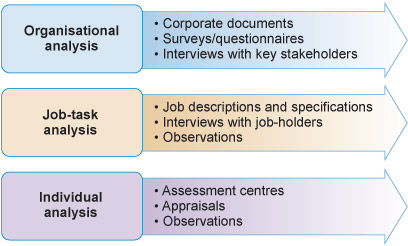
Most commentators agree that the first step, the TNA, is the most important part of the training lifecycle. This is where the gaps between current and desired capabilities are assessed – that is, where the scale as well as the nature of the training requirement begins to become clear. A classic TNA will usually examine these needs at three levels – organisation, job-task and individual.
Organisational analysis: This is where the TNA links to corporate strategy (or equivalent for the non-corporate sector) and the HRD strategy. Here you will consider how well the organisation as a whole is equipped to deal not only with current challenges, but also with future skills needs, to the extent that these can be predicted based on developments in strategy, or, for example, the introduction of new technologies.
You may use data from your workforce planning activities to assess the impact on your organisation of a variety of issues such as employees reaching retirement age, getting promoted and therefore needing to be back-filled, or managing short- and long-term sick leave.
A key consideration at this level is to get input from leaders and other key stakeholders on the assumptions you are making about the future direction of the organisation, and the skills the organisation will therefore need to build, recruit, retain and potentially phase out.
Job-task analysis: This is where the analysis moves to individual jobs and roles to assess the gap between current and desired skills and capabilities. Examining job descriptions and specifications provides the basis of decisions about any gaps in capability levels.
There is an important link between this analysis and any business process reengineering (BPR) work that the organisation is undertaking. BPR often results in a significant demand for the development of new skills and/or the refinement of existing skills to adapt to new technologies and/or processes.
One further term you may hear in this context is ‘job family’. Job families are groups of jobs that involve the same or similar kinds of work, and which therefore require the same or similar skills, attitudes and behaviours. Clustering jobs into families can make training planning and delivery more efficient, as well as being useful for other HRD activities, such as remuneration, reward and career progression.
Individual analysis: This is where the link is made between each individual’s training needs and their overall performance management and appraisal. If an employee’s appraisal reveals problems with performance, then often the most obvious step is to recommend training to fill the gap and help the employee to meet the desired performance standard.
A competency-based approach
TNAs tend to reflect a ‘competency’ approach to learning and development. There are many different kinds of competency models, but the fundamental idea is that ‘competency’ is an umbrella term which encompasses different sorts of training needs, often categorised into the three areas: skills, attitudes and behaviours. These categories are intended to reflect the different aspects of workplace performance – that is, both what people do and how they do it. Competency approaches therefore attempt to reflect both ‘hard’ and ‘soft’ abilities and aptitudes required by the organisation.
Box 1: Competence or competency?
In the past, HRD professionals drew a distinction between ‘competence’ and ‘competency’. The term ‘competence’ (plural competences) was used to describe what people need to do to perform a job, and was concerned with effect and output, rather than effort and input. ‘Competency’ (plural competencies) described what lies behind competent performance, such as critical thinking, analytical skills or interpersonal qualities. These days, however, there is growing awareness that job performance requires a mix of skills, attitudes and behaviours. The terms ‘competence’ and ‘competency’ are now used interchangeably to reflect this mix.
Tools for TNA
The main tools you can use to gather data for TNA work include the following:
- Surveys/questionnaires: These may be specifically designed for TNA work, or they may be surveys that are being administered for other purposes (e.g. to gauge employee engagement or staff satisfaction) where the data can also be used to identify training needs.
- Interviews: Instructional designers often decide to interview job-holders in order to build a richer picture of what a job entails than the one available in formal job descriptions. Interviewing job-holders, and potentially other relevant stakeholders, can help to elicit the hidden and implicit aspects of the job, as well as the more obvious ones.
- Assessment centres: These are often a good way of building a picture of employees’ development needs across a range of functions and activities. If used for TNA purposes, they need to be aligned with the overall performance management strategy.
- Observations: You might decide to collect data on what skills are deployed in a more naturalistic setting than that offered by interviews and assessment centres – that is, when people are engaged in their normal day-to-day activities.
- Document reviews: TNA work frequently involves examining key documents, such as job descriptions, person specifications, business plans and articulations of corporate strategy and values. This is especially useful for the organisational analysis, and for predicting future needs, rather than just documenting current ones.
Figure 2 shows how some of these different sources of data can be used to inform each of the levels of TNA work.
1.2 Sketching out the training programme
Once you have collected your data on current versus desired capabilities, you can begin to sketch out an overall design for the training programme. This will typically include:
- expected learning outcomes
- assumptions about prior learning and current skill base
- key success factors and analysis of risks
- suggestions for delivery method
- ideas for training evaluation
- indicative timescales
- indicative costs
- stakeholder engagement strategy.
At this stage, the programme design is provisional – a ‘sketch’. It reflects your first ideas and working assumptions about the training provision you think is required. At the TNA stage, you need to document these elements so that you can get feedback and endorsement for your approach from key organisational stakeholders. As you move into the subsequent training design, development and delivery phases, you may well need to revisit some of these ideas and assumptions.
1.3 What kind of training?
An important step in TNA work is the selection of delivery method(s) for the training needs that you have identified. The criteria for selection of methods are likely to include:
- the priority and/or urgency of the learning and talent development needs
- the organisational culture and its attitude towards learning and talent development
- the type of occupation, level of seniority and qualifications/educational background of learners
- the type of learning need to be met
- any data you have about learner styles and preferences
- any evaluation data you have of the effectiveness of previous learning and talent development interventions
- costs and budgets available.
Options for training delivery typically include:
- courses and classroom training
- in-house development programmes
- external courses and programmes, including formal qualifications
- on-the-job training, including shadowing and observation
- coaching and mentoring (we will explore this option in more detail later in this course).
1.4 Using technology for training
One of the most vibrant debates among instructional designers concerns the use of technology for training. As students from this course, you will already have a sense of some of the advantages and disadvantages of technology-based training, such as distance learning, and if you are or have been an OU student you are likely to have come across computer simulations, webinars and certainly online discussion forums (synchronous and asynchronous). It used to be assumed that technology-based training would be cheaper than face-to-face methods. However, both empirical and anecdotal evidence suggest that any savings associated with reduced travel costs and facilitator time are normally offset by increased spending on IT equipment and support (Kraiger, 2003).
One technology-based approach that is attracting a lot of attention among theorists, practitioners and in the media is MOOCs (massive open online courses). MOOCs are designed for unlimited participation and open access via the web, and are built around the principle of sharing knowledge and resources.
1.5 Training evaluation
The final stage in the standard approach to training (as shown in Figure 1) is evaluation. Although evaluation typically takes place at the end of the training cycle, deciding on the approach to evaluation is something which should normally be part of TNA work: evaluation criteria should be built into a training programme from the outset, and not as an afterthought!
A great deal of work in this area is based on the Kirkpatrick (1979) model, which has become a classic in the field of instructional design. It is easy to understand, well tested and forms something of a common currency among training evaluators and HRD professionals. The model proposes four levels of evaluation:
- reactions
- learning
- behaviour (job impact)
- results (business impact).
Level 1 – reactions
Reactions are usually captured using attitude questionnaires or surveys administered at the end of a course. These ask students what they thought of the programme, whether the setting was conducive to learning, which parts they particularly liked, and whether there were any aspects they did not like. Questionnaires measure subjective perceptions of training, not whether it will have any impact on behaviour or performance. This subjectivity is both a strength and a limitation. On the one hand, such surveys can capture rich, often qualitative, data on the student experience, sometimes revealing aspects of the training that course designers and facilitators may not have been aware of. On the other hand, by focusing on students’ likes and dislikes, such surveys may distort an instructional design towards what will be popular and/or enjoyable, rather than what will be most effective or informative.

Level 2 – learning
Learning relates to the absorption of new knowledge and content. Evaluation at this level is usually undertaken using pre-test/post-test comparison – that is, a measurement of the changes in skills and/or knowledge that can be directly attributed to the training intervention. Formal assessments, qualifications and exams are all examples of measuring achievement at this level of evaluation.
Level 3 – behaviour
Behaviour refers to the successful application of learning – that is, the transition from the classroom to the workplace. Level 3 evaluations can be performed using formal assessment or through more informal approaches, such as observation. This sort of evaluation normally needs to be conducted by someone with in-depth understanding of the job in question and the degree of performance improvement that can realistically be expected from the training. This type of training evaluation should be aligned with performance management reviews for the individual trainee.
Level 4 – results
Results refer to the link between impact on the job and impact on the organisation. If training has been well designed and has met its objectives in terms of individual performance (level 3), there should be a feed-through to enhanced business performance. It is at this level that training can start to be evaluated in terms of its return on investment (ROI). Thus, HRD strategy often involves gauging the rate of return for an organisation’s investment in its people. Training and development often make up substantial proportions of this investment; so level 4 evaluation is considered a crucial competency for HRD professionals in corporate and business strategy.
1.5.1 Current practices of evaluation
Instructional designers often try to work all four levels into their evaluation strategy for a programme. By progressing through each level, they can build a kind of ‘chain of evidence’ which can connect individual participant reactions with organisational performance. Having the right conditions for learning (level 1) enables the acquisition of new knowledge and skills (level 2). This lays the foundation for learning to be applied back in the workplace (level 3), which in turn should have an impact on organisational or business performance (level 4).
Although very basic (Holton, 1996), the Kirkpatrick model continues to form the basis of many decisions about evaluation. Other models have been developed more recently, and it is useful to view these as extensions or modifications of the classic Kirkpatrick approach. For instance, the CIPD recommends the ‘RAM’ approach (Bee and Bee, 2007), which focuses on the need for:
- Relevance: how training provision will meet the actual needs of the organisation, both now and in the future.
- Alignment: how training is linked to other key HRD activities, such as performance management and reward and employee engagement, and to other functional areas, such as finance and strategy.
- Measurement: how training metrics can be linked to other performance metrics and key performance indicators (KPIs).
Contemporary discussions also highlight the crucial importance of the human skills of insight and intuition in HRD (Sadler-Smith, 2008). If we can supplement the formal criteria of the Kirkpatrick model and its successors with ‘gut feel’ about what will or will not work, we can move towards a more holistic approach to evaluation. After all, theories about the way we think have evolved to incorporate both our rational and our instinctive capabilities. You may have heard of, perhaps even read, Daniel Kahneman’s best-seller Thinking, Fast and Slow (Kahneman, 2011). It suggests that intuition may be fast; in other words, that it is not the result of systematic, logical evaluation, but it is a vital aspect of how we operate as human beings – a different kind of ‘expertise’. As Kahneman puts it:
[E]ach of us performs feats of intuitive expertise many times each day. Most of us are pitch perfect in detecting anger in the first word of a telephone call, recognise as we enter a room that we were the subject of the conversation, and quickly react to subtle signs that the driver of the car in the next lane is dangerous.
Kahneman’s words remind us that the skills of any activity of evaluation involve this kind of intuitive fast thinking, as well as the more systematic, slow kind.
1.6 Critical thinking about TNAs
Recent developments in HRD thinking have highlighted the crucial significance of the ‘real world’ context of TNA activities. This involves acknowledging the social networks and power relations of organisational life, including the influence of self-interest, self-promotion and/or self-preservation among the organisational members whose opinions you are seeking in your TNA research. For instance, when employees are asked to describe the constitutive components of their jobs, they may be motivated to describe an ideal job performance rather than a realistic one, or to over-emphasise the complexity of the job in order to boost their own profile in the organisation. Questions such as whether a formal qualification is essential for a job’s performance may well be a matter of opinion, rather than unchallengeable fact, perhaps revealing organisational members’ personal prejudices.
Clarke (2003) presents a useful list of questions for HRD professionals, highlighting some of the key issues associated with the politics of TNAs. You may find some of these questions useful when completing Activity 2, which follows.
Self-interest
- Who are the key stakeholders in the TNA and what are their sources of influence?
- How might the TNA and its conclusions influence the current balance(s) of power?
- What are the expressed motives for the TNA?
- Can the nature of any undisclosed motives be identified?
- How might the TNA affect job security or career prospects?
Organisational conflict
- What is the degree of conflict between organisational members with a stake in the TNA?
- What is the nature of this conflict?
- Is there a climate of openness and trust?
- How do different stakeholder groups view each other?
- Are the goals of the TNA shared?
Activity 1: Doing a TNA
Think about your current role, or one you may have in the future, or one with which you are familiar from your previous experience. Using the content of this course so far, note down in the text box below your answers to the following questions:
- a.How would you go about gathering information to guide a TNA for this role?
- b.What training methods would you consider if you were designing a programme to address these needs, and why?
- c.How would you evaluate the effectiveness of the training you design? Would you use the Kirkpatrick criteria, or are there other important considerations when considering the value of training? Would an informal approach work better? If so, why?
- d.How would you take into account the political context of your TNA? Are there any ways in which self-interest or organisational conflict might influence your conclusions?
- e.What are the strengths and limitations of this formal training-based approach to understanding learning and talent development requirements?
Keep hold of your notes, because you will need to refer to them in the next activity.
Feedback
In thinking about potential data sources for your TNA, you may have considered the options depicted in Figure 2. You may also have found yourself drawing on more informal sources of information, such as your own judgement and instincts about priorities, and your own experience of what works well within the particular context you have chosen. You might think that the formal methods depicted in Figure 2 are relatively intensive in terms of time and effort, and that the pragmatics of organisational life sometimes require a ‘quick and dirty’ approach instead. However, if you do have to do TNA work more quickly, be prepared for robust challenge from organisational stakeholders who want to know what data your work is based on. Training and development interventions can be expensive, and sponsors will need to be persuaded that the design is based on a trustworthy analysis of the organisation and its needs.
Throughout the previous activity, you may have started to wonder whether training is always the best answer to an organisation’s or an individual’s capability gaps. Traditionally, HRD professionals have reached for the training ‘solution’, almost irrespective of what the performance ‘problem’ actually is. This assumption is increasingly being questioned; and this is the focus of the next section.
2 The shift from training to learning
A gradual shift from training to learning began during the 1980s, mainly in the US and the UK. This was a time of high employment and labour turnover, when organisations were competing with each other for skilled workers and were keen to understand how to retain and develop employees. It was also a time when innovation in the use of technology and of increasing global competition started to be noticed, and there was pressure on organisations to respond quickly to these changes. To make this rapid response easier, organisations increasingly started to move to flatter structures and project-based working, with a marked increase on the outsourcing of work to contractors and agencies. Employees began to work in different ways as new technologies made flexible working and home working much easier and more common. Against this background, new ideas began to develop about how organisations could think strategically about individual and organisational learning and how both individuals and organisations could be helped to learn quickly and continuously in order to develop the new skills demanded by organisational change.
For those employed as trainers, there were major challenges to face, with a shift from delivering training in specific areas of knowledge to finding a range of ways to support and facilitate learning, often through coaching or mentoring. This sometimes meant encouraging individuals to decide for themselves how to learn, and even what to learn, rather than being told or led by the trainer. In this new world, those who specialised in learning within organisations had to think about how their roles have changed and the competencies they would need.
This shift is also related to the different understandings of learning: specifically, the development of theory from behaviourism, through cognitivist and humanism, towards social constructivism. In the social constructivist view, we make active sense of our worlds, we construct our own versions of ideas and we craft our own connections between them (Burr, 2015). This means that social constructivist learners are active, rather than passive; they take ownership of their own learning, rather than merely being recipients of the training specified and designed by others.
In this section you will explore, in a little more detail, the idea that learners take ownership for their learning. Although some of these ideas are quite conceptual and abstract, they do have direct relevance for the practices of learning and talent development. In particular, they signal a move away from relying only on formal training-based approaches towards seeing training as just one component in a suite of different learning experiences.
2.1 From skills to skilfulness
There has been increased emphasis within HRD strategy on the need to be more agile and responsive in the face of the rapidly changing environment of work and organisations, especially with the advent of new technologies. Specific skills can quickly become out of date, sometimes becoming obsolete even by the time a formal training programme has been defined, approved and implemented. This has led many learning experts to call for a shift ‘from skills to skilfulness’ (Bigelow, 1995).
Such a shift in emphasis represents a change in our understandings of the agency or responsibility for learning, too. Scholars and practitioners are increasingly focusing on the need for learners to develop a sense of ownership of their own learning objectives, methods and outcomes, rather than relying on these being assessed, defined or mandated by their employer. One of the most crucial aspects of an individual employee’s skilfulness (rather than skills) is a proactive attitude and a willingness to take charge of at least some elements of their own development. This mirrors developments in other aspects of organisational strategy, such as leadership and change management approaches, with their increasing emphasis on facilitating and enabling, rather than directing and mandating.
One of the motivations for these developments is a heightened focus on the ethics of organisational and institutional life, especially in the wake of recent corporate scandals. As Vince (2011, p. 344) puts it, instructional designers now think that ‘passive approaches to learning reinforce passive approaches to managing’. So, if we want our leaders, managers and other employees to question wrongdoing, we need to encourage such questioning in the development programmes we design for them, including enabling them to take responsibility for their own learning by questioning whether a particular programme is right for them.
2.2 A broader scope of learning
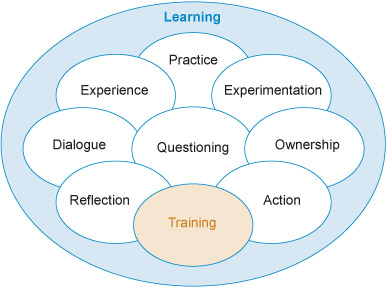
All these developments and contextual factors are contributing to a move away from the assumption that formal, usually classroom-based, training solutions are the best approach to learning and talent development, and towards exploring alternative approaches that both enable and rely on learners making their own connections between theory and practice, and some of their own decisions about their development priorities. The shift from training to learning – from skills to skilfulness – has quite profound implications for the scope of HRD work in this area. It means, for instance, that the TNA is only one tool in a broader suite of methods for articulating learning needs and designing and facilitating learning interventions (see Figure 2). Many educational theorists have started using the idea of a ‘learning needs analysis’ (LNA) to encompass this broader range. The notion of a LNA will be the focus of the next activity.
Activity 2: From training to learning
Return to your reflective notes on TNAs from Activity 1.
In the text box below, write down the ways in which doing an LNA (learning needs analysis) might be different from doing a TNA (training needs analysis). In what ways might your choice of delivery method, your approach to evaluation or your approach to stakeholder engagement change if the focus is on learning, rather than training? Note down the implications of any differences for:
- a.your role as an HRD professional
- b.the organisational members whose learning needs you are assessing
- c.the organisation.
Feedback
The key learning point to be derived from this exercise is that the increased agency of learners is likely to result in decreased control for HRD professionals, and hence the organisation. This decrease in control relates both to the identification of needs, and to the proposed ways of tackling these needs. Although critical and experiential theorists love the shift from training to learning, from skills to skilfulness, etc., the practical and political dynamics of organisational life mean that it might not always be viable. Organisational stakeholders may not embrace the self-managing, self-monitoring aspects of the (empowered) learning discourse, however attractive the rhetoric of ‘the learning organisation’. Two areas that get more complex (and hence require more nuanced work on the part of HRD professionals) as we move from training to learning are: facilitation and evaluation.
Within this context of increasing emphasis on self-directed learning, coaching and mentoring have become rather popular tools. The CIPD/Cornerstone OnDemand Learning and Development 2014 annual survey (CIPD, 2014) questioned 1000 learning and development UK professionals and reported that 76 per cent of organisations now provide coaching and mentoring; this figure rises to 85 per cent in the public sector. The survey also reported that coaching is perceived by HR professionals as the most effective way to deliver learning and development, and that half of those questioned intend to introduce coaching in the near future. It is also interesting to note that coaching is seen as more effective at present than other kinds of provision including emerging technological provision such as e-learning and MOOCs (CIPD, 2014, p. 8).
Both coaching and mentoring are ways of facilitating and supporting self-managed learning. In the next section we will introduce some basic ideas around coaching and mentoring and give you the opportunity to practise some foundation coaching skills.
3 Coaching and mentoring: an overview of similarities and differences
It is surprisingly difficult to define ‘coaching’ precisely, and this term is used in rather different ways depending on the context. It is also difficult to distinguish definitively between coaching and mentoring. Both rely on the coach or mentor to facilitate the individual’s learning and to help them to take responsibility for, and to manage, their own learning, and both need some foundation coaching skills – although mentoring requires additional skills to do with supporting the mentee through guiding, career counselling and networking (Clutterbuck, 2014).
In the following activity you will spend some time thinking about your own experiences of coaching and mentoring, and you will hear from our panel of learning and development practitioners about what they see as being the differences between coaching and mentoring.
Activity 3: Coaching and mentoring
Part 1: What do we mean by ‘coaching’ and ‘mentoring’?
Think about what you understand by the terms ‘coaching’ and ‘mentoring’. You may draw on what you have read about each of these and/or on your previous experience, either as a coach/mentor or as a person who has had some coaching and mentoring, either at work or in another context. In the text box below, write a few sentences on each of the two terms and how you think they are different.
Feedback
A popular way of distinguishing between coaching and mentoring is to identify that mentors usually have more experience than the person whom they are mentoring, while this is less often true in coaching. However, this is complicated by the fact that many successful coaches, particularly executive coaches, are, or have been, successful senior executives themselves and draw on this experience in their work as coaches.
There is a continuing debate between coaches about how much experience they need of the work context of those whom they are coaching, and how much they can rely on the generic skills of facilitating and supporting learning, which you will practise later in this course. In relation to mentoring, however, there is no real debate about the importance of the mentor having relevant workplace or other experience; this is normally assumed to be necessary.
You may have mentioned in your own definitions that the techniques and skills of coaching and mentoring can also be similar; for example, in terms of goal setting, questioning and exploring options for action. Part 2 of this activity will explore similarities and differences a bit further.
Part 2: Practitioner views
Now watch the video below in which our panel of HRD experts talk about what they see as being the differences between coaching and mentoring. As you watch, make notes in the text box below of the main points about coaching and mentoring.

Transcript: Differences and similarities between coaching and mentoring
Feedback
In the video, the practitioners mention the following differences and similarities:
- a coach probes for answers, while a mentor may only ask the individual to reflect
- a mentor is more likely to be older than their mentee
- a mentor is often an expert in the work, role and organisation, and can offer specific advice; a coach may or may not be an expert in the work, but enables the coachee to explore options and unlocks the coachee’s own knowledge and problem-solving capacity.
You will already see that drawing a distinction between coaching and mentoring is not simple. Clutterbuck (2008) highlights the features that they seem to have in common; both:
- require, and draw upon, the helper’s experience
- involve giving advice in some form
- coaching and mentoring are based on goals set by, or for, the learner
- methods deal with significant transitions the learner wishes to make
- deal with personal growth ambitions.
However, there are key differences between coaching and mentoring. Passmore (2007) provides a useful table describing some of these differences in seven areas: level of formality, length of contract, outcome focus, level of business knowledge, training, client, and supervision or support.
| Coaching | Mentoring | |
| 1. Level of formality | More formal: contract or ground rules set, often involving a third-party organisational client. | Less formal: agreement, most typically, between two parties. |
| 2. Length of contract | Shorter term: typically, between 4 and 12 meetings agreed over two to twelve months. | Longer term: typically, unspecified number of meetings with relationships often running over 3 to 5 years. |
| 3. Outcome Focus | More performance-focused: typically, a greater focus on short-term skills and job performance. | More career-focused: typically, a concern with longer-term career issues, obtaining the right experience and longer-term thinking. |
| 4. Level of business knowledge | More generalist: typically, coaches have a strong appreciation of business or commercial realities. | More sector knowledge: typically, mentors have detailed knowledge of organisation or business sector. |
| 5. Training | More relationship training: typically, coaches have a background in psychology, psychotherapy or human resources, or have undertaken specialist coaching training. | More management training: typically, mentors have a background in senior management, with limited coaching/mentoring training. |
| 6. Client | Dual client: more typically, a dual focus on the needs of the individual and the needs of the organisation. | Single client: more typically, a single focus on the needs of the individual. |
| 7. Supervision or support | Formal: typically, the coach will be in (or be expected to be in) supervision as part of their CPD. | Informal: typically, the mentor may have period discussions or briefings from HR, if based within an organisation. |
4 Supporting learning in coaching and mentoring
Coaching and mentoring work within a constructivist paradigm. Constructivists emphasise the uniqueness of each learning experience as individuals develop meaning through their own interactions with the environment. In line with this, coaching and mentoring encourages a learner- or client-centred approach. Thus, coaching and mentoring as a learning methodology differs from teaching and training, as the coach often facilitates non-directive and non-judgemental sessions, thereby encouraging the individual to find their own answers. The learner is encouraged to find their own way towards new knowledge and skills; so, instead of ‘telling’ the learner the answers, learning is facilitated through a cycle of experience and reflection.
Reflective learning in coaching and mentoring
The experiential learning cycle (Kolb 1984) in Figure 5 below shows how a learner’s actions and experience can be explored through reflection, which can lead to changed thinking and behaviours. If the learner is encouraged to explore a range of theoretical perspectives and practical applications, they may decide to act differently, which will inform future reflection.
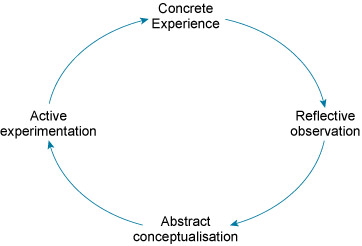
Reflection plays a key part in learning and will appear frequently in a coaching relationship for both coach and coachee. You may want to log your reflections as you study this course, and as you carry out personal development planning and skills development. This may be particularly useful in relation to Section 5, as it has a more applied focus.
5 An introduction to coaching in practice
In this section we provide an introduction to professional coaching skills, with a focus on practical approaches and techniques.
Watch the video below, in which our panel of HRD experts – all experienced coaches – talk about what they believe are the features of successful coaching and what they look for in a coach in terms of skills and behaviours.
Transcript
The HRD professionals highlight the following key areas of coaching behaviours and skills:
- understanding resistance to coaching – a coach may need to prepare for that and consider how that resistance could be used as part of the discussion
- the use of good judgement on when to offer instruction, or to simply guide the coachee
- sensing the learner’s emotions towards the process, through active listening and awareness
- enabling the learner to find their own answers – this is preferable to offering instruction or being directive
- building trust and rapport as the relationship is the key feature of successful coaching.
The remaining sections will present a brief introduction to professional coaching skills, with a focus on practical aspects, such as planning the session, delivering the sessions, and some of the basic skills involved.
5.1 Planning a series of coaching sessions
There are a number of actions that a coach needs to take in order to set up a series of coaching sessions. This checklist sets out the main things you will need to consider.
- Arrange dates (and venues if not virtual) for the agreed number of coaching sessions.
- Coachee welfare and contracting:
- What are the boundaries of the coaching relationship?
- What professional code of ethics are you following (these can be found in the main Coaching and Mentoring associations websites)?
- What agreement will you make between you about confidentiality? Normally in coaching you would offer qualified confidentiality – that is, you would undertake not to repeat anything said to you in the session unless there are overriding ethical considerations, such as concern for the welfare of the coachee, or concern that the law was being broken.
- Are there any other ethical issues you want to discuss and come to an agreement on? You may, for example, want to agree that you will all commit to working together constructively and supportively, and/or that you will all attend punctually and be fully prepared.
- Agree aims and objectives for the coaching sessions (usually set with line managers/HRD partners).
- The first session details: where? when? how if virtual?
- Prepare to introduce and use a range of models and techniques as appropriate.
- Question approaches – prepare some initial questions.
- Note-taking: how will you do this? Will you signal that you are going to do it?
- Reflection after the session by both parties.
In the next section we will introduce a well-known framework for coaching.
5.2 Using the GROW coaching model
The GROW framework helps to structure the coaching session(s) (Whitmore, 2009). (GROW stands for Goals, Reality, Options and Will.) There are other models (you may know others, or, if you are already an experienced coach, you may have develop your own). We offer this model as a useful example which is often used by coaches.

5.2.1 GROW: Goals
The coach begins by asking exploratory questions to establish the overall goals of the coaching, and then sets objectives for the first session and subsequent sessions to meet the overall aims. This can be more difficult than it sounds as the coachee may not be aware of the reasons for the coaching or find it difficult to put it into words. Before starting to discuss goals, however, it is important for the coach to develop a rapport with the coachee, so that they feel a sense of trust.
In the next two activities you will watch good examples of this important phase in the coaching relationship.
Activity 4: Building trust and rapport
Part A
Listen to the following short audio recording on building rapport.
Transcript: Building rapport
Now watch the video below for an example of how a coach attempts to build trust and rapport at the beginning of the coaching session. Notice the ways in which the coach tries to put the coachee at ease before starting to progress on to the objective of the session.

Transcript: How to build trust and rapport at the beginning of a coaching session
Part B
Consider how you can put a potential client at ease in your practice sessions. Make some notes in the text box below on ways to ‘break the ice’ at the beginning of the session and so start to build trust.
Activity 5: Goal-setting techniques
You will now have an opportunity to watch experienced coaches probing more closely and setting goals with their clients. This is a crucial first step and part of the ‘contracting’ process of setting a clear direction and purpose for the dialogue.
Part A
Watch this series of five short videos showing coaches setting goals with coachees. Sometimes it is difficult for both parties to get to the heart of the issue, so pay attention – and make notes – on how the coach uses language and questions to try to draw out the coachee’s ‘real’ objective each time.

Transcript: Good practice in setting workable goals

Transcript: Good practice when goals threaten to be too vague

Transcript: Good practice in prioritising goals

Transcript: Good practice when a goal is about someone else other than the client in the room

Transcript: Good practice in setting positive rather than negative goals
Part B
In the text box below, make a list of questions that you could use to elicit ideas and set goals with a potential coachee. Consider how you will deal with someone who says they don’t know what their goals are.
Feedback
Research consistently shows that the key ingredient for the effective coaching lies in the quality of the relationship between coach and coachee. Being able to build good rapport is therefore paramount, as this will facilitate the other key stages in the process, including the setting of realistic and achievable goals.
5.2.2 GROW: Reality
The second stage of the GROW framework involves questioning the coachee about their understanding of the reality of the situation or the context, and issues or problems they wish to address. At this point, the coach will be asking questions to establish the facts and feelings involved.
Here are some possible opening questions that the coach could use:
- What is happening now? (Use the ‘5 Ws and H’ questions: What, when, why, who, where, how?)
- What actions have you already taken? What happened?
- What have you learned from the experience?
- What is keeping you from finding a solution?
- What is really going on, do you think?
The following video illustrates some examples of good questioning. Notice how the questions are framed. Note the importance of ‘open’ questions (questions without a direct, one-word answer) to elicit fuller answers.

Transcript: Examples of good questioning
A complementary skill to effective questioning is active listening – using language and gestures to signal to the coachee that you are following their description of the issues or explanation of the background. (While specifically referred to here, questioning and active listening are key skills to use throughout the whole process.)
5.2.3 GROW: Options
The third step in the GROW model is specifically used to move on from the description of the issues, to generating options for actions to take forward. This is a crucial step, as it gives the individual time to come up with a range of ideas without the coach suggesting action or giving advice. The coach may encounter some opposition or barriers here, where the coachee may have tried to take steps in the past which have not been fruitful. It may be that the coach has to interrupt the flow and ask what prevents the coachee from taking any particular option. This may also be the stage where the coach will need to challenge any assumptions made; this can sometimes be uncomfortable for the coachee.
Box 2: Exploring options
Here are some suggestions of questions you might ask to encourage the coachee to explore options. Make a list of the ones you prefer for your practice coaching session and add any others, from your own experience, which you would find useful.
Actions
Which options do you think might work best for you? To what extent does this option meet your goals? When will you prepare an action plan? When are you going to start?
Support
What help or support do you need? What could I do, as a coach, to help and support you in your plans?
Obstacles to action
What could prevent you from taking action, and how will you get around it? How committed are you to taking the plan forward?
Evaluation/measures
How will success look and feel? How will you measure or evaluate success?
After generating some options for action, and agreeing on the ones which seem viable to the coachee, there is a final stage in the GROW model to seal these ideas and agree on an action plan to take forward.
5.2.4 GROW: Will
The final step in the framework is to elicit a commitment to take up some of the ideas suggested in the options conversation: to turn discussion into action. Both parties will have taken notes and will agree an action plan at this point. Towards the end of the session, the coach can remind the coachee of the importance of writing a reflection on the session, considering the whole experience, as well as the details for action going forward. There will be some discussion of the aims for the next session, as they may have developed further (and practicalities, such as where and when it will happen).
Coaching is a demanding activity on both sides; so coaches need to be strongly qualified, and adhere to rigorous ethical standards and coachees need to be in relatively good health to consider engaging in this activity. If you want to deepen your understanding about coaching or become a coach yourself, you may want to check the different paths in one of the widely recognised coaching and mentoring bodies – for example, the International Coaching Federation (ICF), the European Coaching and Mentoring Council (EMCC), the Association for Coaching (AC), and the Association for Professional Executive Coaching and Supervision (APECS).
Conclusion
In this free course, Workplace learning with coaching and mentoring, you have explored and critically evaluated the traditional training-based approach to learning and talent development. You looked at the shift from training to learning, and its key implications for the work of HRD professionals. You then explored the GROW model – a particular learning tool that illustrates the shift to learning through coaching and mentoring – and drew out some of the basic skills and techniques that lie at the heart of effective coaching. The videos in this course were intended to help you see and hear from good coaches in action; you will have been able to observe some key language and questioning skills to help you guide a coaching session.
Keep on learning

Study another free course
There are more than 800 courses on OpenLearn for you to choose from on a range of subjects.
Find out more about all our free courses.
Take your studies further
Find out more about studying with The Open University by visiting our online prospectus.
If you are new to university study, you may be interested in our Access Courses or Certificates.
For reference, full URLs to pages listed above:
OpenLearn – www.open.edu/ openlearn/ free-courses
Visiting our online prospectus – www.open.ac.uk/ courses
Access Courses – www.open.ac.uk/ courses/ do-it/ access
Certificates – www.open.ac.uk/ courses/ certificates-he
Newsletter – www.open.edu/ openlearn/ about-openlearn/ subscribe-the-openlearn-newsletter
References
Further reading
Acknowledgements
This free course was written by Cristina Quinones.
Except for third party materials and otherwise stated (see terms and conditions), this content is made available under a Creative Commons Attribution-NonCommercial-ShareAlike 4.0 Licence.
The material acknowledged below is Proprietary and used under licence (not subject to Creative Commons Licence). Grateful acknowledgement is made to the following sources for permission to reproduce material in this free course:
Course image
© Jacob Wackerhausen/iStockphoto.com.
Figures
Figure 3: © 1997 John McPherson. Reprinted with permission of UNIVERSAL UCLICK. All rights reserved.
Figure 5: adapted from: Kolb, D. A. (1984) Experiential Learning: Experience as the Source of Learning and Development, Englewood Cliffs, NJ, Prentice Hall.
Tables
Table 1: adapted from: Passmore, J. (2007) ‘Coaching and mentoring – the role of experience and sector knowledge’, International Journal of Evidence Based Coaching and Mentoring, Special Issue 1, summer, pp. 10–16.
Every effort has been made to contact copyright owners. If any have been inadvertently overlooked, the publishers will be pleased to make the necessary arrangements at the first opportunity.
Don't miss out
If reading this text has inspired you to learn more, you may be interested in joining the millions of people who discover our free learning resources and qualifications by visiting The Open University – www.open.edu/ openlearn/ free-courses.