History of reading tutorial 3: Famous writers and their reading - Elizabeth Barrett Browning and Vernon Lee
Use 'Print preview' to check the number of pages and printer settings.
Print functionality varies between browsers.
Printable page generated Monday, 14 September 2026, 12:32 AM
History of reading tutorial 3: Famous writers and their reading - Elizabeth Barrett Browning and Vernon Lee
Introduction
The purpose of this course is to demonstrate how the UK Reading Experience Database (RED) can be used in a study of the reading habits of a writer, and how this information can be used in a literary study of that writer’s own writing. To this end we will be focussing on the reading experiences of Elizabeth Barrett Browning and Vernon Lee. This course builds on the previous two courses, Red_1 and Red_2, and trains users in advanced search functions and close analysis of data.
Learning outcomes
After studying this course, you should be able to:
perform advanced searches of data held on the UK RED site, including locating evidence by place of reading experience or by combining search queries
recognise development in evaluative and interpretative skills in handling a range of source material
understand how evidence on the UK RED site might be useful in shaping broader studies of writers’ reading, biography, and cultural and literary history.
1 Overview
This course looks at specific examples of the reading and responses of two great British women writers and intellectuals: the poet Elizabeth Barrett Browning (1806-1861), and the art historian, critic and essayist Vernon Lee (pseudonym of Violet Paget, 1856-1935).
The author of Aurora Leigh (1857) and Sonnets from the Portuguese (1844), Barrett Browning was one of the leading poets of mid-Victorian Britain; such was her popularity and critical standing that on the death of William Wordsworth in 1850, she was considered for the post of Poet Laureate, an appointment which eventually went to Tennyson. Writing a generation later, Lee was less feted in her lifetime than Barrett Browning, but her astonishingly original literary output – over 40 books on a wide range of subjects from aesthetics to music and biography to literary criticism – influenced writers as diverse as Jack London, Edith Wharton and Virginia Woolf. Building upon Red_1, which explained the range of data available to historians of reading, and Red_2, which looked at how the site can be used to map the reception history of a specific book, this course shows how examining the evidence of reading of two famous writers can tell us a great deal about their own intellectual lives, and that of the times in which they lived.
Living in an era when women were largely denied the benefits of a university education, both Elizabeth Barrett Browning and Vernon Lee were taught at home with the aid of tutors, and developed their formidable intellects through voracious and often systematic reading at home.
Both had the run of their parents’ libraries, and as child prodigies, displayed a prodigious gift for languages: French, German, Italian, Greek and Latin, and in Barrett Browning’s case, Hebrew as well. A letter from Elizabeth Barrett to her then fiancée Robert Browning in January 1846 also suggests the ways in which her father tried (and failed) to control her teenage reading (and raiding) of his library for radical literature:
‘Papa used to say “Don’t read Gibbon’s history – it’s not a proper book – don’t read Tom Jones & none of the books on this side, mind – so I was very obedient & never touched the books on that side & only read instead, Tom Paine’s Age of Reason & Voltaire’s Philosophical Dictionary, Hume’s Essays, & Werther, & Rousseau, & Mary Wollstonecraft…which did as well’.
For both women, reading became essential to their professional ambition and identity as writers, but they also had to contend with the dilemma of finding their own voice and establishing their names in an overwhelmingly male literary tradition: one that often assumed women to be consumers and not producers of great literature. In this tutorial, we will investigate some of the reading and response of Elizabeth Barrett Browning and Vernon Lee, and see how they shaped themselves as writers through their reading.
2 Elizabeth Barrett Browning
Elizabeth Barrett Browning was a child prodigy with a remarkable appetite for the printed word, a facility for languages, and ambitions to become a great poet. But what did she read as a child and a teenager, and how did this shape her thinking and writing? Much of the evidence of her reading from her family correspondence is now contained on the UK RED site, so let’s start by conducting an advanced search.
Activity 1
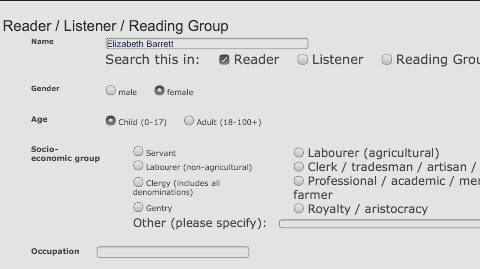
Search for the evidence of Elizabeth Barrett’s childhood reading in UK RED. Click on ‘Advanced Search’, and scroll down. Enter ‘Elizabeth Barrett’ (her maiden name) in the ‘Name of Reader’ box, check ‘female’ for gender, and ‘child’ for age – it should look like this:
Now submit your query, which will return all the evidence of Elizabeth Barrett Browning’s reading in UK RED before the age of 18. What do you find? Is her reading unusual? You may want to use the ‘My List’ function to facilitate easier interpretation of your search results.
Comment
Your search should return 50 entries (January 2011), and three things may well strike you. First of all, Elizabeth Barrett Browning’s precocity as a child reader, who read histories, Homer’s Odyssey, some of Shakespeare’s plays and portions of Milton’s Paradise Lost by the age of eight (UK RED: 16069), and French novels (UK RED: 15961) and Latin grammars (UK RED: 15964) by the age of 10.
Second, the extent to which she starts to shape her own identity as a budding author through her reading and evaluative response, such as the comparison of Madame de Sévigné’s letters with Byron’s verse:
‘I do not admire “Madame de Sévigné’s letters,” though the French is excellent [...] yet the sentiment is not novel […] the last Canto of “Childe Harold” (certainly much superior to the others) has delighted me more than I can express. The description of the waterfall is the most exquisite piece of poetry that I ever read [...] All the energy, all the sublimity of modern verse is centered in those lines’.
Only two years after writing this letter, Elizabeth Barrett Browning would have her first work of poetry published.
Finally, her childhood reading reveals the paucity of previous women poets as role models. While 15 of the 50 books in the search results are by women, only one volume of poetry, her own long poem The Battle of Marathon (1820), is by a female author (UK RED: 16095). Her reading and response to Mary Wollstonecraft’s A Vindication of the Rights of Woman (UK RED: 17599 and UK RED: 17010) indicates her early awareness of the circumstances faced by women writers and thinkers in this period.
After their marriage in 1846, the Brownings moved to Italy, living in ‘Casa Guidi’, a house in the Oltrarno district of Florence from 1847 until Elizabeth Barrett Browning’s death in 1861. Vernon Lee lived at ‘Il Palmerino’, a villa in Maiano in the hills just outside Florence, from 1889 until her death in 1935. Although they never met (Barrett Browning died when Lee was still only five years old), they were both prominent members of the large Anglo-Florentine community, many of whose members were writers. Robert Browning was Lee’s favourite nineteenth-century British poet, and she read through all of his poems immediately after his death in December 1889. Who were the other prominent members of this literary community in the nineteenth century, and did they read one another’s works?
Activity 2
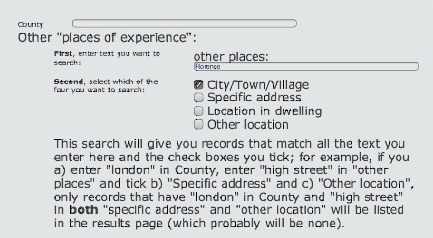
We can start to investigate this by performing an advanced search of UK RED and locating readers in Florence. Click on ‘Advanced Search’, and scroll down the list of search fields, until you reach ‘Places of Experience’ – put ‘Florence’ in the ‘other places’ box, and check the ‘City/Town/Village’ box, like this:
Make sure that the box for ‘reader’ in the Reader/Listener/Reading Group field is not checked – remember that you are searching by place, and not by reader. Now click on ‘submit query’. What does this search yield? Make a note of the famous writers listed as readers in the results, and see if they read each others’ writing, or if you can find some common social networks between them.
Comment
This search should yield 250 hits [January 2011], and reads a little bit like a who’s who of great nineteenth-century British writers: Percy and Mary Shelley, Claire Clairmont, Sarah Harriet Burney, Mrs Oliphant, Henry James, John Ruskin, Gertrude Bell, and of course Vernon Lee and both Elizabeth and Robert Browning are here.
Then as now, there were thousands of British people residing in Florence, or visiting it each year as part of the Grand Tour, and many left records of their reading in their diaries and correspondence. The data on the UK RED site is far from exhaustive and is still being added to, but what it does indicate is that there were identifiable British reading communities or social networks of practicing writers active in Florence through the nineteenth-century, and that they often read each other’s work collectively, fostering their own creativity.
The Shelley circle (Percy Shelley, Mary Shelley, and her step-sister Claire Clairmont) were all influenced by Lord Byron, whose Don Juan (1819-24) was the poetic sensation of the era. Staying in a rented pensione in Florence, the Shelley household often read to each other, while engaging in their own literary projects. Thus on 3 January 1820, Mary Shelley notes in her diary that her husband read Byron’s Don Juan ‘aloud in the evening’ (UK RED: 16143), while her step-sister Claire Clairmont, recording the same reading event in her journals, notes that it was Cantos I and II of Byron’s poem (UK RED: 15391) – Byron was writing Cantos III and IV that very winter in Ravenna, some 140 km away. Thirty years later, it would be Shelley’s turn to be read in the same way by the Brownings – Elizabeth Barrett Browning noting in a letter to her sister in December 1850 that she had been reading Shelley’s poems aloud to her husband, and that they had ‘talked & admired & criticised every separate stanza’ (UK RED: 19632). Barrett Browning was a frequent reader of Shelley throughout her life, and the evidence already in UK RED suggests that while she was always appreciative of his poetic talent (see UK RED: 19520), she was sometimes critical of this tendency to be ‘too immaterial for our sympathies’ (UK RED: 893) and also questioned his ability as a classicist (UK RED: 16570).
This kind of reading is both social and professional, indicating a literary community attached to a particular place (Florence) and a specific activity (writing in relation to an established literary or poetic tradition). Writers’ reading can give us clear indications of their many literary influences, tastes, and judgements, and how these might change over time. Indeed, in her reading of Shelley’s The Revolt of Islam (1817) in August 1831 when she criticised him for being ‘too immaterial’, Barrett Browning also admitted that ‘as I read him on, I may reverse this opinion’ (UK RED: 893).
3 Vernon Lee
The majority of Elizabeth Barrett Browning’s responses to her reading are recorded in her correspondence to friends and family, most of which has since been published, but for the Anglo-Florentine writer Vernon Lee, responses to reading were overwhelmingly recorded in two unpublished sources: in her commonplace books (covering the period 1887-1900), and in the marginal comments of books in her own library. How might private, unpublished responses to reading function differently from the evidence in correspondence or published sources, designed to be read by others? We can examine this by looking at an example of each.
Activity 3
Perform an ‘Advanced Search’ for Lee’s reading in Florence in the period up to 1900 by scrolling down, and selecting the following:
- for ‘Century of Experience’, the half-century ‘1850-1899’
- for ‘Name of Reader’, enter ‘Vernon Lee’
- for ‘Gender’, select ‘female’
- for ‘Places of Experience’, check ‘specific address’, select ‘Other Places’, and enter ‘Il Palmerino’
- Now click on ‘Submit Query’.
Comment
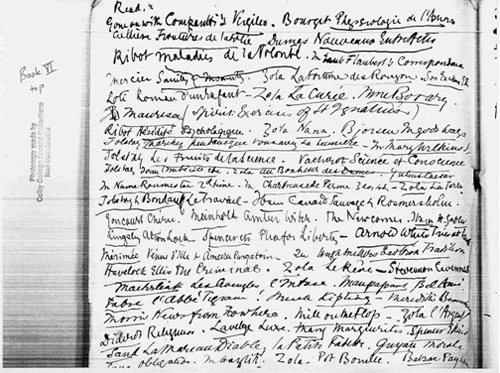
Your search should return 31 entries (January 2011), and glancing at the summary of the ‘Evidence’ column, you can see that there are two broad sources of evidence: marginalia, and the list of books read from her commonplace books (UK RED: 20618 onwards). Let us know drill down a little further and closely examine commonplace book number VI, which covers the 11 month period from 25 February 1891 to 14 January 1892. During this period Vernon Lee read some 60 books, for which 58 authors and 55 titles can be precisely identified (Hazlitt, Kipling and Mary Wilkins are named as being read, without any information about which title was being read).
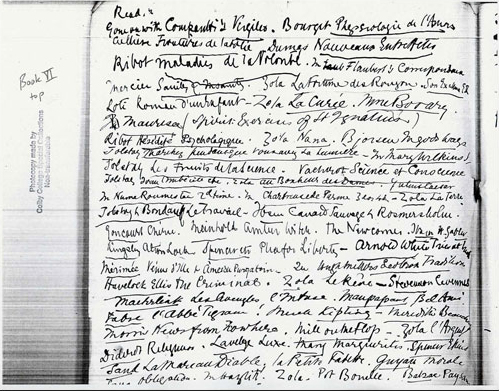
Several of the books were clearly re-read, such as Stendhal’s La Chartreuse de Parme and Alphonse Daudet’s Numa Roumestan (for the transcription of this list, see ID: 20618). We can analyse the field of literature here through the filters of language, genre, and recentness (or date of publication). Certain clear patterns emerge in Lee’s reading over this 11 month period.
First: the majority of her reading was in French (37 of 60 titles, or 62%); despite this, all the entries in the commonplace book are in English (an implicit act of translation takes place her between reading and first written response).
Second: both Russian and Norwegian literature –specifically Tolstoy and Ibsen – was read in French translation, and not in English, despite the availability of these works in English translations.
Third: half the titles read were fiction, more than all the other genres put together, while not a single volume of poetry seems to have been read or recorded over this 11 month period. Clearly this is anomalous; many members of Lee’s circle, including her half-brother Eugene Lee-Hamilton, were practising poets, so the evidence offered by the commonplace book in this instance is highly deviant.
Fourth: the overwhelming majority of Lee’s reading during this period was of contemporary books, with 30% of books having been published less than 2 years before, and 52% less than 10 years earlier; the back catalogue of out of copyright reprints, in other words, of classics, is surprisingly small.
What this snapshot of trends for 1891-2 indicates is that Vernon Lee was programmatic in her approach to reading contemporary European (largely French) fiction, an activity that found its outcome in a series of published articles in literary journals. The title list for Commonplace Book VI offers strong evidence of the professional reading of a literary critic and essayist.
Vernon Lee clearly used her commonplace books to structure a considered response to an act of reading, but more immediate (and perhaps less guarded) responses can be found in the marginalia in 299 of the 425 books in her private library that still survive.
Activity 4
Perform an ‘Advanced Search’ for Lee’s marginalia by scrolling down, and selecting the following:
- in the ‘Keyword (in evidence)’ field, enter ‘marginalia’
- for ‘Name of Reader’, enter ‘Vernon Lee’
- Now click on ‘Submit Query’.
Comment
Your search will locate all of Lee’s books with marginalia entered into UK RED, some 40 items (January 2011). Marginalia works in a number of different ways – marginal notes can be used as aids to memory when re-reading a book, or they can be designed to assist quick reference, so that a particular passage or idea can be located quickly. As these are comments in privately owned books, marginalia is not explicitly intended for publication, and therefore the opinions expressed might be much more direct and unguarded than usual. Conversely, owned books with marginalia maybe be borrowed or circulated privately, amongst friends and family, thus making these comments in some sense, public. Occasionally, more than one reader may leave a mark, such as in Lee’s copy of Rudolf Goldscheid’s Höherentwicklung und Menschenökonomie: grundlegung der sozialbiologie (UK RED: 16970) which she lent to her friend, the Italian pragmatist philosopher Mario Calderoni.
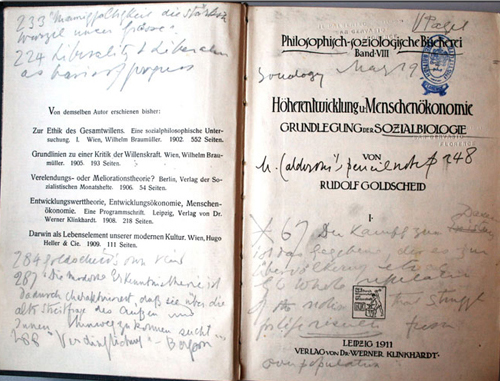
Calderoni returned the book with his own marginalia (some commenting on Lee’s first of notes), which prompted Lee to re-read the work, and leave some additional marginal marks, completing a literary conversation. The marginal marks from her second reading explicitly refer to Calderoni’s glosses; for example, on the title page of the book, she notes in ink the importance of Calderoni’s marginal comments on page 248 of the work (‘Calderoni pencil note p.248’). In this German text, Lee’s largely English marginal notes engage Calderoni’s German comments, reinforcing points made in their private correspondence, which was exclusively in Italian, and providing evidence of a multilingual, intratextual interpretive community reading the same book. Sometimes, marginalia can act as a barrier in the sequence between reading and published writing. For example, although Lee’s copy of Henry Ford’s My Life and Work (ID:16964) was heavily marked, at no point in her own publications does she refer to having read Ford’s autobiography. Conversely we should also not assume that just because a book is unmarked, it is unread. Reading is a process, and we need to be aware of the multiple ways and places in which readers might register their responses to the act of reading.
4 Conclusion
Writing is a reflexive business, and before they ever put pen to paper, writers are themselves, readers. Studying the recorded evidence of a famous writer’s reading can offer us wonderful insights into his or her intellectual development through time. By gathering together responses to reading, we can begin to piece together the pathways of both influence and resistance through the act of reading. We can find out how an author was influenced by reading a particular book over a period of time, tracing the changing nature of their responses through their notes, correspondence, and marginalia. We can also map out where certain authors, books, or ideas were resisted, even after being read: reading and commenting on a book may sometimes obviate or even prevent a particular borrowing or influence from appearing in a published work. Examining the reading of writers allows us to illuminate the chain of sequences in literary composition from reading to publication. And more than anything else, we can begin to flesh out the intellectual universe of a specific writer, and the wider cultural concerns of a period, by scrutinising their reading.
The burgeoning number of recent publications on famous writers and public figures as readers, from Alan Bennett’s fictionalisation of Queen Elizabeth II’s reading in The Uncommon Reader, to James Carley’s excavation of royal marginalia in The Books of King Henry VIII and His Wives, and from Robert DeMaria’s study Samuel Johnson and the Life of Reading to Thomas Wright’s examination of Oscar Wilde’s reading (including in Reading Gaol), Oscar’s Books, tangibly demonstrates the value of records of reading in literary criticism, biography and life writing: invariably, we are what we read. Reading after all, is not a singular activity, but rather a complex series of negotiations and interpretations between reader and text: our views of a book can change with time.
The changing recorded responses of British writers’ to their reading, as increasingly catalogued in UK RED, offers us an alternative way of mapping the ‘Great Tradition’: not simply through the influence explicitly visible through authors’ published writings, but also in the private and often unpublished (and uncompromised) responses in letters, commonplace books, and marginalia. This is a process that is far from complete, and UK RED welcomes volunteers wishing to work on the reading of a particular writer. Perhaps the evidence of your favourite British writer’s reading has not yet been published, researched exhaustively, and entered into UK RED. If that is the case, we would like to hear from you.
You can find information on contributing to the project, and our simple online contribution form, here.
Further reading
Colby, Vineta. Vernon Lee: A Literary Biography (University of Virginia Press, 2003).
Donaldson, Sandra, The Works of Elizabeth Barrett Browning, 5 vols (London: Pickering & Chatto, 2010).
The Harold Acton Library, The British Institute of Florence (Vernon Lee library)
Il Palmerino (Vernon Lee’s villa)
Karlin, Daniel. The Courtship of Robert Browning and Elizabeth Barrett (Oxford: OUP, 1988)
Kelley, Philip, Ronald Hudson, and Scott Lewis (eds) The Brownings’ Correspondence, 17 vols. to date (Winfield, Kan: Wedgestone Press, 1983-).
Kelley, Philip and Ronald Hudson (eds) Diary by E.B.B.: The Unpublished Diary of Elizabeth Barrett Barrett, 1831-1832, (Athens, Ohio: Ohio University Press, 1969).
Aknowledgements
This course was written by Dr Shaftquat Towheed.
Course image: random letters in Flickr made available under Creative Commons Attribution-NonCommercial-ShareAlike 2.0 Licence.
Figure 1: Elizabeth Barrett Browning (1859), by Field Talfourd, National Portrait Gallery
Figure 2: Vernon Lee (1881), John Singer Sargent, Tate Enterprises LTD
Figure 3: Vernon Lee, Commonplace book VI, 25 February 1891 to 14 January 1892, Colby College, Waterville, Maine, Special Collections, Vernon Lee Collection
Figure 4: Rudolf Goldscheid’s Höherentwicklung und Menschenökonomie: grundlegung der sozialbiologie. The British Institute of Florence
The Ten Cent Breakfast by Willard Leroy Metcalf, 1887, Denver Art Museum
Don't miss out:
If reading this text has inspired you to learn more, you may be interested in joining the millions of people who discover our free learning resources and qualifications by visiting The Open University - www.open.edu/ openlearn/ free-courses
Grateful acknowledgement is made to the following sources for permission to reproduce material in this course: