Building number confidence: Time
3. 12-hour clock time
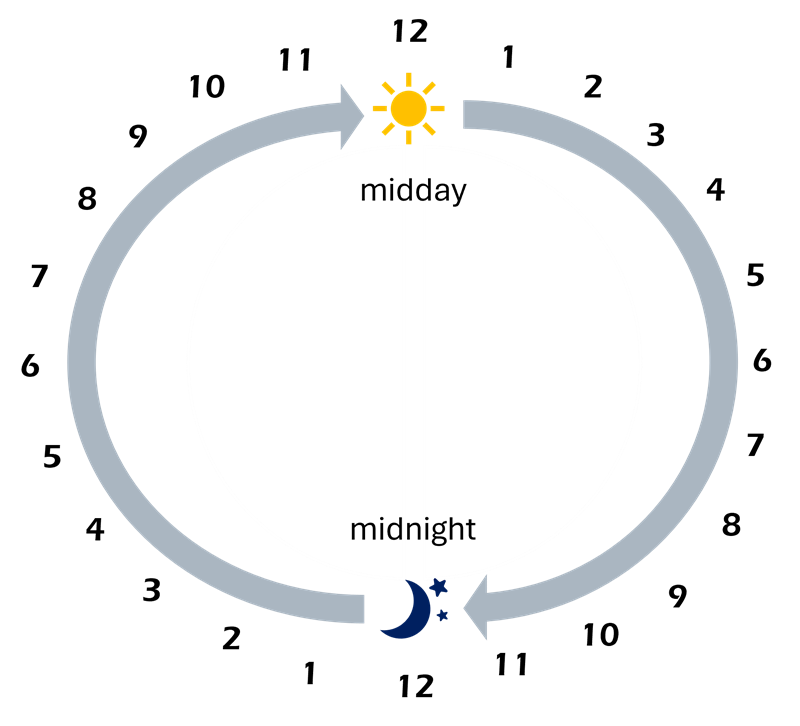
There are 24 hours in a day, however 12-hour clock time splits these into two blocks of twelve hours, which run either side of midday (noon), when the sun is at its highest point in the sky.
Analogue clock time
A standard analogue clock indicates the current time during a 12 hour period with ‘hands’ that move (clockwise) around a clockface. The small hand points to the hour (1 to 12), and the large (minute) hand indicates the number of minutes after that hour.
If the large hand points to 12, the time is 'on the hour' (0 minutes past). In this example the time is 3 o’clock.

3 o'clock
Each of the hour markers also represent a 5 minute interval (12 x 5 minutes = 60 minutes).
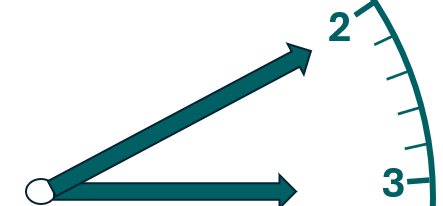
When the large hand is pointing to 2, for example, this indicates 10 minutes past the hour (2 x 5 = 10).

Ten minutes past 3
Some clocks also include markers for the minutes between the 5 minute intervals.
To or past the hour?
In the UK, the first 30 minutes of an hour are often stated as ‘past’ the hour, with the following minutes as ‘to’ the next hour.
For example,
35 minutes past 4 (4:35) may be given as 25 minutes to 5.
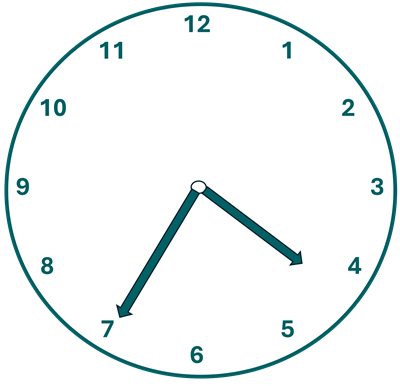
Twenty five minutes to 5
Time check
Using this convention, how would you say 2:40?
The time would be 20 minutes to 3.

Twenty minutes to 3
Morning, afternoon or evening?
To ensure clarity when using the 12-hour clock, we also need to know if the hour shown is during the 12 hour period:
- before midday, for example 3 o’clock in the morning or
- after midday, for example 3 o'clock in the afternoon.
We can do this using the suffix:
- am (from the Latin ante meridiem, before midday) or
- pm (post meridiem, after midday).
So
- 3 am for 3 in the morning
- 3 pm for 3 in the afternoon.
12am or 12pm?
Although midday is sometimes referred to as 12pm, and midnight as 12am, technically this is not quite right (am = 'before midday', pm = 'after midday'). To avoid any confusion, it is safer to simply say 'midday' and 'midnight' for these hours.