Building number confidence: Time
8. Time zones and UTC
As the earth rotates on its axis, different parts of the world are gradually exposed to the sun, bringing daylight, as others move into darkness. Over a 24 hour period, the local time of day varies around the globe as a result.
To account for these time differences, the globe has been divided into 24 time zones using imaginary lines called meridians, which run between the North and South Poles.
Most countries adopt a single time zone, even when they partially cross another meridian, however larger countries, such as the USA, must operate within a number of time zones.
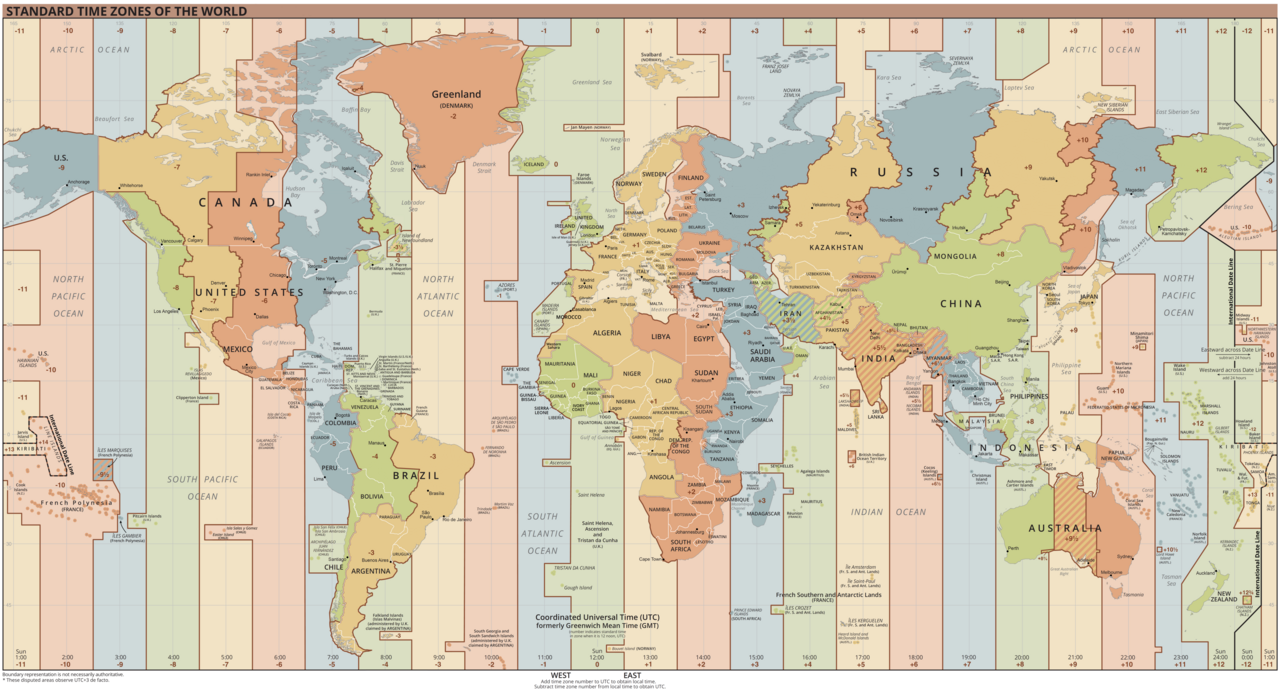
World time zones map
Wikimedia / Public domain
The Prime Meridian
The Prime Meridian (° degrees longitude) runs through Greenwich in London.
Travelling from the Prime Meridian to the
- East, across Europe and beyond, local time is ahead of that in the UK.
- West, towards the Americas and beyond, local time is behind that in the UK.
UTC
Coordinated Universal Time, or Universal Time Coordinated (UTC), is the recognised world-wide standard for measuring clock time.
UTC+0 is the time zone at the Prime Meridian, with time in other time zones being either ahead (UTC+) or behind (UTC-).
For example, if the time in GMT/UTC-0 is 12:00 (midday), then the time in:
- UTC+2 is 2 hours ahead (14:00), and
- UTC-3 (09:00) is 4 hours behind UTC+1 (13:00).

At midday (12:00) GMT/UTC-0, the time in UTC+1 is an hour ahead (13:00), and in UTC-1 is an hour behind (11:00).
Time zone names and abbreviations
As is the custom in the UK, where we refer to Greenwich Mean Time, or GMT, other time zones around the world are also referred to by localised names and abbreviations, for example:
- UTC+1: Central European Time (CET), West Africa Time (WAT)
- UTC+9: Japan Standard Time (JST), Korea Standard Time (KST)
- UTC-5: Eastern Standard Time (EST), Columbia Time (COT).
Time check
A flight from London is scheduled to depart at 10:00 and arrive in Tokyo the following day at 07:00 local time.
The local time in Tokyo is 9 hours ahead (UTC+9) of that in London (UTC+0).
What is the expected duration of this flight?
Subtract 9 hours from the Tokyo (UTC+9) arrival time to convert it to (UTC+0) London time which is 22:00 in the evening of the departure date.
The duration is the difference between these (UTC+0) departure and arrival times i.e. 12 hours.
A flight departing Phoenix (MST, UTC-7) at 13:30 arrives in Honolulu (HST, UTC-10) 7 hours later.
What is the local arrival time in Honolulu?
The flight arrives in Honolulu at 17:30 local time.
The arrival time according to Pheonix time is 20:30 (13:30 + 7 hours). Honolulu is 3 hours behind Pheonix, so this brings the local arrival time in Honolulu to 17:30 (20:30 - 3 hours).
The International Dateline
Halfway around the world, 180° east or west from the Prime Meridian, is another imaginary line called the International Date Line (IDL), which defines the boundary between one day and the next.
Crossing the IDL while travelling
- East, you subtract a day,
- West, you add a day.