Building number confidence: Time
6. Calculating and recording duration
Duration: How long something takes; an amount of time.
Calculating what time it will be after a given duration
To calculate what time it will be after a certain number of minutes have passed, it can be helpful to visualise (or actually look at) an analogue clock face.
Each of the time markers around the clock represent 5 minutes of time, so if you count (clockwise, to the right) around the markers, using multiples of 5 (5, 10, 15, 20, 25, 30...), until you get to the duration required, the marker at which you stop indicates what the time will be.
Let's look at some examples.
You put a tray of biscuits into the oven at 5 past 9, which need to bake for 20 minutes. What time will they be ready?
From the start time, where the minute hand is pointing to 1 (the 5 minutes marker), count the markers which follow: 5, 10, 15, 20, which takes you to 5 (the 25 minutes past marker), which tells us the biscuits will be ready at 25 past nine (09:25).
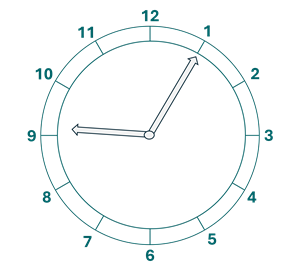
09:05

09:25 (20 minutes later)
This time, the start time is 09:35, or 25 minutes to 10 in the morning, and the bake time is 45 minutes. There are only 25 minutes left in the hour, so this duration will take us past 10 am.
From the start time marker (where the minute hand is pointing to 7), counting around the time markers which follow, (5, 10, 15, 20, 25, 30, 35, 40, 45) takes us to the 4 (20 past) marker. Remembering we have gone over the hour, the stop time will be 20 past 10 (10:20).
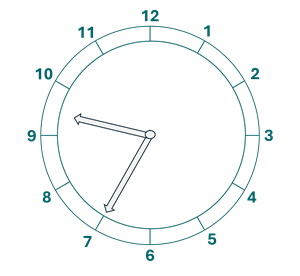
09:35
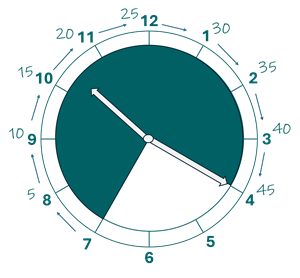
10:20 (45 minutes later)
Alternatively, knowing that the start time is 25 minutes from the next hour (which in this case would be 10 am) you can simply subtract 25 from the duration (45 minutes) which will tell you how many minutes past 10 this will be: 45 - 25 = 20, which means the stop time will be 20 past 10 (10:20).
A duration of half an hour (30 minutes) moves the minute hand to the time marker directly opposite the starting point, so no counting required!
09:05 (The minute hand is pointing to 1)
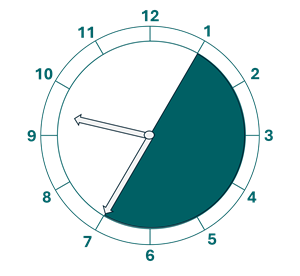
09:35 (Half an hour later, the minute hand is pointing to 7, directly opposite )
You can count hours around the clock in the same way, with each of the time markers representing 1 hour of time.
Calculating the duration between a start and stop time
Count the number of full hours between the start and stop time, and add any minutes either side.
You may find it easier to use the 24-hour clock, particularly if start and stop times are either side of mid-day.
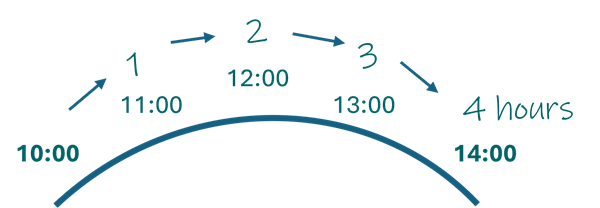
For example, to check the duration of a train journey, departing 10:00 and arriving at 14:00, count the number of hours on from the departure time to the arrival time:
(10:00): 11:00, 12:00, 13:00, 14:00 (4 hours).
Click the headings below to view some examples.
The first bus to Aberdeen departs at 06:00 and is scheduled to arrive at 09:00. How long should the journey take?
Both times are on the hour, so you can either:
- count the number of hours from 6 to the stop time: 7, 8, 9 (3 hours), or
- subtract the start time from the stop time: 9 - 6 = 3 hours.
Total journey time: 3 hours.
You plan to catch the 09:15 train to Glasgow, which is scheduled to arrive at 13:30. How long should the journey take?
Both start and stop time include minutes past the hour. The minutes past the stop time hour are greater than those at the start time hour.
Calculate the difference between the full start time (including the minutes past the hour) and the same number of minutes past the stop time hour, then add the remaining minutes:
- Hours: 9:15 to 13:15 is 4 hours (13 - 9 = 4, or count from 9: 10, 11, 12, 13 (4 hours).
- Minutes: 13:15 to 13:30 = 15 minutes.
Total journey time: 4 hours and 15 minutes.
The 11:45 train from Edinburgh to London is scheduled to arrive at 17:20. How long should the journey take?
Calculate the duration between the nearest hour(s) and then add the remaining minutes:
The start time is 15 minutes before the next hour (12:00) and there are 20 minutes after the stop time hour.
- Hours: 12:00 to 17:00 is 5 hours (17 - 12 = 5, or count from 12: 13, 14, 15, 16, 17 (5 hours).
- Minutes: 11:45 to 12:00 = 15 minutes, and 17:00 to 17:20 = 20 minutes. 15 + 20 = 35 minutes
Total journey time: 5 hours and 35 minutes.
Time check
Your usual journey to visit friends takes an hour and a half. If you set off at 10 past 3 in the afternoon, what time should you arrive?
An hour on from 10 past 3 is 10 past 4. Add half an hour (30 minutes) to this which will take the time to 4:40 pm (20 minutes to 5 in the afternoon).
You have booked a seat on the 07:50 train from Inverness to Newcastle, which is scheduled to arrive at 13:10. How long should the journey take?
Count the hours from the start time (07:50) to the nearest hour (and minutes) before the stop time and add on the remaining minutes:
- Hours: 07:50 to 12:50 is 5 hours (12 - 7 = 5, or count from 7: 8, 9, 10, 11, 12 (5 hours).
- Minutes: 12:50 to 13:10 = 20 minutes.
Total journey time: 5 hours and 20 minutes.