Building number confidence: Time
| Site: | OpenLearn Create |
| Course: | Building number confidence: Time |
| Book: | Building number confidence: Time |
| Printed by: | Guest user |
| Date: | Sunday, 25 October 2026, 11:23 PM |
1. Introduction
From the earliest of times, knowledge of the patterns of sunrise and sunset, and of the seasons, has enabled people to organise and plan their lives. For example, to gauge how much daylight is available in each new day, and when to plant and harvest crops.
Early civilisations began the development of calendars based around the:
- solar year, defined by changing seasons as the earth revolves around the sun;
- solar day, with its periods of light and darkness due to the earth rotating on its axis;
- lunar month, which follows the phases of the moon as it orbits the earth.
Various tools were also developed to aid time management, including:
- sun dials onto which shadows cast by the movement of the sun across the sky indicate the time of day;
- lunar calendars based on the monthly cycle of the Moon's phases;
- water clocks which capture the time taken for water to flow through;
- candle clocks and incense sticks which record time by the rate at which they burn.
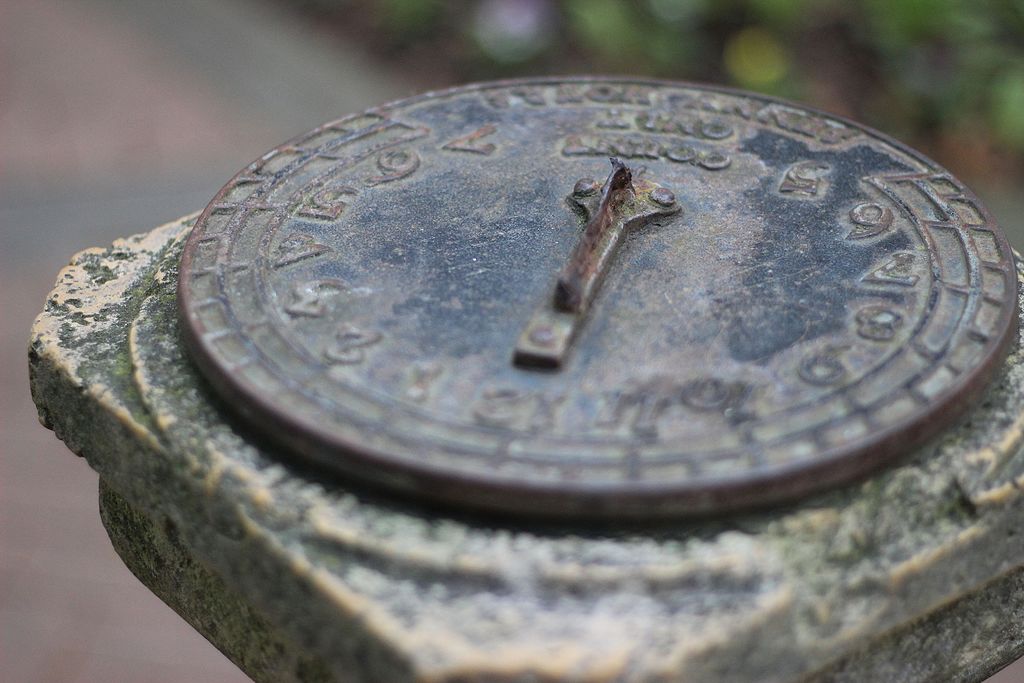
A sundial located in Shakespeare’s Garden, Stratford upon Avon
Wikimedia / CC BY-SA 4.0
Some of these methods were more reliable than others. Consider, for example, the ability to tell the time accurately using a sundial when the sun is hidden in poor weather!
2. Modern measures of time
Time is measured in different units. Here are some common time measurements and how they relate to one another:
Seconds, minutes, hours and days
- 60 seconds in a minute
- 60 minutes in an hour
- 15 minutes in quarter of an hour
- 30 minutes in half an hour
- 24 hours in a day
- 7 days in a week
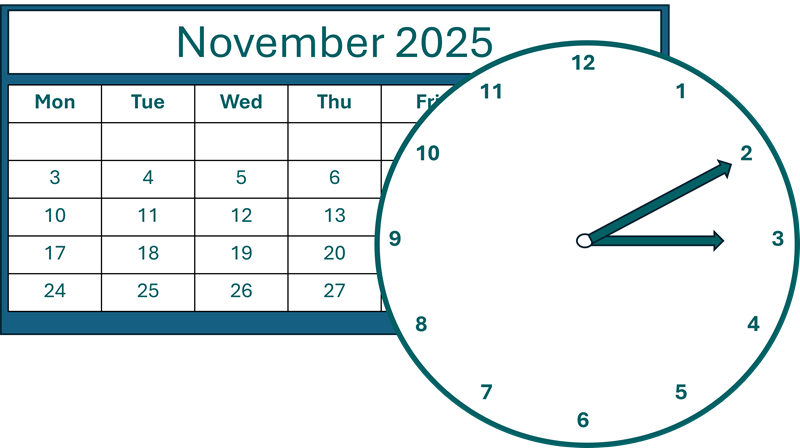
Days, weeks, months and years
Converting between units of time
As with other types of measurement, like length or weight, time can usually be converted into larger or smaller units using simple operations. For example:
- There are 60 seconds in a minute, so to find how many seconds there are in 3 minutes, multiply 3 by 60: 3 × 60 = 120 seconds.
- There are 60 minutes in an hour, so to find how many minutes there are in 4 hours, multiply 4 by 60: 4 × 60 = 240 minutes.
- There are 24 hours in a day, so to find how many hours there are in 3 days, multiply 3 x 24: 3 x 24 = 72 hours.
- There are 7 days in a week, so to find how many days there are in 12 weeks, multiply 12 by 7: 12 x 7 = 84 days.
Bear in mind that some conversions might require a little more consideration. For example, the number of days in 3 months may vary depending on the number of days in the months selected.
Time check
How many minutes are there in 3 hours?
180 minutes
There are 60 minutes in an hour. 60 x 3 = 180 minutes.
How many seconds are there in half an hour?
1800 seconds
There are 60 minutes in an hour, so half an hour is 30 minutes (60 ÷ 2). There are 60 seconds in a minute, so 30 minutes x 60 = 1800 seconds.
How many hours are there in two days?
48 hours
There are 24 hours in a day. 24 x 2 = 48 hours.
How many minutes are there in an hour and a half?
90 minutes
An hour is 60 minutes, and half an hour (60 ÷ 2) is 30 minutes. 60 + 30 = 90.
How many days are there in 6 weeks?
42 days
There are 7 days in a week. 6 x 7 = 42.
3. 12-hour clock time
There are 24 hours in a day, however 12-hour clock time splits these into two blocks of twelve hours, which run either side of midday (noon), when the sun is at its highest point in the sky.
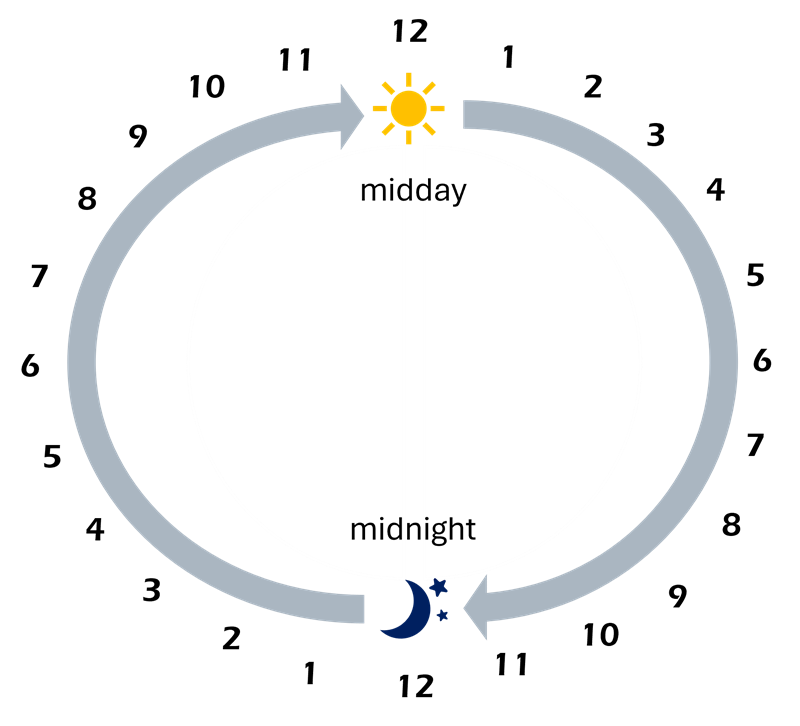
Analogue clock time
A standard analogue clock indicates the current time during a 12 hour period with ‘hands’ that move (clockwise) around a clockface. The small hand points to the hour (1 to 12), and the large (minute) hand indicates the number of minutes after that hour.
If the large hand points to 12, the time is 'on the hour' (0 minutes past). In this example the time is 3 o’clock.

3 o'clock
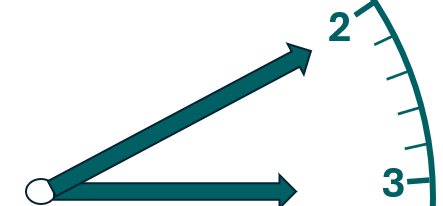
Each of the hour markers also represent a 5 minute interval (12 x 5 minutes = 60 minutes).
When the large hand is pointing to 2, for example, this indicates 10 minutes past the hour (2 x 5 = 10).

Ten minutes past 3
Some clocks also include markers for the minutes between the 5 minute intervals.
To or past the hour?
In the UK, the first 30 minutes of an hour are often stated as ‘past’ the hour, with the following minutes as ‘to’ the next hour.
For example,
35 minutes past 4 (4:35) may be given as 25 minutes to 5.
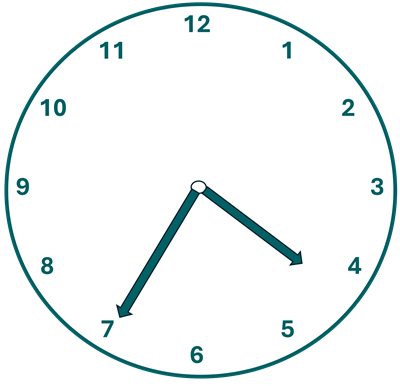
Twenty five minutes to 5
Time check
Using this convention, how would you say 2:40?
The time would be 20 minutes to 3.

Twenty minutes to 3
Morning, afternoon or evening?
To ensure clarity when using the 12-hour clock, we also need to know if the hour shown is during the 12 hour period:
- before midday, for example 3 o’clock in the morning or
- after midday, for example 3 o'clock in the afternoon.
We can do this using the suffix:
- am (from the Latin ante meridiem, before midday) or
- pm (post meridiem, after midday).
So
- 3 am for 3 in the morning
- 3 pm for 3 in the afternoon.
12am or 12pm?
Although midday is sometimes referred to as 12pm, and midnight as 12am, technically this is not quite right (am = 'before midday', pm = 'after midday'). To avoid any confusion, it is safer to simply say 'midday' and 'midnight' for these hours.
3.1. Analogue clock markers
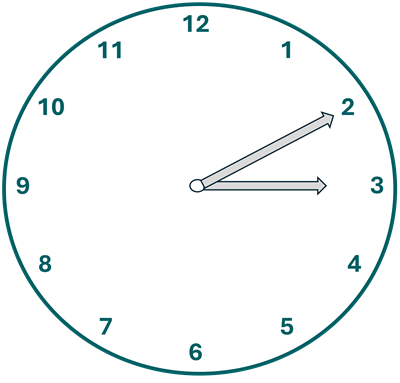
The hour markers on an analogue clock are usually displayed using the numbers from 1 to 12, or the equivalent Roman numerals.
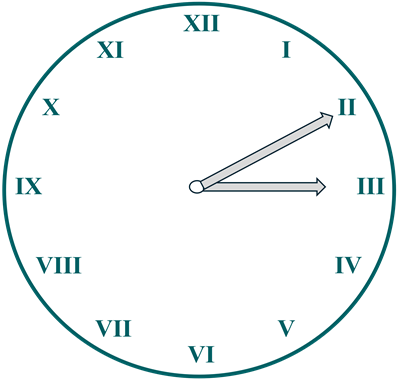
| 1 | 2 | 3 | 4 | 5 | 6 | 7 | 8 | 9 | 10 | 11 | 12 |
|---|---|---|---|---|---|---|---|---|---|---|---|
| I | II | III | IV | V | VI | VII | VIII | IX | X | VI | XII |
Smaller timepieces, such as a wristwatch, may simply display markers for each of the 12 hours.
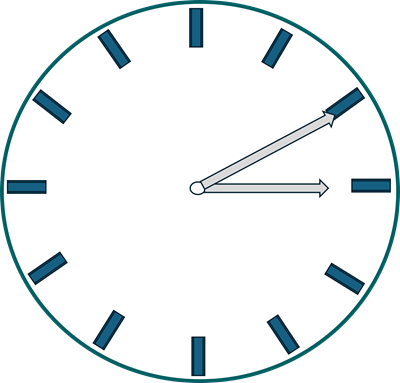
To tell the time where there are only markers, you need to remember the position of the hours. For example, 12 is always at the top of the dial and 6 is always directly opposite at the bottom.
4. 24-hour clock time
The 24-hour clock system uses all 24 hours in the day to accurately display the time. It is not necessary to clarify whether the time stated applies to the morning, or afternoon, as this is clear from the hour shown.

Digital clock time
Whereas an analogue clock uses pointing hands which move around the clock face to indicate the current time, a digital clock displays the exact time.
The standard display of 24-hour time on a digital clock uses four digits, two either side of a colon. The first two digits display the hour (from 00 to 23*) followed by the number of minutes (from 00 to 59) past that hour.
- 00:00 to 12:00 are the (am) hours from midnight to midday/noon.
- 13:00 to 23:00 are the hours from 1pm to 11pm.
*When the time reaches midnight, rather than displaying 24:00, the clock resets to 00:00, indicating the start of a new day.

15:00 (3 pm)
Some digital clocks also display seconds, using an additional colon and a further two digits.
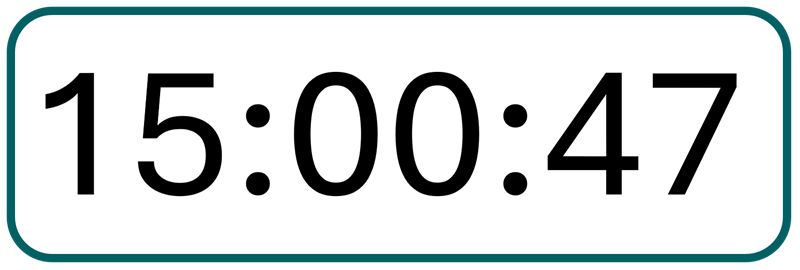
15:00:47 (47 seconds past 3 pm)
Stating the time
Digital (24-hour) time is spoken by stating the hour followed by the number of minutes, and the suffix ‘hrs’ (for hours) is often included.
For example:
- 19:20 (“nineteen twenty hours”)
Time on the hour (when there are two zeros in the minutes spaces) is usually spoken with the hour followed by ‘hundred’ or ‘hundred hours’.
For example:
- 15:00 (“fifteen hundred" or “fifteen hundred hours”)
5. Converting between 12-hour and 24-hour time
The first 12 hours are the same in both systems, just written differently:
8 am = 08:00
12-hour to 24-hour time
Add 12 to afternoon (pm) hours:
3 pm = 3 +12 = 15:00 hrs
24-hour to 12-hour time:
Subtract 12 from hours greater than 12.
13:00 hrs = 13 – 12 = 1 pm
Time check
Using 24-hour time, how would you write 7 minutes past 10 in the evening?
22:07 hrs (10 + 12 = 22).
How would you say 16:45 hrs, using the 12-hour clock system?
16 is greater than 12, so 16-12 = 4, so the time is 4.45 pm, or quarter to 5 in the afternoon (when the minute hand points at 9, there are 15 minutes, or quarter of an hour, until the next hour).
6. Calculating and recording duration
Duration: How long something takes; an amount of time.
Calculating what time it will be after a given duration
To calculate what time it will be after a certain number of minutes have passed, it can be helpful to visualise (or actually look at) an analogue clock face.
Each of the time markers around the clock represent 5 minutes of time, so if you count (clockwise, to the right) around the markers, using multiples of 5 (5, 10, 15, 20, 25, 30...), until you get to the duration required, the marker at which you stop indicates what the time will be.
Let's look at some examples.
You put a tray of biscuits into the oven at 5 past 9, which need to bake for 20 minutes. What time will they be ready?
From the start time, where the minute hand is pointing to 1 (the 5 minutes marker), count the markers which follow: 5, 10, 15, 20, which takes you to 5 (the 25 minutes past marker), which tells us the biscuits will be ready at 25 past nine (09:25).
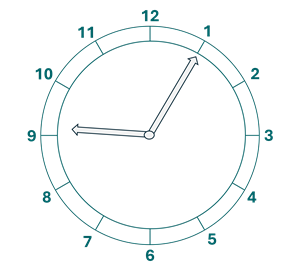
09:05

09:25 (20 minutes later)
This time, the start time is 09:35, or 25 minutes to 10 in the morning, and the bake time is 45 minutes. There are only 25 minutes left in the hour, so this duration will take us past 10 am.
From the start time marker (where the minute hand is pointing to 7), counting around the time markers which follow, (5, 10, 15, 20, 25, 30, 35, 40, 45) takes us to the 4 (20 past) marker. Remembering we have gone over the hour, the stop time will be 20 past 10 (10:20).
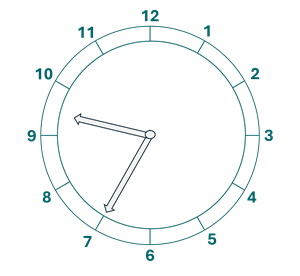
09:35
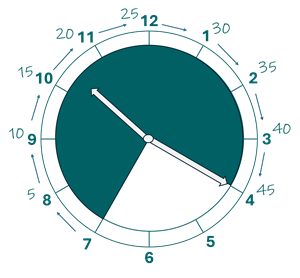
10:20 (45 minutes later)
Alternatively, knowing that the start time is 25 minutes from the next hour (which in this case would be 10 am) you can simply subtract 25 from the duration (45 minutes) which will tell you how many minutes past 10 this will be: 45 - 25 = 20, which means the stop time will be 20 past 10 (10:20).
A duration of half an hour (30 minutes) moves the minute hand to the time marker directly opposite the starting point, so no counting required!
09:05 (The minute hand is pointing to 1)
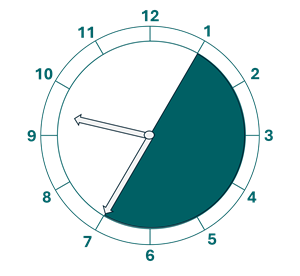
09:35 (Half an hour later, the minute hand is pointing to 7, directly opposite )
You can count hours around the clock in the same way, with each of the time markers representing 1 hour of time.
Calculating the duration between a start and stop time
Count the number of full hours between the start and stop time, and add any minutes either side.
You may find it easier to use the 24-hour clock, particularly if start and stop times are either side of mid-day.
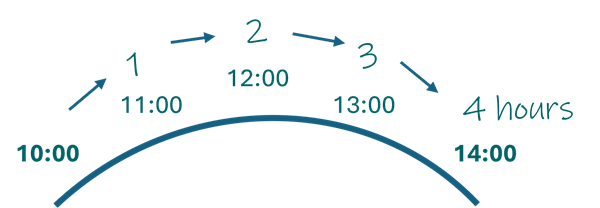
For example, to check the duration of a train journey, departing 10:00 and arriving at 14:00, count the number of hours on from the departure time to the arrival time:
(10:00): 11:00, 12:00, 13:00, 14:00 (4 hours).
Click the headings below to view some examples.
The first bus to Aberdeen departs at 06:00 and is scheduled to arrive at 09:00. How long should the journey take?
Both times are on the hour, so you can either:
- count the number of hours from 6 to the stop time: 7, 8, 9 (3 hours), or
- subtract the start time from the stop time: 9 - 6 = 3 hours.
Total journey time: 3 hours.
You plan to catch the 09:15 train to Glasgow, which is scheduled to arrive at 13:30. How long should the journey take?
Both start and stop time include minutes past the hour. The minutes past the stop time hour are greater than those at the start time hour.
Calculate the difference between the full start time (including the minutes past the hour) and the same number of minutes past the stop time hour, then add the remaining minutes:
- Hours: 9:15 to 13:15 is 4 hours (13 - 9 = 4, or count from 9: 10, 11, 12, 13 (4 hours).
- Minutes: 13:15 to 13:30 = 15 minutes.
Total journey time: 4 hours and 15 minutes.
The 11:45 train from Edinburgh to London is scheduled to arrive at 17:20. How long should the journey take?
Calculate the duration between the nearest hour(s) and then add the remaining minutes:
The start time is 15 minutes before the next hour (12:00) and there are 20 minutes after the stop time hour.
- Hours: 12:00 to 17:00 is 5 hours (17 - 12 = 5, or count from 12: 13, 14, 15, 16, 17 (5 hours).
- Minutes: 11:45 to 12:00 = 15 minutes, and 17:00 to 17:20 = 20 minutes. 15 + 20 = 35 minutes
Total journey time: 5 hours and 35 minutes.
Time check
Your usual journey to visit friends takes an hour and a half. If you set off at 10 past 3 in the afternoon, what time should you arrive?
An hour on from 10 past 3 is 10 past 4. Add half an hour (30 minutes) to this which will take the time to 4:40 pm (20 minutes to 5 in the afternoon).
You have booked a seat on the 07:50 train from Inverness to Newcastle, which is scheduled to arrive at 13:10. How long should the journey take?
Count the hours from the start time (07:50) to the nearest hour (and minutes) before the stop time and add on the remaining minutes:
- Hours: 07:50 to 12:50 is 5 hours (12 - 7 = 5, or count from 7: 8, 9, 10, 11, 12 (5 hours).
- Minutes: 12:50 to 13:10 = 20 minutes.
Total journey time: 5 hours and 20 minutes.
7. Greenwich Mean Time (GMT)
Until the introduction of standardised time, local time, which was determined by the position of the sun in the sky, and with the aid of a sundial, varied from town to town and region to region across the UK.
The need for a standard time across the nation quickly became apparent with the arrival of the railways, in order to accurately schedule services transporting goods, and passengers, over long distances.
First introduced in 1840 by the Great Western Railway, Railway time was gradually adopted by all UK railway companies, with schedules organised, and station clocks aligned to London time - Greenwich Mean Time (GMT) - which was set at the Royal Observatory in Greenwich.
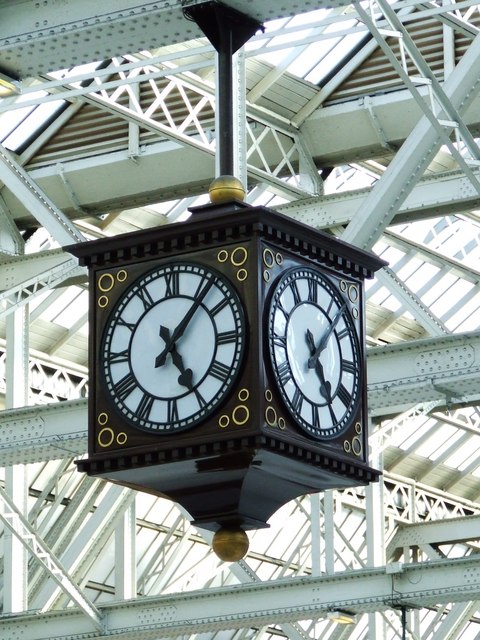
Glasgow Central Railway Station clock
Thomas Nugent @ Geograph / cc-by-sa/2.0
Forty years later, the Statutes (Definition of Time) Act 1880 formally defined GMT as the legal standard of time for Great Britain.
British Summer Time (BST) / Daylight Saving Time (DST)
In the UK, between the last Sunday in March and the last Sunday in October, clocks are set one hour ahead of Greenwich Mean Time (GMT) to provide an extra hour of daylight towards the end of each day.
Known as British Summer Time (BST), this practice is also in use in other countries around the world, where it is commonly referred to as Daylight Saving Time (DST).
8. Time zones and UTC
As the earth rotates on its axis, different parts of the world are gradually exposed to the sun, bringing daylight, as others move into darkness. Over a 24 hour period, the local time of day varies around the globe as a result.
To account for these time differences, the globe has been divided into 24 time zones using imaginary lines called meridians, which run between the North and South Poles.
Most countries adopt a single time zone, even when they partially cross another meridian, however larger countries, such as the USA, must operate within a number of time zones.
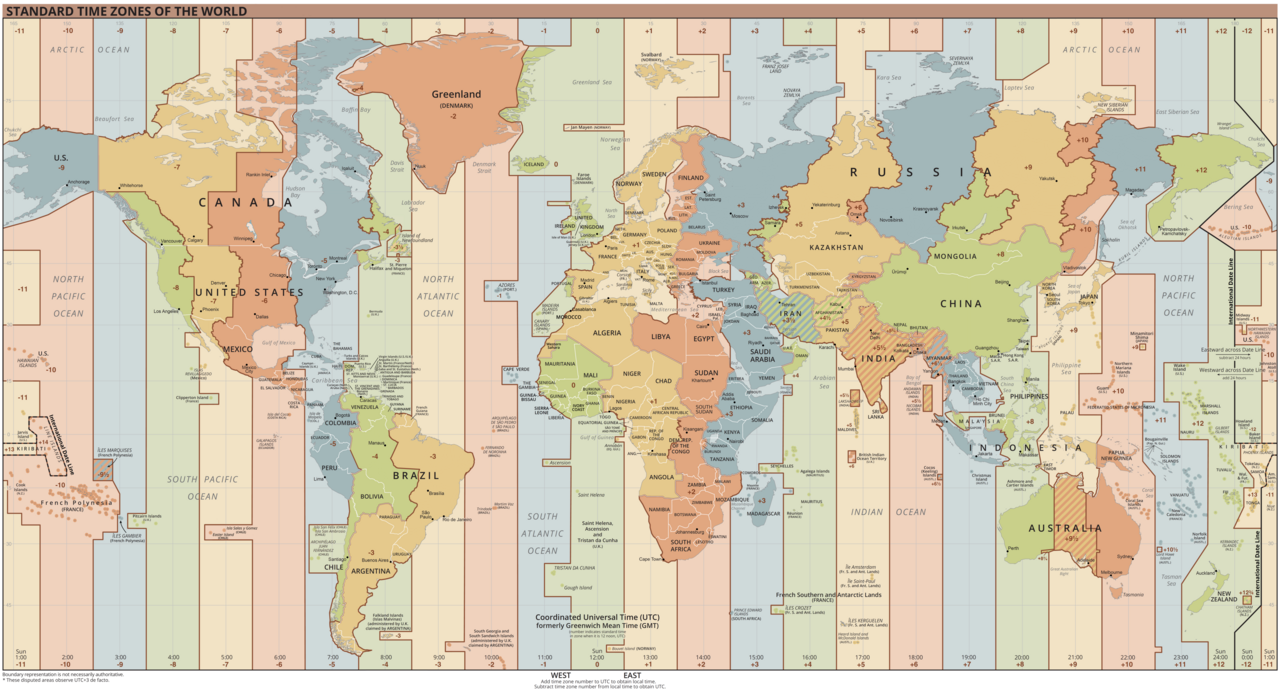
World time zones map
Wikimedia / Public domain
The Prime Meridian
The Prime Meridian (° degrees longitude) runs through Greenwich in London.
Travelling from the Prime Meridian to the
- East, across Europe and beyond, local time is ahead of that in the UK.
- West, towards the Americas and beyond, local time is behind that in the UK.
UTC
Coordinated Universal Time, or Universal Time Coordinated (UTC), is the recognised world-wide standard for measuring clock time.
UTC+0 is the time zone at the Prime Meridian, with time in other time zones being either ahead (UTC+) or behind (UTC-).
For example, if the time in GMT/UTC-0 is 12:00 (midday), then the time in:
- UTC+2 is 2 hours ahead (14:00), and
- UTC-3 (09:00) is 4 hours behind UTC+1 (13:00).

At midday (12:00) GMT/UTC-0, the time in UTC+1 is an hour ahead (13:00), and in UTC-1 is an hour behind (11:00).
Time zone names and abbreviations
As is the custom in the UK, where we refer to Greenwich Mean Time, or GMT, other time zones around the world are also referred to by localised names and abbreviations, for example:
- UTC+1: Central European Time (CET), West Africa Time (WAT)
- UTC+9: Japan Standard Time (JST), Korea Standard Time (KST)
- UTC-5: Eastern Standard Time (EST), Columbia Time (COT).
Time check
A flight from London is scheduled to depart at 10:00 and arrive in Tokyo the following day at 07:00 local time.
The local time in Tokyo is 9 hours ahead (UTC+9) of that in London (UTC+0).
What is the expected duration of this flight?
Subtract 9 hours from the Tokyo (UTC+9) arrival time to convert it to (UTC+0) London time which is 22:00 in the evening of the departure date.
The duration is the difference between these (UTC+0) departure and arrival times i.e. 12 hours.
A flight departing Phoenix (MST, UTC-7) at 13:30 arrives in Honolulu (HST, UTC-10) 7 hours later.
What is the local arrival time in Honolulu?
The flight arrives in Honolulu at 17:30 local time.
The arrival time according to Pheonix time is 20:30 (13:30 + 7 hours). Honolulu is 3 hours behind Pheonix, so this brings the local arrival time in Honolulu to 17:30 (20:30 - 3 hours).
The International Dateline
Halfway around the world, 180° east or west from the Prime Meridian, is another imaginary line called the International Date Line (IDL), which defines the boundary between one day and the next.
Crossing the IDL while travelling
- East, you subtract a day,
- West, you add a day.