3.7 University and College Choices

Site: OpenLearn Create
Course: College and Career Readiness (For Myanmar Youth)
Book: 3.7 University and College Choices
Printed by: Guest user
Date: Thursday, 26 November 2026, 1:08 AM

1. How Do You Choose? (Pg 1/3)

Navigation Tips
Click the arrow, top left, to go to the previous page
Click the arrow, top right, to go to the next page 

Choosing a University or College

Earlier in this section, you explored different modes of study such as online, blended, and in-person learning and learned that education can follow many pathways, not just a single route.

🌏 Context: External Realities

For learners from Myanmar and other developing countries, choosing a university or college is often shaped by external realities, not just personal interest. These may include travel restrictions, visa requirements, financial limitations, language readiness, political conditions, and family responsibilities.

Because of this, choosing where to study is not only about which university sounds best, but also about:

💻
How you can study (online, hybrid, part-time, or full-time)
🛣️
What pathways are available (starting with a certificate or diploma and progressing to a degree or master’s)
🚀
What opportunities this choice creates (work experience, further study, or returning home with recognised skills)
⚖️ Balancing Ambition with Practicality   (Click to expand)+

In many cases, learners from Myanmar need to balance ambition with practicality. A highly ranked university may not always be the best option if costs, visas, or living conditions make it difficult to complete the programme successfully. Sometimes, a smaller or less well-known institution with strong support, flexible pathways, or scholarships can lead to better long-term outcomes.

Why Informed Decisions Matter

This is why making an informed decision matters. A university or college that suits one learner may not suit another, depending on individual goals, financial situation, mode of study, and plans after graduation.

Coming Up Next

On the next screen, we will explore common questions students have when choosing a university or college through a short visual story. These examples are designed to help you reflect on your own situation, consider realistic options, and think more clearly about what matters most for your future.


2. Making Informed Decisions with University and College Choices (Pg 2/3)

Navigation Tips
Click the link below the image to view it in full screen
Click your browser's back button, top left, to exit full screen

Choosing the right university or college is one of the most important decisions in your academic journey. The right choice can help you achieve your career goals, enjoy your learning experience, and make the most of your time abroad.

When selecting a university or college, consider the following key factors
Download this pdf for to learn about the key factors you might want to consider when selection a university or college


Download & Return
After clicking the Download button, click your browser's back button to return to the course.

DOWNLOAD
Making Informed Decisions PDF
 

3. Generalist vs Specialist Degrees (Pg 3/3)

Navigation Tips
Click the arrow, top left, to go to the previous page
Click the arrow, top right, to go to the next page
Click the link below the image to view it in full screen
Click your browser's back button, top left, to exit full screen

General Degrees vs Specialist Degrees

Undergraduate Level Comparison

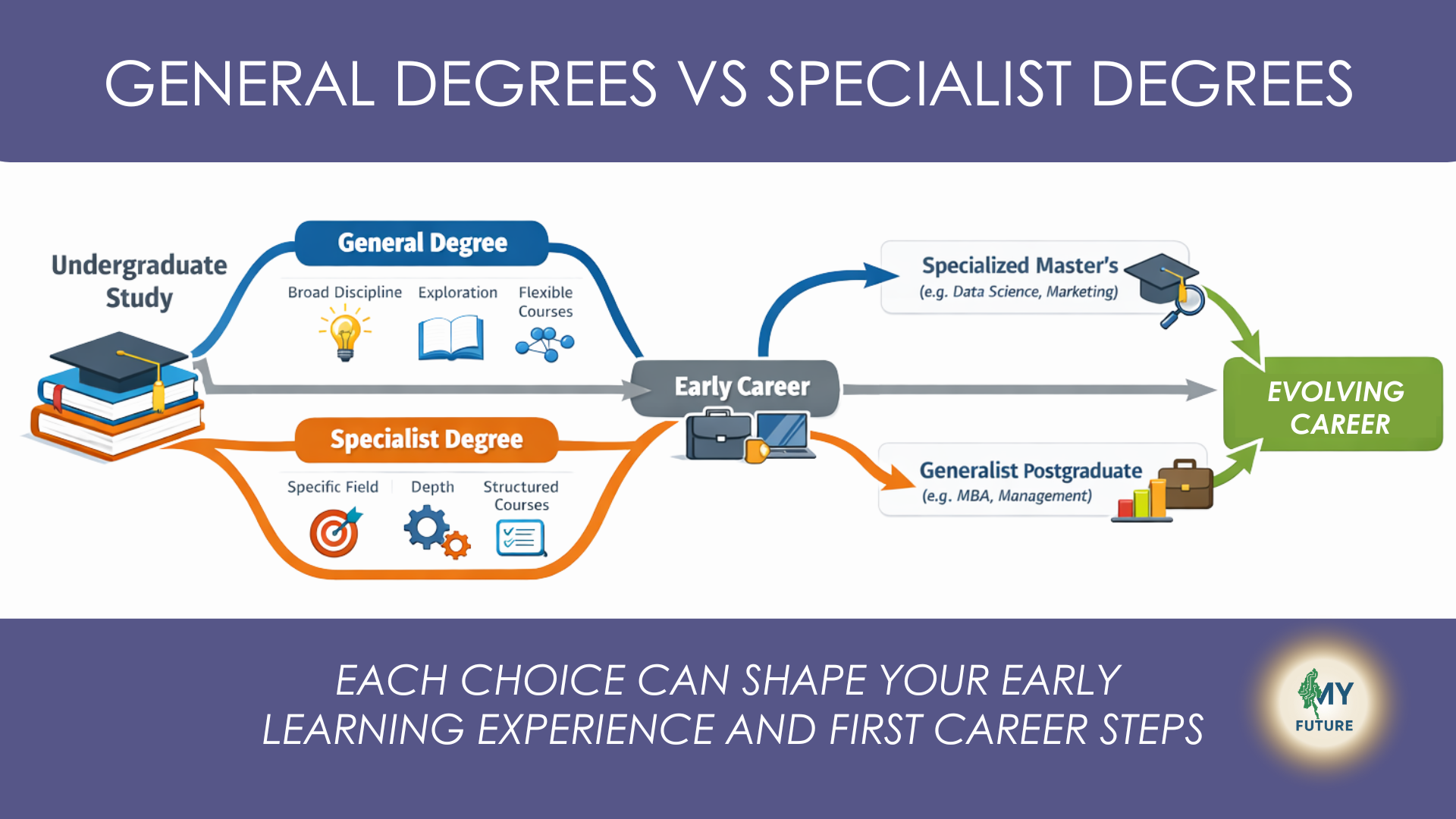
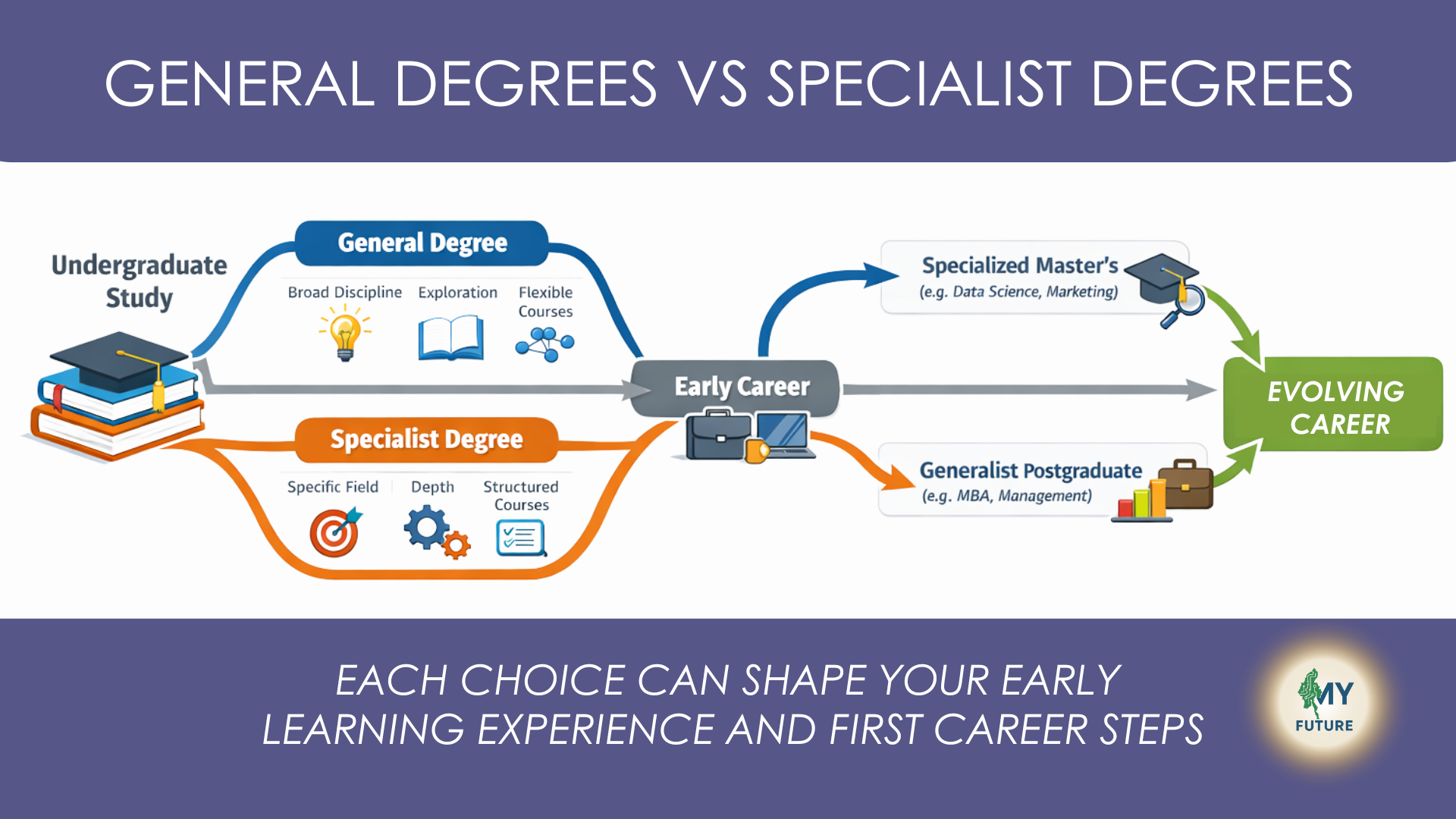
At the undergraduate level, universities offer degrees that differ mainly in how broad or narrow the field of study is. These are commonly described as general degrees and specialist degrees. The difference is not about quality, but about scope, focus, and how specialization happens over time.

(Click on the titles below to expand)
🌐 General Degrees

General degrees focus on the full scope of a discipline. In the early years, students are introduced to a wide range of topics that make up the field. For example, a general degree such as Business Management, Computer Science, or Design exposes students to many areas within the discipline, rather than focusing on one specialization immediately.

In a general business degree, students may study marketing, finance, management, operations, and entrepreneurship. In a general computer science degree, students may learn programming, data structures, systems, databases, and software development. In a general design degree, students may explore visual design, user experience, theory, and creative tools.

Specialization in general degrees usually happens later, often through elective courses, majors, minors, or concentrations chosen in the second or third year. This structure allows students to explore the discipline broadly before deciding where to focus.

🔬 Specialist Degrees

Specialist degrees are more narrowly focused and aim to build expertise in a specific area of a discipline. While the first year may still include general foundational subjects, the program moves into specialization much earlier and more intensively.

For example, instead of studying a broad business degree, students may enrol in a specialist degree such as Marketing, Finance, or Human Resource Management. Instead of studying a broad Computer Science degree, students may enrol in a specialist degree or track such as Software Engineering, Data Science, Cybersecurity, or Systems Engineering.

As students progress, most courses are mandatory or closely aligned with the specialization, leaving less room for broad exploration. The goal is depth rather than breadth.

💡 Why it matters

The main difference between general and specialist degrees lies in how much flexibility students have and when specialization occurs. General degrees offer more flexibility in course selection and allow specialization later. Specialist degrees reduce flexibility but provide stronger focus and depth from an earlier stage.

General degrees suit students who want to understand a discipline broadly or keep their options open. Specialist degrees suit students who already know the area they want to focus on and prefer a more directed academic path.

Choosing a general or specialist degree matters because it shapes your early learning experience and first career steps. General degrees support exploration and broad skill development, while specialist degrees provide early focus and depth in a specific area. Over time, careers naturally evolve. Many graduates build on their undergraduate foundation by specialising further through postgraduate study, while others broaden their scope through management or generalist programs. What matters most is choosing the degree structure that best fits your goals at the start of your journey, knowing that learning and specialization continue throughout your career.

Click to view the image in full screen

Click here to go to the next page