Use 'Print preview' to check the number of pages and printer settings.
Print functionality varies between browsers.
Printable page generated Thursday, 24 September 2026, 9:13 AM
Session 7 Bringing it all together: safeguarding at events
7.1 Introduction

In this session, you will apply everything you have learned so far to explore safeguarding in the context of competitions.

Learning outcomes
In this session, you will:
Develop the basics of competition safeguarding, planning, and risk assessment |
Explore effective reporting and case management during international events. |
Let’s get started.
7.2 Competitions in context – the basics
Competing at local, national, and international level is what many athletes work so hard for.
Competitions that involve elite-level participants attract large numbers of spectators, and may involve significant travel and overnight stays for athletes, staff, and volunteers.
Large competitions may also involve children in roles such as volunteers, flag bearers, ball kids, and athlete escorts.
Safeguarding arrangements need to apply to everyone involved and be embedded from the very start.
 Activity: What basic measures should be in place BEFORE a competition?
Using all your learning to date, take a moment to think about the measures you would want to have in place BEFORE a competition takes place.
Comment
Here are a few we came up with – do they match your list?
- Include safeguarding in the complete life cycle of the competition.
- Identify someone to take an overall lead for safeguarding before, during, and after the competition.
- Engage with local safeguarding and protection services to ensure all plans line up with the local context.
- Consider everyone who may be impacted by the competition – athletes, volunteers, spectators, etc.
- Conduct a risk assessment for the competition and create a plan to mitigate each identified risk.
- Create a competition safeguarding plan.
- Develop or adapt safeguarding policies, procedures, and codes of conduct for the competition.
- Communicate, promote, and explain these requirements to all stakeholders.
- Ensure different ways for concerns to be reported are available and widely communicated.
- Prepare to respond to safeguarding concerns by developing clear processes.
- Create a training plan for all relevant stakeholders in the competition.
Let’s now consider a competition safeguarding plan in more detail.
7.3 A competition safeguarding plan
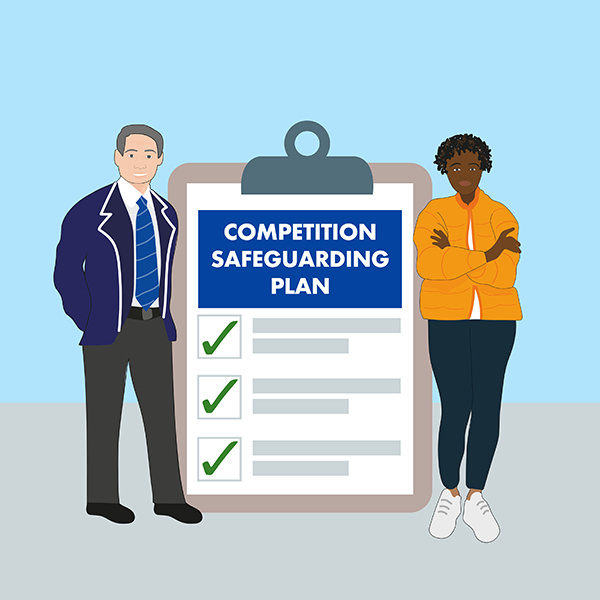
We recommend creating a specific safeguarding plan for each competition, which sets the minimum operating standards for everyone taking part.
The plan can be used as a template for future events.
 Activity: Patience describes developing her competition safeguarding plan

Listen to Patience’s account and develop a checklist based on her actions.
Transcript
Comment
Here’s our checklist – does it agree with yours?
- Identification of relevant local stakeholders and available resources.
- Safer recruitment, employment, and deployment of staff and volunteers.
- Codes of conduct.
- Risk assessment and mitigation plan.
- Reporting process supported by simple reporting forms.
- Agreed ratios of supervisors to children/young people.
- Missing persons process.
- Consents and medical information.
- Information for athletes, parents, staff, and volunteers.
You can download a Safeguarding Checklist for Smaller Activities and Events on the Safeguarding Resources site.
7.4 Large competitions: safeguarding structure, roles, and responsibilities

At large competitions there are lots of different stakeholders from different organisations, with different safeguarding responsibilities, and this can make safeguarding challenging.
To help address this, organisers should appoint a Competition Safeguarding Manager, who should create a network of individuals to implement safeguarding.
This will include people in different roles (venue or course managers, volunteer coordinators, discipline, safety and security, competition management, etc.) and also individuals from participating teams (in team-based competitions). They will all require an understanding of how safeguarding applies in practice.
In very large competitions with multiple venues, or for competition courses that cover a wide geographic area, a safeguarding focal point may even be needed in each location.
Activity: Different safeguarding roles at a large competition
Read each of the description and safeguarding responsibilites listed below. Use the drop-down menu next to each description to match it to the correct role for that description and responsibilities.
We have provided the first answer to help get you going.
Comment
Collaboration is essential for the delivery of a safe competition.
This network of individuals, with specific safeguarding roles and responsibilities, should be identified before the competition so they can receive information and/or training, and be easily identified during the event.
Now you explore pre-departure risk assessment, reporting, and case management in more detail through a case study.
7.5 An athlete’s competition experience

For many athletes, attending a large event and representing their region or country is a very special experience. Travelling, meeting other athletes, and experiencing different places and cultures, all offer valuable opportunities for athletes.
However, without undertaking risk assessments and putting adequate safeguarding arrangements in place, some of these same experiences may increase the risk of abuse.
Activity: Identify the safeguarding risks an athlete could face at a competition

Comment
It is useful to think about the possible experiences of young athletes like this.
It clearly shows the potential impact of poor practice, bullying, and abuse on vulnerable individuals, and helps to emphasise why safeguarding arrangements at events are so important, particularly when athletes are away from home.
7.6 How safeguarding concerns can be reported

Having a well-publicised system for reporting abuse is one of the essential parts of preparing for any competition.
When it is an international competition, there are even more considerations – such as making sure those taking part and the local organisers understand the system, reporting is available in different languages, and there are different ways for concerns to be shared. Offering the chance to report in more than one language, and identifying people who can act as translators can be challenging and will need resources.
The important thing is to think about different scenarios ahead of time, and work with those taking part in the event and local organisations, to create something that works.
There are some key aspects to consider about reporting processes at competitions.
Details about how to share a concern – in person, by phone, by email or online – should be easily accessible. Avenues for reporting concerns should include:
- Contacting local authorities and child/adult protection services directly if a concern is urgent or if someone is in imminent danger. This contact information must be clearly communicated and accessible to everyone.
- Approaching any member of the competition safeguarding staff or security team, who should know how to manage the concern.
- Speaking to the on-site Safeguarding Officers. Contact information and how they can be located must be clearly communicated to everyone.
- Contacting the competition organiser using their reporting tools, for example, an online safeguarding reporting mechanism, or completing simple reporting forms.
Part of the competition safeguarding plan should address how information about reporting safeguarding concerns can be shared with everyone.
Activity: Identify how to promote information about reporting to different stakeholders
Think about the following competition stakeholder groups and list the different opportunities organisers could use to communicate information about reporting.
| Stakeholder group | Ways to share information on concern reporting |
|---|---|
| Athletes | |
| Spectators | |
| Match officials | |
| Entourage members, for example, physios, doctors, chaperones, caddies, etc. | |
| Venue or course staff such as caterers, ground staff and volunteers |
Comment
| Stakeholder group | Ways to share information on concern reporting |
|---|---|
| Athletes |
|
| Spectators |
|
| Match officials |
|
| Entourage members, for example, physios, doctors, chaperones, caddies, etc. |
|
| Venue or course staff such as caterers, ground staff and volunteers |
|
You need to be imaginative when identifying ways to promote the competition reporting process – and to apply what you know about each stakeholder group in order to communicate to them effectively.
 |
Communication |
Communication in a range of languages (including sign language) and using visual images is more likely to be effective – for example, you can use QR codes to link to online information that can be translated. |
Now let’s think about what responding to concerns looks like for an international competition.
7.7 Responding to concerns

Reporting systems are only one part of the process. Competition organisers also need a system to respond effectively to safeguarding concerns.
This can be one of the most challenging parts of competition safeguarding – you may have a report concerning a victim from one country, an alleged abuser from a second country, all taking place in a third country. Or you may be made aware of an athlete experiencing abuse back in their home country, not directly connected to the event.
You need to do the work ahead of time to make sure cases don’t get passed from team to team, and that there is a clear system for dealing with concerns.
Activity: The five basic principles for responding to concerns during a competition
The headings for the five basic principles – Plan, Be consistent, Centralise, Seek expert input and Share information appropriately – are shown in the left-hand column below. For each heading, choose the correct explanation in the right-hand column. Use the arrow keys to scroll though the possible explanations and then click on Submit to see if you are correct or not.
Comment
Once concerns have been received and considered, there are several possible responses, depending on the seriousness of the concern.
Finally, we consider some tips about this topic.
Responding to concerns at competitions – three tips:
- The initial response should be about providing the potential victim(s) with the care and support they need. An initial assessment must be made of the seriousness of the concern reported. You might need someone neutral, not connected to the case, to act as an interpreter (including a sign-language interpreter for people who are hearing impaired). You may also need to contact the consular office of the person’s country of origin.
- In collaboration with other relevant teams, a decision must be made about whether an alleged perpetrator should be immediately removed from the competition or if other measures could reduce the risk, for example, restricting accreditation.
- Other responses will depend, for example, on whether the victim is a child or adult, a local citizen or an international visitor. With less serious issues, the initial decision may be for the matter to be passed back to the relevant stakeholder organisation (the visiting team, service provider, etc.) to take forward.
Ultimately, the most important thing is to set all your systems up well in advance so that everyone knows what to do once the competition is underway.
7.8 Summary of Session 7

|
| The main learning and messages from this session are: |
|
7.9 Course conclusion
Congratulations on completing Course 3!
You should now have a greater understanding of the role of the Safeguarding Lead and what you need to do to strengthen safeguarding in your own organisation.
 The Safeguarding in Sport series
Let’s hear again from Patience as she summarises everything you have learned from the three online courses in the Safeguarding in Sport series.
Transcript
7.10 Course quiz 2

Now it’s time to complete Course quiz 2 – it’s a great way to check your understanding of the course content so far.
This quiz contains 16 questions and a pass mark of 70% and above is required to obtain your digital badge and course certificate.
You can review the answers you gave, and which were correct/incorrect, after each attempt has been completed.
If you don’t pass the quiz at the first attempt, you are allowed as many attempts as you need to pass. There is a 24-hour delay between each attempt to allow you time to look back at the course content again.
To receive your course certificate and digital badge, you must have completed all the elements of the course and passed both quizzes.