Use 'Print preview' to check the number of pages and printer settings.
Print functionality varies between browsers.
Printable page generated Tuesday, 1 September 2026, 8:51 AM
Session 5: Identifying my next steps and where I can find information and support
Introduction

You have been looking at how to start working towards your goals, and how you can help yourself. You now have an idea of where you want to get to and what difficulties there might be. You also know what aspects of your life might help you. We all need some help in getting to where we want to be in life. Are there people you know who can also help you and support you – family members, friends, work colleagues, carers’ centre staff or others?
Listen to Alana describe the support she gets from the Young Adult Carers’ scheme at NEWCIS, her local carers’ centre.

Transcript
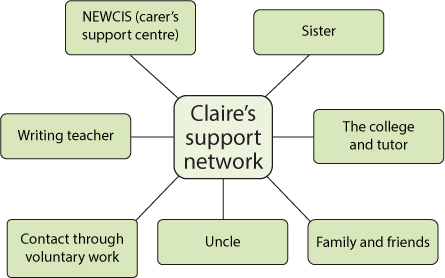
Look at the spider diagram in Figure 5.2, which shows Claire’s support network.
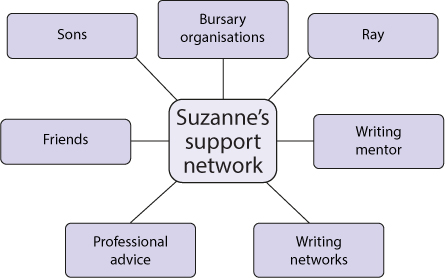
Now look at Suzanne’s support network.
Your support and next steps
- Did you find that you used some of the same skills as Claire, Suzanne or Alana?
- Did you discover that you have other skills, maybe some that you were not aware of?
- Are you now aware of qualities that you have but hadn’t considered before?
- Does your support network have any similarities to Claire, Alana or Suzanne’s?
Family and friends were mentioned but also organisations that could help them. In the next activity you will think about the people and organisations you think could help you towards achieving your goals.
Activity 5.1 My support networks
Think about the people who have helped you or who might help you in the future with any plans you have.
Now make a spider diagram like the one for Claire and Suzanne on Activity sheet 5.1 provided.
OR
Go to Activity 5.1 of your Reflection Log. Once you have completed the activity, make sure you save the document again.
You have nearly reached the end of this course. Activity 5.2 involves planning the next move towards your goals – you need to think carefully about where you are trying to get to.
There is a lot of information and advice available if you would like further guidance or support. You can visit Carers Trust or The Open University’s Careers Advisory Service.
You can also use the Find out more section at the end of the course for information links and contact details for further resources and support.
Activity 5.2 My long-term goal and first ‘next step’
Starting from now and where you are at the moment, think very carefully about what you need to do to get to where you want to be. Think back on the activities you have done, and what you have learned from:
- your past experiences (Activity 2.3)
- the skills, qualities and abilities you have (Activity 3.2)
- anything that will help you, as well as any difficulties you may need to overcome (Activities 4.3 and 4.4)
- any people that you know will be there to help you (Activity 5.1).
We’ve heard from Suzanne throughout the course – and here are the long-term goals and the first next steps Suzanne identified.
| My long-term goal |
|
| What am I going to do? |
| Spend time with Dad this summer and research options in USA |
| Where will I go for help and advice? |
|
| When will I do this? |
| This summer |
Use Activity sheet 5.2 to reflect on your long-term goal and the actions you will take to achieve it. Use this information to write a sentence starting: ‘The first step I am going to take ...’
OR
Go to Activity 5.2 in your Reflection Log. Once you have completed the activity, make sure you save the document again.
Review your table
To help you summarise what you have gained from your reflections, we’d like you to return to the table you created in Session 1.
Activity 5.3 Review my table

In the introduction to this course we said that ‘reflection is a way of working on what we know already and it generates new knowledge’. Revisiting the table you completed in Session 1 is a means to assess this process of reflection. If you saved a copy of the table, keep it handy as you will need it at the end of this activity.
Take another look at Alana’s table to remind you.
| How do I see myself now? | What makes me happy? |
|
|
| What am I most proud of? | How would I like to see myself in the future? |
|
|
As you did in Session 1, fill in the boxes in Activity 5.3.
OR
Go to Activity 5.3 of your Reflection Log. Once you have completed the activity, make sure you save the document again.
If you are working in a group and you would like to share your answers, when you have completed your table, compare it with the one that you completed in Session 1.
- Is it the same?
- Are there any changes?
It may be very similar or it may be quite different. Reflection is an on-going process that may not necessarily bring about immediate changes, but it may lead to subtle differences in our thinking about ourselves, our plans and our goals that will emerge over time.
Final activity
Your final activity is to summarise briefly what you have gained from this course.
Activity 5.4 What have I learned?

Here are the learning outcomes that we listed in this course’s introduction:
- a clearer understanding of your experiences as a carer and also in your wider roles
- an understanding of the various skills that you have developed as a carer and in your wider roles and how these are transferable to other situations
- an appreciation of personal qualities developed through your caring role
- a chance to think about your goals and aspirations for the future
- an idea of how you might work towards these goals and where you may get help and support
- the ability to use information technology (IT) to carry out reflective activities in writing and communicating
- the ability to use the internet to find information useful to you
- the ability to explore and use new ways of expressing ideas.
Make a note of the learning outcomes that you think you’ve achieved, either fully or partially. Also write down anything else you feel you have achieved that was not in them, such as making some new friends, learning that everybody has difficulties of some kind and so on.
You can use Activity sheet 5.4 to complete this activity.
OR
Go to Activity 5.4 of your Reflection Log. Once you have completed the activity, make sure you save the document again.
We hope you have enjoyed studying the course. We hope you have learned a little bit more about yourself: how much you can do and what you would like to do in the future. Everyone has strengths, qualities and abilities, and we sometimes need help in recognising and using these. We hope you will go on to achieve great things with your talents!
If you haven’t done so already you may want to look at the Find out more section at the end of the course. It has information links and contact details for further resources and support including carers support services, careers, education and training.
Further Welsh medium courses and qualifications can be found on our Take your learning further web page.
Tell us what you thought of the course and claim your certificate of completion here.
Acknowledgements
What about me? was developed by Carers Trust Wales and OU in Wales. It is based on and adapted from content developed by Lindsay Hewitt and Christine McConnell of The Open University in Scotland in collaboration with Bridges Programmes.
We are hugely grateful to the carers and staff from North East Wales Carers Information Service (NEWCIS) for sharing their stories and testing out the course activities. We hope you find something in their experiences that speaks to you as well.
Except for third party materials and otherwise stated (see terms and conditions), this content is made available under a Creative Commons Attribution-NonCommercial-ShareAlike 4.0 Licence.
The material acknowledged below is Proprietary and used under licence (not subject to Creative Commons Licence). Grateful acknowledgement is made to the following sources for permission to reproduce material in this course:
Images
Figure 5.1: © Christopher Futcher/iStockphoto.com
Figure 5.2: © The Open University
Figure 5.3: © The Open University
Figure 5.4: © Moncherie/iStockphoto.com
Figure 5.5: © Gwetterkind/iStockphoto.com
Video/audio: © The Open University
Every effort has been made to contact copyright owners. If any have been inadvertently overlooked, the publishers will be pleased to make the necessary arrangements at the first opportunity.
Click the link above for further information on:
– further study in Welsh related to this subject
– related study content from The Open University
– this topic and free course materials on OpenLearn
– studying from outside the UK? We have students in over a hundred countries studying online qualifications.
Next: Find out more