Week 6: Understanding and using academic style
Use 'Print preview' to check the number of pages and printer settings.
Print functionality varies between browsers.
Printable page generated Thursday, 24 September 2026, 5:10 AM
Week 6: Understanding and using academic style
Introduction
Style is the way people express themselves when communicating with other people. They do this through body language, choice of clothes, the tone of their voice and through images, music and language.
The way people express themselves depends on their personality, but their stylistic choices are also constrained by each specific situation in which they communicate.
This week you will look at the ways in which people adapt style to fit different everyday contexts and then focus on academic style. Academic style is the way in which language can be used to communicate in writing and to be understood in a university context.
Transcript
Welcome to Week 6.
This week you will look at academic style. This is the way in which you express yourself in speaking and writing. Some of the features of academic style are already familiar to you. For example, in previous weeks you learned that academic texts are clearly organised and follow a standard pattern. Ideas are clearly expressed and it is important to acknowledge your sources.
This week you look at more features of academic style, their use of vocabulary and grammatical structures that allow writers to express themselves more formally but also more clearly and concisely.
By the end of this week you will:
- recognise that different styles are appropriate to different situations
- recognise the different styles used by university texts
- begin to use a formal academic style.
1 Different situations call for different styles
In everyday life we are likely to communicate with different people in different situations. It is therefore quite natural to adapt our style of communication so that it is appropriate to these situations.
In this section you will look at the way in which people adapt their speaking and writing style in everyday life and consider the technical language they sometimes use.
1.1 Everyday talk
At home we might talk with our family and friends, at work with colleagues, customers and business partners, and in other environments, such as the bar, restaurant or club, with acquaintances and friends. We are likely to behave and speak differently depending on the context in which we communicate with other people.
In the next activity you will consider the different ways in which people adapt the way they talk with other people to fit different situations.
Activity 1
The pictures below show different contexts where communication happens between people. Consider the likely behaviour and the language used by the people who are involved. Write your thoughts about this in the boxes below, then compare them to mine.
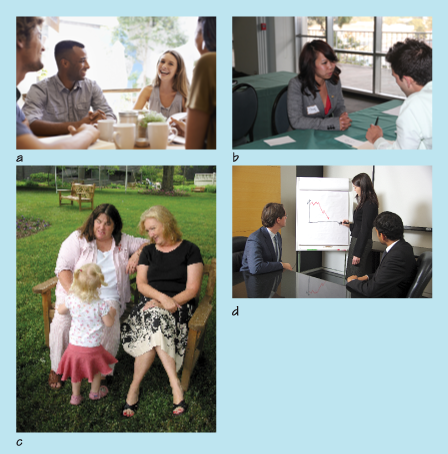
Figure 1a
Answer
a. This picture shows some friends having a drink at a coffee shop. This is an informal situation as can be seen by their relaxed attitude and casual clothes. Their conversation will be spontaneous and may include laughter, jokes and informal language.
Figure 1b
Answer
b. This picture illustrates a job interview. Both participants will typically wear a business suit and behave formally. The conversation will also be more formal. The person being interviewed may have prepared their answers and will carefully choose the language they use, perhaps selecting technical and formal terms to impress the interviewer.
Figure 1c
Answer
c. In this picture, two adults talk with a child at the park. Both adults will probably use simple familiar words and phrases and speak slowly to be understood by the child. They may also change their tone of voice to sound more friendly
Figure 1d
Answer
d. The presenter in this picture is probably addressing a group of colleagues or business partners. The situation calls for formal behaviour and the use of formal language and technical terms. The speaker is likely to have prepared their talk in advance and, to help colleagues follow, they would present a clearly structured talk, supported by diagrams and data.
Comment
This activity shows that the context in which communication takes place affects people’s chosen style. In other words, the physical context, the people and their reasons for talking affect the kind of behaviour and language they choose to adopt. Different behaviour and language could be adopted but would be considered inappropriate. For example the kind of spontaneous, very informal language and tone used between friends at a coffee shop would be inappropriate during a job interview or when talking with a child.
1.2 Written styles in everyday life
The style adopted in everyday written communication can vary too. You can probably think of times when you have chosen a different style to take into account who you were writing to and your reason for writing. This will have had an effect on the layout, formality and structure of your text as well as on your choice of vocabulary.
For example, a business email will be more formally organised and written than an email to a friend, and a text message may be very informally written, contain symbols and even grammatical errors.
Similarly, different newspapers may follow a different style depending on the readers they are addressing.
Activity 2
Compare the different styles adopted by the UK newspapers The Guardian and The Sun to cover the topic of immigration. These are some of the things you could consider:
- layout
- size of text
- use of images
- use of colour
- amount of text
- the headlines.
Make some notes in the box below before comparing your answer to mine.

Answer
The Sun uses large fonts and images and vivid colours to illustrate the point made by the headlines. The amount of text is limited. The headline talks directly to the readers in ‘you tell him’, and uses colloquial speech with language such as ‘or else!’ and
The Guardian uses smaller fonts and fewer images. The news on immigration is not illustrated and colour is not used. The front page contains a large amount of text arranged on several columns. The headlines simply report information using more formal language such as ‘condemn’ and ‘immigration law’.
The two newspapers use different styles because they address readers who have different requirements. The Sun’s readers look for a light read, stories and language that relate to their everyday lives. The Sun fulfils these requirements through their distinctive use of fonts, colour, images and language. In contrast, The Guardian’s readers want to gain a deeper understanding of a range of stories and prefer a newspaper that provides a great deal of information presented in paragraphs.
1.3 Use of specialist words in everyday life
A key part of any writing style is choice of vocabulary. It is common to use specialist vocabulary in the workplace when it is necessary to describe specific situations and objects. The same applies when people talk about shared hobbies and interests and often use a great deal of specialist language.
If you have a hobby or special interest, you may regularly use specialist words that may only be understood by people who share your interest. For example, I have recently read a sports magazine that refers to football players using specialist terms I do not fully understand, such as midfielder, sweeper and winger.
Activity 3
Do you have a hobby or an interest that you discuss with other people using specialist or technical language? Do you ever read a specialist magazine or website about your hobby or talk about it with other people? Think of some examples of words or phrases you might use.Write some notes in the box below and then compare your answers to mine.
Answer
The answer is personal to you, but you might like to read my example. I have recently come across some written instructions my daughter has used to knit a scarf.

While I consider these very complex instructions, my daughter seems to have no problem following them despite having only recently learned to knit. She uses some of this language when talking about her knitting with friends who have the same hobby and have helped her to get started.
Specialist language, symbols and language structures are often used by groups of people who have a common interest and purpose for communicating. This common language allows them to understand each other when referring to topics that are very specific to their field or their interests. While it may be difficult to start with, those who are new to the field are gradually introduced to this style by more expert friends and colleagues.
2 Academic style
As you have seen in the previous section, the style used depends on the topic being dealt with and the situation in which communication is taking place. In familiar situations, it is much easier to use the most appropriate style, but speaking or writing in new contexts, or about a new topic, or with different people, makes greater demands on communication skills and may make it necessary to learn different ways to communicate.
If you decide to study for a university degree, you will become a member of the community that studies your chosen subject. As such, you will be helped by the study materials and your tutor to gradually learn to understand and use the specific style that is followed by members of this community.
This consists in learning to understand and write texts that follow a very specific structure. You would also learn to use specific grammatical structures and the academic and the specialised vocabulary of the field.
In this section you will look at some formal and less formal university texts.
2.1 Distinguishing between formal and informal texts
You will now read and compare three business studies texts. This comparison will allow you to identify some of the characteristics of formal and informal university texts.
Activity 4
Skim read Texts 1, 2 and 3. You should just get the gist of these texts and look at their style, so it is not necessary to understand every word or understand their content in any depth. When you have finished, complete the tasks that follow.
Text 1
The cause of (dis)satisfaction for an individual at work may be the result of one or many factors. It is likely that our satisfaction within work is both implicit (inside ourselves and difficult to articulate) and relative to our circumstances at any particular time; it is also likely to be affected by our previous jobs. We are likely to enjoy some aspects of our work but not others. There is no one theory that can explain job satisfaction, but there are some models and frameworks that can help us think about it. This is difficult for those individuals (managers and HRM people) who are responsible for both the productivity and the psychological well-being of people within a business.
Text 2
Studies in organizational behavior support the position that organizational structure affects performance, employee satisfaction, and job related stress. Kerr et al. (1974) observed that rule oriented structure adversely affects employee satisfaction but improves productivity. In general, it has been observed that high autonomy and broad
job scope are directly related to employees’ intrinsic job satisfaction (Fleishman, 1973; House, 1971; Hunt and Liebscher, 1973). Contradicting the mainstream trend in literature, Zeist (1983) reported a greater degree of job satisfaction in more highly structured roles since role clarity reduced anxiety and served as a basis for reward seeking activities. The size of the organization is also a factor in determining employee satisfaction. Porter and Lawler (1964) observed that although satisfaction is greater in relatively flat organizations with 5,000 or fewer employees, satisfaction was also found to be greater in large organizations with more than 5,000 employees and many hierarchical levels. Senatra (1980) observed significant relationships between organizational climate, role perceptions, job related tension, satisfaction, and propensity to leave.
Text 3
I started this job a year ago. There are very strict rules and I can’t make any decisions. I like to do my job well and come up with lots of ideas but my boss only cares to check how well or badly I do routine jobs.
He doesn’t care about anything other than me doing my work fast and on demand, but I would really like to make my own decisions and get involved in different tasks and in different departments. I think that there are more opportunities and staff should be more satisfied in big companies like ours. But at the end of the day, because of the way I am managed, I don’t really enjoy what I do at work.
I have noticed that there isn’t much to be learnt from the environment I am working in. More often than not I’m nervous about failing my tasks and everything that goes on at the office and so, like many others in this department, I’m frustrated with my surroundings.
So it’s obvious that many of us want to quit.
Task 1
Decide which of the three texts is:
- a.an informal
reflection - b.a formal paragraph taken from first year Open University (OU) teaching materials
- c.a very formal journal article.
Answer
(Task 1)
a.Text 3. This is an informal text in which a student reflects on their personal experiences at work. The student might have posted it in an
online forum as part of a discussion with fellow students.b.Text 1. This is a more formal text taken from Open University Business Studies teaching materials.
c.Text 2. This is a very formal text taken from a specialist journal article. Students may study this type of text if they conduct independent research at the end of their second or third year.
Task 2
What features of each text helped you decide which texts were more formal than others? For example, look at the way they are organised and which kind of words they use.
Write some notes in the box below before comparing your answer to mine.
Answer
(Task 2)
In Text 3, the student discusses their own personal experiences and feelings. For this reason, ‘I’ is used throughout. The language used includes idioms, such as ‘at the end of the day’, and familiar expressions such as ‘big companies’ and ‘my boss’. This text is informally organised as it contains several short paragraphs, each dealing with several issues. Sentences are only sometimes linked using informal linking words such as ‘but’ and ‘so’.
Text 1 is written by an OU academic writer who aims to teach students through a written text. The author uses informal words such as ‘we’ as they are talking to the students, as well as more formal terms such as ‘factors’, ‘implicit’ and ‘psychological’. The definition of ‘implicit’ is provided in brackets to help the students understand. The text is presented as a paragraph that starts with an effective topic sentence and ideas are clearly linked.
Text 2 is a very formal text written by a researcher who writes for those who study or are doing research on the topic. The text reports information from research and contains a great deal of formal and specialist language. Specialist language includes ‘rule oriented structure’ and ‘job related tension’. The text starts with a clear topic sentence, which is followed by sentences that illustrate its main point.
Comment
The style of university texts may vary depending on their authors, the purpose for writing and the intended readers. Students’ writing can not only take the form of informal reflections shared in informal forum discussions but also very formally organised texts. The style of Open University study materials is formal but, particularly in the first year, the technical words are defined. Their authors tend to use a friendly tone and talk directly to the students.
Student essays should follow the style adopted in the essay you read in Week 4. This essay uses a formal structure and the academic and specialist vocabulary displayed in Texts 1 and 2. It does not, however, use the informal language you noticed in Text 3 nor the friendly tone achieved by the OU materials through the use of ‘we’ and ‘our’.
Open University students gradually learn to understand and use academic language and are helped in this by their tutors. As they progress with their studies, students are usually ready and interested in more complex readings that contain a great deal of more formal and technical language.
3 The main features of academic style
You will now look again at Text 2 and Text 3 to identify the most common features of academic style in more detail.
As you know, before reading an academic text it is a good idea to consider the things you already know about its topic. You will do this in the next activity.
Activity 5
Text 2 looks at the ways in which a business structure can have an effect on employees. Read it again and think about your experience as an employee or the experience of somebody you know. Then answer the questions that follow.
Text 2
Studies in organizational behavior support the position that organizational structure affects performance, employee satisfaction, and job related stress. Kerr et al. (1974) observed that rule oriented structure adversely affects employee satisfaction but improves productivity. In general, it has been observed that high autonomy and broad job scope are directly related to employees’ intrinsic job satisfaction (Fleishman, 1973; House, 1971; Hunt and Liebscher, 1973). Contradicting the mainstream trend in literature, Zeist (1983) reported a greater degree of job satisfaction in more highly structured roles since role clarity reduced anxiety and served as a basis for reward seeking activities. The size of the organization is also a factor in determining employee satisfaction. Porter and Lawler (1964) observed that although satisfaction is greater in relatively flat organizations with 5,000 or fewer employees, satisfaction was also found to be greater in large organizations with more than 5,000 employees and many hierarchical levels. Senatra (1980) observed significant relationships between organizational climate, role perceptions, job related tension, satisfaction, and propensity to leave.
How do the following factors affect your (or their) job satisfaction and productivity?
- A highly structured role
- Level of autonomy
- Your job scope
- Size of the business that employs you
- Do any of these factors cause anxiety or stress?
Answer
The answer is personal to you but you may be interested in reading mine.
When I first started to work I was inexperienced and anxious about my ability to be productive. I therefore needed narrow job scope (to do only a very limited range of tasks) and a highly structured role (several guidelines and rules to follow). Later I started gaining satisfaction (enjoyment) from a broader job scope and higher autonomy.
Comment
This activity has helped you to think about the topic of the two texts and to use some of the specialist vocabulary they contain to think about your own experience. You should now be ready to read the two texts in more detail.
3.1 Comparing formal and informal language
In this activity you will look at how similar ideas can be expressed using formal and informal language.
Activity 6
Part 1
Below, Text 2 and Text 3 have some phrases highlighted in bold italic font.
Look at Table 1 below and the using the table provided, match the highlighted expressions of formal language in Text 2 to the informal phrases in bold italics in Text 3 that have a similar meaning or function. Some words and expressions have already been placed in the table as examples.
Text 2
Studies in organizational behavior support the position that organizational structure affects performance, employee satisfaction, and job related stress. Kerr et al. (1974) observed that rule oriented structure adversely affects employee satisfaction but improves productivity. In general, it has been observed that high autonomy and broad job scope are directly related to employees’ intrinsic job satisfaction (Fleishman, 1973; House, 1971; Hunt and Liebscher, 1973). Contradicting the mainstream trend in literature, Zeist (1983) reported a greater degree of job satisfaction in more highly structured roles since role clarity reduced anxiety and served as a basis for reward seeking activities. The size of the organization is also a factor in determining employee satisfaction. Porter and Lawler (1964) observed that although satisfaction is greater in relatively flat organizations with 5,000 or fewer employees, satisfaction was also found to be greater in large organizations with more than 5,000 employees and many hierarchical levels. Senatra (1980) observed significant relationships between organizational climate, role perceptions, job related tension, satisfaction, and propensity to leave.
Text 3
I started this job a year ago. There are very strict rules andI can’t make any decisions. I like to do my job well and come up with lots of ideas but my boss only cares to check how well or badly I do routine jobs.
He doesn’t care about anything other than me doing my work fast and on demand, but I would really like to make my own decisions and get involved in different tasks and in different departments. I think that there are more opportunities and staff should be more satisfied in big companies like ours. But at the end of the day, because of the way I am managed, I don’t really enjoy what I do at work.
I have noticed that there isn’t much to be learnt from the environment I am working in. More often than not I’m nervous about failing my tasks and everything that goes on at the office and so, like many others in this department, I’m frustrated with my surroundings.
So it’s obvious that many of us want to quit.
| Formal language | Informal language |
| performance | to do my job well doing my job fast |
| I don’t really enjoy what I do at work | |
| job related stress | |
| There are very strict rules and I can’t make any decisions | |
| adversely affects employee satisfaction | But at the end of the day, because of the way I am managed, I don’t really enjoy what I do at work. |
| It has been observed | |
| to make my own decisions | |
| get involved in different tasks and in different departments | |
Porter and Lawler (1964) observed that… ….was also found to be | I think that |
| large organisations | |
| many of us want to quit |
Answer
| Formal language | Informal language |
performance productivity | to do my job well doing my work fast |
employee satisfaction job satisfaction | I don’t really enjoy what I do at work |
job related stress anxiety job related tension | I’m nervous about failing my tasks I’m frustrated with my surroundings |
| rule oriented structure | there are very strict rules and I can’t make any decisions |
| adversely affects employee satisfaction | But at the end of the day, because of the way I am managed, I don’t really enjoy what I do at work. |
| It has been observed | I think that |
| high autonomy | to make my own decisions |
| broad job scope | get involved in different tasks and in different departments |
Porter and Lawler (1964) observed that was also found to be | I have noticed that… so it’s obvious |
| large organisations | big companies |
| propensity to leave | many of us want to quit |
Part 2
When you have finished, compare the two lists. In what ways do each set of phrases differ?
Make some notes in the box below before comparing your answer to mine.
Answer
The formal phrases express similar meanings or functions in a more concise way. This is done by using either one technical term, such as ‘performance’ or ‘satisfaction’, or a group of terms, such as ‘broad job scope’.
More informal phrases tend to use full sentences such as ‘get involved in different tasks and in different departments’. While these phrases may sound more familiar, their more formal equivalents are able to express specific and technical meanings that are commonly used and understood by specialists.
The language used in the formal text indicates that the writer draws on research (Porter and Lawler found (1964) that…) and discusses the topic in an objective way. Conversely, the language used in the informal text shows that its author takes a subjective approach as they draw on personal experiences and views (I have noticed, I think).
3.2 Identifying specific features of academic style
The next activity follows on from your work in Activity 6. You will look at the two lists of phrases in your table and identify specific features of academic and formal style.
Activity 7
Looking at your table from Activity 6, compare the formal and informal expressions, and any other differences you may have noticed while reading the two texts. Here are some of the things you may have noticed:
- use of contractions, such as ‘it’s’, ‘don’t’
- use of personal pronouns such as ‘I’, ‘you’, ‘he’, ‘she’, ‘it’, ‘we’, ‘they’
- expressions used to introduce information or ideas
- number of words used to describe an idea
- length and complexity of sentences
- overall structure of the text
- choice of words.
Write your observations in the box below before comparing them to mine.
Answer
| Formal texts | Informal texts |
Use of expanded forms it is, cannot | Use of contractions it’s, can’t, doesn’t |
Texts are impersonal I is rarely used. Formal texts more commonly use: it, he, she, they, the organisation | Informal texts tend to use: I, we, you, ours |
Writers strive to be objective and use research findings to support the points they make Studies…support the position that… it has been observed …was found to be greater Porter and Lawler (1964) observed | Writers make subjective statements. They state personal views and experiences I think I feel that It’s obvious |
Use of technical terms and very concise expressions employee satisfaction propensity to leave | Use of less concise everyday expressions staff are satisfied many of us want to quit |
Complex sentences Contradicting the mainstream trend in literature, Zeist (1983) reported a greater degree of job satisfaction in more highly structured roles since role clarity reduced anxiety and served as a basis for reward seeking activities. | Simpler sentences I think that there are more opportunities and staff should be more satisfied in big companies like ours. |
Texts are structured in paragraphs Texts move from general to specific | Texts follow an informal structure There may several short paragraphs and a less logical progression |
Word choice Formal vocabulary: one long word instead of two or more short words; words of Latin or Greek origin, e.g. oriented, adversely, autonomy, hierarchical, propensity Formal verbs such as to arrive, to obtain | Word choice Informal vocabulary: short words do, make, get Idiomatic expressions: at the end of the day Use of phrasal verbs such as come up, goes on Phrasal verbs, which consist of a verb and a preposition or an adverb, are more commonly used in informal texts and informal conversation. |
4 Using formal vocabulary
This section gives you the opportunity to practise using some of the features of academic style through a few exercises.
As you have seen, everyday expressions such as idioms, informal words and long wordy phrases are not normally used in formal academic texts. You will practise finding formal equivalents of these expressions in the next activity.
Activity 8
Read the sentences below and explain why it would be better to avoid using the italicised words and phrases in an assignment. Then, reduce their informality by replacing them with one of the formal equivalents listed below.
- negative
- A profitable business
- A considerable amount
- It is recommended
- In addition
- can be passed
- Porter and Jones (2013) found that
- invest in
- It is widely accepted that
- throughout
- This example shows that
1. A lot of time was wasted.
Answer
1. Informal word – A considerable amount of time was wasted.
2. Smoking can have bad health effects.
Answer
2. Informal word – Smoking can have negative health effects.
3. The business has shops all over the place in the UK.
Answer
3. Idiom – The business has shops throughout in the UK.
4. I believe the government should support small businesses.
Answer
4. Subjective expression – It is recommended the government should support small businesses.
5. People need to come up with some money to buy solar panels.
Answer
5. Wordy and informal – People need to invest in solar panels.
6. Some researchers said that antimalarial tablets were effective.
Answer
6. Imprecise –Porter and Jones (2013) found that that antimalarial tablets were effective.
7. If we look at this example we can see that not all babies develop at the same rate.
Answer
7. Wordy and informal – This example shows that not all babies develop at the same rate.
8. Another thing is that not all babies develop at the same rate.
Answer
8. Informal and imprecise – In addition not all babies develop at the same rate.
A business that makes a lot of profit is considered successful.
Answer
9. Wordy and informal – A profitable business is considered successful.
10. The term heritage is used to refer to property or practices that you can pass from one generation to the next.
Answer
10. Use of ‘you’ is informal – The term heritage is used to refer to property or practices that can be passed from one generation to the next.
11. As we all know, scientific knowledge is tested through experiments and observations.
Answer
11. Informal – It is widely accepted that, scientific knowledge is tested through experiments and observations.
4.1 Replacing phrasal verbs with one-word equivalents
Actions are expressed through words called verbs. In everyday speech, or in less formal written communication, it is common to refer to actions using phrasal verbs. Phrasal verbs consist of two words such as go on and find out.
Some phrasal verbs are used in formal texts. Examples of these are:
‘Gains (2013) pointed out that...’
‘The investigation was carried out by means of a questionnaire.’
‘The article puts forward a new theory.’
However, many phrasal verbs are considered informal and are usually replaced with one-word verbs. In the following activity you will practise finding more formal one-word equivalents of informal phrasal verbs.
Activity 9
Use the one-word formal verbs listed below to replace the informal phrasal verbs used in the sentences below.
- decreased
- arrived
- devised
- identify
- increased
- returned
- investigate
- repeated
- include
1. It is necessary to add in the new information.
Answer
1. include
2. Due to the recession, sales went down.
Answer
2. decreased
3. The immigration rates have gone up recently.
Answer
3. increased
4. The team came up with a good strategy.
Answer
4. devised
5. They turned up late.
Answer
5. arrived
6. It is important to find out the potential problems.
Answer
6. identify
7. The Romans left Britain in 383 and never came back.
Answer
7. returned
8. This essay will look into the effects of global warning.
Answer
8. investigate
9. Experiments are done again to verify the accuracy of the findings.
Answer
9. repeated
4.2 Becoming familiar with specialised vocabulary
Academic texts use a great deal of technical vocabulary that is specific to the field being written about. When you start a university qualification, you will be exposed to a range of readings that contain both technical and formal vocabulary and this will help you to become used to it and learn it.
One way to familiarise yourself with specialist language before starting a university qualification is to read websites and magazines or watch documentaries that specialise in the subject you are thinking of studying in the future. For example, you could read good quality English language newspapers, listen to good quality radio programmes such as those on BBC Radio 4, watch OU/BBC documentaries, or study a short OpenLearn or FutureLearn course.
However, it is important to note that, in order to be understood by a wide range of people, newspapers and websites contain some less formal expressions.
If you wish to build your vocabulary, you could take time to notice new specialist or formal words as you read or watch documentaries. Look them up in a dictionary if necessary and record them for future use. You will learn how to make effective use of dictionaries and record vocabulary in Week 7.
5 Reporting information from sources
As you saw in Week 2, academic writers follow some very specific conventions when they acknowledge ideas and information taken from sources. One of these conventions requires them to include in their texts the names of other authors and their ideas. One way to acknowledge an author is to use an in-text citation. This is done through the use of a range of verbs called reporting verbs.
These verbs are used to report what other authors have said. However, rather than the informal verb ‘say’, a range of other more formal verbs are used, as in these examples:
Zeist (1983) reported a greater degree of job satisfaction...
Kerr et al. (1974) observed that rule oriented structure adversely affects employee satisfaction.
As you can see, both these phrases include the name of the author and the date their work was published. This is followed by the reporting verb and the information taken from another source.
Tables 4 and 5 below show that two patterns are normally followed.
Table 4 illustrates pattern 1. As you can see, the reporting verb is followed by a noun. Only a small number of verbs can be used in this way. The tense used can be the present (identifies) or the past (identified). The use of the past tense highlights the fact that information and ideas were published sometime in the past, while the use of the present tense focuses more on the fact that these ideas are still valid and useful.
| Author | Reporting verb | Noun (thing or idea being reported) |
| Pears (2009) | identifies described proposes mentions | three possible strategies. |
Table 5 illustrates pattern 2. As you can see, the reporting verb is followed by ‘that’ and by a sentence describing the idea or information being reported. A larger number of verbs can be used to report information in this way. Again, the tense used can be the present (states) or the past (stated).
| Author | reporting verb + that | Sentence describing the idea/information reported noun+verb |
| Phillips (1974) | observed that argued that found that states that explained that | children learn through play. |
Alternatively, information can be reported using the phrase ‘according to’ as shown in Table 6.
| According to | Author (date) | Sentence describing the idea/information reported noun+verb |
| According to | Phillips (1974) | children learn through play. |
Table 7 shows a pattern often used when reporting a definition.
| Author (date) | defines ... as | + definition |
| Preston (2012) | defines autonomy as | ‘the extent to which the job allows the employee to exercise choice in their work’. |
Activity 10
In the following two sentences an in-text citation is placed after a quotation. Rewrite them using one of the phrases you have seen above.
- ‘Accent refers specifically to differences in pronunciation’ (Seargeant, 2012, p. 13).
Answer
Quotation 1 can be rewritten in two ways:
- According to Seargeant (2012, p. 25), the term accent ‘refers specifically to differences in pronunciation’.
- Seargeant (2012, p. 25) defines accent as ‘differences in pronunciation’.
- ‘Ultimately it is the diversity of human society which will shape the future of English’ (Seargeant, 2012, p. 346).
Answer
Quotation 2 can also be rewritten in two ways:
- According to Seargeant (2012, p. 81), ‘ultimately it is the diversity of human society which will shape the future of English’.
- Seargeant (2012, p. 81) argues that ‘ultimately it is the diversity of human society which will shape the future of English’.
6 Hedging
Hedging is a further key part of academic style. It means using ‘cautious’ language. This is because academics have to be cautious when making statements as there may not always be enough evidence to be certain about something that their research findings seem to indicate.
Consider the following three sentences:
- Languages are always associated with cultural, social and political issues, which are in tension with one another.
- It is often the case that languages are associated with cultural, social and political issues, some of which are in tension with one another.
- Sanders (2013, p. 34) found that the English language is often associated with social and political issues, which may be in tension with one another.
The first sentence indicates that an association always exists and suggests that all issues are contrasting. This is a very general statement that could be proven wrong as there may not be enough evidence to prove that this is always the case.
The second sentence is more cautious and uses ‘hedging’ expressions such as ‘often’ and ‘some’ to acknowledge that some languages may not be associated with these issues and that, in any case, these are not always in tension with one another.
The third sentence is less general as it focuses more specifically on the English language. It also supports the statement with reference to research. It uses the words ‘often’ and ‘some’ to indicate that there is no absolute certainty.
The most common words used to hedge are shown in Table 8.
| Verbs | Adverbs | Adjectives | Phrases |
may could can might seem to appear to tend to | possibly probably generally in general mainly largely usually perhaps often sometimes | probable possible likely unlikely usual | to a great extent it would appear it is often the case |
Activity 11
Part 1
Read the following three sets of sentences. For each set identify the sentence that uses hedging and the specific words used to hedge.
- a. This debate will probably continue for many decades to come.
- b. This debate will certainly continue for many decades to come.
Answer
- a. Hedging is achieved by using ‘probably’
- a. Obviously people around the world are ambivalent about the English language.
- b. People around the world may be ambivalent about the English language.
Answer
- b. Hedging is achieved by using ‘may’
- a. With rapid advances in communication technology, it is likely that we will become literate in new ways.
- b. With rapid advances in communication technology, we will all become literate in new ways.
Answer
- a. Hedging is achieved by using ‘likely’.
Part 2
Make the following sentences sound less certain and more cautious by introducing suitable hedging words or phrases.
- Migrants use the local language when interacting with their children at home.
- Today’s students cannot read critically.
- In the past, students took responsibility for their mistakes.
- Past students thought of education as a privilege; current students view it as an entitlement.
Answer
There are many ways to edit these phrases. Here are some suggestions:
- Migrants are likely to use the local language when interacting with their children at home.
- It seems that today’s students cannot read critically.
- In the past, students appear to have taken responsibility for their mistakes.
- Past students generally thought of education as a privilege; current students sometimes view it as an entitlement.
7 This week's quiz
Well done, you’ve just completed the last of the activities in this week’s study before the weekly quiz. This quiz will let you check your understanding of what you have learned this week, while also helping to prepare you for the badge quiz at the end of Week 8. By completing the weekly quiz you’ll also know how the quizzes work before you complete the badge quiz, so it’s a good idea to make time for them if you can.
Go to:
Open the quiz in a new tab or window (by holding ctrl [or cmd on a Mac] when you click the link).
8 Summary
These are the key learning points this week:
- The term ‘style’ refers to the way people communicate in different contexts.
- In everyday life, people tend to adopt a different style according to the situation and who they communicate with.
- Academic writing uses a specific style which fits the type of subject being studied.
- Academic writers vary their style to fit the context in which they are writing, but generally they will use a formal style and technical terms.
- Formal academic style tends to express ideas more concisely and precisely through a range of grammatical structures and formal words.
- Students learn academic style gradually by reading academic texts and with the support of a tutor.
- There are a number of ways to report information from sources in a formal way.
- When stating ideas and reporting information it is important to hedge; that is, to use cautious language.
You can now go to Week 7.
References
Acknowledgements
This course was written by Anna Calvi.
Except for third party materials and otherwise stated (see FAQs), this content is made available under a Creative Commons Attribution-NonCommercial-ShareAlike 4.0 Licence.
The material acknowledged below is Proprietary and used under licence (not subject to Creative Commons Licence). Grateful acknowledgement is made to the following sources for permission to reproduce material in this unit:
Images
Figure 1: (a) © PeopleImages/iStockphoto.com; (c) © Paul Schultz in Flickr made available under: https://creativecommons.org/ licenses/ by/ 2.0; (d): Kasto80/iStockphoto.com.
Every effort has been made to contact copyright owners. If any have been inadvertently overlooked, the publishers will be pleased to make the necessary arrangements at the first opportunity.
Don't miss out:
1. Join over 200,000 students, currently studying with The Open University – http://www.open.ac.uk/ choose/ ou/ open-content
2. Enjoyed this? Find out more about this topic or browse all our free course materials on OpenLearn – http://www.open.edu/ openlearn/
3. Outside the UK? We have students in over a hundred countries studying online qualifications – http://www.openuniversity.edu/ – including an MBA at our triple accredited Business School.