Week 8: Structuring sentences and word groups
Use 'Print preview' to check the number of pages and printer settings.
Print functionality varies between browsers.
Printable page generated Saturday, 17 October 2026, 5:29 PM
Week 8: Structuring sentences and word groups
Introduction
As you have seen in previous weeks, to express their ideas clearly, academic writers use language in a structured way. So far, you have looked at the overall structure of academic and formal texts and, in particular, essays. You have seen that these texts are organised in paragraphs and that paragraphs are composed of sentences.
This week you will focus on the way writers communicate their ideas through sentences and smaller units of language called word groups. You will also learn how punctuation is used to help writers to organise sentences and increase their clarity.
Transcript
Congratulations, you’ve made it to Week 8.
During the past seven weeks you focused on the structure of contexts and paragraphs. During this final week you focus on sentences. Learning how to structure sentences is very important because it allows you to express your ideas more clearly.
You will start by looking at the structure of the two main components of a sentence, noun groups and verb groups. Then you will learn how to structure simple compound and complex sentences.
At the end of this week you will be able to do a second and final quiz that will allow you to gain your badge. And then you will be all set to get on with your academic writing.
By the end of this week, you will be able to:
- distinguish between units of language
- use noun and verb groups
- structure sentences
- use punctuation.
1 Units of language
It is helpful to look at the organisation of texts by dividing language into six units: the word, the word group, the clause, the sentence, the paragraph and the text.
The table below illustrates each of these units with examples taken from the essay you read in Week 4.
| Unit | Example |
word | lives |
verb group | fully independent lives
can lead |
clause | they can no longer lead fully independent lives |
sentence | The residents have all had to come to terms with the fact that, for reasons such as age or infirmity, they can no longer lead fully independent lives, but can happily accept this compromise. |
paragraph | Paragraph 5: In a good residential home … happily accept this compromise. |
text | The whole essay written by Fred |
You have already looked at the way in which a whole text and its paragraphs are organised. You now need to focus on ways to organise word groups and sentences accurately so that you can use them to express ideas and convey information clearly and concisely.
2 Structuring noun groups
Noun groups are one type of word group. Nouns usually refer to a person, an animal, a thing, an event (a meeting) or process (for example, digestion), or a concept (in science, diversity). They can combine with articles, adjectives, adverbs and other nouns to form noun groups. Each noun group has one main noun which is the word that all the other words help to define.
For example
their own private spaces in public areas
This noun group contains the noun spaces which is the main noun. Information before and after the main noun is used to define it. In this example, the adjectives placed before the main noun are used to specify which spaces (i.e. their, own, private) the writer is focusing on. The main noun can also be followed by information that further describes it. In this example, this information is ‘in public areas’.
Newspaper headlines often use noun groups to present a great deal of information in a limited space and as a way to get the reader’s attention:

2.1 Giving information in noun groups
As you have seen, extra information about the main noun may come before or after the main noun. The different ways in which this can be done are summarised in this activity.
Activity 1
Look at the list of examples of noun groups below. The main nouns in each sentence are in bold.
The activity is split into two: ‘Before the main noun’ and ‘After the main noun’. You need to:
- Look at the type of word you are being asked to look for. Use the examples (in italics) or a dictionary if you are unsure of any of the terms.
- Choose the noun group from the examples given below.
- Type the relevant part of the noun group into the text boxes.
- Broadcasting rights for sports events
- competition between media providers
- The large-scale media coverage that is devoted to sport, and especially football
- Béthune’s open-air market
- The setting, place du Maréchal Foch, with its surrounding Art Deco and Flemish style houses
- The open-air market
- Electromagnetic radiation
- some of these
- The energy contained in these photons
- different aspects of the spectrum
- Technological advances
- One of the best forms of communication
- papers published in one country
Part 1: Before the main noun
Adjectives (describe a noun), e.g. primary research
Answer
- Electromagnetic
- Different
- Technological
- Best
- The open-air
Other nouns, e.g. government statistics
Answer
- Media coverage
- Setting, place du Maréchal Foch
- Forms of communication
Suffix -ing, e.g. smoking ban
Answer
Broadcasting rights
Noun + possessive ‘s’, e.g. children’s health
Answer
Béthune’s
Articles, determiners, e.g. this decision
Answer
- some of
- One of the
Part 2: After the main noun
Word groups starting with a preposition (e.g. to, for, in), e.g. travellers to the USA
Answer
- for sports events
- between media providers
- with its surrounding Art Deco and Flemish style houses
- of the spectrum
Defining relative clauses, e.g.. items that were found during an investigation.
These can be ‘reduced’, e.g. items found during an investigation.
Answer
- that is devoted to sport, and especially football
- contained in these photons
- published in one country
Comment
Sometimes noun groups are extended by adding extra examples with the conjunction and, for example:
- with its surrounding Art Deco and Flemish style houses
- that is devoted to sport, and especially football
2.2 Ordering information before the main noun
A great deal of information can be conveyed by placing adjectives, adverbs and other nouns before the noun. However, these must be placed in the order indicated by the table below.
You probably do this much of the time without thinking, but academic writing can be helped by becoming more aware of the underlying ‘rules’.
| Which? | How is it? | What is it like? | What kind? | Main noun | |||||
Determiner (my, the, a, this, some) | opinion | size | age | shape | colour | origin | material | purpose | |
her | beautiful | black | silk | party | dress | ||||
a | new | red | Italian | racing | car | ||||
some | large | prehistoric | animals | ||||||
Activity 2
Look at the following word lists and create a grammatically correct noun group for each one.
- corporation – multinational – large – a – American
- insect – a – flying – brightly coloured – long
- long-term – undesirable – economic – several – effects
- solution – temporary – accounting – acceptable – an
- task – time-consuming – very difficult – this – reading
- very small – five-year-old – cat – a – rescue – black
- antique – impressive – table – dinner – marble – Italian – an
Answer
- a large American multinational corporation
- a long brightly coloured flying insect
- several undesirable long-term economic effects
- an acceptable temporary accounting solution
- this very difficult time-consuming reading task
- a very small five-year-old black rescue cat
- an impressive antique Italian marble dinner table
Comment
This activity shows that a great deal of information can be conveyed through noun groups. Adjectives (e.g. large, difficult, antique), adverbs (very, brightly) and nouns (dinner, marble, rescue) placed before the main noun allow a writer to convey a great deal of information in a clear and concise way.
Writing concisely using noun groups that give detailed information is often important in assignments where there is a need to keep within a strict word limit. Of course, it is important not to overuse adjectives and adverbs as, if too many are included, the text can become too dense and difficult to read.
2.3 Use of the apostrophe to express possession
In English, ’s (apostrophe s) is used to show possession, as in the following sentences:
- The Open University’s main campus is in Milton Keynes.
- Labov’s model has been used to analyse the story.
In the first sentence,’s is used to express the relationship between an owner, The Open University, and something that is being possessed: the main campus. The second sentence mentions a model that has been devised by Labov. It is his model.
Also, it is necessary to add ’s to singular words ending in ‘s’ as in this example:
The business’s goal is to expand overseas.
If the owners are described through a plural noun ending in s, it is just necessary to add the apostrophe at the end of the word as in this example:
Open University tutors mark their students’ assignments promptly.
Common errors
It is incorrect to leave out the apostrophe as in this example:
The authors view has been criticised. 
In this example the writer is referring to the view of the author and not to several authors, so the word author should be followed by ’s.
The correct sentence is:
The author’s view has been criticised. 
It is incorrect to use the ’s to make a word or an
- I have three dog’s.
- I have many DVD’s.
But it is correct to write:
- I have three dogs.
- I have many DVDs.
Activity 3
Answer
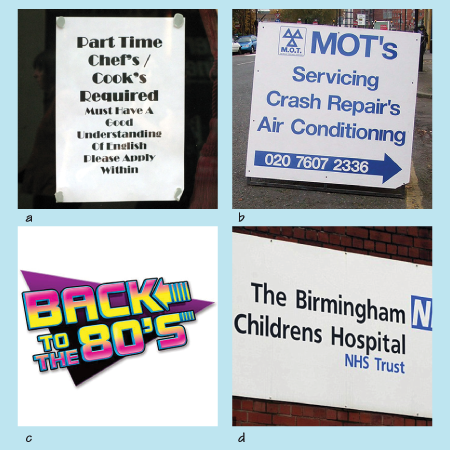
- a.Here ’s is used incorrectly to make chef and cook plural. Correction: chefs and cooks.
- b.Acronyms such as MOT should be formed by just adding an s. Correction: MOTs and repairs.
- c.The plural of dates is formed by adding an s, as in 1970s and 70s. Correction: 80s.
- d.Correction: Children's Hospital.
Comment
Some road signs no longer use ‘s to indicate possession and in the UK many people no longer use it in informal writing. However, in academic writing this form is still used as it provides clarity.
2.4 Using noun groups to write more concisely
Activity 4
As well as adding information so that the writer can say what they mean more clearly and accurately, noun groups can help the writer to say something in fewer words.
For example:
(a) The rights to broadcast sporting events on radio and television have become more lucrative. (14 words)
becomes
Broadcasting rights for sports events have become more lucrative. (9 words)
(b) The open-air market which takes place in the town of Béthune (11 words)
becomes
Béthune’s open-air market (3 words).
Rewrite the sentences below using a noun group to reduce the number of words and create one sentence.
(a) The first magazines which were produced about sports appeared in the eighteenth century. They had a small circulation. (18 words)
Answer
(a) The first sports magazines produced in the eighteenth century had a small circulation. (13 words)
(b) Radio, television and the internet all provide coverage of sporting events. This coverage has transformed sports media into an industry which operates all over the world. (26 words)
Answer
(b) The coverage provided by radio, television and the internet has transformed sports media into a global industry. (17 words)

(c) The warship which was commanded by Admiral Nelson was called the HMS Victory. It is now a major tourist attraction. (20 words)
Answer
(c) Admiral Nelson’s warship, HMS Victory, is now a major tourist attraction. (11 words)
(d) Volunteers who work on the preservation of HMS Victory have gained a lot of specialist knowledge. They share this knowledge with academics, school parties and other visitors. (27 words)
Answer
(d) Specialist knowledge gained by volunteers working on preserving HMS Victory is shared with academics, school parties and other visitors. (19 words)
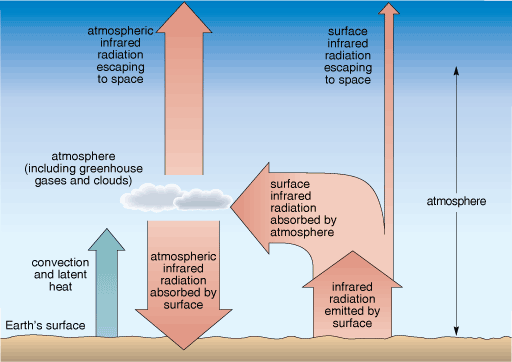
2.5 Using noun groups to label diagrams
Noun groups are often used by teaching materials to convey complex information in a concise and precise way. This allows the writer to express complex information clearly and in a small space. In the example below, which has been taken from the Open University course S104 Exploring science, noun groups are used to label a diagram.
2.6 Learning to recognise and use noun groups
Perhaps the most effective way to learn how to use noun groups is by noticing them in your readings and then trying to express yourself in the same way when writing formal texts.
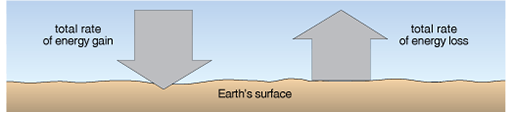
University students meet noun groups in their textbooks. Very often these noun groups are technical terms that students need to learn and reuse in their assignments. The example below, again taken from the Open University course S104 Exploring science, uses the technical terms ‘total rate of energy gain’, ‘total rate of energy loss’ and ‘Earth’s surface’.
Activity 5
Read this extract again from The Guardian newspaper which you read in Week 2, and carry out the following two tasks:
- Write down all the noun groups that you can find in the article.
- Identify the main noun in each group.
The Social Mobility and Child Poverty Commission said the absolute child poverty goal was "simply unattainable" and that this was on course to be the first *decade since records began in 1961 not to see a fall in absolute child poverty. […]
Iain Duncan Smith, the work and pensions secretary, argues that addressing poverty by just increasing benefits is flawed and the root causes must be addressed by getting more parents into jobs. But the commission says "ending poverty mainly through the labour market does not look remotely realistic by 2020". In too many cases it simply moves children from low income workless households to low income working households.
Answer
Here is a list of the noun groups contained in the extract. The main nouns are in bold.
- The Social Mobility and Child Poverty Commission
- the absolute child poverty goal
- the first decade since records began in 1961
- a fall in absolute child poverty
- the work and pensions secretary
- the root causes
- more parents
- the labour market
- too many cases
- children from low income workless households
- low income working households
Comment
This article contains a large number of noun groups. Some of them are quite long and convey a great deal of information in a very precise and concise way. Expressing content in this way is a feature of the academic style, as you saw in Week 6.
Noticing these noun groups not only helps you to get used to this style but also to learn some useful combinations of words that are typical of a specific subject. For example, the expression ‘root causes’ is used in many academic fields and ‘child poverty’, ‘absolute child poverty’ and ‘low income households’ are very often used as technical terms in Social Sciences subjects such as Economics and Politics. If you were to study these subjects, it would be a good idea to make a note of these noun groups and use them in your writing.
3 Structuring verb groups
Verb groups are another type of word group. A verb is a word that describes doing something, for example:
donate, influence, distribute.
It can also be a word that describes thinking, feeling or being, for example:
need, trust, be.
Verbs in English often combine with prepositions to make different meanings, for example:
roll out, look for, find out.
They also combine with other verbs to convey tense (past, present and future), for example:
went, stay, are operating, will help.
As you have seen in Week 6, they may also combine with other verbs to convey certainty or different degrees of possibility, for example:
will achieve, would be, can influence, may sound.
In the next sections you will look at why and how verbs combine to express tense, and how to choose the correct tense in academic writing.
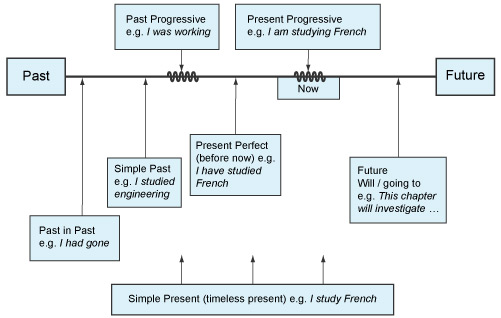
3.1 Indicating present, past and future in English
Verb tense is the way you can show whether an event takes place in the past, the present or the future. Figure 5 shows how this is achieved in English.
3.2 Selecting the most appropriate tense
In academic writing, different tenses are used in different text types for different purposes. In the following activity, you will look at how tenses are used in five university texts.
Activity 6
Read Extracts 1 to 5 and answer the following questions for each of them.
- What is the topic?
- What type of text is it?
- Which verb tense is used?
For each extract, choose from the items in the list below to answer the three questions. Copy or type your answers into the boxes following the extracts.
| Type of text | Topic | Verb tense |
| Ecosystems | Past | |
| Description of an object | Computing | Future |
| Introduction to module material | Job interview | Present |
| Light energy | ||
| Methods section of a research report | Person’s career |
Extract 1
In this chapter we will revisit the food chains from Chapter 2 to investigate how living things process that energy in the form of food, and what this can tell us about the interrelationships between the living and non-living components. We shall also examine the implications for our own use of ecosystems to produce the food we need to support a growing human population.
- What is the topic?
- What type of text is it?
- Which verb tense is used?
Answer
| Question | Extract 1 |
|---|---|
| 1 What is the topic? | Ecosystems |
| 2 What type of text is it? | Introduction of module material (environment) |
| 3 Which verb tense is used? | Future |
Extract 2
I used a lamp with a Megaman Compact 2000 energy-saving light bulb, placed it behind the workbench, arranged the lamp so that the bulb was 3 cm above the table surface and pointed forward. To obtain a light-tight enclosure I had used a shoe box made of cardboard.
- What is the topic?
- What type of text is it?
- Which verb tense is used?
Answer
| Question | Extract 2 |
|---|---|
| 1 What is the topic? | Light energy |
| 2 What type of text is it? | Method section of a report |
| 3 Which verb tense is used? | Past |
Extract 3
A second member of the panel quizzed her closely about her fluency in other languages but was sharply reminded by his colleague that it was not that job they were interviewing for. The third member of the panel explained that he was the current line manager for this role but that he would be retiring before the person they appointed would start the job. The fourth member of the panel asked some relevant questions, but all the time that Rita was responding to his questions, he was looking through a pile of papers on the desk in front of him.
- What is the topic?
- What type of text is it?
- Which verb tense is used?
Answer
| Question | Extract 3 |
|---|---|
| 1 What is the topic? | Job interview |
| 2 What type of text is it? | Biographical recount |
| 3 Which verb tense is it written in? | Past |
Extract 4
After completing two successful gap years as a volunteer at a residential youth centre, I went on to set up my own company and work for myself, as a freelance youth worker. I did this successfully for 3 years, taking on other employees as well. Last year however a position arose at a youth centre in Nottingham where I had previously volunteered.
- What is the topic?
- What type of text is it?
- Which verb tense is used?
Answer
| Question | Extract 4 |
|---|---|
| 1 What is the topic? | Person’s career |
| 2 What type of text is it? | Autobiographical recount |
| 3 Which verb tense is used? | Past |
Extract 5
The processor can be thought of as the ‘brain’ of the computer in that it manages everything the computer does. A processor is contained on a single microchip or ‘chip’. A chip is a small, thin slice of silicon, which might measure only a centimetre across but can contain hundreds of millions of transistors. The transistors are joined together into circuits by tiny wires which can be more than a hundred times thinner than a human hair. These tiny circuits enable the processor to carry out calculations and other manipulations of data.
- What is the topic?
- What type of text is it?
- Which verb tense is used?
Answer
| Question | Extract 5 |
|---|---|
| 1 What is the topic? | Computing |
| 2 What type of text is it? | Description of an object |
| 3 Which verb tense is used? | Present |
Comment
The verb tenses you use will depend on what you are doing when you write. If you are writing a recount (Extracts 3 and 4), many of the verbs will be in the past tense – a recount is a record of events in the past. This is similar to the methods section of a research report (Extract 2) – what you did is recorded. If you are writing a description (Extract 5), many of the verbs will be in the simple present tense – a description focuses on the permanent qualities or routine actions of the thing described and does not refer to time. If you are writing an introduction (Extract 1), many of the verbs will use the future tense because you are writing about something that will happen in the future.
3.3 Expressing the past
In everyday speech, past events can be easily discussed, but combining different verbs to express the past in writing can be challenging. It is therefore helpful to look at some of the key principles.
Activity 7
Look at Extracts 2 and 3 (below) again and highlight examples of the following tenses:
simple past
past in the past (time before then)
past progressive (something which is currently happening in the past).
To highlight your chosen text, first click on one of the coloured highlighter symbols to choose the appropriate tense. Then click on the appropriate part of the text. Click on the eraser symbol and click on the text again if you need to remove the highlight and try again.
Answer
Comment
In Extract 2, there are examples of the simple past (used, placed, arranged, pointed) and there is an example of the past in the past: had used indicates something which happened before something in the past.
Answer
Comment
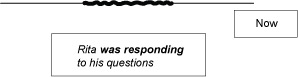
In Extract 3, there are examples of the simple past and the past progressive. The past progressive is used for something which is currently happening in the past (that job they were interviewing for, Rita was responding to his questions, he was looking through a pile of papers). The focus here is on a period of time and not on a point of time.
Expressing the past is done in the following different ways.
Simple past
For example, in Extract 2:
I used a lamp.
This event started and finished in the past.

Past in the past
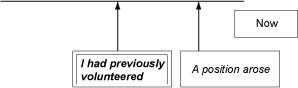
However, in Extract 4, for example:
Last year however a position arose at a youth centre in Nottingham where I had previously volunteered.
This action started and finished in the past, but it is the past in the past because the volunteering occurred before the position arose. The focus here is on the position.
3.4 Using the past tense
You have identified the use of past verb tenses in academic texts. You now focus on using past verb tenses.
Activity 8
Using the right verb tense (past)
In the box below is an example of a historical recount taken from the teaching material for a social sciences course, with some blank spaces. In the spaces insert the correct past verb tense of the verbs in brackets.
Answer
During both world wars there were quite dramatic changes in that women were encouraged out of the home and into production. This happened both in 1914 and in 1939. In some ways the working lives of women were different after each war too. Certainly new employment opportunities were opening up for women in the 1920s, with the growth of office and shop work. Similarly, there were new opportunities for employment in the period after the Second World War with the expansion of part-time work. Part-time work had been virtually unknown before the war and many of the part-time jobs created by the state in the service sector (in teaching, nursing and clerical work) were taken up by married women.
(The Open University (2008) Y157 Understanding society, Text 4, p. 20)
4 Structuring simple sentences
When people speak, they use their voice to signal when they reach the end of one point and are starting another. When you write, you do this by writing a sentence. You may not be consciously aware of whether people use sentences while speaking, and often it does not matter whether people speak in complete sentences or not. However, when you write, it does matter. If it is not written in sentences, your writing can be difficult to read and the meaning may not be clear. Also, writing in complete sentences is an important feature of academic style. But what exactly is a sentence?
Activity 9
a.
Sentence
b.
Not a sentence
The correct answer is b.
Answer
- This example starts with a capital letter and ends with an exclamation mark, so it could be a sentence. However, grammatically, it is not a sentence because it lacks a verb and it does not include the person or thing that does the action.
a.
Sentence
b.
Not a sentence
The correct answer is b.
Answer
- This example contains a noun group, which could be the thing that does the action. However, it is not a sentence because no action is mentioned as this example does not contain a verb or verb group. Finally, this example lacks an important feature of sentences: a full stop, a question mark or an exclamation mark.
a.
Sentence
b.
Not a sentence
The correct answer is a.
Answer
- This example is a sentence because it has all the necessary features. It starts with a capital letter and ends with a full stop. It states the thing being described, the noun group ‘private and public spaces’, and also contains the verb ‘differ’.
a.
Sentence
b.
Not a sentence
The correct answer is a.
Answer
- This example is a sentence, which expresses a question. It starts with a capital letter and ends with a question mark. It mentions a thing being described (a sentence) and contains a verb (is).
a.
Sentence
b.
Not a sentence
The correct answer is b.
Answer
- This is not a sentence. It does contain two verbs expressing an action (been, done) but the person who did this action is not mentioned.
a.
Sentence
b.
Not a sentence
The correct answer is a.
Answer
- This is a sentence which expresses an order. It starts with a capital letter and ends with a full stop. It contains a verb. The person who should carry out the action (you) is implied and this is acceptable in sentences expressing advice.
Comment
Examples 1, 2 and 5 are often used in conversations or in informal texts such as text messages, Facebook messages, postcards or informal emails. They would be considered inappropriate however, if included in an essay or other formal document.
Question 2
Based on the insights you gained from the reading and the answers to Question 1, what are the features of a typical sentence?
Answer
A sentence is a group of words that starts with a capital letter and ends with a full stop, a question mark (?) or an exclamation mark (!).
A sentence can be used to make a statement (example 3), ask a question (example 4) or express an order, a piece of advice or an exclamation.
A sentence normally includes a person, thing or situation that performs an action or is described. This person, thing or situation is a noun or a noun group.
A sentence should also include a verb which either expresses an action or links the thing, person or situation to its description
The sentences you have looked at so far are simple sentences as they contain one noun group and one verb group. To understand how more complex sentences are structured, you need to learn about clauses. You will do this in the following sections.
4.1 Simple sentences and independent clauses
A clause is a group of words that contains:
- a subject – the person, thing or situation that does an action or that is described
- a predicate – information about the subject.
A simple sentence consists of one independent clause that ends with a full stop. This clause must be independent, that is, it must express a complete thought and make sense on its own.
These are two basic patterns frequently followed by independent clauses.
Pattern A
The clause is about a person or a thing (the subject) that does an action as in the following example:
The children slept.
| Clause | |
| Subject | Predicate |
| The children | slept |
In this clause, the subject is the noun group ‘the children’. The action carried out by the subject is expressed by the verb slept.
The predicate is what the clause says about the subject. It always includes at least a verb or a verb group. In this case the predicate only includes the verb slept.
In pattern A, the predicate may also contain an object, as in the following example:
This essay will consider the differences between public and private space.
| HighlightedClause | ||
| Subject | Predicate | |
| Verb group | Object | |
| This essay | will consider | the differences between public and private space |
In this clause, the subject is the noun group ‘This essay’. The action carried out by the subject is expressed by the verb group ‘will consider’. The object is a noun or noun group. It is the thing or person on which the action is performed.
Clauses following pattern A can also contain two predicates as in this example:
The residents have their own rooms and keep many personal possessions.
| Clause | |||
| Subject | Predicate 1 | Connecting word | Predicate 2 |
| The residents | have their own rooms | and | keep many personal possessions |
It is important to know that not all verbs can be followed by an object. For example, it is incorrect to use the verbs go or sleep in the sentences ‘the children slept in the bed’ or ‘I went to the cinema’. These verbs are called intransitive verbs.
Verbs that can be followed by an object, such as consider, eat or write, are called transitive verbs. You can find out if a verb is transitive or intransitive in most dictionaries. When you use an unfamiliar verb, knowing if it is transitive or intransitive can help you use it within a sentence
Pattern B
The clause is about a state or a feeling experienced by the subject as in the following example:
The story is very different in poorly run residential homes.
| Clause | |
| Subject | Predicate |
| The story | is very different in poorly run residential homes |
Clauses following this pattern can also contain two predicates as in this example:
The residents are happy and feel safe.
| Clause | |||
| Subject | Predicate 1 | Connecting word | Predicate 2 |
| The residents | are happy | and | feel safe |
5 Structuring compound sentences
Academic and formal texts may contain some simple sentences. However, many sentences are not simple, instead they contain more than one independent clause.
A compound sentence is a sentence that connects two or more independent clauses with a connecting word.
Here is an example of a compound sentence containing two independent clauses that are linked by the connecting word and:
| Clause 1 | Connecting word | Clause 2 |
Skimming is used to get an overview of a text | and | scanning helps to find a specific piece of information. |
This compound sentence could be broken into two complete sentences:
- Skimming is used to get an overview of a text.
- Scanning helps to find a specific piece of information.
In practice, you would not want to split these two sentences because they work fine joined together. Additionally, if you write only in simple sentences, your writing will read jerkily.
Running things together into longer sentences provides a more flowing read and gives a more ‘natural’ feel.
It is important to remember that in academic texts, two independent clauses must always be joined by a linking word and must be correctly punctuated. The linking words used to connect independent clauses are conjunctions and adverbs.
5.1 Using conjunctions in compound sentences
One way to connect two independent clauses within a sentence is to use the following conjunctions:
as so but or
As is used with a similar meaning to because, when one statement is the reason for another, as in this sentence:
I cannot share this information as it is confidential.
So is used when one statement is the result of the previous one, as in this sentence:
Do tasks that are quickly achieved so they don’t seem too daunting.
But is used when there is a contrast between the two, for example:
Friends are important to young people but parents still have a very important role.
Or is used when a statement is an alternative to the previous one, for example:
Parents may send their children to school or they may educate them at home.
Other conjunctions include: for, yet and nor.
When the two clauses are quite long, place a comma before the coordinating conjunction to help the reader to see where one clause ends and another begins.
5.2 Using adverbs in compound sentences
The two independent clauses that form a compound sentence are often linked through an adverb. You met most of these adverbs in Week 5 when you looked at ways to link ideas. The most common of these adverbs are listed in the following table.
| Adding emphasis | Giving an example | Adding a consequence | Adding a contrasting idea | Adding a similar idea |
indeed in fact | for example for instance | therefore consequently hence thus as a result | however conversely on the other hand instead on the contrary nevertheless | similarly likewise |
Compound sentences linked through an adverb are structured as follows:
| First independent clause | Semi-colon | Adverb | Comma | Second independent clause |
| Researchers have studied AIDS for many years | ; | however | , | a vaccine has not been found yet. |
Activity 10
The following sets of sentences have been incorrectly or unclearly organised. Rewrite them including the adverb in the brackets and making correct use of punctuation.
Example:
Staff must be able to observe the patients this has the effect of reducing patients’ privacy and dignity. (however)
Answer
Staff must be able to observe the patients; however, this has the effect of reducing patients’ privacy and dignity.
- Migration is often seen as a large-scale or impersonal issue. It is an intense personal experience which transforms the individual lives of those who move. (however)
Answer
- Migration is often seen as a large-scale or impersonal issue; however, it is an intense personal experience which transforms the individual lives of those who move.
- Global warming causes changes in ecosystems many animal populations will dwindle or die out. (consequently)
Answer
- Global warming causes changes in ecosystems; consequently, many animal populations will dwindle or die out.
- Technology includes social innovations, a book can be thought of as a technology for sharing ideas. (for example)
Answer
- Technology includes social innovations; for example, a book can be thought of as a technology for sharing ideas.
- All businesses must be aware of the environments in which they operate, they must identify factors that may affect them. (in particular)
Answer
- All businesses must be aware of the environments in which they operate; in particular, they must identify factors that may affect them.
- At Cedar Court Nursing Home, rights to privacy and dignity are totally ignored by staff; residents are treated as objects of care. (indeed)
Answer
- At Cedar Court Nursing Home, rights to privacy and dignity are totally ignored by staff; indeed, residents are treated as objects of care.
6 Structuring a complex sentence
Complex sentences differ from compound sentences in that their meaning depends on the combination of the two clauses, one of which is incomplete because it cannot stand on its own.
Look at this example:
If children’s diets are low in energy
This clause contains a subject (children’s diets) and a predicate (are low in energy) but it cannot stand on its own because it starts with ‘if’. This type of clause is called a dependent clause because in order to be meaningful it needs to be joined to an independent clause.
For example:
| Dependent clause | Comma | Independent clause |
| If children’s diets are low in energy | , | they will stop growing and gaining weight. |
Now look at another example:
When people suffer from malnutrition, they are often deficient in the vitamins and minerals needed by the body.
As with the example using ‘if’, this sentence consists of two clauses, each of which includes a subject and a predicate. However, the first clause cannot stand on its own because it starts with ‘when’: it therefore needs to be joined to an independent clause to make sense. When the two sentences are joined, it is clear to the reader that it is only when people are deficient in the vitamins and minerals needed by the body that they may suffer from malnutrition.
6.1 Connecting sentences with ‘if’ and ‘when’
Compound sentences are formed by connecting two or more clauses which could stand on their own with the same meaning even if they were separated.
Complex sentences differ from compound sentences in that their meaning depends on the combination of the two statements, so that the two clauses cannot stand on their own.
The most common words used to connect sentences in this way are if and when.
Activity 11
Look at this example:
If children’s diets are low in energy
Does this clause make sense to you? Is it clear?
This clause needs to be joined to another one in order to be meaningful.
For example:
If children’s diets are low in energy, they will stop growing and gaining weight.
The two clauses are combined as shown below.
| somebody | does or is | something | |
| subject | verb | object (or rest of the clause) | |
| First clause | children’s diets | are | low in energy |
| Second clause | they | will stop growing and gaining | weight |
Each of the above clauses has a meaning on its own but, when if is added, it means that not all children’s diets are low in energy and not all of them will stop growing and gaining weight.
Sentences with if and when cannot stand alone but must always combine two clauses. The meaning of one of the clauses always depends on the meaning of the other.
Now look at another example:
When people suffer from malnutrition, they are often deficient in the vitamins and minerals needed by the body.
As with the example using ‘if’, this sentence consists of two clauses which include a subject, verb and the object or rest of the clauses:
| somebody | does or is | something | |
| subject | verb | object or rest of the clause | |
| First clause | people | suffer | from malnutrition |
| Second clause | they | are | often deficient in the vitamins and minerals needed by the body |
Again, each of these clauses has a meaning, but that meaning is changed by the addition of when when both are combined into a sentence. This makes it clear to the reader that it is only when people are deficient in the vitamins and minerals needed by the body that they may suffer from malnutrition.
A sentence containing if or when which does not combine two clauses doesn’t make sense.
Match each of the clauses below with a suitable clause starting with If or When from the left-hand column to make a sensible sentence.
Two lists follow, match one item from the first with one item from the second. Each item can only be matched once. There are 6 items in each list.
they tend to maintain this practice into adulthood.
their level of concentration suffers.
call the out-of-hours number provided.
you will put on weight.
take the next dose as normal.
you are less likely to have heart disease.
Match each of the previous list items with an item from the following list:
a.1. If children are introduced to good dental hygiene early,
b.5. If you forget to take your medicine,
c.4. If you take in more calories than your body consumes,
d.3. If the surgery is closed,
e.6. If you take regular exercise,
f.2. When people don’t sleep enough,
- 1 = a,
- 2 = f,
- 3 = d,
- 4 = c,
- 5 = b,
- 6 = e
Comment
Note how clauses beginning with ‘If’ or ‘When’ end in a comma. You will see more examples of this in the next activity.
6.2 Other connecting words that work like if and when
There are several more ways of joining two or more clauses together to make longer sentences. Some of these connecting words are because, although or even though, and while.
Because is used to indicate the reason for whatever is stated in the other half of the clause.
Although, even though and while are all used to express a contradiction between the two joined clauses.
As, becausee, although and even though all behave in the same way in that they are attached to a clause which is joined to another clause. They can be used at the beginning of the sentence or in the middle but the statement they are attached to must follow immediately after them.
Activity 12
Select the appropriate connecting words to complete the sentences below.
| after | before | even if | since | unless | until |
| whenever | where | whereas/while | because | although/even though |
Answer
Sara had had a rather negative impression of her father until she started to attend counselling sessions.
Answer
The affairs of one patient should never be discussed in the hearing of others, even if they have the same condition unless this is agreed with the patient concerned.
Answer
Whereas/While some people make particular use of their local support group, others prefer to make this kind of contact online.
Answer
After his mother became ill, Harry attended to all her paperwork and bill payments.
Answer
Even if a support group starts in a pub and feels very casual, it will need one or two people to keep the whole process going.
Answer
Where confidential information is passed on by phone, it should be given only to the person authorised to receive it.
7 This week's quiz
Well done – you’ve not only come to the end of this week’s study, but you've also almost completed the final week in English: skills for learning.
To finish up in style and be able to share this achievement with others, if you want to, now complete the Week 8 badge quiz.
Go to:
Remember, this quiz counts towards your badge. If you're not successful the first time you can attempt the quiz again in 24 hours.
Open the quiz in a new tab or window (by holding ctrl [or cmd on a Mac] when you click the link).
8 Summary
This week you have learned how to structure word groups and use them to form clauses and sentences.
In Week 8 you have learned:
- A noun can combine with articles, adjectives, adverbs and other nouns to form a unit of language called a noun group.
- Noun groups are used in academic and formal texts to express a great deal of information very concisely. They are frequently used to make notes and label diagrams.
- It is useful to notice and make a note of noun groups you find in your readings.
- Verbs are words used to describe doing or feeling, thinking and being.
- Verb tense is the way you can show whether an event takes place in the past, the present or the future.
- Verbs can combine with other verbs to form a unit of language called a verb group.
- Noun and verb groups can be combined to form either an independent or a dependent clause.
- Clauses contain a subject and a predicate.
- A sentence is a unit of language that makes sense on its own. It starts with a capital letter and ends with a full stop, question mark or exclamation mark.
- There are three types of sentence: simple, compound and complex sentences.
Well done for completing English: skills for learning! During the past eight weeks, you have learned the skills necessary to communicate effectively at university but also in many everyday contexts. In particular, you have learned how English speaking academic communities structure units of language and link ideas, and how to exploit this understanding to read and write university texts. You have also learned how to break reading and writing tasks into manageable steps and how to employ a range of note making strategies. You should also be better able to recognise and use an academic and formal style and use online dictionaries to select the most appropriate vocabulary.
I hope that these skills will help you to fulfil your wish to become a more confident communicator and a successful student.
If you've gained your badge you'll receive an email to notify you. You can view and manage your badges in My OpenLearn within 24 hours of completing all the criteria to gain a badge.
You can now return to the course progress page.
Tell us what you think
Now you've come to the end of the course, we would appreciate a few minutes of your time to complete this short end-of-course survey (you may have already completed this survey at the end of Week 4). We’d like to find out a bit about your experience of studying the course and what you plan to do next. We will use this information to provide better online experiences for all our learners and to share our findings with others. Participation will be completely confidential and we will not pass on your details to others.
References
Acknowledgements
This course was written by Anna Calvi.
Except for third party materials and otherwise stated (see FAQs), this content is made available under a Creative Commons Attribution-NonCommercial-ShareAlike 4.0 Licence.
The material acknowledged below is Proprietary and used under licence (not subject to Creative Commons Licence). Grateful acknowledgement is made to the following sources for permission to reproduce material in this unit:
Images
Figure 2: (a) © photograph: Stevefaeembra in Flickr made available under https://creativecommons.org/licenses/by-nc/2.0/; (b) © photograph: Grahamc99 in Flickr made available under https://creativecommons.org/licenses/by/2.0/; (c) Back to the 80’s poster; (d) Birmingham Children’s hospital sign; Figure 3: various logo images from iStockphoto.com; Figure 4: iStockphoto.com/Paul McKeown.
Every effort has been made to contact copyright owners. If any have been inadvertently overlooked, the publishers will be pleased to make the necessary arrangements at the first opportunity.
Don't miss out:
1. Join over 200,000 students, currently studying with The Open University – http://www.open.ac.uk/ choose/ ou/ open-content
2. Enjoyed this? Find out more about this topic or browse all our free course materials on OpenLearn – http://www.open.edu/ openlearn/
3. Outside the UK? We have students in over a hundred countries studying online qualifications – http://www.openuniversity.edu/ – including an MBA at our triple accredited Business School.